


A Note From
the EDITOR
Welcome to the July Analog Dialogue
Robust systems often allow multiple power sources. When different power sources are used to power a device, switches need to be implemented to separate the power supplies from each other to avoid damage....
Rarely Asked Questions

Toward Smarter Digital Predistortion Engines: A Neural Network-Based Approach
What is the impact of using different activation functions in the neural network-based digital predistortion (DPD) models on the overall system performance and energy efficiency?
VIEW THE ANSWER

If you’re an electrical engineering student or recent graduate with an interest in analog electronics, you’re just a click or two away from articles, tutorials, and a wealth of other helpful resources.

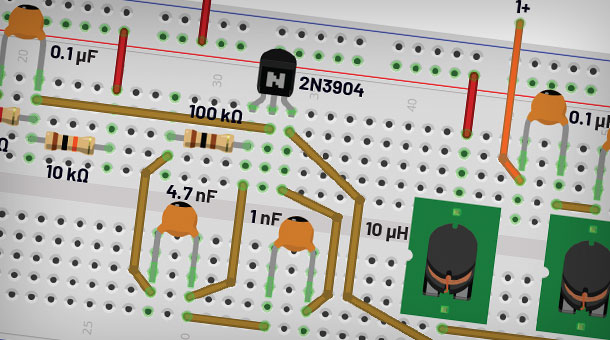
ADALM2000 Activity: Pulsed Oscillators
by Antoniu Miclaus

ADALM2000 Activity: The Peltz Oscillator
by Antoniu Miclaus
More StudentZone Articles


Past Journals
 VOLUME 57, Number 3
VOLUME 57 NUMBER 3
IN THIS ISSUE
Operational Amplifier for Electrochemical SensorsHow to Design a Low Power, Highly Accurate Bicycle Power MeterDigital Control for Isolated Bidirectional Power ConvertersCan a High Precision RTD Temperature Measurement System (±0.15°C) Be Designed Without the Need for Calibration?Building a Better –48 VDC Power Supply for 5G and Next-Generation Telecom EquipmentA Comprehensive Guide to LDO Regulators: Navigating Noise, Compromise, Applications, and TrendsHow to Protect Your Power System Designs Against FaultsIs There Such a Thing as a True Glitch-Free Voltage Supervisor IC? VOLUME 57, Number 2
VOLUME 57 NUMBER 2
IN THIS ISSUE
Why Using PassThru Technology Can Help Extend an Energy Storage System’s LifeDrive Reliable Automation with Remote Motion Control for Intelligent NodesHow to Design Motor Encoders for Next-Generation Sustainable ApplicationsRevolutionizing Wireless Coverage: The Power of Cellular DAS Integrated SolutionsSimplify Your USB-C PD Design Using a Standalone PD ControllerStep-by-Step Process to Calculate a DC-to-DC Compensation NetworkAchieve Accurate RF Testing with a Raspberry Pi-Based DDS Signal GeneratorHow Edge Processing Is Enabling Next-Gen Millimeter Wave ScannersHardware Conversion of Convolutional Neural Networks: What Is Machine Learning?—Part 3Did You Know Optocouplers Are Not Needed for Isolated DC-to-DC Conversion?Generating Negative Voltages—Why You Need Level Shifting in Buck-Boost CircuitsMaximize Predictive Maintenance with Careful Selection of MEMS Accelerometers VOLUME 57, Number 1
VOLUME 57 NUMBER 1
IN THIS ISSUE
How Secure Electronic Authentication Mitigates Risk at the Point-of-CareTraining Convolutional Neural Networks: What Is Machine Learning?—Part 2How to Optimize the MCU SPI Driver to Reach High Speed ADC ThroughputIntroduction to Convolutional Neural Networks: What Is Machine Learning?—Part 1Transformer-Based Voltage Regulators with Flexible TLVR Structure for Extremely Fast Dynamic ResponsePractical Input-Referred Calculations in Precision SystemsHow to Create a Dual-Output Voltage Rail with Source and Sink Functionality for ATE ApplicationsHow to Select Antenna Front-End Components for Non-GEO Space ApplicationsPower Quality Monitoring Part 2: Design Considerations for a Standards Compliant Power Quality MeterWhy a Perfectly Stable Switch-Mode Power Supply May Still Oscillate Due to Negative ResistanceHow to Prototype a Power Bank Charger Without Building Any Dedicated Hardware VOLUME 56, Number 4
VOLUME 56 NUMBER 4
IN THIS ISSUE
How to Easily Achieve Superior Audio Performance with Plug and Play Digital Input Class D AmplifiersPower Optimization Techniques for Low Power Signal Chain ApplicationsPower Quality Monitoring Part 1: The Importance of Standards Compliant Power Quality MeasurementsA Better Way to Prototype RF Designs, Using X-MicrowaveThe Internet from Space: RFIC Advances in High Capacity, Low Latency LEO Satellite User and Ground TerminalsA Highly Integrated, System-Level Approach to Ease Design of Isolated Software Configurable I/O ChannelsHow to Design a Programmable Gain Instrumentation Amplifier for Precision Wide Bandwidth Signal ChainsHow to Use Zero-Drift Amplifiers in Wider Bandwidth ApplicationsHow to Design a Simple, Uninterruptible Power Supply with Supercapacitors VOLUME 56, Number 3
VOLUME 56 NUMBER 3
IN THIS ISSUE
What Are the Basic Guidelines for Layout Design of Mixed-Signal PCBs?Multiturn Position Sensor Provides True Power-On Capabilities with Zero PowerWhat Are the Most Important Timing Factors for Low Power Precision Signal Chain Applications? Part 2Thermistor-Based Temperature Sensing System—Part 2: System Optimization and EvaluationWhat Are the Most Important Timing Factors for Low Power Precision Signal Chain Applications? Part 1How to Achieve Ultrafast Power Supply Transient Response for RF ApplicationsHigh Performance Buck Regulators Solve the Power Thirst of the Transmitter Circuit in Current LoopsThermistor-Based Temperature Sensing System—Part 1: Design Challenges and Circuit ConfigurationHow Do You Amplify AC Signals with Large DC Offsets Using an Indirect Current-Mode In-Amp? VOLUME 56, Number 2
VOLUME 56 NUMBER 2
IN THIS ISSUE
How Monolithic Driver + MOSFET (DrMOS) Technology Improves Power System DesignHow Digitally Tunable Filters Enable Wideband Receiver ApplicationsAutomotive LED Driver Power Conversion Topology GuideAccelerate Your Test Capability and System Productivity with New MEMS SwitchesWhat Are the Best Applications for IoT in the New World of IC Power Management?High IF Sampling Puts Wideband Software-Defined Radio Within ReachDigital Predistortion for RF Communications: From Equations to ImplementationSimplifying TWS Earbud Designs with 1-Wire ConnectivityLow Noise Silent Switcher μModule and LDO Regulators Improve Ultrasound Noise and Image Quality VOLUME 56, Number 1
VOLUME 56 NUMBER 1
IN THIS ISSUE
Level-Setting DAC Calibration for ATE Pin ElectronicsTransceiver with Scalable Power and Performance: A Solution to Mission Critical CommunicationsHow to Effectively Compare the Performance of CMOS Switches with Solid-State RelaysHoney, Where Is My Power Cord?In the New Era of Wireless Battery Management Systems (wBMS), Security Takes the SpotlightIBIS Modeling—Part 3: How to Achieve a Quality Level 3 IBIS Model Through Bench MeasurementCurrent Sensing with PMBus Digital Power System Managers—Part 2How to Accelerate Peripheral Monitoring in Low Power Wearables with DMAOptical Liquid Analysis Prototyping Platform Lights the Pathway to Ubiquitous Sensing VOLUME 55, Number 4
VOLUME 55 NUMBER 4
IN THIS ISSUE
Software-Configurable Analog I/O Heralds More Compact and Convenient CalibratorsStep-by-Step Noise Analysis Guide for Your Signal ChainCurrent Sensing with PMBus Digital Power System Managers—Part 1How to Cancel Ambient Light for LIDAR ReceiversI2C Communication Protocol: Understanding I2C Primer, PMBus, and SMBusHow to Improve Power Supply Output Regulation Accuracy with the LTpowerCAD Resistor Divider ToolThe Next-Gen, Software-Defined Radio (SDR) Transceiver Delivers Big Advances in Frequency Hopping (FH)IBIS Modeling—Part 2: Why and How to Create Your Own IBIS ModelThe Easy Steps to Calculate Sampling Clock Jitter for Isolated, Precision High Speed DAQsHow to Easily Select the Right Frequency Generation Component VOLUME 55, Number 3
VOLUME 55 NUMBER 3
IN THIS ISSUE
A Precision Temperature Measurement Solution with High EMC Performance Using an RTDIBIS Modeling—Part 1: Why IBIS Modeling Is Critical to the Success of Your DesignCTSD Precision ADCs— Part 5: Digital Data Interface Simplification with Asynchronous Sample Rate Conversion (ASRC)Understanding and Using the No-OS and Platform DriversHow to Make a Digital Predistortion Solution Practical and RelevantTime of Flight System Design—Part 1: System Overview4-Switch Buck-Boost Controller Layout for Low Emissions—Single Hot Loop vs. Dual Hot LoopRF Signal Chain Discourse—Part 2: Essential Building Blocks VOLUME 55, Number 2
VOLUME 55 NUMBER 2
IN THIS ISSUE
Does the Assembly Orientation of an SMPS Inductor Affect Emissions?Low Noise and Low Power DAQ Solution for Seismology and Energy Exploration ApplicationsHow to Select and Design the Best RTD Temperature Sensing SystemHow A2B Technology and Digital Microphones Enable Superior Performance in Emerging Automotive ApplicationsOptimizing Power Systems for the Signal Chain—Part 3: RF TransceiversCTSD Precision ADCs— Part 4: Ease of ADC Input and Reference Drive Simplify Signal Chain DesignCTSD Precision ADCs—Part 3: Inherent Alias Rejection Made PossibleOptimizing Power Systems for the Signal Chain—Part 2: High Speed Data ConvertersRF Signal Chain Discourse: Properties and Performance Metrics VOLUME 55, Number 1
VOLUME 55 NUMBER 1
IN THIS ISSUE
Adding Hysteresis for Smooth Undervoltage and Overvoltage LockoutCTSD Precision ADCs—Part 2: CTSD Architecture Explained for Signal Chain DesignersOptimizing Power Systems for the Signal Chain—Part 1: How Much Power Supply Noise Is Tolerable?Improving Power Supply Design Using Semi-Automation—Five Steps to Quick and Efficient DesignDC Energy Metering ApplicationsCTSD Precision ADCs—Part 1: How to Improve Your Precision ADC Signal Chain Design TimeIt’s Just a Triangle, or What Does a Symbol Really Mean?SFDR Considerations in Multi-Octave Wideband Digital ReceiversA Practical Method for Separating Common-Mode and Differential-Mode Emissions in Conducted Emissions Testing VOLUME 54, Number 4
VOLUME 54 NUMBER 4
IN THIS ISSUE
UART: A Hardware Communication Protocol Understanding Universal Asynchronous Receiver/TransmitterThe Interleaved Inverting Charge Pump—Part 2: Implementation and ResultsAutomotive USB 2.0 and a 5 V, Type-C Solution for Charging and Robust Data Line ProtectionThe Interleaved Inverting Charge Pump—Part 1: A New Topology for Low Noise Negative Voltage SuppliesMultiparameter Vital Signs Monitoring Is Easier Than Ever BeforeNonlinear Simulation of RF IC Amplifiers in Keysight Genesys and SystemVuePeak Current of Isolated Gate Drivers Low Voltage Battery Monitor Floats into High Voltage Electric Vehicles LIDAR for Autonomous System Design: Object Classification or Object Detection? VOLUME 54, Number 3
VOLUME 54 NUMBER 3
IN THIS ISSUE
Choosing the Best Vibration Sensor for Wind Turbine Condition MonitoringThe A to Z of A2B Applications Multirail Power Supply Design for Successful Application Boards—Part 2: Layout Tips and Tricks Using A2B for Audio-Conferencing SystemsAC and DC Data Acquisition Signal Chains Made EasyMultirail Power Supply Design for Successful Application Boards—Part 1: StrategyCharacterizing the PSRR of Data Acquisition μModule Devices with Internal Bypass CapacitorsPhased Array Antenna Patterns—Part 3: Sidelobes and TaperingSolving the Cable TV Infrastructure Downstream Transmitter Challenge VOLUME 54, Number 2
VOLUME 54 NUMBER 2
IN THIS ISSUE
Phased Array Antenna Patterns—Part 2: Grating Lobes and Beam SquintUsing LTspice to Analyze Vibration Data in Condition-Based Monitoring SystemsDC-to-DC Conversion Directly from Automotive Battery Input: 5 A, 3.3 V, and 5 V Supplies Meet Stringent EMI Emission StandardsPhased Array Antenna Patterns—Part 1: Linear Array Beam Characteristics and Array FactorTiming Challenges in Multiaxis Robotics and Machine Tool ApplicationsAdd an Efficient Positive Rail to a Unipolar Negative SupplySpeed Up the Design of EMI Filters for Switch-Mode Power SuppliesLeveraging the On-Chip FIR and IIR Hardware Accelerators on a Digital Signal ProcessorFast Reacting, Optical Encoder Feedback System for Miniature Motor Driven Applications VOLUME 54, Number 1
VOLUME 54 NUMBER 1
IN THIS ISSUE
Reduce Power Supply Requirements for Ceramic Capacitors with a High Efficiency, High Frequency, Low EMI DC-to-DC ConverterWhy Does Voltage Reference Noise Matter?Contactless Fluid-Level Measurement Using a Reflectometer ChipProtecting and Powering Automotive Electronics Systems with No Switching Noise and 99.9% EfficiencyOpen-Source LIDAR Prototyping PlatformWireless Water Quality Monitoring SystemElectric Vehicle Warning Sound SystemADI SDR Transceivers Enable Amateur Space CommunicationParalleling Very Low Dropout Linear Regulators for Increased Output Current and Even Heat Distribution VOLUME 53, Number 4
VOLUME 53 NUMBER 4
IN THIS ISSUE
ADI ToF Depth Sensing Technology: New and Emerging Applications in Industrial, Automotive Markets, and MoreUnderstanding the Fundamentals of Earthquake Signal Sensing NetworksDual AMR Motor Position Sensor for Safety Critical ApplicationsSingle IC Can Produce Isolated or Nonisolated ±12 V Outputs from 30 V to 400 V InputPart 2: Optimized Sigma-Delta Modulated Current Measurement for Motor ControlHigh Power Density in a Small Form FactorA Direct Method of Measuring Op Amp Input Differential Capacitance Part 1: Optimized Sigma-Delta Modulated Current Measurement for Motor Control VOLUME 53, Number 3
VOLUME 53 NUMBER 3
IN THIS ISSUE
Newest Sigma-Delta ADC Architecture Averts Disrupted Data Flow When Synchronizing Critical Distributed SystemsDoes My Voltage Reference Design Hold Water? Methods of Managing Humidity and Performance in Precision Analog SystemsIs It Possible to Fit Low EMI Power Supplies onto Crowded Boards?Composite Amplifiers: High Output Drive Capability with PrecisionComprehensive Power Supply System Designs for Harsh Automotive Environments Consume Minimal Space, Preserve Battery Charge, Feature Low EMIHigh Accuracy Resolver Simulator System with Fault Injection FunctionHigh Voltage Boost and Inverting Converters for Communications JESD204C Primer: What’s New and in It for You—Part 2Can You Really Get ppm Accuracies from Op Amps? VOLUME 53, Number 2
VOLUME 53 NUMBER 2
IN THIS ISSUE
Bipolar, Single Output, and Adjustable Power Supplies Based on the Common Buck ConverterJESD204C Primer: What’s New and in It for You—Part 1How Sensor Performance Enables Condition-Based Monitoring SolutionsAnalysis of Input Current Noise with Even Harmonics Folding Effect in a Chopper Op AmpThe Evolutionary Path to the 100 A μModule RegulatorMaximize the Performance of Your Sigma-Delta ADC DriverSilent Switcher Devices Are Quiet and SimpleMaking Sense of Sounds, or How Analog Devices’ AI Can Boost Your Machine UptimeSigma-Delta ADC Clocking—More Than Jitter VOLUME 53, Number 1
VOLUME 53 NUMBER 1
IN THIS ISSUE
Looking Inside Real-Time EthernetFinally, A 12 V to 12 V Dual Battery Automotive Bidirectional DC-to-DC Controller for RedundancyStrapdown Inertial Navigation System Based on an IMU and a Geomagnetic SensorHigh Performance Data Converters for Medical Imaging SystemsSynchronous Boost Converter Powers High Current LEDs Even at Low Input VoltagesSynchronization of Multiaxis Motion Control over Real-Time NetworksSimple Battery Charger ICs for Any ChemistryPhased Array Beamforming ICs Simplify Antenna DesignClock Skew in Large Multi-GHz Clock Trees VOLUME 52, Number 4
VOLUME 52 NUMBER 4
IN THIS ISSUE
Overcoming Constraints: Design a Precision Bipolar Power Supply on a Simple Buck ControllerRemote Sensing Using a High Precision Instrumentation AmplifierProgrammable Gain Instrumentation Amplifiers: Finding One that Works for YouFunctional Safety in a Data Acquisition System Care and Feeding of FPGA Power Supplies: A How and Why Guide to SuccessOver-the-Air (OTA) Updates in Embedded Microcontroller Applications: Design Trade-Offs and Lessons LearnedUse of Integrated Passives in Micromodule SIPsA Large Current Source with High Accuracy and Fast SettlingModeling and Control for a Current-Mode Buck Converter with a Secondary LC Filter VOLUME 52, Number 3
VOLUME 52 NUMBER 3
IN THIS ISSUE
Automotive USB Type-C Power Solution: 45 W, 2 MHz Buck-Boost Controller in a 1 Inch SquareIntroduction to SPI InterfaceAntialiasing Filtering Considerations for High Precision SAR Analog-to-Digital Converters60 V and 100 V, Low IQ Boost/SEPIC/Inverting Converters for Compact, Efficient, Low EMI Power SuppliesSome Recent Developments in the Art of Receiver Technology: A Selected History on Receiver Innovations over the Last 100 YearsThe Many Uses of a 200 mA Precision Voltage ReferenceAutomotive Radar Sensors and Congested Radio Spectrum: An Urban Electronic Battlefield?Phase-Locked Loop (PLL) FundamentalsPowering Infotainment Devices in Automotive Start/Stop Systems VOLUME 52, Number 2
VOLUME 52 NUMBER 2
IN THIS ISSUE
Isolated Gate Drivers—What, Why, and How?High Speed Amplifier Testing Involves Enough Math to Make Your Balun Spin!LED Driver for High Power Machine Vision FlashiCoupler Isolated Communication Solutions for Essential Monitoring of Solar PV and Energy StorageAn Integrated Bidirectional Bridge with Dual RMS Detectors for RF Power and Return-Loss MeasurementSingle, 2 MHz Buck-Boost Controller Drives Entire LED Headlight Cluster Meets CISPR 25 Class 5 EMIPerformance Optimization of Multichannel Data Acquisition (DAQ) Systems: The Untold Story of the Input Settling TimeMoving Up the Stack Challenges for Measurement Engineering at ADIThe Refulator: The Capabilities of a 200 mA Precision Voltage Reference VOLUME 52, Number 1
VOLUME 52 NUMBER 1
IN THIS ISSUE
Vehicle Tracking Systems: Anytime, Anywhere, AnyhowPower Management for FPGAsA Robust Precision Data Acquisition and Control Platform for Extreme High Temperature EnvironmentsHow to Improve the Accuracy of Inclination Measurement Using an AccelerometerSolving IEC System Protection for Analog Inputs72 V Hybrid DC-to-DC Converter Reduces Intermediate Bus Converter Size by up to 50%Low EMI/EMC Emission Switching Converter Eases ADAS DesignsMUSIC-Based Algorithm for On-Demand Heart Rate Estimation Using Photoplethysmographic (PPG) Signals on WristPreventing Start-Up Issues Due to Output Inrush in Switching Converters VOLUME 51, Number 4
VOLUME 51 NUMBER 4
IN THIS ISSUE
Maximize the Run Time in Automotive Battery Stacks Even as Cells AgeStrategies for Choosing the Appropriate Microcontroller when Developing Ultra Low Power SystemsRadically Extending Bandwidth to Crush the X-Band Frequencies Using a Track-and-Hold Sampling Amplifier and RF ADCHow to Choose Cool Running, High Power, Scalable POL Regulators and Save Board SpacePin-Compatible, High Input Impedance ADC Family Enables Ease of Drive and Broadens ADC Driver SelectionChoosing the Most Suitable Accelerometer for Your Application—Part 2High Precision Voltage SourceA Look at the New ANSI/ESDA/JEDEC JS-002 CDM Test StandardChoosing the Most Suitable MEMS Accelerometer for Your Application—Part 1 VOLUME 51, Number 3
VOLUME 51 NUMBER 3
IN THIS ISSUE
Intelligent Video Analytics at the Edge of IoTUncompromising Linearity from the LTC2185 and ADA4927-1GaN Breaks Barriers—RF Power Amplifiers Go Wide and HighWireless Current Sense Circuit Floats with Sense ResistorMirror, Mirror on the Wall—Understanding Image Rejection and Its Impact on Desired SignalsImproved DAC Phase Noise Measurements Enable Ultralow Phase Noise DDS ApplicationsTransmit LO Leakage (LOL)—An Issue of Zero-IF That Isn’t Making People Laugh Out LoudUltrawideband Digital Predistortion (DPD): The Rewards (Power and Performance) and Challenges of Implementation in Cable Distribution SystemsMEMS Vibration Monitoring: From Acceleration to VelocityMassive MIMO and Beamforming: The Signal Processing Behind the 5G Buzzwords VOLUME 51, Number 2
VOLUME 51 NUMBER 2
IN THIS ISSUE
Understanding and Eliminating 1/f NoisePrecision SPI Switch Configuration Increases Channel DensityAnalyzing and Solving Fixed Frequency Spur Issues in High Precision ADC Signal ChainsFlexible ECG Front-End IC Serves Ultralow Power IoT Edge Node Signal Processing DesignsSometimes, a Signal Needs to Ride the RailsPresto! Multiply Your ADC’s Virtual Channel Count with DDC Magic VOLUME 51, Number 1
VOLUME 51 NUMBER 1
IN THIS ISSUE
Passive Intermodulation (PIM) Effects in Base Stations: Understanding the Challenges and SolutionsAnalyzing and Managing the Impact of Supply Noise and Clock Jitter on High Speed DAC Phase NoiseComplex RF Mixers, Zero-IF Architecture, and Advanced Algorithms: The Black Magic in Next-Generation SDR TransceiversUnderstanding and Extending Safety Operation in a Sigma-Delta ADCImproving Precision Data Acquisition Signal Chain Density Using SiP TechnologyHigh Definition, Low Delay, SDR-Based Video Transmission in UAV Applications VOLUME 50, Number 4
VOLUME 50 NUMBER 4
IN THIS ISSUE
Next-Generation SAR ADC Addresses Pain Points of Precision Data Acquisition Signal Chain DesignPLC DCS Analog Input Module Design Breaks Barriers in Channel-to-Channel Isolation and High DensityWhat’s Up With Digital Downconverters—Part 2Fully Automatic Self-Calibrated Conductivity Measurement SystemComplete Gas Sensor Circuit Using Nondispersive Infrared (NDIR)Improper Power Sequencing in Op Amps: Analyzing the Risks VOLUME 50, Number 3
VOLUME 50 NUMBER 3
IN THIS ISSUE
Where Zero-IF Wins: 50% Smaller PCB Footprint at ⅓ the CostRF Transceivers Provide Breakthrough SWaP Solutions for Aerospace and DefenseCrossing a New Frontier of Multiband Receivers with Gigasample ADCs—Part OneWhat’s Up With Digital Downconverters—Part 1New RF DAC Broadens Software-Defined Radio Horizon VOLUME 50, Number 2
VOLUME 50 NUMBER 2
IN THIS ISSUE
Replacing Discrete Protection Components with Overvoltage Fault Protected Analog SwitchesElectromagnetic Flow Meters: Design Considerations and SolutionsDesigning for Low Noise Feedback Control with MEMS GyroscopesOp Amp Input Overvoltage Protection: Clamping vs. IntegratedPractical Filter Design Challenges and Considerations for Precision ADCs VOLUME 50, Number 1
VOLUME 50 NUMBER 1
IN THIS ISSUE
Analog Front-End Design Considerations for RTD Ratiometric Temperature MeasurementsPhase Response in Active FiltersDesign a PLL Filter When Only the Zero Resistor and Capacitor Are AdjustableFerrite Beads DemystifiedPowering GSPS or RF Sampling ADCs: Switcher vs. LDOIntegrated Multiplexed Input ADC Solution Alleviates Power Dissipation and Increased Channel Density ChallengesAn Engineering Walk Through Virtual Eval, ADI's Online Data Converter Product Evaluation Tool VOLUME 49, Number 4
VOLUME 49 NUMBER 4
IN THIS ISSUE
Four Quick Steps to Production: Using Model-Based Design for Software-Defined Radio (Part 4)New Complete, High Resolution, and Multifunctional Bipolar DACs: an Easy to Use, Universal SolutionVersatile, Precision Single-Ended-to-Differential Signal Conversion Circuit with Adjustable Output Common Mode Boosts System Dynamic RangeFour Quick Steps to Production: Using Model-Based Design for Software-Defined Radio (Part 3)Four Quick Steps to Production: Using Model-Based Design for Software-Defined Radio (Part 2)Using ESD Diodes as Voltage Clamps VOLUME 49, Number 3
VOLUME 49 NUMBER 3
IN THIS ISSUE
New Advances in Energy Harvesting Power ConversionFour Quick Steps to Production: Using Model-Based Design for Software-Defined Radio (Part 1)A Low Power Data Acquisition Solution for High Temperature Electronics ApplicationsAnalyzing Optimizing and Eliminating Integer Boundary Spurs in Phase-Locked Loops with VCOs at up to 13.6 GHzInterleaving ADCs: Unraveling the MysteriesZero-Drift Amplifiers: Now Easy to Use in High Precision Circuits VOLUME 49, Number 2
VOLUME 49 NUMBER 2
IN THIS ISSUE
The Basics of MEMS IMU/Gyroscope AlignmentMultifunction: a Dilemma or Reality?No Pain High Gain: Building a Low-Noise Instrumentation Amplifier with Nanovolt SensitivityLow-Power Synchronous Demodulator Design ConsiderationsLiquid Level Sensing Using Capacitive-to-Digital ConvertersRF-Sampling ADC Input Protection: Not Black Magic After All VOLUME 49, Number 1
 VOLUME 48, Number 4
VOLUME 48 NUMBER 4
IN THIS ISSUE
Wearable Electronic Devices Monitor Vital Signs Activity Level and MoreUnderstand Low-Dropout Regulator (LDO) Concepts to Achieve Optimal DesignsBioimpedance Circuit Design Challenges for Body-Worn SystemsSynchronous Detectors Facilitate Precision Low-Level MeasurementsADC Modeling Tools Speed Up EvaluationTwo New Devices Help Reinvent the Signal GeneratorRF-to-Bits Solution Offers Precise Phase and Magnitude Data for Material Analysis VOLUME 48, Number 3
VOLUME 48 NUMBER 3
IN THIS ISSUE
Configure Controller Area Network (CAN) Bit Timing to Optimize PerformanceMinimum Load Current Operation—Zero-Load OperationAsk the Applications Engineer—41: LDO Operational Corners: Low Headroom and Minimum LoadUnderstanding Switching Regulator Output Artifacts Expedites Power Supply DesignAccurate Analog Controller Optimizes High-Efficiency Li-Ion Battery ManufacturingDemystifying High-Performance Multiplexed Data-Acquisition SystemsDesigning Robust, Isolated I2C/PMBus Data Interfaces for Industrial, Telecommunications, and Medical Applications VOLUME 48, Number 2
VOLUME 48 NUMBER 2
IN THIS ISSUE
Complex Power-Supply Sequencing Made EasyAn Introduction to MEMS Vibration MonitoringSimple Circuit Allows Backward Compatibility for Digital Power ControllersCreative Compensation Enables Tiny Amplifier to Drive 200-mW LoadsCurrent-Output Circuit Techniques Add Versatility to Your Analog ToolboxCapacitance-to-Digital Converter Facilitates Level Sensing in Diagnostic Systems VOLUME 48, Number 1
VOLUME 48 NUMBER 1
IN THIS ISSUE
Noise-Reduction Network for Adjustable-Output Low-Dropout RegulatorsPrecision Resolver-to-Digital Converter Measures Angular Position and VelocityElectromagnetic Flow Meters Achieve High Accuracy in Industrial ApplicationsA Deeper Look into Difference AmplifiersHow to Stay Out of Deep Water when Designing with Bridge SensorsDual-Loop Clock Generator Cleans Jitter, Provides Multiple High-Frequency Outputs VOLUME 47, Number 4
VOLUME 47 NUMBER 4
IN THIS ISSUE
FPGA-Based System Combines Two Video Streams to Provide 3D VideoSuccessive-Approximation ADCs: Ensuring a Valid First ConversionHighest Power Density, Multirail Power Solution for Space-Constrained ApplicationsMEMS Microphones, the Future for Hearing AidsHigh-Performance Data-Acquisition System Enhances Images for Digital X-Ray and MRISome Tips on Making a FETching Discrete Amplifier VOLUME 47, Number 3
VOLUME 47 NUMBER 3
IN THIS ISSUE
How to Design and Debug a Phase-Locked Loop (PLL) CircuitMinimizing Errors in Multiplexed 3-Wire RTD Data-Acquisition SystemsSystem Demonstration Platform Eases Transition from Evaluation to PrototypingAmplifier Disable Function Eliminates Need for Multiplexers in Multichannel ApplicationsReduced Integration Time Improves Accuracy in Dead Reckoning Navigation SystemsCompensating Current Feedback Amplifiers in Photocurrent Applications VOLUME 47, Number 2
VOLUME 47 NUMBER 2
IN THIS ISSUE
Voltage Reference Design for Precision Successive-Approximation ADCsMultipliers vs. ModulatorsSafeguard Your RS-485 Communication Networks from Harmful EMC EventsProgrammable-Gain Transimpedance Amplifiers Maximize Dynamic Range in Spectroscopy SystemsComplete Sensor-to-Bits Solution Simplifies Industrial Data-Acquisition System DesignChoose Resistors to Minimize Errors in Grounded-Load Current Source VOLUME 47, Number 1
VOLUME 47 NUMBER 1
IN THIS ISSUE
Convert a Buck Regulator into a Smart LED Driver, Including DimmingAnalog Devices’ Engineering University—Why YOU Should AttendHDMI Made Easy: HDMI-to-VGA and VGA-to-HDMI ConvertersUnderstanding How Amplifier Noise Contributes to Total Noise in ADC Signal ChainsThe Successful Implementation of High-Performance Digital RadioModeling Amplifiers as Analog Filters Increases SPICE Simulation Speed VOLUME 46, Number 4
VOLUME 46 NUMBER 4
IN THIS ISSUE
Front-End Amplifier and RC Filter Design for a Precision SAR Analog-to-Digital ConverterCompensating Amplifiers That Are Stable at Gain ≥ 10 to Operate at Lower GainsImplementing an Isolated Half-Bridge Gate DriverDetecting and Distinguishing Cardiac Pacing ArtifactsHART Communication Networks Are Improved by Small, Flexible, Low-Power Modem ICsVersatile, Low-Power, Precision Single-Ended-to-Differential Converter VOLUME 46, Number 3
VOLUME 46 NUMBER 3
IN THIS ISSUE
Making Batteries Last Longer with Fast, High-Precision SAR Analog-to-Digital-ConvertersIsolation Technology Helps Integrate Solar Photovoltaic Systems onto the Smart GridDesigning Robust Isolated RS-232 Data Interfaces for Harsh Industrial ApplicationsADuC7026 Provides Programmable Voltages for Evaluating Multiple Power Supply SystemsAnalyzing Frequency Response of Inertial MEMS in Stabilization SystemsDiagnostic Technique Detects Open and Short Circuits in Wiring Harnesses VOLUME 46, Number 2
VOLUME 46 NUMBER 2
IN THIS ISSUE
Optimize High-Current Sensing Accuracy by Improving Pad Layout of Low-Value Shunt ResistorsStaying Well GroundedUnderstanding Microphone SensitivityADI Capacitance-to-Digital Converter Technology in Healthcare ApplicationsSimple Circuit Provides Adjustable CAN-Level Differential-Output SignalHigh-Temperature Electronics Pose Design and Reliability Challenges VOLUME 46, Number 1
VOLUME 46 NUMBER 1
IN THIS ISSUE
Low-Noise, Gain-Selectable AmplifierModern DACs and DAC Buffers Improve System Performance, Simplify DesignDesigning a Low-Power Toxic Gas DetectorRobust Amplifiers Provide Integrated Overvoltage ProtectionEfficient FSK/PSK Modulator Uses Multichannel DDS to Switch at Zero CrossingsDDS Devices Generate High-Quality Waveforms Simply, Efficiently, and Flexibly VOLUME 45, Number 4
VOLUME 45 NUMBER 4
IN THIS ISSUE
How to Apply DC-to-DC Step-Up/Step-Down Regulators SuccessfullyOversampled ADC and PGA Combine to Provide 127-dB Dynamic RangeMonitoring and Sequencing in Multirail Power-Supply SystemsFront End Turns PC Sound Card into High-Speed Sampling OscilloscopeS-Parameters Allow High-Frequency Verification of RF Switch ModelsUltrahigh-Performance Differential-Output Programmable-Gain Instrumentation Amplifier for Data Acquisition VOLUME 45, Number 3
VOLUME 45 NUMBER 3
IN THIS ISSUE
How to Apply DC-to-DC Step-Up (Boost) Regulators SuccessfullyPower Management Design for PLLsSystem Demonstration Platform Facilitates Quick Prototyping and EvaluationInsight into digiPOT Specifications and Architecture Enhances AC PerformanceSimple Ambient Light Sensor CircuitDifferential Interfaces Improve Performance in RF Transceiver Designs VOLUME 45, Number 2
VOLUME 45 NUMBER 2
IN THIS ISSUE
How to Apply DC-to-DC Step-Down (Buck) Regulators Successfully AD7879 Controller Enables Gesture Recognition on Resistive Touch ScreensAsk The Applications Engineer—40: Switch and Multiplexer Design Considerations for Hostile EnvironmentsLow-Power, Unity-Gain Difference Amplifier Implements Low-Cost Current SourceSimple Op Amp MeasurementsHigh-Resolution Temperature Measurement VOLUME 45, Number 1
VOLUME 45 NUMBER 1
IN THIS ISSUE
Activate Cell Phone Indicator LEDs While Preserving Standby TimeMinimizing Noise and Power Consumption in Automotive Audio Systems with SigmaDSPHDMI Transceivers Simplify the Design of Home Theater SystemsCyclic Redundancy Checking Ensures Correct Data CommunicationsElectromagnetic Interference (EMI) Filtering Reduces Errors in Precision Analog ApplicationsLow Dropout Regulators—Why the Choice of Bypass Capacitor Matters VOLUME 44, Number 4
VOLUME 44 NUMBER 4
IN THIS ISSUE
High-Side Current Sensing with Wide Dynamic Range: Three Solutions Boost Supply and High-Voltage DAC Provide Tuning Signal for Antennas and FiltersInertial Sensors Facilitate Autonomous Operation in Mobile RobotsMultichannel DDS Enables Phase-Coherent FSK ModulationHigh-Performance Difference Amplifier with Precision Supply-Referenced Level ShiftTwo Ways to Measure Temperature Using Thermocouples Feature Simplicity, Accuracy, and Flexibility VOLUME 44, Number 3
VOLUME 44 NUMBER 3
IN THIS ISSUE
New High-Resolution Multiplying DACs Excel at Handling AC SignalsLow-Voltage Current Sink Controls High-Voltage LED StringDual Difference Amplifier with On-Chip Resistors Implements Precision ADC DriverPower Cycling 101: Optimizing Energy Use in Advanced Sensor ProductsHigh-Speed, Current-Feedback Amplifier Drives and Equalizes Up to 100-m VGA CablesQuad 16-Bit Voltage-/Current-Output DACs Save Space, Cost, and Power in Multichannel PLCs VOLUME 44, Number 2
VOLUME 44 NUMBER 2
IN THIS ISSUE
Full-Featured Pedometer Design Realized with 3-Axis Digital AccelerometerDifferential-Output Difference Amplifier System with G = 1/2Synchronous Inverse SEPIC Topology Provides High Efficiency Buck/Boost Voltage ConvertersUltralow Distortion Audio Panpot AmplifierMore Value from Your Absolute Value Circuit—Difference Amplifier Enables Low-Power, High-Performance Absolute Value CircuitThe 20-Bit DAC Is the Easiest Part of a 1-ppm-Accurate Precision Voltage Source VOLUME 44, Number 1
VOLUME 44 NUMBER 1
IN THIS ISSUE
Free and Open-Source Software—An Analog Devices PerspectiveAsk The Applications Engineer—39: Zero-Drift Operational AmplifiersDriving PIN Diodes: The Op-Amp AlternativeNew Touch-Screen Controllers Offer Robust Sensing for Portable DisplaysTermination of High-Speed Converter Clock Distribution Devices VOLUME 43, Number 4
VOLUME 43 NUMBER 4
IN THIS ISSUE
Automobile Tail Lamp and Brake Lamp ControllerAdjustable-Gain Difference Amplifier Circuit Measures Hundreds of Volts, Rejects Large Common-Mode SignalsDesigning High-Performance Phase-Locked Loops with High-Voltage VCOsUsing Isolated RS-485 in DMX512 Lighting ApplicationsSynchronizing Device Clocks Using IEEE 1588 and Blackfin Embedded ProcessorsIsolation in High-Voltage Battery Monitoring for Transportation Applications VOLUME 43, Number 3
VOLUME 43 NUMBER 3
IN THIS ISSUE
Difference Amplifier Forms Heart of Precision Current SourcePhase Response in Active Filters Part 2, the Low-Pass and High-Pass ResponseHow to Successfully Apply Low-Dropout RegulatorsThe Basics of Video Decoders in Supervision and InspectionDetecting Human Falls with a 3-Axis Digital AccelerometerMeasuring Noise of Low-Fixed-Gain Differential Amplifiers VOLUME 43, Number 2
VOLUME 43 NUMBER 2
IN THIS ISSUE
Automated Calibration Technique Reduces DAC Offset to Less than 1 mVSkin Impedance Analysis Aids Active and Passive Transdermal DeliveryAccelerometers—Fantasy & RealityDigital Isolator Simplifies USB Isolation in Medical and Industrial Applications"Rules of the Road" for High-Speed Differential ADC DriversPLC Evaluation Board Simplifies Design of Industrial Process-Control systemsNotch Filter Reduces Amplifier Peaking and Increases Gain Flatness VOLUME 43, Number 1
VOLUME 43 NUMBER 1
IN THIS ISSUE
Analog Microcontroller Forms Heart of Low-Cost, High-Efficiency PA MonitorReconstruct a DAC Transfer Function from its Harmonic Spectral ContentThis Should Work: Thermistor Senses Liquid LevelsSonic Nirvana: Using MEMS Accelerometers as Acoustic Pickups in Musical InstrumentsSmart Metering Technology Promotes Energy Efficiency for a Greener WorldLow-Cost Video Multiplexing Using High-Speed AmplifiersEqualization and Pre-Emphasis Enable Use of 30-Meter Cat-5 UTP Cable VOLUME 42, Number 4
VOLUME 42 NUMBER 4
IN THIS ISSUE
Analog Front End for 3G Femto Base Stations Brings Wireless Connectivity HomeArchitecting a Multi-Voltage JTAG Chain8-channel data-acquisition system uses single ADC driverImplementing In-Application Programming on the ADuC702xResidual Phase Noise Measurement Extracts DUT Noise from External Noise SourcesDesign, Simulate, and Document Proprietary Wireless SystemsProtecting Off-AmpsAdding Test Capability to a Window Comparator VOLUME 42, Number 3
VOLUME 42 NUMBER 3
IN THIS ISSUE
Considering Multipliers (Part 1) [The Wit and Wisdom of Dr. Leif—7]Maintaining Public Railways with Lower Cost and Improved SafetyImpedance Measurement Monitors Blood CoagulationLinear Variable Differential TransformersFingerprint Sensor and Blackfin Processor Enhance Biometric-Identification Equipment Design VOLUME 42, Number 2
VOLUME 42 NUMBER 2
IN THIS ISSUE
Noise Figure and Logarithmic Amplifiers [The Wit and Wisdom of Dr. Leif—6]Open-Loop Calibration Techniques for Digital-to-Analog ConvertersInexpensive High-Speed Amplifiers Make Flexible Clock BuffersAC Shield Enhances Remote Capacitive SensingUnderstanding Hot Swap: Example of Hot-Swap Circuit Design ProcessDiscrete- and Integrated Control of Power Amplifiers in Base-Station Applications VOLUME 42, Number 1
VOLUME 42 NUMBER 1
IN THIS ISSUE
Cooking Inductively: ADI iCoupler Technology Isolates the Hob and the User InterfaceThe Contaminator of Signals: High-Frequency Common-Mode-Generated ErrorsAnalog-to-Digital Converter Clock Optimization: A Test Engineering PerspectiveBIST for Analog WeeniesADuC702x Analog Microcontroller Generates Programmable Digital WaveformsPulse Oximeter Uses ADuC7024 MicroConverterMeasuring Ambient TemperatureHigh-Side Current Sensing: Difference Amplifier vs. Current-Sense AmplifierLeif's Teaser Number 1—Infinite Bandwidth Op Amp with Limited Bandwidth Feedback VOLUME 41, Number 4
VOLUME 41 NUMBER 4
IN THIS ISSUE
DC-to-DC Switching-Regulator Insights—Achieving Longer Battery Life in DSP SystemsProviding an Edge in Capacitive Sensor ApplicationsIC provides temperature, bias, and gain in single-supply applicationsAsk The Applications Engineer—38: Better, Faster Open-Loop Gain MeasurementBroadband I/Q Modulator Eases Radio DesignESD Diode Doubles as Temperature SensorPhase Relations in Active FiltersSolving Dynamic Range Problems in Analog SystemsData Converter Function Can Help Solve Cost and Size Design Challenges in 3G and 4G Wireless Infrastructure VOLUME 41, Number 3
VOLUME 41 NUMBER 3
IN THIS ISSUE
Data and Power Isolation in One Package Provides Total Isolation SolutionToward More-Compact Digital MicrophonesHighly Integrated, Programmable Single-Component Sensors for Industrial System DesignIf All Else Fails, Read This Article. Avoid Common Problems When Designing Amplifier CircuitsBoost Precision and Accuracy with Single Chip Capacitance- and Impedance-to-Digital ConvertersSingle-Chip Clock Generator with 14-Channel Distribution Solves Timing Challenges in Networks8-Channel, 12-Bit, 10-MSPS to 50-MSPS Front End: The AD9271—A Revolutionary Solution for Portable Ultrasound VOLUME 41, Number 2
VOLUME 41 NUMBER 2
IN THIS ISSUE
Reducing Ground Bounce in DC-to-DC Converters—Some Grounding EssentialsHigh-Speed DAC Controls Power Amplifier Ramp ProfileAmplifier Input Protection... Friend or Foe?Ask The Applications Engineer—37: Low-Dropout RegulatorsMotionless Bandwidth Test for MEMS SensorsElements of Motion: 3D Sensors in Intuitive Game Design VOLUME 41, Number 1
VOLUME 41 NUMBER 1
IN THIS ISSUE
High-Speed Time-Domain Measurements—Practical Tips for ImprovementEnhancing the Performance of Pedometers Using a Single AccelerometerAsk The Application Engineer—36: Wideband A/D Converter Front-End Design Considerations II: Amplifier-or Transformer Drive for the ADC?Measuring PCB TemperatureHigh-Performance Multichannel Power-Line Monitoring with Simultaneous-Sampling ADCs VOLUME 40, Number 4
VOLUME 40 NUMBER 4
IN THIS ISSUE
Digital Isolation Offers Compact, Low-Cost Solutions to Challenging Design ProblemsLens Drivers Focus on Performance in High-Resolution Camera ModulesAsk The Application Engineer—35 Capacitance Sensors for Human Interfaces to Electronic EquipmentD-Day (continued) [The Wit and Wisdom of Dr. Leif—5] VOLUME 40, Number 3
VOLUME 40 NUMBER 3
IN THIS ISSUE
Fast, Versatile Blackfin® Processors Handle Advanced RFID Reader ApplicationsPrecision Signal-Processing and Data-Conversion ICs for PLCs Now Have More Performance at Less Power, Size, and CostWideband A/D Converter Front-End Design Considerations: When to Use a Double Transformer ConfigurationD-Day [The Wit and Wisdom of Dr. Leif—4] VOLUME 40, Number 2
VOLUME 40 NUMBER 2
 VOLUME 40, Number 1
 VOLUME 39, Number 4
 VOLUME 39, Number 3
VOLUME 39 NUMBER 3
 VOLUME 39, Number 2
 VOLUME 39, Number 1
 VOLUME 38, Number 4
VOLUME 38 NUMBER 4
 VOLUME 38, Number 3
 VOLUME 38, Number 2
VOLUME 38 NUMBER 2
IN THIS ISSUE
Ask The Application Engineer—32: Practical Techniques to Avoid Instability Due to Capacitive LoadingBridge-Type Sensor Measurements are Enhanced by Autozeroed Instrumentation Amplifiers with Digitally Programmable Gain and Output OffsetCurrent Measurement in Solenoids for Automotive Control Systems VOLUME 38, Number 1
VOLUME 38 NUMBER 1
 VOLUME 37, Number 4
 VOLUME 37, Number 3
 VOLUME 37, Number 2
VOLUME 37 NUMBER 2
IN THIS ISSUE
Solving Power-Management Problems with a Single Chip that Handles up to 7 Channels of Sequencing, Monitoring, and SupervisionCompact Web Manufacturing Process Defect-Detection System Uses a Camera and ADI Blackfin® ProcessorFast-Locking, High Sensitivity Tuned-IF Radio Receiver Achieved with a 7-GHz SynthesizerAsk The Applications Engineer—31: Amplifiers as Comparators? VOLUME 37, Number 1
 VOLUME 36, Number 2
 VOLUME 36, Number 1
VOLUME 36 NUMBER 1
IN THIS ISSUE
Interfacing a Blackfin DSP to High-Speed Converters for Wireless ApplicationsVersatile Mixed-Signal Front Ends Speed Customized Design of Wireline Broadband Modems and Home NetworksX-Amp™, A New 45-dB, 500-MHz Variable-Gain Amplifier (VGA) Simplifies Adaptive Receiver DesignsSimplify Audio Setups with a SigmaDSP™ Pre-Programmed Fully Configurable Digital Audio Processor VOLUME 35, Number 1
VOLUME 35 NUMBER 1
 VOLUME 34, Number 1
 VOLUME 33, Number 1
VOLUME 33 NUMBER 1
IN THIS ISSUE
Phase-Locked Loops for High-Frequency Receivers and Transmitters - Part 1Ask The Applications Engineer—28: Logarithmic Amplifiers ExplainedAll-Electronic Power and Energy MetersAsk The Applications Engineer—27: Signal Corruption in Industrial MeasurementDual Axis, Low g, Fully Integrated Accelerometers A Chip You Can Use to Monitor Environmental Conditions on PC Motherboard Designs VOLUME 32, Number 1
 VOLUME 31, Number 3
VOLUME 31 NUMBER 3
IN THIS ISSUE
Powerful Design Tools for Motion Control ApplicationsSelecting Mixed-Signal Components for Digital Communications Systems—Part VDSP 101 Part 3: Implement Algorithms on a Hardware PlatformAsk The Applications Engineer—26: Switches and MultiplexersInnovative Mixed-Signal Chipset Targets Hybrid-Fiber Coaxial Cable Modems VOLUME 31, Number 2
VOLUME 31 NUMBER 2
IN THIS ISSUE
14-Bit Monolithic ADCs: First to Sample Faster than 1 MSPSQuad-SHARC DSP in Ceramic Quad Flatpack200-MHz 16 x 16 Video Crosspoint Switch ICLi-Ion Battery Charging Requires Accurate Voltage SensingAsk The Applications Engineer-25: Op Amps Driving Capacitive LoadsSelecting Mixed Signal Component for Digital Communications Systems IV: Receiver Architecture ConsiderationsWhy use a DSP? [Digital Signal Processing 101-An Introductory Course in DSP System Design-Part 2] VOLUME 31, Number 1
VOLUME 31 NUMBER 1
IN THIS ISSUE
Selecting Mixed Signal Components for Digital Communication Systems—III: Sharing the ChannelBuild a Smart Analog Process-Instrument Transmitter with Low-Power Converters and a MicrocontrollerDSP 101 Part 1: An Introductory Course in DSP System DesignAsk The Applications Engineer–24: ResistanceController Board System Allows For Easy Evaluation Of General-Purpose Converters VOLUME 30, Number 4
VOLUME 30 NUMBER 4
IN THIS ISSUE
Voltage Regulators for Power ManagementSelecting Mixed-Signal Components for Digital Communication Systems-IIAsk The Applications Engineer-23: Current Feedback Amplifiers IIAdvanced Digital Video EncodersEMC, CE Mark, IEC801: What's it all about?Single- and Dual-Axis Micromachined AccelerometersFor Efficient Signal Processing in Embedded Systems, Take a DSP, not a RISC VOLUME 30, Number 3
VOLUME 30 NUMBER 3
IN THIS ISSUE
Ask The Applications Engineer-22: Current Feedback Amplifiers IBuffered Multiplexers for Video ApplicationsDACs are Optimized for Communication Transmit PathSelecting Mixed-Signal Components for Digital Communication Systems—An IntroductionSingle-Chip Direct Digital Synthesis vs. the Analog PLL VOLUME 30, Number 2
VOLUME 30 NUMBER 2
IN THIS ISSUE
Ask The Applications Engineer–21: Capacitance And CapacitorsDSP and motor-control chips simplify DSP-based AC motor control hardwareAudio Noise-Reduction ICA Bibliography on EMC/EMI/ESDIndustry's First Integrated Wavelet Video Codec Sets New Standards for Cost, Image Quality and FlexibilitySingle-Chip Digital Stereo Subsystem VOLUME 30, Number 1
VOLUME 30 NUMBER 1
IN THIS ISSUE
New Fixed-Point DSP Family Provides High-Performance Processing of Concurrent Signals Ask The Applications Engineer—20: Interfacing To Serial Converters-IIDigital-Output Sensor Simplifies Temperature AcquisitionBattery Discharge Power And EnergyRead-Channel Processor Uses PRML to Increase Capacity of MR Head-Based Disk DrivesSingle-Chip PC Sound SystemConsiderations In Designing Single Supply, Low-Power Systems Part II: Battery Powered Systems VOLUME 29, Number 3
VOLUME 29 NUMBER 3
IN THIS ISSUE
Considerations In Designing Single Supply, Low-Power Systems Part I: Designs Using Ac Line PowerLow-Power, Low-Voltage IC Choices for ECG System RequirementsSingle-Supply Acceleration-to-Frequency CircuitsVery Low Voltage, Micropower Amplifiers (V, (S)< 3 V, I(SY) < 500 µA)Ask The Applications Engineer—19: Interfacing To Serial Converters-I10-Bit Quad DACs for Single-Supply 3.0 V to 5.5 V Operation VOLUME 29, Number 2
VOLUME 29 NUMBER 2
IN THIS ISSUE
Two-Stage Current-Feedback AmplifierNew High-Speed, Low-Power Data-Acquisition ICsApplication Example—ADC DriverUsing Histogram Techniques to Measure A/D Converter NoiseA Pipelined Converter (AD876)Single-Supply IF-Strip Digitizes QAM SignalsAD607 ArchitectureAsk the Applications Engineer—18: Settling TimeWideband Radios Need Wide Dynamic Range ConvertersChoosing High-Speed Signal Processing Components for Ultrasound Systems VOLUME 29, Number 1
VOLUME 29 NUMBER 1
IN THIS ISSUE
Wideband Supply Current-feedback Op AmpHighly Integrated Stereo Codec ICs Drive MultimediaDesign Circuits with Digitally Controllable Variable ResistorsMicromachined Complete-on-a-Chip SensorAbout Ratiometric ConvertersDSP Family Adds 3.3 V OperationAsk the Applications Engineer-17: Must a 16-bit Converter Settle to 16 ppm?Understanding High-speed Clamp Amps VOLUME 28, Number 3
VOLUME 28 NUMBER 3
IN THIS ISSUE
High-speed A/D Converters for CommunicationsFloating-point DSP Leads in PerformanceVoltage-feedback Op Amps Offer Accurate Clamping8-bit, 16-channel Voltage-output DACs16-bit Fixed-point DSP with 80 kBytes of RAM12-bit Dual DAC: Serial, Single Supply Saves SpaceDSP On-chip SRAM Design ConsiderationsTechniques to Protect Amplifiers from OvervoltageLow-cost 16-bit DAC Updates at 30 MHzDSP Cluster Multi-processing VOLUME 28, Number 2
 VOLUME 28, Number 1
VOLUME 28 NUMBER 1
IN THIS ISSUE
Dual Set-Point Single-Chip Temperature ControllerIntelligent Digitizing Signal Conditioner IC for SensorsAsynchronous Sample-rate ConvertersIC Vector Processor for Motor ControlInstrumentation Applications for Sigma-Delta ADCsGSM Chipset Implements All Baseband FunctionsLVDT Interfaces Offer Choice of Analog or Digital OutputSerial Input 16-bit DAC Has Choice of RangesGetting the Most from IC Voltage ReferencesMicroprocessor Supervisory ICsLow-distortion Mixer: +24 dBm 3rd-order InterceptAsk the Applications Engineer—15: Using Sigma-Delta Converters, Part 1 VOLUME 27, Number 2
VOLUME 27 NUMBER 2
IN THIS ISSUE
CMOS 10-bit 15 MHz ADC for Imaging Applications"Uncommon-mode" High-speed Video Feedback AmplifierSurface-machined Monolithic AccelerometerFast, Accurate, Monolithic Sampling A/D ConverterIncrease Laser Printer Resolution Video RAM-DACs Offer True-color Screen ImagesHigh-performance ICs in Single-supply Analog CircuitsDesign Ideas for Sigma-Delta Instrumentation ADCsUse Analog I/O Ports as Infinite Sample/Holds and Peak FollowersAsk the Applications Engineer—14: High Frequency Signal Contamination VOLUME 27, Number 1
VOLUME 27 NUMBER 1
IN THIS ISSUE
SoundPort Codecs: Complete Audio I/O Subsystem ICsFast, Accurate, Timing Recovery for Fiber Optics LinksADI's Smallest, Lowest-cost, Signal Conditioning Modules for Process Control3V Supply 12-bit Multi-channel Data Acquisition System Samples at 50 kHzFour New Wideband Op Amps for Video, Imaging, and Much MoreLow-noise, Low-drift, Precision Op Amps for InstrumentationTwo Op Amp Types Combine Precision and Wide BandwidthOp Amps in Line-driver and Receiver Circuits – Part 2Monolithic 80-dB +5 V Single-supply Log Amp Has 50-MHz Frequency RangeAsk the Applications Engineer-13: Confused About Amplifier Distortion Specs?What's New in DSPComplete 12-bit and 10-bit 25.6 MSPS A/D Converters VOLUME 26, Number 2
VOLUME 26 NUMBER 2
IN THIS ISSUE
3-V Precision Op Amps from Analog DevicesSingle- or Dual-supply Difference Amplifier's Common-mode Range Exceeds SupplyLow-noise, Wideband Voltage-controlled Amplifier with "Linear-in-dB" GainOp Amps in Line Driver and Receiver Circuits – Part 1Dual Op Amp Has Low-noise and DissipationSignal Computing: Hardware Chipsets & Signal-processing Algorithms CombinedLow-cost 12-bit IC Resolver-to-Digital Converter Emulates Optical EncoderAsk the Applications Engineer—12: Grounding (Again)Decreasing Size, More-Demanding Performance Pace Disk-Drive IC DesignWhy Do You Say That the Clock of a System is a Reference? VOLUME 26, Number 1
VOLUME 26 NUMBER 1
IN THIS ISSUE
IF Stages are Going Digital for Both Analog and Digital SignalsMonolithic Sigma-Delta A/D Converters Offer 21-bit ResolutionApplying a High-performance Video Operational AmplifierAn Analog Multiplier SPICE MacromodelAsk the Applications Engineer—11: How Good Must a Voltage Reference Be? VOLUME 25, Number 2
VOLUME 25 NUMBER 2
IN THIS ISSUE
Floating-point DSP for High Speed Signal ProcessingDevelopment Tools and Third-party Support for Floating-point DSPNumerical C Speeds Code Development and ExecutionSingle-supply In-amp for Automotive ApplicationsMonolithic 10-bit, 18 MSPS Sampling A/D Converter with On-chip Track-HoldDisk-drive ICs - Optimized for Read-channel and Servo Loop Control3 New S/H Chips for Fast, Accurate Data AcquisitionComplete 16-bit DACPORT in SOIC Package Includes On-chip 10-V ReferenceAdvanced SPICE Op-amp Macromodel: A Powerful Tool for DesignersAsk the Applications Engineer—10: About WirePhase Accumulator for Direct Digital Synthesis Resolves to Within 0.7 HzFET-input Op Amp Has Lowest Combined V and I NoiseSerial IC Analog I/O Port: 14-bit Performance and Small Package VOLUME 25, Number 1
VOLUME 25 NUMBER 1
IN THIS ISSUE
Dolby Pro-logic Surround Sound Decoder for Audio RealismAutomotive Sensor Detects Lamp and Indicator Failures AutomaticallyFast 14-bit ADC Samples at 10 MSPS, Has 50-MHz BandwidthMonolithic 16-bit Voiceband Codec Uses Sigma-Delta TechnologyA Quarter-Century of Analog DialogueAsk the Applications Engineer—9: Seminars and SupportSampling 12-bit ADC: Faster, Better, and Cheaper VOLUME 24, Number 3
VOLUME 24 NUMBER 3
IN THIS ISSUE
RAM-DAC Upgrade Enhances VGA GraphicsFirst Monolithic Triple 10-bit Video DACs Provide True ColorComplete Monolithic Current TransformerMixed-signal ASICs Offer Designers an Alternative SolutionDSP Enhancements Include IC Processors, Development ToolsAsk the Applications Engineer—8: Op-Amp IssuesElectronic Adjustment Made Easy with TrimDAC VOLUME 24, Number 2
VOLUME 24 NUMBER 2
IN THIS ISSUE
Peak Detector Circuit Captures 200-ns PulsesLow-dissipation Multiple Line Drivers/ReceiversMixed-signal Processor Merges DSP with A/D, D/A Converters3/4 GHz Monolithic Unity-gain Buffer for Analog SignalsCurrent-output Module Augments 6B SeriesMeasuring Amplifier Differential Gain and Phase AccuratelyIndustrial Process Controller IC is Programmable in C Monolithic 12-bit High-speed A/D Converter OptionsAsk the Applications Engineer—7: Op-amp Noise VOLUME 24, Number 1
VOLUME 24 NUMBER 1
IN THIS ISSUE
Application Decides Optimal DSP Processor ArchitectureMonolithic Op Amps Have Wide Bandwidth, Low DistortionFastest 10-bit ADCs Provide Superior Dynamic Performance12-bit, 100-kSPS Complete Sampling A/D Converter IC Isolation Amplifiers for Low-level Signals14-bit, 2-Channel Synchro/Resolver-to-Digital ConverterAsk The Applications Engineer—6: Op Amp Issues: Why are There so Many Types of Op Amps?Real-world Interface Cards for Micro-channel SystemsComputer Interface Panel Handles Eight Analog Outputs VOLUME 23, Number 4
VOLUME 23 NUMBER 4
IN THIS ISSUE
High-speed Automatic Testing for Advanced Components8-bit Analog I/O Port for Position Monitoring and ControlFloating-point Data Acquisition System12-bit DACs Optimized for Direct Digital SynthesisDistributed Data Acquisition and Control FlexibilityHigh-performance Electrometer Op Amp in 8-pin Plastic DIPComplete Monolithic 12-bit DAC Interfaces with Fast DSPsIndustry's Fastest Monolithic FET-input Op AmpUltrafast Monolithic Single and Dual TTL ComparatorsMonolithic Dual 12-bit DACPORTs Save Space, Power, CostFast Precise Comparator Has Differential Input RangeAsk the Applications Engineer—5: High-speed Comparators Provide Many Useful Circuit Functions VOLUME 23, Number 3
VOLUME 23 NUMBER 3
IN THIS ISSUE
22-bit A/D Converter Evaluation Board for the PCMonolithic DC-to-120-MHz Log-amp is Stable and Accurate8-bit Flash A/D Converters Encode at up to 300 MSPSGrounding for Low- and High-frequency Circuits14-bit 100 kSPS Monolithic Sampling A/D ConvertersIC LVDT Conditioner is Insensitive to Usual Error SourcesRatiometric 16-bit LVDT-to-Digital ConverterA Pair of 16-bit-Performance Sample-Hold AmplifiersPortable µP-controlled Synchro Simulator and TesterAsk the Applications Engineer—4: Disk-based Component Selection Guide Seeks Best ChoicesCPU, Software & I/O Integrated in Distributed Control VOLUME 23, Number 2
VOLUME 23 NUMBER 2
IN THIS ISSUE
Advanced Microcomputer is Optimized for DSPConverter/Filter Chipset for Voiceband Applications6-bit Monolithic Flash ADCs Sample at up to 500 MHzIsolated Strain-gage Chipset Module Joins 5B Conditioner FamilyFastest Slewing Monolithic Op Amp has Wide BandwidthFast, Low-power Op Amps Offer Gain-bandwidth ChoiceAsk The Applications Engineer—3: V/F ConvertersEnhancements to LTS-2020 Benchtop IC Testers VOLUME 23, Number 1
VOLUME 23 NUMBER 1
IN THIS ISSUE
Sensor-to-Serial Communications with a ScrewdriverHigh-accuracy, Widest Bandwidth IC Analog MultiplierReference Maximizes Resolution with 12-V SuppliesUltra-high-speed Phase Discriminator Has no Dead ZoneDual Bipolar Op Amp Provides Superior Matching of SpecsNew 12-bit Sampling ADCs Digitize Fast AC WaveformsAsk the Applications Engineer—2: When it Comes to Trimming Offset and Gain...4 Sample/Holds on a Chip with 1-µs Max Acquisition TimeIsolated mV/TC Conditioner Has High Gain, Low Drift VOLUME 22, Number 2
VOLUME 22 NUMBER 2
IN THIS ISSUE
200-MSPS 8-bit IC A/D Converter Has 250-MHz BandwidthOp Amps Combine Superb DC Precision and Fast SettlingEvaluation Board Explores Capabilities of 8-Bit AD770High-Volume Automatic Testing of IC Flash Converters4-Channel Video Multiplexer Sustains 30-MHz BW12-Bit Monolithic ADC Samples at up to 100 kHzQuad Precision BiFET Op Amp Has Superior AC and DC Specs3 Analog and Digital I/O Boards for the PS/2 Micro ChannelFirst Complete Low-Cost 12-Bit IC MDAC Has On-Chip AmplifierMonolithic Serial 12-Bit ADC Converts in 10 Microseconds12-Bit, 10-MSPS Sampling ADC in a DIPVoltage-to-Current Isolator Also Supplies Loop PowerAsk the Applications Engineer—1: Log Compensation Resistors VOLUME 22, Number 1
VOLUME 22 NUMBER 1
IN THIS ISSUE
Low-Cost True-RMS Chips also Compute AC Average12-Bit ADCs for DSP Provide Complete InterfaceTrue 18-Bit DAC in Hybrid Package Has Small Size, Low CostDisk-Read ICs Condition and Deliver Bits at 50 Mbits/sPrecision Bipolar Op Amp Has Lowest Drift, OffsetCMOS Video DACs Provide Memory, Interface, 3 Outputs15 New CMOS Switches and Muxes in Convenient VarietyFaster DSP µP: 1,024-Point Radix-4 FFT in 3.0 msMonolithic Digitally Programmable Delay GeneratorFast Monolithic Log Amp with Better than 250-MHz BWMonolithic 12-Bit Quad Readback DAC Saves Board SpaceVoltage-to-Current Isolator Provides High Accuracy12-Bit Monolithic ADC Guarantees 3-µs Conversion TimeAD652: Improved Monolithic Synchronous V/F ConverterNew Enhancements to LTS-Series of Benchtop IC TestersChoose VMEbus Video Digitizer Boards to Match SourceData Acquisition and Control Software for PC Plug-Ins VOLUME 21, Number 2
VOLUME 21 NUMBER 2
IN THIS ISSUE
Monolithic Software-Programmable-Gain AmplifierMonolithic DAC Combines Speed and Accuracy22-Bit Complete Modular Integrating A/D ConverterComplete Monolithic 8-Bit 400-kSPS Analog I/O SystemMonolithic 10-Bit, 20-µs Sampling A/D ConverterPlug-In Boards Add Power and Versatility for VMEbus UsersTwo New High-Precision Monolithic Voltage ReferencesTwo New Multiple M-DACs Save Space and Power in Board DesignsFast, Accurate BiFET Op Amp Settles to 0.01% in 900 ns max8-Bit Video Digitizer for Cameras Includes Control SignalsHigh-Resolution Monolithic Resolver-to-Digital Converter64-Bit Floating-Point Chipset with 40-MFLOPS ThroughputFast-Settling 12-Bit DAC Provides 40-ns µP InterfacingMonolithic Electrometer Has 60 fA max Bias CurrentHigh-Speed Single and Dual Monolithic Latching ComparatorsHigh-Performance Analog Input Boards for IBM PC-AT VOLUME 21, Number 1
VOLUME 21 NUMBER 1
IN THIS ISSUE
16 x 16-Bit Multiplication in 15 nsMonolithic IC for Process-Control Transmitters8-Bit ADC with 150-MSPS Encode Rate8-Bit, 300-MHz Monolithic D/A Converter for DisplaysNew DSP ICs for Increased Functionality and PerformanceMonolithic Precision Voltage ReferenceWide-Bandwidth Fast-Settling Operational AmplifierFirst Monolithic Resolver-to-Digital ConverterQuad 12-Bit Readback DAC with 40-ns Bus Access TimeHigh-Speed Pin Driver for Digital Device TestingProcess Monitoring and Operator Interface Software for µMACsPrecision Signal Conditioner for Bridge TransducersModular I/O Card for the IBM PC VOLUME 20, Number 2
VOLUME 20 NUMBER 2
IN THIS ISSUE
Fast, Flexible CMOS Single-Chip µP for Digital Signal Processing16-Bit DAC Is 16-Bit Monotonic—All Grades and Temp RangesCompact Low-Cost Signal-Conditioning ModulesExpandable Modular I/O Processor for Industrial AutomationPrecision Wideband Three-Port Isolation AmplifierMonolithic Synchronous V/F Converter: 0.005% max NonlinearityThe Easy Way to Interface an LVDT to DigitalHighest-Linearity 16-Bit DAC Is Digitally TrimmableSmall, Fast, Low-Cost, High-Resolution Integrating ADCLow-Cost Hybrid Strain-Gage Signal Conditioner VOLUME 20, Number 1
VOLUME 20 NUMBER 1
IN THIS ISSUE
Fast, Flexible CMOS ICs Simplify Design of DSP SystemsIsolation Amplifiers Become Low-Cost ComponentsMonolithic CMOS A/D Converter: 12-Bits in 5 µsFast 64-Bit IEEE-754 Floating-Point Multiplier and ALUµP-Based Autoranging Thermocouple MetersReal-World Interface Cards for IBM Personal ComputersSoftware-Programmable 12-Bit Data-Acquisition System3 New 4-DAC DIPS: 8- and 12-Bit Quad D/A ConvertersTesting Engine Emissions More EffectivelyUltrafast High-Resolution Sampling A/D ConvertersMonolithic Triple 4-Bit D/A ConverterComplete Monolithic Serial-Output 10-Bit A/D Converter VOLUME 19, Number 1
VOLUME 19 NUMBER 1
IN THIS ISSUE
24 x 24-Bit Fixed-Point CMOS Digital MultiplierDual 12-Bit Microprocessor-Compatible DAC in 0.3" DIPLow-Cost Voltage-to-Frequency Converter ChipComplete Monolithic Analog Multifunction ChipNew Plug-In Signal-Conditioning Modules for 3B Series Low-Cost 8-Bit Monolithic ADC Converts in 1.36 µs maxHigh-Performance Precision Hybrid Isolation AmplifierDouble-Buffered 14-Bit Monolithic CMOS Multiplying DACThermometer with Resolution Better than 0.0001°CReal-World I/O Cards for the CMOS STD BusHigh-Performance 10-Bit, 800-ns A/D ConverterSPGA-T/H Amplifier for Data-Acquisition System Design VOLUME 18, Number 3
VOLUME 18 NUMBER 3
IN THIS ISSUE
IVS-100 HardwareIVS-100: THE EYE™—An Intelligent Vision System for Industrial Image AnalysisIVS-100 SoftwareMonolithic Analog Trigonometric Function GeneratorIVS-100 ApplicationsMonolithic Sample-Hold Is Complete, Fast, AccurateResolver/Digital with Accurate Tachometric Output8 New Plug-In Signal-Conditioning Modules in 3B SeriesPrecision Demo Units Simplify Analog IC EvaluationsFast 1.5-Micron Multiplier and Multiplier/Accumulators VOLUME 18, Number 2
VOLUME 18 NUMBER 2
IN THIS ISSUE
The Complete General-Purpose 12-Bit D/A ConverterSpeeding up FIR Filters (Making the FIR Fly)Flash Converters Work Better with Track/HoldsADSP-1110: Single-Port 16 X 16 Multiplier-AccumulatorThermocouple-Based Setpoint ControllersFlexible Monolithic Instrumentation AmplifierUse the Monolithic AD630 for Precision WaveformsFirst 12-Bit, 1-MHz Hybrid A/D Converter with Track/HoldAutoranging µP-Based RTD/Thermistor MetersLow-Cost 12-Bit Analog Interface Boards for VME BusNew Hybrid Resolver-to-Digital Converter Family VOLUME 18, Number 1
VOLUME 18 NUMBER 1
IN THIS ISSUE
Data-Conversion Amplifier Noise RevisitedSecond-Generation Monolithic RMS-to-DC Converter75-MHz Conversions with 6-Bit Monolithic Flash ADCFast, Simple Approximation of FunctionsComplete Monolithic 8-Bit, 10-µs A/D ConverterMonolithic CMOS Triple-Output DC-to-DC ConverterRate-of-Cooling Meter for Cryogenic Applications VOLUME 17, Number 3
VOLUME 17 NUMBER 3
IN THIS ISSUE
Standalone Single-Board Measurement and Control SystemProgram Interrupts, Error Trapping, Program Workspaces12-Channel Analog Expander Board for µMAC SystemsMUX200 Increases Channel Capacity of MACSYM 350 SystemsGround Rules for High-Speed CircuitsBooleans, 8-Color Plotter, 10MB Winchester, BuffersData Acquisition Information System VOLUME 17, Number 2
 VOLUME 17, Number 1
VOLUME 17 NUMBER 1
IN THIS ISSUE
Fast, Flexible Switched Dual-Input Op Amp and ComparatorLow-Power Digital Signal-Processing ICsShielding and Guarding12-Bit, 10-MHz Analog-to-Digital ConverterLevel-Independent Automatic Gain ControlModular Alarm Limit Subsystem Is Versatile and RuggedTest Digital and Linear ICs with LTS-2000 Test SystemsUnderstanding the MACSYM 150/350 Software VOLUME 16, Number 3
VOLUME 16 NUMBER 3
IN THIS ISSUE
Analog Signal-Conditioning ICs Take Two Giant StepsSensor-Based Intelligent Data Acquisition for STD BusMultichannel Signal-Conditioning Input/Output SubsystemPowerful Measurement-and-Control System... and Much MoreFaster Testing with New µC-Based Benchtop TesterIndustry's First Quad 12-Bit DAC in a 28-Pin DIPMACSYM SpeaksUnderstanding Interference-Type NoiseWideband 2-Channel Monolithic Analog Multiplier/DividerHighest-Performance 12-Bit Monolithic D/A Converter VOLUME 16, Number 2
VOLUME 16 NUMBER 2
IN THIS ISSUE
MultitaskingUse Your Personal Computer for Measurement and ControlApplying High-Performance Monolithic FET-Input Op AmpsAD7528: A Dual Monolithic DAC for Many ReasonsLogarithmic Multiplying CMOS D/A ConverterDeglitching a 16-Bit Monolithic D/A ConverterVersatile µP-Based Meters for J-K-T-E-R-S ThermocouplesImproved Vector-Scan Displays Are ComingHigh-Performance Hybrids for Data-AcquisitionNew Software Package for LTS-2010 Test SystemsSuper-Performance Hybrid Op-Amp Families VOLUME 16, Number 1
VOLUME 16 NUMBER 1
IN THIS ISSUE
Monolithic 12-Bit DAC Has 6-Word FIFO MemoryWorld's First Monolithic 16-Bit D/A ConverterHybrid Isolation Amplifiers with a New TwistFirst Monolithic FET Op Amp with 1 µV/°C DriftMonolithic Systems DACAnalog I/O Interface Cards for STD BusDouble-Buffered Complete 12-Bit D/A ConverterHigh-Resolution Data-Acquisition FamilyMACSYM 10 for Industrial-Plant-Floor EnvironmentsTesting A/D Converters Automatically VOLUME 15, Number 2
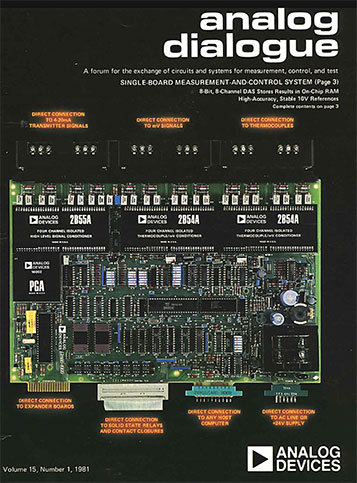 VOLUME 15, Number 1
 VOLUME 14, Number 3
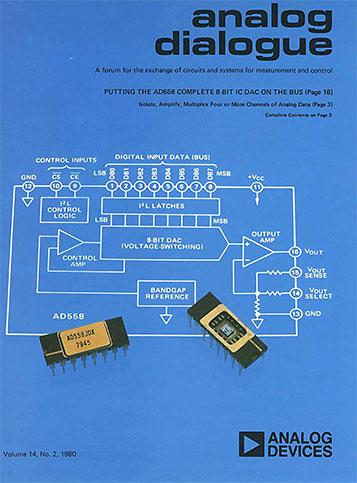 VOLUME 14, Number 2
VOLUME 14 NUMBER 2
IN THIS ISSUE
Isolated Conversion from Digital to 4-to-20 mA2B56 Programmable Cold-Junction CompensatorIsolate, Amplify, Multiplex 4+ Channels0 to 88.5 dB in 1.5-dB Steps10-Bit 20-MHz Video A/D Converter12-Bit CMOS M-DAC Interfaces Directly with µPsDAC Controls Precision UHF Noise LevelPutting the AD558 DACPORT™ on the Bus VOLUME 14, Number 1
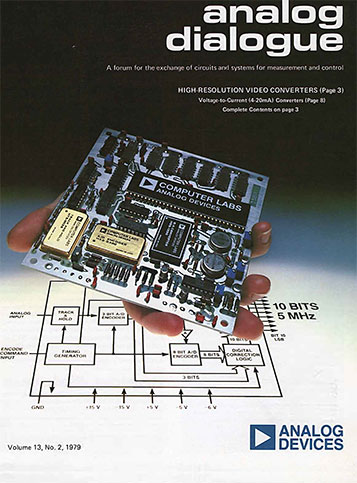 VOLUME 13, Number 2
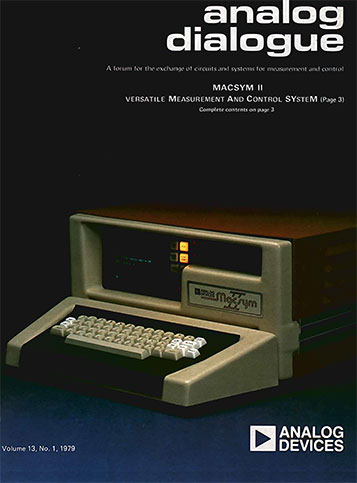 VOLUME 13, Number 1
VOLUME 13 NUMBER 1
IN THIS ISSUE
MACSYM II: A Complete Measurement-And-Control SYsteMMACSYM II: Fast, Efficient 16-Bit Central-Processing UnitMACSYM II: ADIO Controller and Bus Minimize Interference, Power, and CostMACSYM II: Card Library Provides Flexible Input/Output CapabilityMACSYM II: The Proof of MACSYM's Power Is in the ApplicationsMACSYM II: MACBASIC Measurement-and-Control-Oriented Software VOLUME 12, Number 3
 VOLUME 12, Number 2
 VOLUME 12, Number 1
 VOLUME 11, Number 2
 VOLUME 11, Number 1
 VOLUME 10, Number 2
 VOLUME 10, Number 1
VOLUME 10 NUMBER 1
IN THIS ISSUE
13-Bit Monolithic CMOS A/D ConverterMonolithic Sample-Hold AmplifiersInductosyn-to-Digital ConvertersFET-Input IC ElectrometersSimple Rules for Choosing Resistor Values in Adder-Subtractor Circuits10-Volt (±1 mV) ReferencesD/A Conversion with Single-Supply CurrentDifferential High-Impedance RMS-to-DC ConversionAudio Application Ideas for CMOS DACs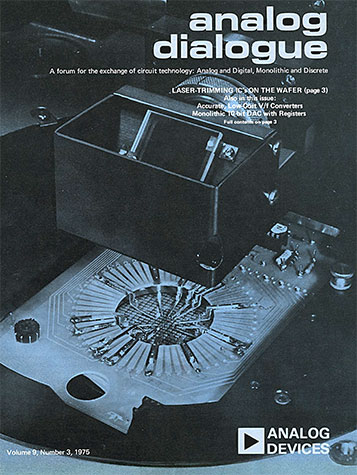 VOLUME 9, Number 3
VOLUME 9 NUMBER 3
 VOLUME 9, Number 2
VOLUME 9 NUMBER 2
IN THIS ISSUE
10-Bit Monolithic CMOS Analog-to-Digital ConverterRoot-Mean-Square Digital Panel MeterAn Improved 12-Bit Multiplying D/A ConverterAutomatic Gain Adjustment Using D/A ConvertersIsolation Amplifiers for Effective Data AcquisitionApplications of the AD580Two-Speed Synchro Conversion Systems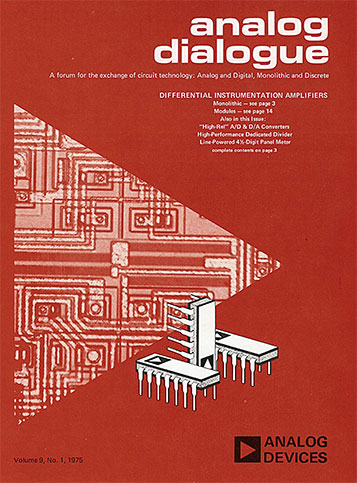 VOLUME 9, Number 1
 VOLUME 8, Number 2
VOLUME 8 NUMBER 2
IN THIS ISSUE
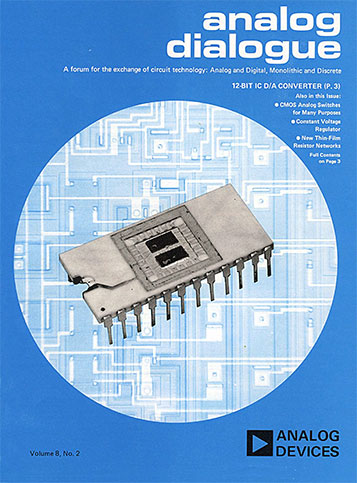
Comparing Thin Films for Precision Resistor NetworksSpecifying and Measuring a Low-Noise FET-Input IC Op Amp12-Bit Integrated Circuit D/A ConverterHandling Variable Data Rates with SERDEXVoltage Measurements in Biomedical ResearchKeys to Longer Life for CMOSUsing DPMs in Our Own Test EquipmentWays of Using the AD7520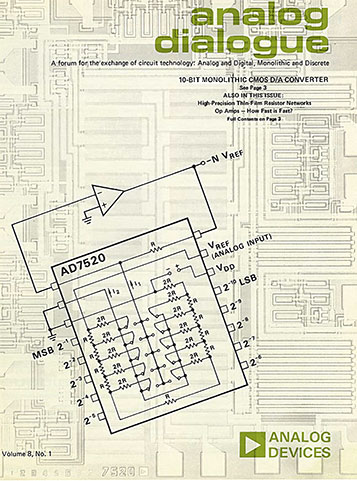 VOLUME 8, Number 1
VOLUME 8 NUMBER 1
IN THIS ISSUE
A 10-Bit Monolithic CMOS D/A ConverterHigh-Precision Thin-Film Resistance NetworksHigh-Speed Op Amps RevisitedReducing Multiplier Linearity ErrorsTemperature Measuring Circuit Borrows Power and Reference from DPMUsing CMOS Switches For...Lock-In Amplifier Uses Single ICCurrent Controller Uses Adjustable Exponent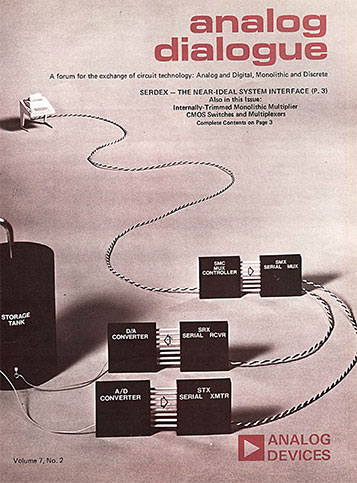 VOLUME 7, Number 2
VOLUME 7 NUMBER 2
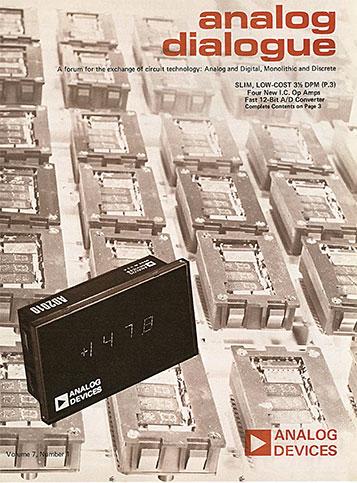 VOLUME 7, Number 1
VOLUME 7 NUMBER 1
IN THIS ISSUE
Designing a Slim, Low-Cost 3½-Digit DPMNot by Drift Alone... The 741 Op Amp Family30-dB Automatic Gain Control with the AD531True RMS Measurement Using the AD531The AD520: Not an Op Amp but an Instrumentation AmplifierVector Difference with the AD531A Low-Noise, Low-Drift FET-Input Amplifier Design VOLUME 6, Number 3
VOLUME 6 NUMBER 3
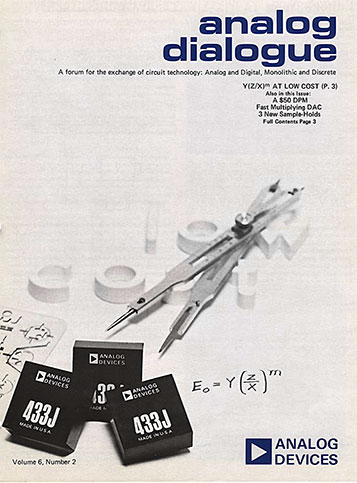 VOLUME 6, Number 2
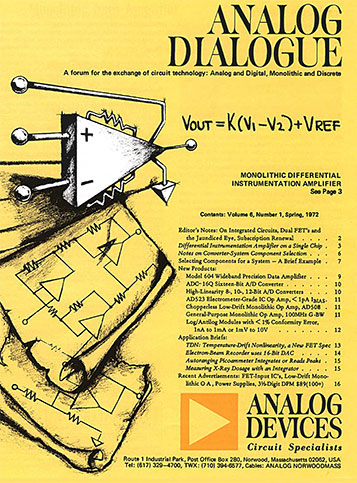 VOLUME 6, Number 1
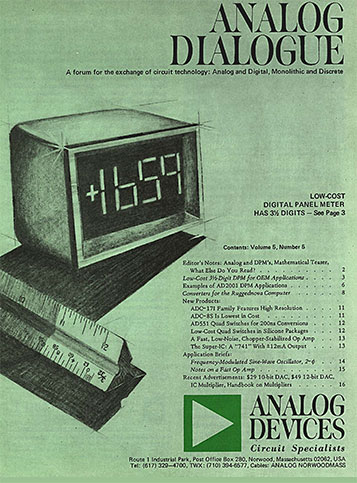 VOLUME 5, Number 5
VOLUME 5 NUMBER 5
IN THIS ISSUE
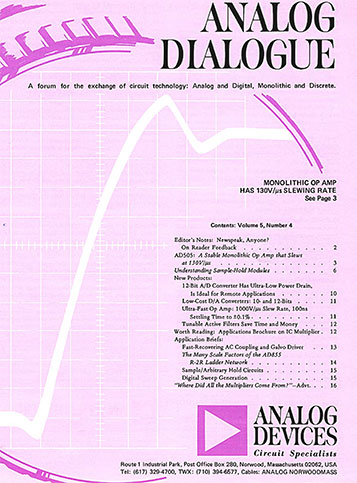 VOLUME 5, Number 4
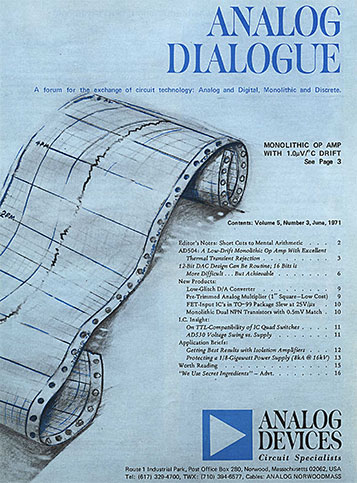 VOLUME 5, Number 3
VOLUME 5 NUMBER 3
IN THIS ISSUE
Monolithic Operational Amplifier with 1 µ/°C Drift12-Bit DAC Design Can Be Routine... 16 Bits Is more Difficult, but AchievableQuad-Switch TTL-CompatibilityProtecting a 1/8-Gigawatt Power Supply, or How Do You Make a 2000-A Fuse?Good Circuit Practice Gets Best Results from Isolation Amplifiers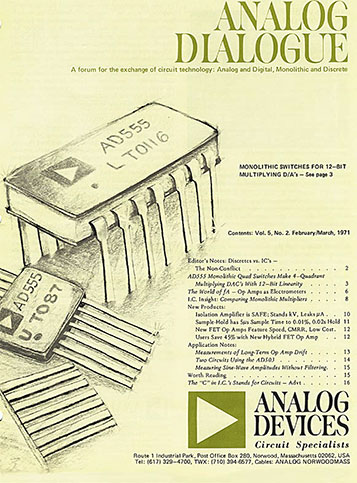 VOLUME 5, Number 2
VOLUME 5 NUMBER 2
IN THIS ISSUE
Op Amps as Electrometers or—The World of fAAD555 Monolithic "µDAC" Quad Switches Make 4-Quadrant Multiplying DACs with 12-Bit LinearityA Choice, Not an Echo: The AD530 vs....Track-Hold AmplifierLong-Term Drift Measurements on Op AmpsCharge AmplifierMeasuring Sine-Wave Amplitudes Without Filtering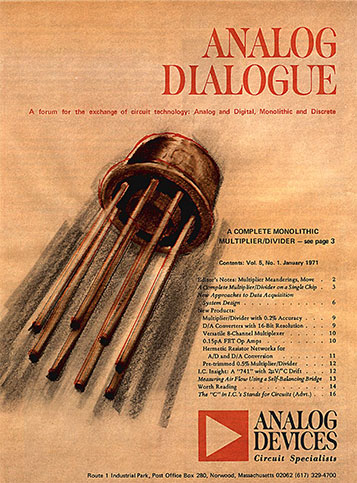 VOLUME 5, Number 1
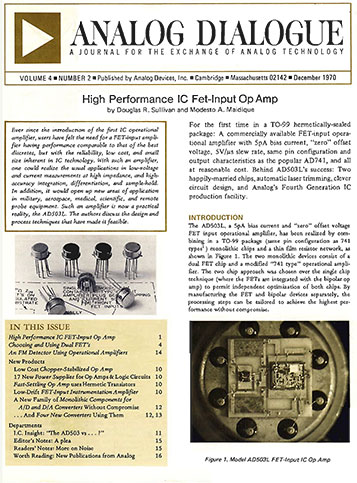 VOLUME 4, Number 2
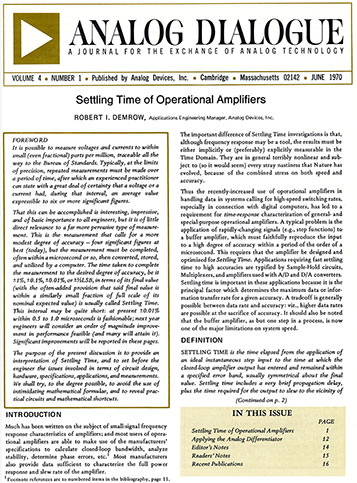 VOLUME 4, Number 1
VOLUME 4 NUMBER 1
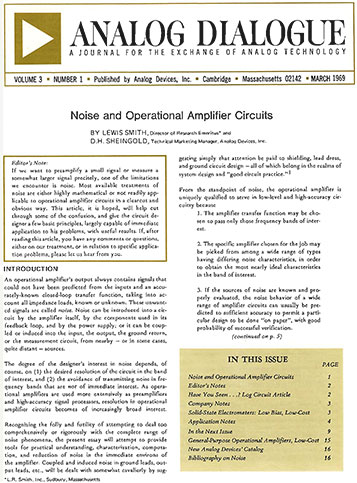 VOLUME 3, Number 1
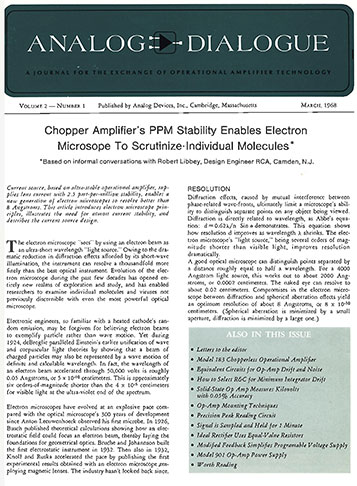 VOLUME 2, Number 1
VOLUME 2 NUMBER 1
IN THIS ISSUE
How to Select R and C for Minimum Integrator DriftChopper Amplifier's PPM Stability Enables Electron Microscope to Scrutinize Individual MoleculesEquivalent Circuits for Operational Amplifier Drift and NoiseIdeal Rectifier Uses Equal-Value ResistorsSolid-State Op Amp Measures Kilovolts with 0.05% AccuracyModified Feedback Simplifies Programmable Voltage SupplySignal Is Sampled and Held for 1 MinuteOp Amp Mounting TechniquesPrecision Peak-Reading Circuit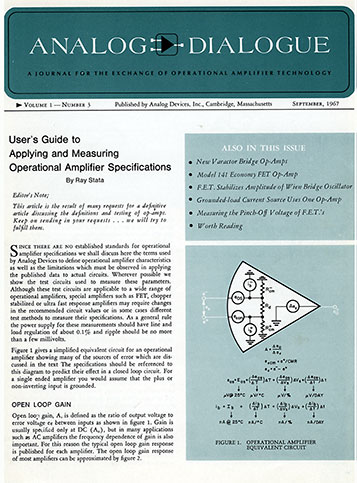 VOLUME 1, Number 3
VOLUME 1 NUMBER 3
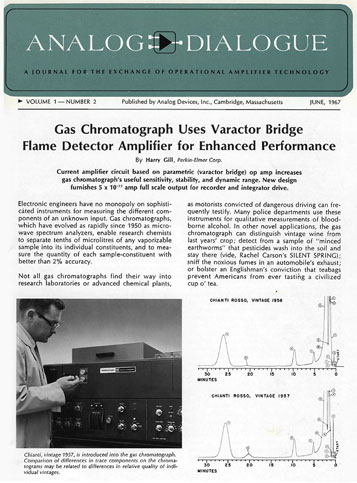 VOLUME 1, Number 2
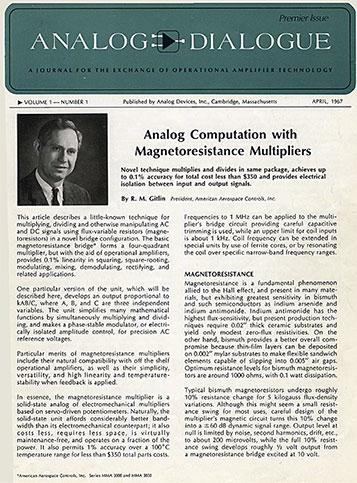 VOLUME 1, Number 1
VOLUME 1 NUMBER 1
 Analog Dialogue Turned 50
For five decades, we’ve been honored to be your engineering resource for innovative design. Take a look back with our first editor and discover some of our favorite articles.