JESD204 Serial Interface

JESD204 Serial Interface and JEDEC Standard Data Converters
The JESD204 and the JESD204B revision data converter serial interface standard was created through the JEDEC committee to standardize and reduce the number of data inputs/outputs between high-speed data converters and other devices, such as FPGAs (field-programmable gate arrays). Fewer interconnects simplifies layout and allows smaller form factor realization without impacting overall system performance. These attributes are important to address the system size and cost constraints of a range of high speed ADC applications, including wireless infrastructure (GSM, EDGE, W-CDMA, LTE, CDMA2000, WiMAX, TD-SCDMA) transceiver architectures, software-defined radios, portable instrumentation, medical ultrasound equipment, and Mil/Aero applications such as radar and secure communications. Analog Devices is an original participating member of the JEDEC JESD204 standards committee and we have concurrently developed compliant data converter technology and tools, and a comprehensive product roadmap to fully enable our customers to take advantage of this significant interfacing breakthrough.
JESD204 Interface Framework
Analog Devices’ JESD204 Interface Framework is a system-level software and HDL package targeted at simplifying system development by providing a performance optimized IP framework that integrates complex hardware such as high speed converters, transceivers and clocks with various FPGA platforms.

JESD204-Compatible Data Conversion Products
High Speed ADC and IF/RF Receiver Products (22)
AD6672
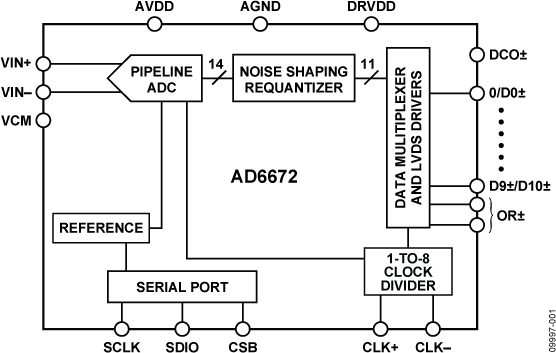
The AD6672 is an 11-bit intermediate receiver with sampling speeds of up to 250 MSPS. The AD6672 is designed to support communications applications, where low cost, small size, wide bandwidth, and versatility are desired.
The ADC core features a multistage, differential pipelined architecture with integrated output error correction logic. The ADC features wide bandwidth inputs supporting a variety of user-selectable input ranges. An integrated voltage reference eases design considerations. A duty cycle stabilizer is provided to compensate for variations in the ADC clock duty cycle, allowing the converters to maintain excellent performance.
The ADC core output is connected internally to a noise shaping requantizer (NSR) block. The device supports two output modes that are selectable via the serial port interface (SPI). With the NSR feature enabled, the outputs of the ADCs are processed such that the AD6672 supports enhanced SNR performance within a limited region of the Nyquist bandwidth while maintaining an 11-bit output resolution. The NSR block is programmed to provide a bandwidth of up to 33% of the sample clock. For example, with a sample clock rate of 250 MSPS, the AD6672 can achieve up to 73.6 dBFS SNR for an 82 MHz bandwidth at 185 MHz fIN.
With the NSR block disabled, the ADC data is provided directly to the output with an output resolution of 11 bits. The AD6672 can achieve up to 66.6 dBFS SNR for the entire Nyquist bandwidth when operated in this mode.
APPLICATIONS
- Communications
- Diversity radio and smart antenna (MIMO) systems
- Multimode digital receivers (3G)
WCDMA, LTE, CDMA2000
WiMAX, TD-SCDMA - I/Q demodulation systems
- General-purpose software radios
Applications
Wireless Communication Solutions
AD6673
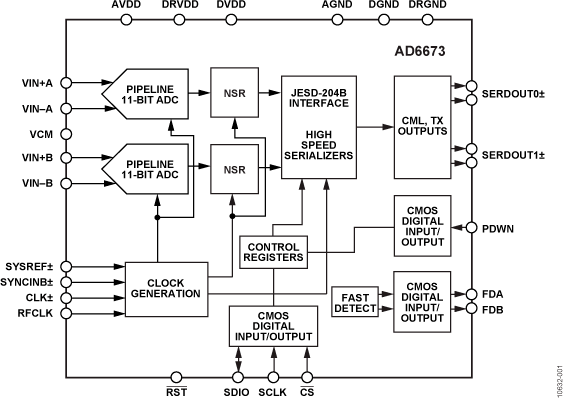
The AD6673 is an 11-bit, 250 MSPS, dual-channel intermediate frequency (IF) receiver specifically designed to support multi-antenna systems in telecommunication applications where high dynamic range performance, low power, and small size are desired.
The device consists of two high performance analog-to-digital converters (ADCs) and noise shaping requantizer (NSR) digital blocks. Each ADC consists of a multistage, differential pipelined architecture with integrated output error correction logic, and each ADC features a wide bandwidth switched capacitor sampling network within the first stage of the differential pipeline. An integrated voltage reference eases design considerations. A duty cycle stabilizer (DCS) compensates for variations in the ADC clock duty cycle, allowing the converters to maintain excellent performance.
Each ADC output is connected internally to an NSR block. The integrated NSR circuitry allows for improved SNR performance in a smaller frequency band within the Nyquist bandwidth. The device supports two different output modes selectable via the SPI. With the NSR feature enabled, the outputs of the ADCs are processed such that the AD6673 supports enhanced SNR performance within a limited portion of the Nyquist bandwidth while maintaining an 11-bit output resolution.
The NSR block can be programmed to provide a bandwidth of either 22% or 33% of the sample clock. For example, with a sample clock rate of 250 MSPS, the AD6673 can achieve up to 76.3 dBFS SNR for a 55 MHz bandwidth in the 22% mode and up to 73.5 dBFS SNR for a 82 MHz bandwidth in the 33% mode.
When the NSR block is disabled, the ADC data is provided directly to the output at a resolution of 11 bits. The AD6673 can achieve up to 65.9 dBFS SNR for the entire Nyquist bandwidth when operated in this mode. This allows the AD6673 to be used in telecommunication applications such as a digital predistortion observation path where wider bandwidths are required.
By default the ADC output data is routed directly to the two external JESD204B serial output lanes. These outputs are at current mode logic (CML) voltage levels. Two modes are supported such that output coded data is either sent through one lane or two (L = 1; F = 4 or L = 2; F = 2). Single lane operation supports converter rates up to 125 MSPS. Synchronization input controls (SYNCINB± and SYSREF±) are provided.
PRODUCT HIGHLIGHTS
- The configurable JESD204B output block with an integrated phase-locked loop (PLL) to support up to 5 Gbps per lane with up to two lanes.
- IF receiver includes two, 11-bit, 250 MSPS ADCs with programmable noise shaping requantizer (NSR) function that allows for improved SNR within a reduced bandwidth of 22% or 33% of the sample rate.
- Support for an optional RF clock input to ease system board design.
- Proprietary differential input maintains excellent SNR performance for input frequencies of up to 400 MHz.
- An on-chip integer, 1-to-8 input clock divider and SYNC input allows synchronization of multiple devices.
- Operation from a single 1.8 V power supply.
- Standard serial port interface (SPI) that supports various product features and functions, such as controlling the clock DCS, power-down, test modes, voltage reference mode, overrange fast detection, and serial output configuration.
APPLICATIONS
- Communications
- Diversity radio and smart antenna (MIMO) systems
- Multimode digital receivers (3G)
TD-SCDMA, WiMAX, WCDMA, CDMA2000, GSM, EDGE, LTE - I/Q demodulation systems
- General-purpose software radios
Applications
Wireless Communication Solutions
- Wireless Infrastructure Solutions
AD6674
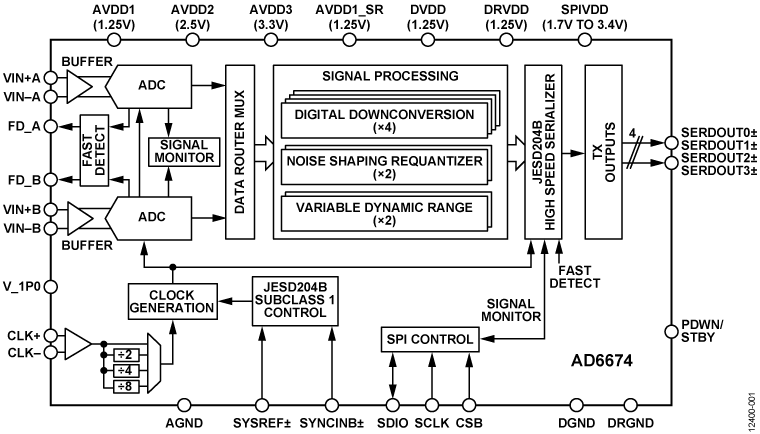
The AD6674 is a 385 MHz bandwidth mixed-signal intermediate frequency (IF) receiver. It consists of two, 14-bit 1.0 GSPS/750 MSPS/500 MSPS analog-to-digital converters (ADC) and various digital signal processing blocks consisting of four wideband DDCs, an NSR, and VDR monitoring. It has an on-chip buffer and a sample-and-hold circuit designed for low power, small size, and ease of use. This product is designed to support communications applications capable of sampling wide bandwidth analog signals of up to 2 GHz. The AD6674 is optimized for wide input bandwidth, high sampling rate, excellent linearity, and low power in a small package.
The dual ADC cores feature a multistage, differential pipelined architecture with integrated output error correction logic. Each ADC features wide bandwidth inputs supporting a variety of user-selectable input ranges. An integrated voltage reference eases design considerations.
Applications
- Diversity multiband, multimode digital receivers 3G/4G, TD-SCDMA, W-CDMA, GSM, LTE, LTE-A
- DOCSIS 3.0 CMTS upstream receive paths
- HFC digital reverse path receivers
Applications
Aerospace and Defense Systems
- Air Data, Altitude, Heading Reference Systems (ADAHRS)
- Avionic Systems
Wireless Communication Solutions
AD6676
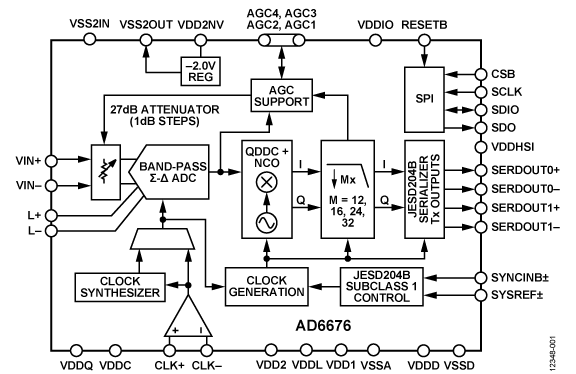
The AD6676 is a highly integrated IF subsystem that can digitize radio frequency (RF) bands up to 160 MHz in width centered on an intermediate frequency (IF) of 70 MHz to 450 MHz. Unlike traditional Nyquist IF sampling ADCs, the AD6676 relies on a tunable band-pass Σ-Δ ADC with a high oversampling ratio to eliminate the need for band specific IF SAW filters and gain stages, resulting in significant simplification of the wideband radio receiver architecture. On-chip quadrature digital downconversion followed by selectable decimation filters reduces the complex data rate to a manageable rate between 62.5 MSPS to 266.7 MSPS. The 16-bit complex output data is transferred to the host via a single or dual lane JESD204B interface supporting line rates of up to 5.333 Gbps.
Applications
- Wideband cellular infrastructure equipment and repeaters
- Point-to-point microwave equipment
- Instrumentation
- Spectrum and communication analyzers
- Software defined radio
Applications
Wireless Communication Solutions
- Wireless Infrastructure Solutions
Instrumentation and Measurement Solutions
- Communications Test Equipment Solutions
- Radio Frequency (RF) Signal and Vector Network Analyzer Solutions
Aerospace and Defense Systems
- Missiles and Precision Munitions
- Electronic Surveillance and Countermeasures
- Military Communication Solutions
AD6684
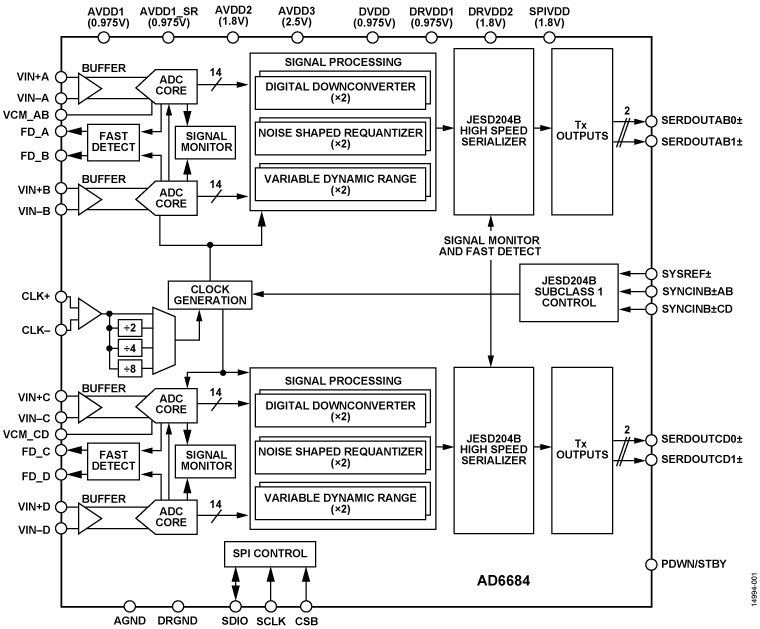
The AD6684 is a 135 MHz bandwidth, quad intermediate frequency (IF) receiver. It consists of four 14-bit, 500 MSPS ADCs and various digital processing blocks consisting of four wideband DDCs, an NSR, and VDR monitoring. The device has an on-chip buffer and a sample-and-hold circuit designed for low power, small size, and ease of use. This device is designed to support communications applications. The analog full power bandwidth of the device is 1.4 GHz.
The quad ADC cores feature a multistage, differential pipelined architecture with integrated output error correction logic. Each ADC features wide bandwidth inputs supporting a variety of user-selectable input ranges. An integrated voltage reference eases design considerations. The AD6684 is optimized for wide input bandwidth, excellent linearity, and low power in a small package.
The analog inputs and clock signal input are differential. Each pair of ADC data outputs are internally connected to two DDCs through a crossbar mux. Each DDC consists of up to five cascaded signal processing stages: a 48-bit frequency translator, NCO, and up to four half-band decimation filters.
Each ADC output is connected internally to an NSR block. The integrated NSR circuitry allows improved SNR performance in a smaller frequency band within the Nyquist bandwidth. The device supports two different output modes selectable via the serial port interface (SPI). With the NSR feature enabled, the outputs of the ADCs are processed such that the AD6684 supports enhanced SNR performance within a limited portion of the Nyquist bandwidth while maintaining a 9-bit output resolution.
Each ADC output is also connected internally to a VDR block. This optional mode allows full dynamic range for defined input signals. Inputs that are within a defined mask (based on DPD applications) are passed unaltered. Inputs that violate this defined mask result in the reduction of the output resolution.
With VDR, the dynamic range of the observation receiver is determined by a defined input frequency mask. For signals falling within the mask, the outputs are presented at the maximum resolution allowed. For signals exceeding defined power levels within this frequency mask, the output resolution is truncated. This mask is based on DPD applications andsupports tunable real IF sampling, and zero IF or complex IF receive architectures.
Operation of the AD6684 in the DDC, NSR, and VDR modes is selectable via SPI-programmable profiles (the default mode is NSR at startup).
In addition to the DDC blocks, the AD6684 has several functions that simplify the AGC function in the communications receiver. The programmable threshold detector allows monitoring of the incoming signal power using the fast detect output bits of the ADC. If the input signal level exceeds the programmable threshold, the fast detect indicator goes high. Because this threshold indicator has low latency, the user can quickly turn down the system gain to avoid an overrange condition at the ADC input.
Users can configure each pair of IF receiver outputs onto either one or two lanes of Subclass 1 JESD204B-based high speed serialized outputs, depending on the decimation ratio and the acceptable lane rate of the receiving logic device. Multiple device synchronization is supported through the SYSREF±, SYNCINB±AB, and SYNCINB±CD input pins.
The AD6684 has flexible power-down options that allow significant power savings when desired. All of these features can be programmed using the 1.8 V capable, 3-wire SPI.
The AD6684 is available in a Pb-free, 72-lead LFCSP and is specified over the −40°C to +105°C junction temperature range.
Product Highlights
- Low power consumption per channel.
- JESD204B lane rate support up to 15 Gbps.
- Wide full power bandwidth supports IF sampling of signals up to 1.4 GHz.
- Buffered inputs ease filter design and implementation.
- Four integrated wideband decimation filters and NCO blocks supporting multiband receivers.
- Programmable fast overrange detection.
- On-chip temperature diode for system thermal management.
Applications
- Communications
- Diversity multiband, multimode digital receivers 3G/4G, W-CDMA, GSM, LTE, LTE-A
- HFC digital reverse path receivers
- Digital predistortion observation paths
- General-purpose software radios
Applications
Wireless Communication Solutions
AD6688

The AD6688 is a 1.2 GHz bandwidth, mixed-signal, direct radio frequency (RF) sampling receiver. It consists of two 14-bit, 3.0 GSPS analog-to-digital converters (ADCs) and various digital signal processing blocks consisting of four wideband digital downconverters (DDCs). The AD6688 has an on-chip buffer and a sample-and-hold circuit designed for low power, small size, and ease of use. This product is designed to support communications applications capable of direct sampling wide bandwidth analog signals of up to 5 GHz. The 3 dB bandwidth of the ADC input is greater than 9 GHz. The AD6688 is optimized for wide input bandwidth, high sampling rate, excellent linearity, and low power in a small package.
The dual ADC cores feature a multistage, differential pipelined architecture with integrated output error correction logic. Each ADC features wide bandwidth inputs supporting a variety of user-selectable input ranges. An integrated voltage reference eases design considerations. The analog input and clock signals are differential inputs. The ADC data outputs are internally connected to four DDCs through a crossbar mux. Each DDC consists of up to five cascaded signal processing stages: a 48-bit numerically controlled oscillator (NCO) and up to four half-band decimation filters. The NCO has the option to select preset bands over the general-purpose input/output (GPIO) pins, which enables selection of up to three bands. Operation of the AD6688 between the DDC modes is selectable via SPI-programmable profiles.
In addition to the DDC blocks, the AD6688 has several functions that simplify the automatic gain control (AGC) function in a communications receiver. The programmable threshold detector allows monitoring of the incoming signal power using the fast detect control bits in Register 0x0245 of the ADC. If the input signal level exceeds the programmable threshold, the fast detect indicator goes high. Because this threshold indicator has low latency, the user can quickly turn down the system gain to avoid an overrange condition at the ADC input. Besides the fast detect outputs, the AD6688 also offers signal monitoring capability. The signal monitoring block provides additional information about the signal being digitized by the ADC.
The user can configure the Subclass 1 JESD204B-based high speed serialized output in a variety of one-lane, two-lane, four-lane, six-lane, and eight-lane configurations, depending on the DDC configuration and the acceptable lane rate of the receiving logic device. Multidevice synchronization is supported through the SYSREF± and SYNCINB± input pins.
The AD6688 has flexible power-down options that allow significant power savings when desired. All of these features can be programmed using a 3-wire serial port interface (SPI).
The AD6688 is available in a Pb-free, 196-ball BGA specified over the −40°C to +85°C ambient temperature range.
Product Highlights
- Wide full power bandwidth supports IF sampling of signals up to 9GHz (-3dB point).
- Four Integrated wide-band decimation filter and NCO blocks supporting multi-band receivers.
- Fast NCO switching enabled through GPIO pins.
- Flexible SPI interface controls various product features and functions to meet specific system requirements.
- Programmable fast overrange detection and signal monitoring.
- On-chip temperature dioide for system thermal management.
- 12mm x 12mm 196-Lead BGA
Applications
- Diversity multiband, multimode digital receivers
- 3G/4G, TD-SCDMA, W-CDMA, GSM, LTE, LTE-A
- DOCSIS 3.0 CMTS upstream receive paths
- HFC digital reverse path receivers
Applications
Wireless Communication Solutions
- Wireless Infrastructure Solutions
Instrumentation and Measurement Solutions
- Radio Frequency (RF) Signal and Vector Network Analyzer Solutions
AD9207

The AD9207 is a dual, 12-bit, 6 GSPS analog-to-digital converter (ADC). The ADC input features an on-chip wideband buffer with overload protection. This device is designed to support communications applications capable of direct sampling wideband signals up to 7.5 GHz. An optional low phase noise phase-locked loop (PLL) clock synthesizer is available to generate the ADC sampling clock, simplifying printed circuit board (PCB) distribution of a high frequency clock signal. Alternatively, the CLKIN of the device can be driven directly with the ADC sampling clock (or a higher version up to 12 GHz when the internal clock divider is enabled). An optional CLKOUT buffer is available to transmit the ADC sampling clock to other devices.
APPLICATIONS
- Diversity multiband and multimode digital receivers
- Microwave point-to-point, E-Band, and 5G mm wave
- Broadband communications systems
- Phased array radar and electronic warfare
- Electronic test and measurement systems
AD9208

The AD9208 is a dual, 14-bit, 3 GSPS analog-to-digital converter (ADC). The device has an on-chip buffer and a sample-and- hold circuit designed for low power, small size, and ease of use. This product is designed to support communications applications capable of direct sampling wide bandwidth analog signals of up to 5 GHz. The −3 dB bandwidth of the ADC input is 9 GHz. The AD9208 is optimized for wide input bandwidth, high sampling rate, excellent linearity, and low power in a small package.
The dual ADC cores feature a multistage, differential pipelined architecture with integrated output error correction logic. Each ADC features wide bandwidth inputs supporting a variety of user-selectable input ranges. An integrated voltage reference eases design considerations. The analog input and clock signals are differential inputs. The ADC data outputs are internally connected to four digital downconverters (DDCs) through a crossbar mux. Each DDC consists of up to five cascaded signal processing stages: a 48-bit frequency translator (numerically controlled oscillator (NCO)), and up to four half-band decimation filters. The NCO has the option to select preset bands over the general-purpose input/output (GPIO) pins, which enables the selection of up to three bands. Operation of the AD9208 between the DDC modes is selectable via SPI-programmable profiles.
In addition to the DDC blocks, the AD9208 has several functions that simplify the automatic gain control (AGC) function in a communications receiver. The programmable threshold detector allows monitoring of the incoming signal power using the fast detect control bits in Register 0x0245 of the ADC. If the input signal level exceeds the programmable threshold, the fast detect indicator goes high. Because this threshold indicator has low latency, the user can quickly turn down the system gain to avoid an overrange condition at the ADC input. In addition to the fast detect outputs, the AD9208 also offers signal monitoring capability. The signal monitoring block provides additional information about the signal being digitized by the ADC.
The user can configure the Subclasss 1 JESD204B-based high speed serialized output in a variety of one-lane, two-lane, four- lane, and eight-lane configurations, depending on the DDC configuration and the acceptable lane rate of the receiving logic device. Multidevice synchronization is supported through the SYSREF± and SYNCINB± input pins.
The AD9208 has flexible power-down options that allow significant power savings when desired. All of these features can be programmed using a 3-wire serial port interface (SPI).
The AD9208 is available in a Pb-free, 196-ball BGA, specified over the −40°C to +85°C ambient temperature range. This product is protected by a U.S. patent.
Note that throughout this data sheet, multifunction pins, such as FD_A/GPIO_A0, are referred to either by the entire pin name or by a single function of the pin, for example, FD_A, when only that function is relevant.
Product Highlights
- Wide, input −3 dB bandwidth of 9 GHz supports direct radio frequency (RF) sampling of signals up to about 5 GHz.
- Four integrated, wideband decimation filter and NCO blocks supporting multiband receivers.
- Fast NCO switching enabled through GPIO pins.
- A SPI controls various product features and functions to meet specific system requirements.
- Programmable fast overrange detection and signal monitoring.
- On-chip temperature dioide for system thermal management.
- 12mm × 12mm 196-Lead BGA
Applications
- Diversity multiband, multimode digital receivers
- 3G/4G, TD-SCDMA, W-CDMA, GSM, LTE, LTE-A
- Electronic test and measurement systems
- Phased array radar and electronic warfare
- DOCSIS 3.0 CMTS upstream receive paths
- HFC digital reverse path receivers
Applications
Aerospace and Defense Systems
- Military Communication Solutions
- Phased Array Radar
- Electronic Surveillance and Countermeasures
- Missiles and Precision Munitions
Wireless Communication Solutions
- Wireless Infrastructure Solutions
Instrumentation and Measurement Solutions
- Communications Test Equipment Solutions
- Oscilloscopes and Digitizer Solutions
- Radio Frequency (RF) Signal and Vector Network Analyzer Solutions
- Data Acquisition Solutions
- Electronic Test and Measurement Solutions
Radio Frequency (RF) Solutions
- Radio Frequency (RF) Solutions
AD9209

The AD9209 is a quad, 12-bit, 4 GSPS analog-to-digital converter (ADC). The ADC input features an on-chip wideband buffer with overload protection. This device is designed to support applications capable of direct sampling wideband signals up to 8 GHz. An on-chip, low phase noise, phase-locked loop (PLL) clock synthesizer is available to generate the ADC sampling clock, simplifying the printed circuit board (PCB) distribution of a high frequency clock signal. A clock output buffer is available to transmit the ADC sampling clock to other devices.
The quad ADC cores have code error rates (CER) better than 1 × 10⁻²⁰. Low latency fast detection and signal monitoring are available for automatic gain control (AGC) purposes. A flexible 192-tap programmable finite impulse response filter (PFIR) is avail-able for digital filtering and/or equalization. Programmable integer and fractional delay blocks support compensation for analog delay mismatches.
The digital signal processing (DSP) block consisting of two coarse digital down converters (DDCs) and four fine DDCs per pair of ADCs. Each ADC can operate with one or two main DDC stages in support of multiband applications. The four additional fine DDC stages are available to support up to four bands per ADC The 48-bit numerically controlled oscillators (NCOs) associated with each DDC support fast frequency hopping (FFH) while maintaining synchronization with up to 16 unique frequency assignments selected via the general-purpose input and output (GPIOx) pins or the serial port interface (SPI).
The AD9209 supports one or two JTx links that can be configured for either JESD204B or JESD204C subclass operation, thus allowing for different datapath configurations for each ADC. Multidevice synchronization is supported through the SYSREF± input pins.
APPLICATIONS
- Wireless communications infrastructure
- Microwave point-to-point, E-band, and 5G mm wave
- Broadband communications systems
- DOCSIS 3.1 and 4.0 CMTS
- Phased array radar and electronic warfare
- Electronic test and measurement systems
AD9213
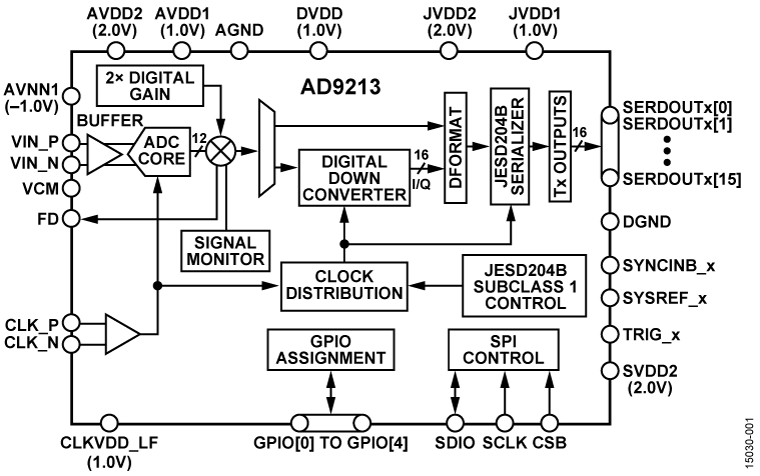
The AD9213 is a single, 12-bit, 6 GSPS/10.25 GSPS, radio frequency (RF) analog-to-digital converter (ADC) with a 6.5 GHz input bandwidth. The AD9213 supports high dynamic range frequency and time domain applications requiring wide instantaneous bandwidth and low conversion error rates (CER). The AD9213 features a 16-lane JESD204B interface to support maximum bandwidth capability.
The AD9213 achieves dynamic range and linearity performance while consuming <4.6 W typical. The device is based on an interleaved pipeline architecture and features a proprietary calibration and randomization technique that suppresses interleaving spurious artifacts into its noise floor. The linearity performance of the AD9213 is preserved by a combination of on-chip dithering and calibration, which results in excellent spurious-free performance over a wide range of input signal conditions.
Applications that require less instantaneous bandwidth can benefit from the on-chip, digital signal processing (DSP) capability of the AD9213 that reduces the output data rate along with the number of JESD204B lanes required to support the device. The DSP path includes a digital downconverter (DDC) with a 48-bit, numerically controlled oscillator (NCO), followed by an I/Q digital decimator stage that allows selectable decimation rates that are factors of two or three. For fast frequency hopping applications, the AD9213 NCO supports up to 16 profile settings with a separate trigger input, allowing wide surveillance frequency coverage at a reduced JESD204B lane count.
The AD9213 supports sample accurate multichip synchronization that includes synchronization of the NCOs. The AD9213 is offered in a 192-ball ball grid array (BGA) package and is specified over a junction temperature range of −20°C to +115°C.
Applications
Instrumentation and Measurement Solutions
- Communications Test Equipment Solutions
- Oscilloscopes and Digitizer Solutions
- Data Acquisition Solutions
- Electronic Test and Measurement Solutions
- Analytical Instruments
- Automated Test Equipment
Aerospace and Defense Systems
- Missiles and Precision Munitions
- Unmanned Aerial Vehicles (UAV)
- Electronic Surveillance and Countermeasures
- Military Communication Solutions
- Phased Array Radar
- Missiles and Precision Munitions Solutions
Radio Frequency (RF) Solutions
- Radio Frequency (RF) Solutions
AD9234
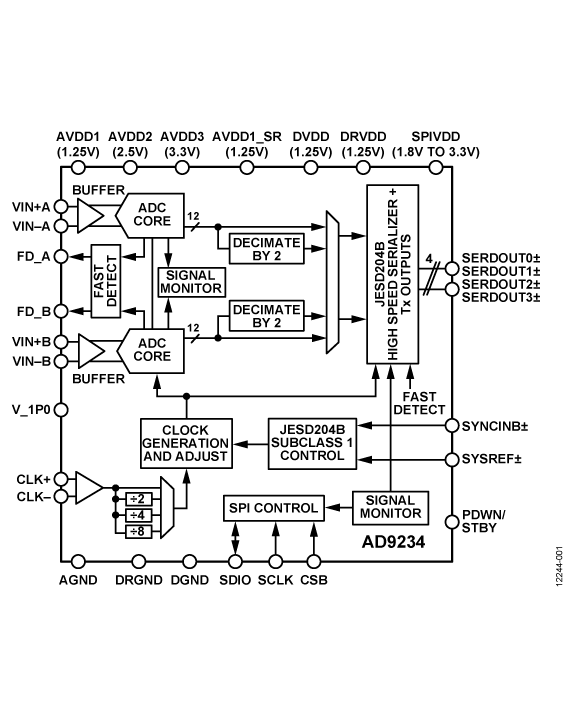
The AD9234 is a dual, 12-bit, 1 GSPS/500 MSPS ADC. The device has an on-chip buffer and sample-and-hold circuit designed for low power, small size, and ease of use. This product is designed for sampling wide bandwidth analog signals. The AD9234 is optimized for wide input bandwidth, high sampling rate, excellent linearity, and low power in a small package.
The dual ADC cores feature a multistage, differential pipelined architecture with integrated output error correction logic. Each ADC features wide bandwidth buffered inputs supporting a variety of user-selectable input ranges. An integrated voltage reference eases design considerations. Each ADC data output is internally connected to an optional decimate-by-2 block. The AD9234 has several functions that simplify the automatic gain control (AGC) function in a communications receiver.
The programmable threshold detector allows monitoring of the incoming signal power using the fast detect output bits of the ADC. If the input signal level exceeds the programmable threshold, the fast detect indicator goes high. Because this threshold indicator has low latency, the user can quickly turn down the system gain to avoid an overrange condition at the ADC input. In addition to the fast detect outputs, the AD9234 also offers signal monitoring capability. The signal monitoring block provides additional information about the signal being digitized by the ADC.
Users can configure the Subclass 1 JESD204B-based high speed serialized output in a variety of one-, two-, or four-lane configurations, depending on the acceptable lane rate of the receiving logic device and the sampling rate of the ADC. Multiple device synchronization is supported through the SYSREF± and SYNCINB± input pins.
The AD9234 has flexible power-down options that allow significant power savings when desired. All of these features can be programmed using a 1.8 V to 3.3 V capable 3-wire SPI.
The AD9234 is available in a Pb-free, 64-lead LFCSP and is specified over the −40°C to +85°C industrial temperature range. This product is protected by a U.S. patent.
PRODUCT HIGHLIGHTS
- Low power consumption analog core, 12-bit, 1.0 GSPS dual analog-to-digital converter (ADC) with 1.5 W per channel.
- Wide full power bandwidth supports IF sampling of signals up to 2 GHz.
- Buffered inputs with programmable input termination eases filter design and implementation.
- Flexible serial port interface (SPI) controls various product features and functions to meet specific system requirements.
- Programmable fast overrange detection.
- 9 mm × 9 mm 64-lead LFCSP.
- Pin compatible with the AD9680 14-bit, 1 GSPS dual ADC.
APPLICATIONS
- Communications
- Diversity multiband, multimode digital receivers
- 3G/4G, TD-SCDMA, W-CDMA, GSM, LTE
- Point-to-point radio systems
- Digital predistortion observation path
- General-purpose software radios
- Ultrawideband satellite receiver
- Instrumentation (spectrum analyzers, network analyzers, integrated RF test solutions)
- Digital oscilloscopes
- High speed data acquisition systems
- DOCSIS 3.0 CMTS upstream receive paths
- HFC digital reverse path receivers
AD9250
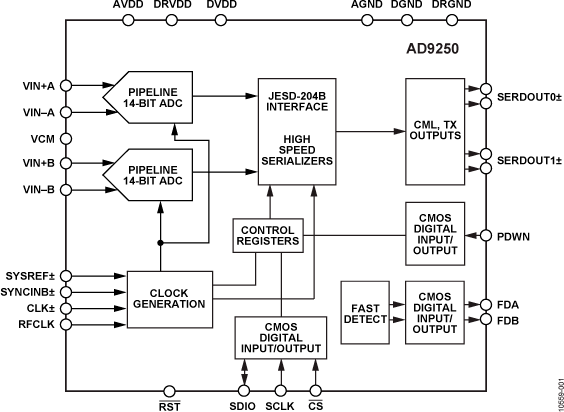
The AD9250 is a dual, 14-bit ADC with sampling speeds of up to 250 MSPS. The AD9250 is designed to support communications applications where low cost, small size, wide bandwidth, and versatility are desired.
The ADC cores feature a multistage, differential pipelined architecture with integrated output error correction logic. The ADC cores feature wide bandwidth inputs supporting a variety of user-selectable input ranges. An integrated voltage reference eases design considerations. A duty cycle stabilizer is provided to compensate for variations in the ADC clock duty cycle, allowing the converters to maintain excellent performance. The JESD204B high speed serial interface reduces board routing requirements and lowers pin count requirements for the receiving device.
By default, the ADC output data is routed directly to the two JESD204B serial output lanes. These outputs are at CML voltage levels. Four modes support any combination of M = 1 or 2 (single or dual converters) and L = 1 or 2 (one or two lanes). For dual ADC mode, data can be sent through two lanes at the maximum sampling rate of 250 MSPS. However, if data is sent through one lane, a sampling rate of up to 125 MSPS is supported. Synchronization inputs (SYNCINB± and SYSREF±) are provided.
Flexible power-down options allow significant power savings, when desired. Programmable overrange level detection is supported for each channel via the dedicated fast detect pins.
Programming for setup and control are accomplished using a 3-wire SPI-compatible serial interface.
The AD9250 is available in a 48-lead LFCSP and is specified over the industrial temperature range of −40°C to +85°C.
Product Highlights
- Integrated dual, 14-bit, 170 MSPS/250 MSPS ADC.
- The configurable JESD204B output block supports up to 5 Gbps per lane.
- An on-chip, phase-locked loop (PLL) allows users to provide a single ADC sampling clock; the PLL multiplies the ADC sampling clock to produce the corresponding JESD204B data rate clock.
- Support for an optional RF clock input to ease system board design.
- Proprietary differential input maintains excellent SNR performance for input frequencies of up to 400 MHz.
- Operation from a single 1.8 V power supply.
- Standard serial port interface (SPI) that supports various product features and functions such as controlling the clock DCS, power-down, test modes, voltage reference mode, over range fast detection, and serial output configuration.
Applications
- Diversity radio systems
- Multimode digital receivers (3G)
- TD-SCDMA, WiMAX, W-CDMA, CDMA2000, GSM, EDGE, LTE
- DOCSIS 3.0 CMTS upstream receive paths
- HFC digital reverse path receivers
- I/Q demodulation systems
- Smart antenna systems
- Electronic test and measurement equipment
- Radar receivers
- COMSEC radio architectures
- IED detection/jamming systems
- General-purpose software radios
- Broadband data applications
AD9625
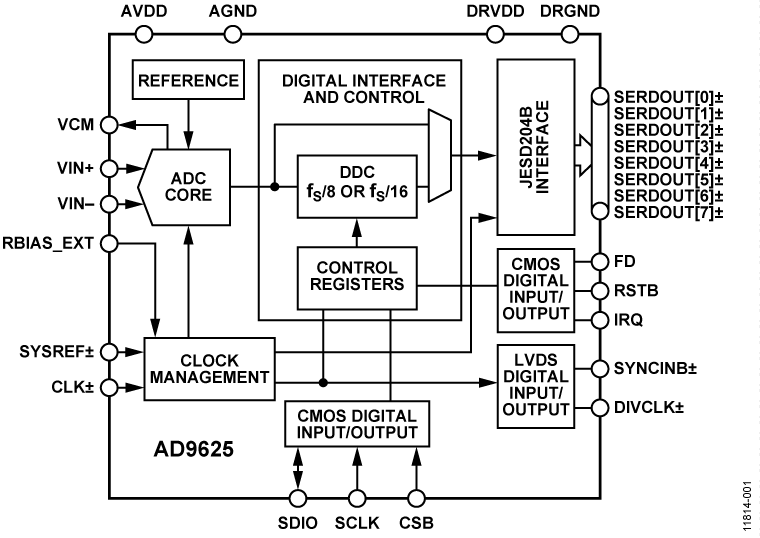
The AD9625 is a 12-bit monolithic sampling analog-to-digital converter (ADC) that operates at conversion rates of up to 2.6 giga samples per second (GSPS). This product is designed for sampling wide bandwidth analog signals up to the second Nyquist zone. The combination of wide input bandwidth, high sampling rate, and excellent linearity of the AD9625 is ideally suited for spectrum analyzers, data acquisition systems, and a wide assortment of military electronics applications, such as radar and jamming/antijamming measures.
The analog input, clock, and SYSREF± signals are differential inputs. The JESD204B-based high speed serialized output is configurable in a variety of one-, two-, four-, six-, or eight-lane configurations. The product is specified over the industrial temperature range of −40°C to +85°C.
PRODUCT HIGHLIGHTS
- High performance: exceptional SFDR in high sample rate applications, direct RF sampling, and on-chip reference.
- Flexible digital data output formats based on the JESD204B specification.
- Control path SPI interface port that supports various product features and functions, such as data formatting, gain, and offset calibration values.
APPLICATIONS
- Spectrum analyzers
- Military communications
- Radar
- High performance digital storage oscilloscopes
- Active jamming/antijamming
- Electronic surveillance and countermeasures
Applications
Instrumentation and Measurement Solutions
- Analytical Instruments
Aerospace and Defense Systems
- Electronic Surveillance and Countermeasures
AD9656
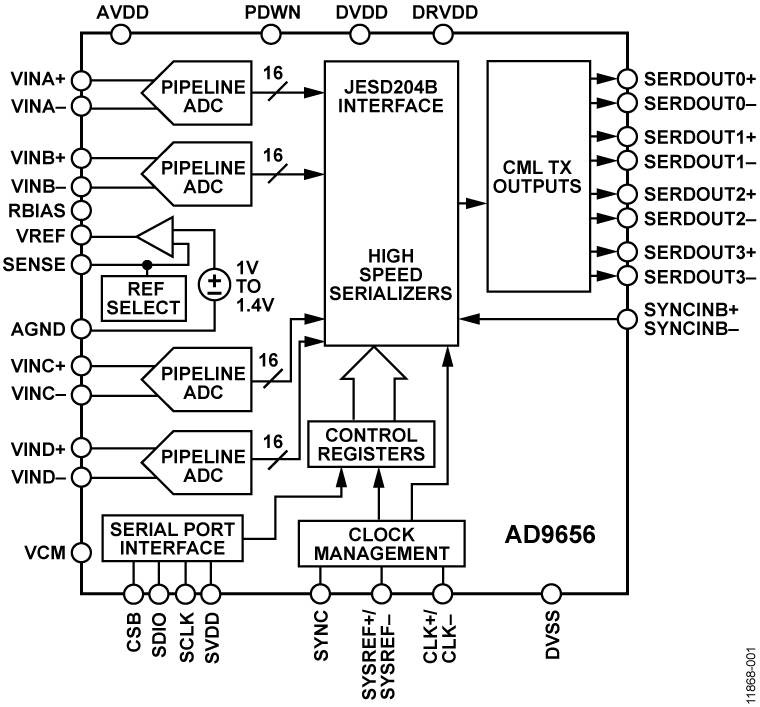
The AD9656 is a quad, 16-bit, 125 MSPS analog-to-digital converter (ADC) with an on-chip sample and hold circuit designed for low cost, low power, small size, and ease of use. The device operates at a conversion rate of up to 125 MSPS and is optimized for outstanding dynamic performance and low power in applications where a small package size is critical.
The ADC requires a single 1.8 V power supply and LVPECL-/CMOS-/LVDS-compatible sample rate clock for full performance operation. An external reference or driver components are not required for many applications.
Individual channel power-down is supported and typically consumes less than 14 mW when all channels are disabled. The ADC contains several features designed to maximize flexibility and minimize system cost, such as a programmable output clock, data alignment, and digital test pattern generation. The available digital test patterns include built-in deterministic and pseudo-random patterns, along with custom user-defined test patterns entered via the serial port interface (SPI).
The AD9656 is available in an RoHS compliant, nonmagnetic, 56-lead LFCSP. It is specified over the −40°C to +85°C industrial temperature range.
Product Highlights
- It has a small footprint. Four ADCs are contained in a small, 8 mm × 8 mm package.
- An on-chip phase-locked loop (PLL) allows users to provide a single ADC sampling clock; the PLL multiplies the ADC sampling clock to produce the corresponding JESD204B data rate clock.
- The configurable JESD204B output block supports up to 8.0 Gbps per lane.
- JESD204B output block supports one, two, and four lane configurations.
- Low power of 198 mW per channel at 125 MSPS, two lanes.
- The SPI control offers a wide range of flexible features to meet specific system requirements.
Applications
- Medical imaging
- High speed imaging
- Quadrature radio receivers
- Diversity radio receivers
- Portable test equipment
AD9680
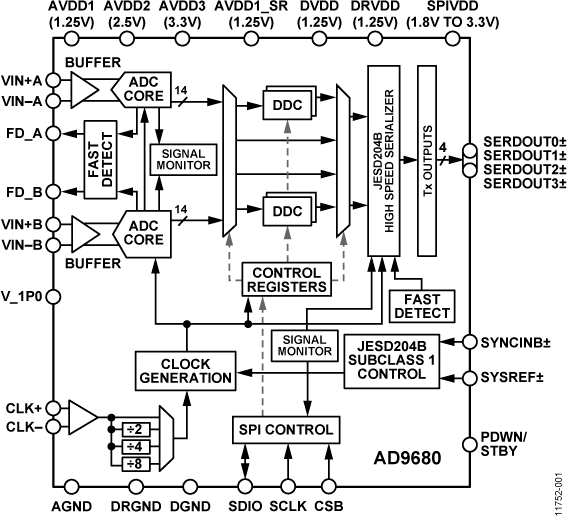
The AD9680 is a dual, 14-bit, 1.25 GSPS/1 GSPS/820 MSPS/500 MSPS analog-to-digital converter (ADC). The device has an on-chip buffer and sample-and-hold circuit designed for low power, small size, and ease of use. This device is designed for sampling wide bandwidth analog signals of up to 2 GHz. The AD9680 is optimized for wide input bandwidth, high sampling rate, excellent linearity, and low power in a small package.
The dual ADC cores feature a multistage, differential pipelined architecture with integrated output error correction logic. Each ADC features wide bandwidth inputs supporting a variety of user-selectable input ranges. An integrated voltage reference eases design considerations.
The analog input and clock signals are differential inputs. Each ADC data output is internally connected to two digital down-converters (DDCs). Each DDC consists of up to five cascaded signal processing stages: a 12-bit frequency translator (NCO), and four half-band decimation filters. The DDCs are bypassed by default.
In addition to the DDC blocks, the AD9680 has several functions that simplify the automatic gain control (AGC) function in the communications receiver. The programmable threshold detector allows monitoring of the incoming signal power using the fast detect output bits of the ADC. If the input signal level exceeds the programmable threshold, the fast detect indicator goes high. Because this threshold indicator has low latency, the user can quickly turn down the system gain to avoid an overrange condition at the ADC input.
Users can configure the Subclass 1 JESD204B-based high speed serialized output in a variety of one-, two-, or four-lane configurations, depending on the DDC configuration and the acceptable lane rate of the receiving logic device. Multiple device synchronization is supported through the SYSREF± and SYNCINB± input pins.
The AD9680 has flexible power-down options that allow significant power savings when desired. All of these features can be programmed using a 1.8 V to 3.3 V capable, 3-wire SPI.
The AD9680 is available in a Pb-free, 64-lead LFCSP and is specified over the −40°C to +85°C industrial temperature range. This product is protected by a U.S. patent.
PRODUCT HIGHLIGHTS
- Wide full power bandwidth supports IF sampling of signals up to 2 GHz.
- Buffered inputs with programmable input termination eases filter design and implementation.
- Four integrated wideband decimation filters and numerically controlled oscillator (NCO) blocks supporting multiband receivers.
- Flexible serial port interface (SPI) controls various product features and functions to meet specific system requirements.
- Programmable fast overrange detection.
- 9 mm × 9 mm, 64-lead LFCSP.
APPLICATIONS
- Communications
- Diversity multiband, multimode digital receivers
- 3G/4G, TD-SCDMA, W-CDMA, GSM, LTE
- General-purpose software radios
- Ultrawideband satellite receivers
- Instrumentation
- Radars
- Signals intelligence (SIGINT)
- DOCSIS 3.0 CMTS upstream receive paths
- HFC digital reverse path receivers
Applications
Instrumentation and Measurement Solutions
- Radio Frequency (RF) Signal and Vector Network Analyzer Solutions
Aerospace and Defense Systems
- Electronic Surveillance and Countermeasures
- Missiles and Precision Munitions
AD9683
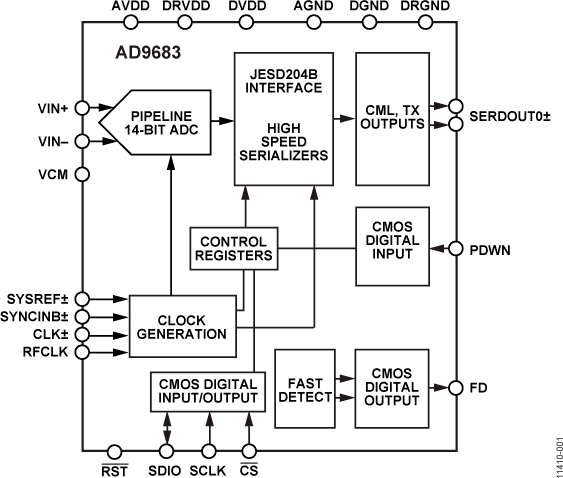
The AD9683 is a 14-bit ADC with sampling speeds of up to 250 MSPS. The AD9683 supports communications applications where low cost, small size, wide bandwidth, and versatility are desired. The ADC core features a multistage, differential pipelined architecture with integrated output error correction logic. The ADC core features wide bandwidth inputs supporting a variety of user-selectable input ranges. An integrated voltage reference eases design considerations. A duty cycle stabilizer (DCS) is provided to compensate for variations in the ADC clock duty cycle, allowing the converter to maintain excellent performance. The JESD204B high speed serial interface reduces board routing requirements and lowers pin count requirements for the receiving device. The ADC output data is routed directly to the JESD204B serial output lane. These outputs are at CML voltage levels. Data can be sent through the lane at the maximum sampling rate of 250 MSPS, which results in a lane rate of 5 Gbps. Synchronization inputs (SYNCINB± and SYSREF±) are provided. Flexible power-down options allow significant power savings, when desired. Programmable overrange level detection is supported via the dedicated fast detect pins. Programming for setup and control is accomplished using a 3-wire SPI-compatible serial interface. The AD9683 is available in a 32-lead LFCSP and is specified over the industrial temperature range of −40°C to +85°C.
Product Highlights
- Integrated 14-bit, 170 MSPS/250 MSPS ADC.
- The configurable JESD204B output block supports lane rates up to 5 Gbps.
- An on-chip, phase-locked loop (PLL) allows users to provide a single ADC sampling clock; the PLL multiplies the ADC sampling clock to produce the corresponding JESD204B data rate clock.
- Support for an optional radio frequency (RF) clock input to ease system board design.
- Proprietary differential input maintains excellent SNR performance for input frequencies of up to 400 MHz.
- Operation from a single 1.8 V power supply.
- Standard serial port interface (SPI) that supports various product features and functions, such as controlling the clock DCS, power-down, test modes, voltage reference mode, overrange fast detection, and serial output configuration.
Applications
- Communications
- Diversity radio systems
- Multimode digital receivers (3G)
TD-SCDMA, WiMAX, W-CDMA, CDMA2000, GSM, EDGE, LTE - DOCSIS 3.0 CMTS upstream receive paths
- HFC digital reverse path receivers
- Smart antenna systems
- Electronic test and measurement equipment
- Radar receivers
- COMSEC radio architectures
- IED detection/jamming systems
- General-purpose software radios
- Broadband data applications
- Ultrasound equipment
AD9689
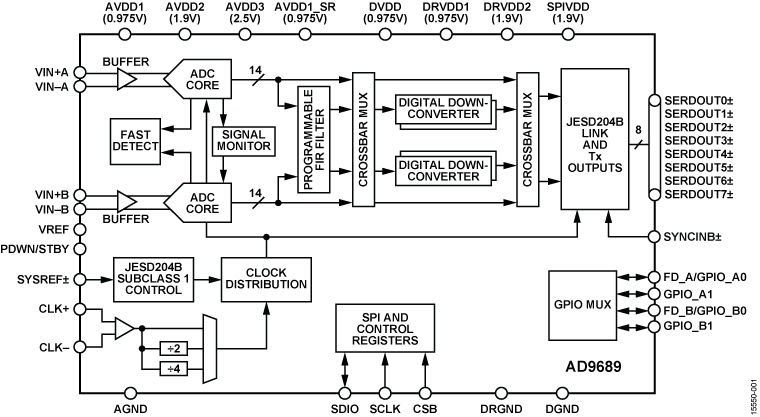
The AD9689 is a dual, 14-bit, 2.0 GSPS/2.6 GSPS analog-to-digital converter (ADC). The device has an on-chip buffer and a sample-and-hold circuit designed for low power, small size, and ease of use. This product is designed to support communications applications capable of direct sampling wide bandwidth analog signals of up to 5 GHz. The −3 dB bandwidth of the ADC input is 9 GHz. The AD9689 is optimized for wide input bandwidth, high sampling rate, excellent linearity, and low power in a small package.
The dual ADC cores feature a multistage, differential pipelined architecture with integrated output error correction logic. Each ADC features wide bandwidth inputs supporting a variety of user-selectable input ranges. An integrated voltage reference eases design considerations. The analog input and clock signals are differential inputs. The ADC data outputs are internally connected to four digital downconverters (DDCs) through a crossbar mux. Each DDC consists of multiple cascaded signal processing stages: a 48-bit frequency translator (numerically controlled oscillator (NCO)), and decimation rates. The NCO has the option to select preset bands over the general-purpose input/output (GPIO) pins, which enables the selection of up to three bands. Operation of the AD9689 between the DDC modes is selectable via SPI-programmable profiles.
In addition to the DDC blocks, the AD9689 has several functions that simplify the automatic gain control (AGC) function in a communications receiver. The programmable threshold detector allows monitoring of the incoming signal power using the fast detect control bits in Register 0x0245 of the ADC. If the input signal level exceeds the programmable threshold, the fast detect indicator goes high. Because this threshold indicator has low latency, the user can quickly turn down the system gain to avoid an overrange condition at the ADC input. In addition to the fast detect outputs, the AD9689 also offers signal monitoring capability. The signal monitoring block provides additional information about the signal being digitized by the ADC.
The user can configure the Subclasss 1 JESD204B-based high speed serialized output in a variety of one-lane, two-lane, four-lane, and eight-lane configurations, depending on the DDC configuration and the acceptable lane rate of the receiving logic device. Multidevice synchronization is supported through the SYSREF± and SYNCINB± input pins.
The AD9689 has flexible power-down options that allow significant power savings when desired. All of these features can be programmed using a 3-wire serial port interface (SPI).
The AD9689 is available in a Pb-free, 196-ball BGA, specified over the −40°C to +85°C ambient temperature range. This product is protected by a U.S. patent.
Note that throughout this data sheet, multifunction pins, such as FD_A/GPIO_A0, are referred to either by the entire pin name or by a single function of the pin, for example, FD_A, when only that function is relevant.
Product Highlights
- Wide, input −3 dB bandwidth of 9 GHz supports direct radio frequency (RF) sampling of signals up to about 5 GHz.
- Four integrated, wideband decimation filters and NCO blocks supporting multiband receivers.
- Fast NCO switching enabled through the GPIO pins.
- SPI controls various product features and functions to meet specific system requirements.
- Programmable fast overrange detection and signal monitoring.
- On-chip temperature diode for system thermal management.
- 12 mm × 12 mm, 196-ball BGA.
- Pin, package, feature, and memory map compatible with the AD9208 14-bit, 3.0 GSPS, JESD204B dual ADC.
Applications
- Diversity multiband and multimode digital receivers
- 3G/4G, TD-SCDMA, W-CDMA, and GSM, LTE, LTE-A
- Electronic test and measurement systems
- Phased array radar and electronic warfare
- DOCSIS 3.0 CMTS upstream receive paths
- HFC digital reverse path receivers
Applications
Wireless Communication Solutions
- Wireless Infrastructure Solutions
Aerospace and Defense Systems
- Phased Array Radar
- Missiles and Precision Munitions
- Military Communication Solutions
- Unmanned Aerial Vehicles (UAV)
- Electronic Surveillance and Countermeasures
Instrumentation and Measurement Solutions
- Radio Frequency (RF) Signal and Vector Network Analyzer Solutions
- Radio Frequency (RF) and Power Measurement Solutions
- Oscilloscopes and Digitizer Solutions
- Data Acquisition Solutions
- Electronic Test and Measurement Solutions
AD9690
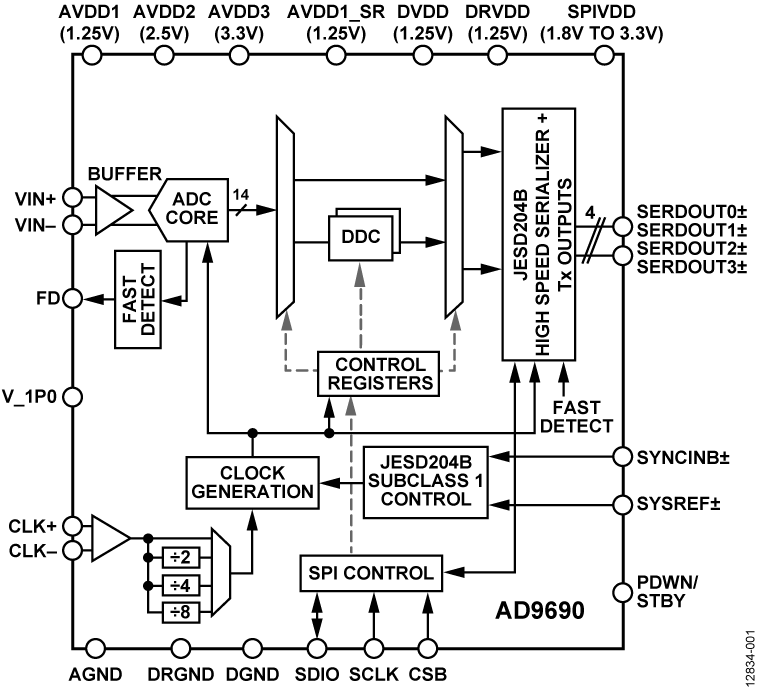
The AD9690 is a 14-bit, 1 GSPS/500 MSPS analog-to-digital converter (ADC). The device has an on-chip buffer and sample-and-hold circuit designed for low power, small size, and ease of use. This device is designed for sampling wide bandwidth analog signals of up to 2 GHz. The AD9690 is optimized for wide input bandwidth, high sampling rate, excellent linearity, and low power in a small package.
The ADC core features a multistage, differential pipelined architecture with integrated output error correction logic. The ADC features wide bandwidth inputs supporting a variety of user-selectable input ranges. An integrated voltage reference eases design considerations.
The analog input and clock signals are differential inputs. The ADC data output is internally connected to two digital down-converters (DDCs). Each DDC consists of four cascaded signal processing stages: a 12-bit frequency translator (NCO), and four half-band decimation filters.
In addition to the DDC blocks, the AD9690 has several functions that simplify the automatic gain control (AGC) function in the communications receiver.
The programmable threshold detector allows monitoring of the incoming signal power using the fast detect output bits of the ADC. If the input signal level exceeds the programmable threshold, the fast detect indicator goes high. Because this threshold indicator has low latency, the user can quickly turn down the system gain to avoid an overrange condition at the ADC input.
Users can configure the Subclass 1 JESD204B-based high speed serialized output in a variety of one-, two-, or four-lane con-figurations, depending on the DDC configuration and the acceptable lane rate of the receiving logic device. Multiple device synchronization is supported through the SYSREF± and SYNCINB± input pins.
The AD9690 has flexible power-down options that allow significant power savings when desired. All of these features can be programmed using a 1.8 V to 3.3 V capable 3-wire SPI.
p>The AD9690 is available in a Pb-free, 64-lead LFCSP and is specified over the −40°C to +85°C industrial temperature range. This product may be protected by one or more U.S. or international patents.
Product Highlights
- Wide full power bandwidth supports IF sampling of signals up to 2 GHz.
- Buffered inputs with programmable input termination eases filter design and implementation.
- Two integrated wideband decimation filters and numerically controlled oscillator (NCO) blocks supporting multiband receivers.
- Flexible serial port interface (SPI) controls various product features and functions to meet specific system requirements.
- Programmable fast overrange detection.
- 9 mm × 9 mm 64-lead LFCSP.
Applications
- Communications
- Multiband, multimode digital receivers 3G/4G, TD-SCDMA, W-CDMA, GSM, LTE
- General-purpose software radios
- Ultrawideband satellite receivers
- Instrumentation
- Radars
- Signals intelligence (SIGINT)
- DOCSIS 3.0 CMTS upstream receive paths
- HFC digital reverse path receivers
Applications
Aerospace and Defense Systems
- Missiles and Precision Munitions
AD9691
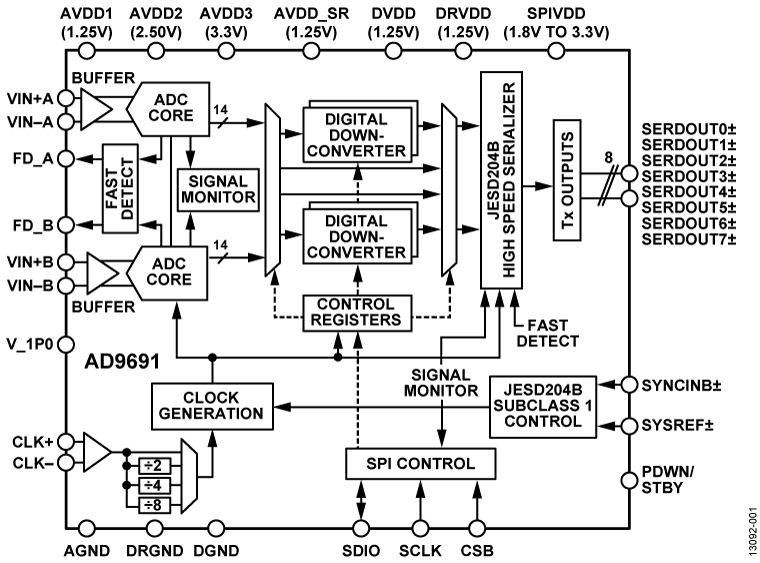
The AD9691 is a dual, 14-bit, 1.25 GSPS analog-to-digital converter (ADC). The device has an on-chip buffer and sample-and-hold circuit designed for low power, small size, and ease of use. The device is designed for sampling wide bandwidth analog signals of up to 1.5 GHz.
The dual ADC cores feature a multistage, differential pipelined architecture with integrated output error correction logic. Each ADC features wide bandwidth inputs supporting a variety of user-selectable input ranges. An integrated voltage reference eases design considerations.
Each ADC data output is internally connected to two digital downconverters (DDCs). Each DDC consists of four cascaded signal processing stages: a 12-bit frequency translator (NCO) and four half-band decimation filters.
In addition to the DDC blocks, the AD9691 has a programmable threshold detector that allows monitoring of the incoming signal power using the fast detect output bits of the ADC. Because this threshold indicator has low latency, the user can quickly turn down the system gain to avoid an overrange condition at the ADC input.
Users can configure the Subclass 1 JESD204B-based high speed serialized output in a variety of one-, two-, four- or eight-lane configurations, depending on the DDC configuration and the acceptable lane rate of the receiving logic device. Multiple device synchronization is supported through the SYSREF± input pins.
The AD9691 is available in a Pb-free, 88-lead LFCSP and is specified over the −40°C to +85°C industrial temperature range. This product is protected by a U.S. patent.
Product Highlights
- Low power consumption analog core, 14-bit, 1.25 GSPS dual analog-to-digital converter (ADC) with 1.9 W per channel.
- Wide full power bandwidth supports IF sampling of signals up to 1.5 GHz.
- Buffered inputs with programmable input termination eases filter design and implementation.
- Flexible serial port interface (SPI) controls various product features and functions to meet specific system requirements.
- Programmable fast overrange detection.
- 12 mm × 12 mm 88-lead LFCSP.
Applications
- Communications (wideband receivers and digital predistortion)
- Instrumentation (spectrum analyzers, network analyzers, integrated RF test solutions)
- DOCSIS 3.x CMTS upstream receive paths
- High speed data acquisition systems
Applications
Instrumentation and Measurement Solutions
- Radio Frequency (RF) Signal and Vector Network Analyzer Solutions
Aerospace and Defense Systems
- Missiles and Precision Munitions
AD9694

The AD9694 is a quad, 14-bit, 500 MSPS analog-to-digital converter (ADC). The device has an on-chip buffer and a sample-and-hold circuit designed for low power, small size, and ease of use. This device is designed for sampling wide bandwidth analog signals of up to 1.4 GHz. The AD9694 is optimized for wide input bandwidth, high sampling rate, excellent linearity, and low power in a small package.
The quad ADC cores feature a multistage, differential pipelined architecture with integrated output error correction logic. Each ADC features wide bandwidth inputs supporting a variety of user-selectable input ranges. An integrated voltage reference eases design considerations.
The analog inputs and clock signals are differential inputs. Each pair of ADC data outputs is internally connected to two DDCs through a crossbar mux. Each DDC consists of up to five cascaded signal processing stages: a 48-bit frequency translator, NCO, and up to four half-band decimation filters.
In addition to the DDC blocks, the AD9694 has several functions that simplify the automatic gain control (AGC) function in the communications receiver. The programmable threshold detector allows monitoring of the incoming signal power using the fast detect output bits of the ADC. If the input signal level exceeds the programmable threshold, the fast detect indicator goes high. Because this threshold indicator has low latency, the user can quickly turn down the system gain to avoid an overrange condition at the ADC input.
Users can configure each pair of intermediate frequency (IF) receiver outputs onto either one or two lanes of Subclass 1 JESD204B-based high speed serialized outputs, depending on the decimation ratio and the acceptable lane rate of the receiving logic device. Multiple device synchronization is supported through the SYSREF±, SYNCINB±AB, and SYNCINB±CD input pins.
The AD9694 has flexible power-down options that allow significant power savings when desired. All of these features can be pro-grammed using the 1.8 V capable, 3-wire SPI.
The AD9694 is available in a Pb-free, 72-lead LFCSP and is specified over the −40°C to +105°C junction temperature range.
PRODUCT HIGHLIGHTS
- Low power consumption per channel.
- JESD204B lane rate support up to 15 Gbps.
- Wide full power bandwidth supports IF sampling of signals up to 1.4 GHz.
- Buffered inputs ease filter design and implementation.
- Four integrated wideband decimation filters and numerically controlled oscillator (NCO) blocks supporting multiband receivers.
- Flexible serial port interface (SPI) controls various product features and functions to meet specific system requirements.
- Programmable fast overrange detection.
- On-chip temperature diode for system thermal management.
APPLICATIONS
- Communications
- Diversity multiband, multimode digital receivers 3G/4G, W-CDMA, GSM, LTE, LTE-A
- General-purpose software radios
- Ultrawideband satellite receivers
- Instrumentation
- Radars
- Signals intelligence (SIGINT)
Applications
Wireless Communication Solutions
- Wireless Infrastructure Solutions
Aerospace and Defense Systems
- Missiles and Precision Munitions
- Phased Array Radar
- Military Communication Solutions
- Electronic Surveillance and Countermeasures
- Avionic Systems
Instrumentation and Measurement Solutions
- Electronic Test and Measurement Solutions
Automotive Solutions
- Advanced Driver Assistance Systems (ADAS) and Safety Solutions
Radio Frequency (RF) Solutions
- Radio Frequency (RF) Solutions
AD9695
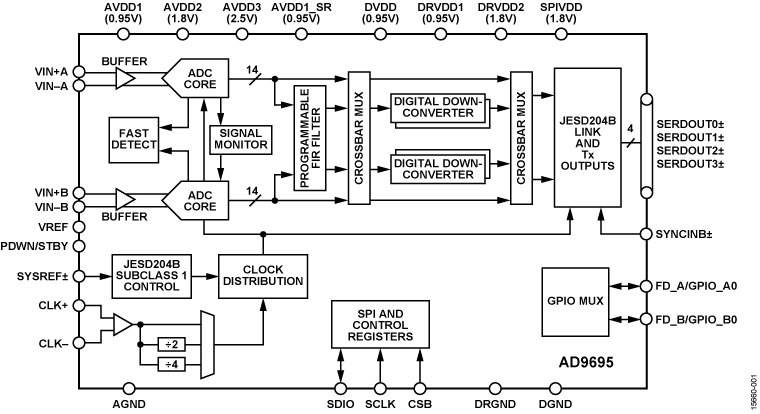
The AD9695 is a dual, 14-bit, 1300 MSPS/625 MSPS analog-to-digital converter (ADC). The device has an on-chip buffer and a sample-and-hold circuit designed for low power, small size, and ease of use. This product is designed to support communications applications capable of direct sampling wide bandwidth analog signals of up to 2 GHz. The −3 dB bandwidth of the ADC input is 2 GHz. The AD9695 is optimized for wide input bandwidth, high sampling rate, excellent linearity, and low power in a small package.
The dual ADC cores feature a multistage, differential pipelined architecture with integrated output error correction logic. Each ADC features wide bandwidth inputs supporting a variety of user-selectable input ranges. An integrated voltage reference eases design considerations. The analog input and clock signals are differential inputs. The ADC data outputs are internally connected to four digital downconverters (DDCs) through a crossbar mux. Each DDC consists of multiple signal processing stages: a 48-bit frequency translator (numerically controlled oscillator (NCO)), and decimation filters. The NCO has the option to select up to 16 preset bands over the general-purpose input/output (GPIO) pins, or use a coherent fast frequency hopping mechanism for band selection. Operation of the AD9695 between the DDC modes is selectable via SPI-programmable profiles.
In addition to the DDC blocks, the AD9695 has several functions that simplify the automatic gain control (AGC) function in a communications receiver. The programmable threshold detector allows monitoring of the incoming signal power using the fast detect control bits in Register 0x0245 of the ADC. If the input signal level exceeds the programmable threshold, the fast detect indicator goes high. Because this threshold indicator has low latency, the user can quickly turn down the system gain to avoid an overrange condition at the ADC input. In addition to the fast detect outputs, the AD9695 also offers signal monitoring capability. The signal monitoring block provides additional information about the signal being digitized by the ADC.
The user can configure the Subclasss 1 JESD204B-based high speed serialized output using either one lane, two lanes, or four lanes, depending on the DDC configuration and the acceptable lane rate of the receiving logic device. Multidevice synchronization is supported through the SYSREF± and SYNCINB± input pins.
The AD9695 has flexible power-down options that allow significant power savings when desired. All of these features can be programmed using a 3-wire serial port interface (SPI) and or PDWN/STBY pin.
The AD9695 is available in a Pb-free, 64-lead LFCSP and is specified over the −40°C to +105°C junction temperature range. This product may be protected by one or more U.S. or international patents.
Note that, throughout this data sheet, multifunction pins, such as FD_A/GPIO_A0, are referred to either by the entire pin name or by a single function of the pin, for example, FD_A, when only that function is relevant.
Product Highlights
- Low power consumption per channel.
- JESD204B lane rate support up to 16 Gbps.
- Wide, full power bandwidth supports intermediate frequency (IF) sampling of signals up to 2 GHz.
- Buffered inputs ease filter design and implementation.
- Four integrated wideband decimation filters and NCO blocks supporting multiband receivers.
- Programmable fast overrange detection.
- On-chip temperature diode for system thermal management.
Applications
- Communications
- Diversity multiband, multimode digital receivers
- 3G/4G, TD-SCDMA, WCDMA, GSM, LTE
- General-purpose software radios
- Ultrawideband satellite receiver
- Instrumentation
- Oscilloscopes
- Spectrum analyzers
- Network analyzers
- Integrated RF test solutions
- Radars
- Electronic support measures, electronic counter measures, and electronic counter-counter measures
- High speed data acquisition systems
- DOCSIS 3.0 CMTS upstream receive paths
- Hybrid fiber coaxial digital reverse path receivers
- Wideband digital predistortion
Applications
Aerospace and Defense Systems
- Phased Array Radar
AD9697
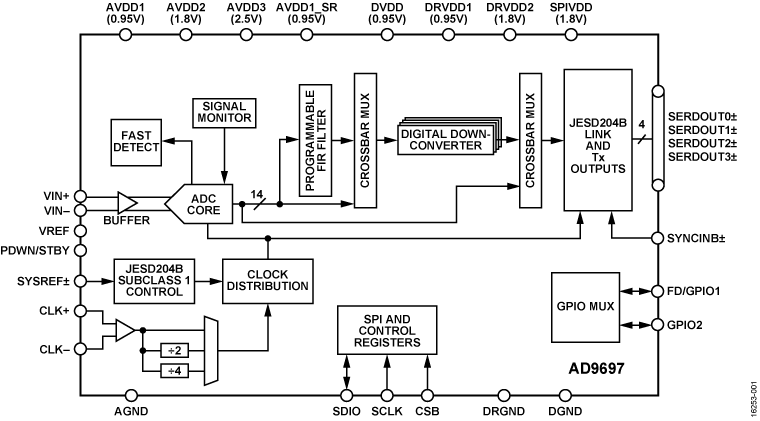
The AD9697 is a single, 14-bit, 1300 MSPS analog-to-digital converter (ADC). The device has an on-chip buffer and a sample-and-hold circuit designed for low power, small size, and ease of use. This product is designed to support communications applications capable of direct sampling wide bandwidth analog signals of up to 2 GHz. The −3 dB bandwidth of the ADC input is 2 GHz. The AD9697 is optimized for wide input bandwidth, high sampling rate, excellent linearity, and low power in a small package.
The ADC core features a multistage, differential pipelined architecture with integrated output error correction logic. The ADC features wide bandwidth inputs supporting a variety of user-selectable input ranges. An integrated voltage reference eases design considerations. The analog input and clock signals are differential inputs. The ADC data outputs are internally connected to four digital downconverters (DDCs) through a crossbar mux. Each DDC consists of multiple signal processing stages: a 48-bit frequency translator (numerically controlled oscillator (NCO)), and decimation filters. The NCO has the option to select up to 16 preset bands over the general-purpose input/ output (GPIO) pins, or to use a coherent fast frequency hopping mechanism for band selection. Operation of the AD9697 between the DDC modes is selectable via serial port interface (SPI)programmable profiles.
In addition to the DDC blocks, the AD9697 has several functions that simplify the automatic gain control (AGC) function in a communications receiver. The programmable threshold detector allows monitoring of the incoming signal power using the fast detect control bits in Register 0x0245 of the ADC. If the input signal level exceeds the programmable threshold, the fast detect indicator goes high. Because this threshold indicator has low latency, the user can quickly turn down the system gain to avoid an overrange condition at the ADC input. In addition to the fast detect outputs, the AD9697 also offers signal monitoring capability. The signal monitoring block provides additional information about the signal being digitized by the ADC.
The user can configure the Subclasss 1 JESD204B-based high speed serialized output using either one lane, two lanes, or four lanes, depending on the DDC configuration and the acceptable lane rate of the receiving logic device. Multidevice synchronization is supported through the SYSREF± and SYNCINB± input pins.
The AD9697 has flexible power-down options that allow significant power savings when desired. All of these features can be programmed using a 3-wire SPI and or PDWN/STBY pin.
The AD9697 is available in a Pb-free, 64-lead LFCSP and is specified over the −40°C to +105°C junction temperature (TJ) range. This product may be protected by one or more U.S. or international patents.
Note that, throughout this data sheet, a multifunction pin, FD/GPIO1, is referred to either by the entire pin name or by a single function of the pin, for example, FD, when only that function is relevant.
Product Highlights
- Low power consumption
- JESD204B lane rate support up to 16 Gbps
- Wide, full power bandwidth supports intermediate frequency (IF) sampling of signals up to 2 GHz
- Buffered inputs ease filter design and implementation
- Four integrated wideband decimation filters and NCO blocks supporting multiband receivers
- Programmable fast overrange detection
- On-chip temperature diode for system thermal management
Applications
- Communications
- Diversity multiband, multimode digital receivers 3G/4G, TD-SCDMA, W-CDMA, GSM, LTE
- General-purpose software radios
- Ultrawideband satellite receiver
- Instrumentation
- Oscilloscopes
- Spectrum analyzers
- Network analyzers
- Integrated RF test solutions
- Radars
- Electronic support measures, electronic counter measures, and electronic counter to counter measures
- High speed data acquisition systems
- DOCSIS 3.0 CMTS upstream receive paths
- Hybrid fiber coaxial digital reverse path receivers
- Wideband digital predistortion
Applications
Wireless Communication Solutions
- Wireless Infrastructure Solutions
Instrumentation and Measurement Solutions
- Data Acquisition Solutions
- Oscilloscopes and Digitizer Solutions
- Radio Frequency (RF) and Power Measurement Solutions
- Radio Frequency (RF) Signal and Vector Network Analyzer Solutions
Aerospace and Defense Systems
- Electronic Surveillance and Countermeasures
- Unmanned Aerial Vehicles (UAV)
- Military Communication Solutions
- Missiles and Precision Munitions
High Speed DAC Products (13)
AD9135
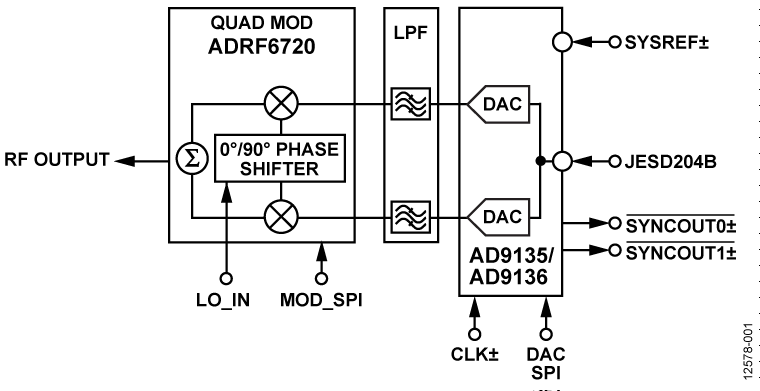
The AD9135 / AD9136 are dual, 11-/16-bit, high dynamic range digital-to-analog converters (DACs) that provide a maximum sample rate of 2800 MSPS, permitting a multicarrier generation over a very wide bandwidth. The DAC outputs are optimized to interface seamlessly with the ADRF6720, as well as other analog quadrature modulators (AQMs) from Analog Devices, Inc. An optional 3-wire or 4-wire serial port interface (SPI) provides for programming/readback of many internal parameters. The full-scale output current can be programmed over a typical range of 13.9 mA to 27.0 mA. The AD9135/AD9136 are available in an 88-lead LFCSP.
PRODUCT HIGHLIGHTS
- Greater than 2 GHz, ultrawide complex signal bandwidth enables emerging wideband and multiband wireless applications.
- Advanced low spurious and distortion design techniques provide high quality synthesis of wideband signals from baseband to high intermediate frequencies.
- JESD204B Subclass 1 support simplifies multichip synchronization in software and hardware design.
- Fewer pins for data interface width with a serializer/deserializer (SERDES) JESD204B eight-lane interface.
- Programmable transmit enable function allows easy design balance between power consumption and wake-up time.
- Small package size with 12 mm × 12 mm footprint.
APPLICATIONS
- Wireless communications
- 3G/4G W-CDMA base stations
- Wideband repeaters
- Software defined radios
- Wideband communications
- Point to point
- Local multipoint distribution service (LMDS) and multichannel multipoint distribution service (MMDS)
- Transmit diversity, multiple input/multiple output (MIMO)
- Instrumentation
- Automated test equipment
AD9136
The AD9135 / AD9136 are dual, 11-/16-bit, high dynamic range digital-to-analog converters (DACs) that provide a maximum sample rate of 2800 MSPS, permitting a multicarrier generation over a very wide bandwidth. The DAC outputs are optimized to interface seamlessly with the ADRF6720, as well as other analog quadrature modulators (AQMs) from Analog Devices, Inc. An optional 3-wire or 4-wire serial port interface (SPI) provides for programming/readback of many internal parameters. The full-scale output current can be programmed over a typical range of 13.9 mA to 27.0 mA. The AD9135/AD9136 are available in an 88-lead LFCSP.
PRODUCT HIGHLIGHTS
- Greater than 2 GHz, ultrawide complex signal bandwidth enables emerging wideband and multiband wireless applications.
- Advanced low spurious and distortion design techniques provide high quality synthesis of wideband signals from baseband to high intermediate frequencies.
- JESD204B Subclass 1 support simplifies multichip synchronization in software and hardware design.
- Fewer pins for data interface width with a serializer/deserializer (SERDES) JESD204B eight-lane interface.
- Programmable transmit enable function allows easy design balance between power consumption and wake-up time.
- Small package size with 12 mm × 12 mm footprint.
APPLICATIONS
- Wireless communications
- 3G/4G W-CDMA base stations
- Wideband repeaters
- Software defined radios
- Wideband communications
- Point to point
- Local multipoint distribution service (LMDS) and multichannel multipoint distribution service (MMDS)
- Transmit diversity, multiple input/multiple output (MIMO)
- Instrumentation
- Automated test equipment
Applications
Wireless Communication Solutions
- Wireless Infrastructure Solutions
AD9144
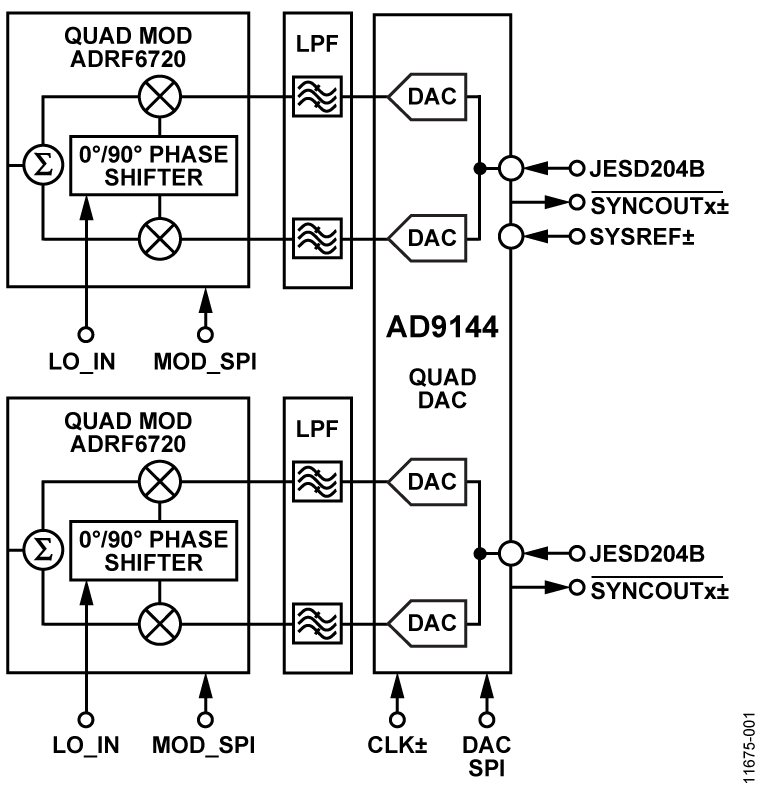
The AD9144 is a quad, 16-bit, high dynamic range digital-to-analog converter (DAC) that provides a maximum sample rate of 2.8 GSPS, permitting a multicarrier generation up to the Nyquist frequency. The DAC outputs are optimized to interface seamlessly with the ADRF6720 analog quadrature modulator (AQM) from Analog Devices, Inc. An optional 3-wire or 4-wire serial port interface (SPI) provides for programming/readback of many internal parameters. Full-scale output current can be programmed over a typical range of 13.9 mA to 27.0 mA. The AD9144 is available in an 88-lead LFCSP.
Product Highlights
- Greater than 1 GHz, ultrawide complex signal bandwidth enables emerging wideband and multiband wireless applications.
- Advanced low spurious and distortion design techniques provide high quality synthesis of wideband signals from baseband to high intermediate frequencies.
- JESD204B Subclass 1 support simplifies multichip synchronization in software and hardware design.
- Fewer pins for data interface width with a serializer/deserializer (SERDES) JESD204B eight-lane interface.
- Programmable transmit enable function allows easy design balance between power consumption and wake-up time.
- Small package size with 12 mm × 12 mm footprint.
Applications
- Wireless communications
- 3G/4G W-CDMA base stations
- Wideband repeaters
- Software defined radios
- Wideband communications
- Point-to-point
- Local multipoint distribution service (LMDS) and multichannel multipoint distribution service (MMDS)
- Transmit diversity, multiple input/multiple output (MIMO)
- Instrumentation
- Automated test equipment
Applications
Instrumentation and Measurement Solutions
- Signal Generator (Audio through RF) Solutions
AD9152
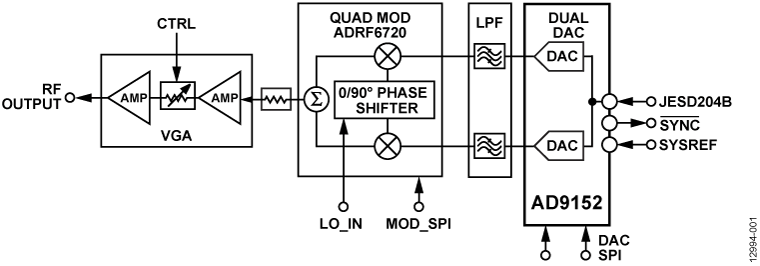
The AD9152 is a dual, 16-bit, high dynamic range digital-to-analog converter (DAC) that provides a maximum sample rate of 2.25 GSPS, permitting a multicarrier generation up to the Nyquist frequency. The DAC outputs are optimized to interface seamlessly with the ADRF6720 analog quadrature modulator (AQM) from Analog Devices, Inc. An optional 3-wire or 4-wire serial port interface (SPI) provides for programming/readback of many internal parameters. The full-scale output current can be programmed over a range of 4 mA to 20 mA. The AD9152 is available in a 56-lead LFCSP. The AD9152 is a member of the TxDAC+® family.
PRODUCT HIGHLIGHTS
- Ultrawide signal bandwidth enables emerging wideband and multiband wireless applications.
- Advanced low spurious and distortion design techniques provide high quality synthesis of wideband signals from baseband to high intermediate frequencies.
- JESD204B Subclass 1 support simplifies multichip synchronization in software and hardware design.
- Fewer pins for data interface width with the serializer/deserializer (SERDES) JESD204B four-lane interface.
- Programmable transmit enable function allows easy design balance between power consumption and wake-up time.
- Small package size with an 8 mm × 8 mm footprint.
APPLICATIONS
-
Wireless communications
- Multicarrier LTE and GSM base stations
- Wideband repeaters
- Software defined radios
- Wideband communications
- Point to point microwave radios
- LMDS/MMDS
- Transmit diversity, multiple input/multiple output (MIMO)
- Instrumentation
- Automated test equipment
Applications
Wireless Communication Solutions
- Wireless Infrastructure Solutions
AD9154
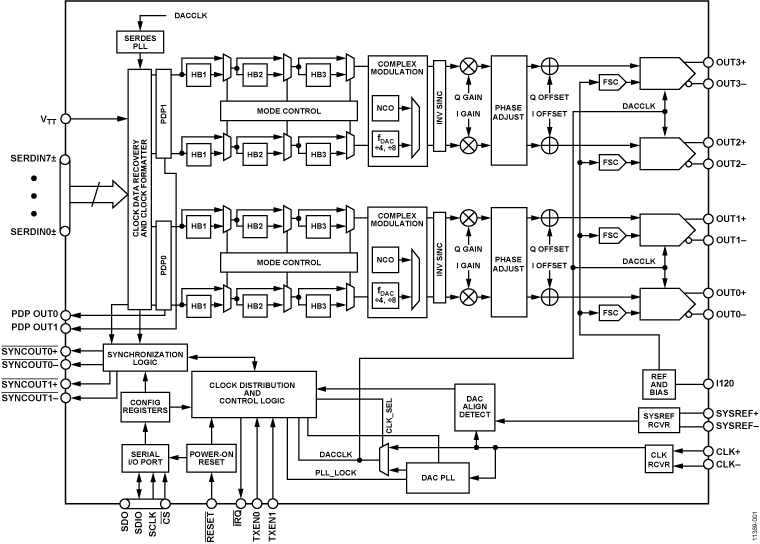
The AD9154 is a quad, 16-bit, high dynamic range digital-to-analog converter (DAC) that provides a maximum sample rate of 2.4 GSPS, permitting multicarrier generation up to the Nyquist frequency in baseband mode. The AD9154 includes features optimized for direct conversion transmit applications including complex digital modulation, input signal power detection, and gain, phase, and offset compensation. The DAC outputs are optimized to interface seamlessly with the ADRF6720-27 radio frequency quadrature modulator (AQM) from Analog Devices, Inc. In mix mode, the AD9154 DAC can reconstruct carriers in the second and third Nyquist Zones. A serial port interface (SPI) provides the programming/readback of internal parameters. The full-scale output current can be programmed over a range of 4 mA to 20 mA. The AD9154 is available in two different 88-lead LFCSP packages.
Product Highlights
- Ultrawide signal bandwidth enables emerging wideband and multiband wireless applications.
- Advanced low spurious and distortion design techniques provide high quality synthesis of wideband signals from baseband to high intermediate frequencies.
- JESD204B Subclass 1 support simplifies multichip synchronization.
- Small package size with a 12 mm × 12 mm footprint.
Applications
- Wireless communications
Multicarrier LTE and GSM base stations
Wideband repeaters
Software defined radios - Wideband communications
Point to point microwave radio - Transmit diversity, multiple input/multiple output (MIMO)
- Instrumentation
- Automated test equipment
Applications
Wireless Communication Solutions
- Wireless Infrastructure Solutions
AD9161
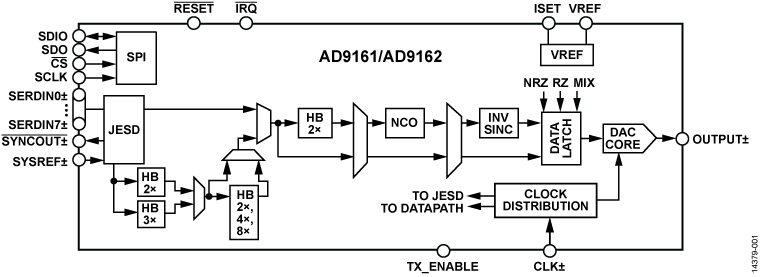
The AD9161 is a high performance, 11-bit digital-to-analog converter (DAC) that supports data rates to 6 GSPS. The DAC core is based on a quad-switch architecture coupled with a 2× interpolator filter that enables an effective DAC update rate of up to 12 GSPS in some modes. The high dynamic range and bandwidth makes these DACs ideally suited for the most demanding high speed radio frequency (RF) DAC applications.
In baseband mode, wide bandwidth capability combines with high dynamic range to support DOCSIS 3.1 cable infrastructure compliance from the minimum of two carriers to full maximum spectrum of 1.794 GHz. A 2× interpolator filter (FIR85) enables the AD9161/AD9162 to be configured for lower data rates and converter clocking to reduce the overall system power and ease the filtering requirements. In Mix-Mode™ operation, the AD9161/AD9162 can reconstruct RF carriers in the second and third Nyquist zones up to 7.5 GHz while still maintaining exceptional dynamic range. The output current can be programmed from 8 mA to 38.76 mA. The AD9161/AD9162 data interface consists of up to eight JESD204B serializer/deserializer (SERDES) lanes that are programmable in terms of lane speed and number of lanes to enable application flexibility.
A serial peripheral interface (SPI) can configure the AD9161/AD9162 and monitor the status of all registers. The AD9161/AD9162 are offered in an 165-ball, 8.0 mm × 8.0 mm, 0.5 mm pitch, CSP_BGA package and in an 169-ball, 11 mm × 11 mm, 0.8 mm pitch, CSP_BGA package, including a leaded ball option for the AD9162.
Product Highlights
- High dynamic range and signal reconstruction bandwidth supports RF signal synthesis of up to 7.5 GHz.
- Up to eight lanes JESD204B SERDES interface flexible in terms of number of lanes and lane speed.
- Bandwidth and dynamic range to meet DOCSIS 3.1 compliance with margin.
Applications
- Broadband communications systems
- DOCSIS 3.1 cable modem termination system (CMTS)/video on demand (VOD)/edge quadrature amplitude modulation (EQAM)
- Wireless communications infrastructure
- W-CDMA, LTE, LTE-A, point to point
- Instrumentation, automatic test equipment (ATE)
- Radars and jammers
AD9162
The AD9162 is a high performance, 16-bit digital-to-analog converter (DAC) that supports data rates to 6 GSPS. The DAC core is based on a quad-switch architecture coupled with a 2× interpolator filter that enables an effective DAC update rate of up to 12 GSPS in some modes. The high dynamic range and bandwidth makes these DACs ideally suited for the most demanding high speed radio frequency (RF) DAC applications.
In baseband mode, wide bandwidth capability combines with high dynamic range to support DOCSIS 3.1 cable infrastructure compliance from the minimum of two carriers to full maximum spectrum of 1.794 GHz. A 2× interpolator filter (FIR85) enables the AD9161/AD9162 to be configured for lower data rates and converter clocking to reduce the overall system power and ease the filtering requirements. In Mix-Mode™ operation, the AD9161/AD9162 can reconstruct RF carriers in the second and third Nyquist zones up to 7.5 GHz while still maintaining exceptional dynamic range. The output current can be programmed from 8 mA to 38.76 mA. The AD9161/AD9162 data interface consists of up to eight JESD204B serializer/deserializer (SERDES) lanes that are programmable in terms of lane speed and number of lanes to enable application flexibility.
A serial peripheral interface (SPI) can configure the AD9161/AD9162 and monitor the status of all registers. The AD9161/AD9162 are offered in an 165-ball, 8.0 mm × 8.0 mm, 0.5 mm pitch, CSP_BGA package and in an 169-ball, 11 mm × 11 mm, 0.8 mm pitch, CSP_BGA package, including a leaded ball option for the AD9162.
Product Highlights
- High dynamic range and signal reconstruction bandwidth supports RF signal synthesis of up to 7.5 GHz.
- Up to eight lanes JESD204B SERDES interface flexible in terms of number of lanes and lane speed.
- Bandwidth and dynamic range to meet DOCSIS 3.1 compliance with margin.
Applications
- Broadband communications systems
- DOCSIS 3.1 cable modem termination system (CMTS)/video on demand (VOD)/edge quadrature amplitude modulation (EQAM)
- Wireless communications infrastructure
- W-CDMA, LTE, LTE-A, point to point
- Instrumentation, automatic test equipment (ATE)
- Radars and jammers
Applications
Aerospace and Defense Systems
- Phased Array Radar
- Electronic Surveillance and Countermeasures
Instrumentation and Measurement Solutions
- Electronic Test and Measurement Solutions
Radio Frequency (RF) Solutions
- Radio Frequency (RF) Solutions
AD9163
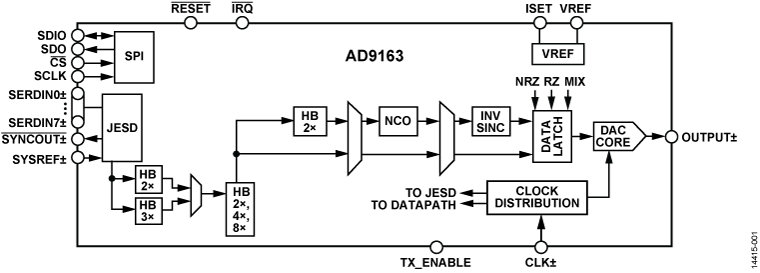
The AD91631 is a high performance, 16-bit digital-to-analog converter (DAC) that supports data rates to 6 GSPS. The DAC core is based on a quad-switch architecture coupled with a 2× interpolator filter that enables an effective DAC update rate of up to 12 GSPS in some modes. The high dynamic range and bandwidth makes this DAC ideally suited for the most demanding high speed radio frequency (RF) DAC applications.
Superior RF performance and deep interpolation rates enable use of the AD9163 in many wireless infrastructure applications, including MC-GSM, W-CDMA, LTE, and LTE-A.
The wide bandwidth of up to 1 GHz and the complex NCO and digital upconverter enable dual band and triple band direct RF synthesis of wireless infrastructure signals, eliminating costly analog upconverters.
Wide analog bandwidth capability combines with high dynamic range to support DOCSIS 3.1 cable infrastructure compliance from the minimum of one carrier up to 1 GHz of signal bandwidth, making it ideal for cable multiple dwelling unit (MDU) applications. A 2× interpolator filter (FIR85) enables the AD9163 to be configured for lower data rates and converter clocking to reduce the overall system power and ease the filtering requirements. In Mix-Mode™ operation, the AD9163 can reconstruct RF carriers in the second and third Nyquist zones up to 7.5 GHz while still maintaining exceptional dynamic range. The output current can be programmed from 8 mA to 38.76 mA. The AD9163 data interface consists of up to eight JESD204B serializer/deserializer (SERDES) lanes that are programmable in terms of lane speed and number of lanes to enable application flexibility.
A serial peripheral interface (SPI) configures the AD9163 and monitors the status of all the registers. The AD9163 is offered in a 169-ball, 11 mm × 11 mm, 0.8 mm pitch CSP_BGA package.
Product Highlights
- High dynamic range and signal reconstruction bandwidth supports RF signal synthesis of up to 7.5 GHz.
- Up to eight lanes JESD204B SERDES interface, flexible in terms of number of lanes and lane speed.
- Bandwidth and dynamic range to meet multiband wireless communications standards with margin.
Applications
- Broadband communications systems
- DOCSIS 3.1 cable modem termination system (CMTS)/ video on demand (VOD)/edge quadrature amplitude modulation (EQAM)
- Wireless communications infrastructure
- MC-GSM, W-CDMA, LTE, LTE-A, point to point
AD9164
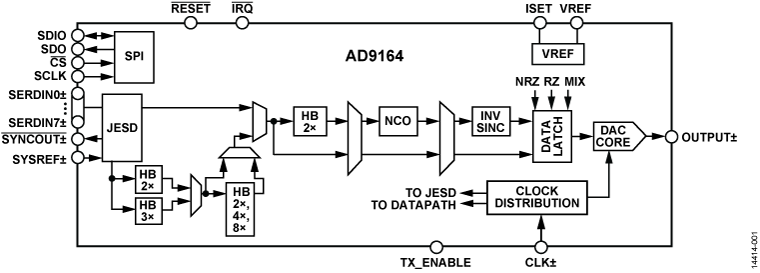
The AD91641 is a high performance, 16-bit digital-to-analog converter (DAC) and direct digital synthesizer (DDS) that supports update rates to 6 GSPS. The DAC core is based on a quad-switch architecture coupled with a 2× interpolator filter that enables an effective DAC update rate of up to 12 GSPS in some modes. The high dynamic range and bandwidth makes these DACs ideally suited for the most demanding high speed radio frequency (RF) DAC applications.
The DDS consists of a bank of 32, 32-bit numerically controlled oscillators (NCOs), each with its own phase accumulator.
When combined with a 100 MHz serial peripheral interface (SPI) and fast hop modes, phase coherent fast frequency hopping (FFH) is enabled, with several modes to support multiple applications.
In baseband mode, wide analog bandwidth capability combines with high dynamic range to support DOCSIS 3.1 cable infrastructure compliance from the minimum of one carrier up to the full maximum spectrum of 1.791 GHz of signal bandwidth. A 2× interpolator filter (FIR85) enables the AD9164 to be configured for lower data rates and converter clocking to reduce the overall system power and ease the filtering requirements. In Mix-Mode™ operation, the AD9164 can reconstruct RF carriers in the second and third Nyquist zones up to 7.5 GHz while still maintaining exceptional dynamic range. The output current can be programmed from 8 mA to 38.76 mA. The AD9164 data interface consists of up to eight JESD204B serializer/deserializer (SERDES) lanes that are programmable in terms of lane speed and number of lanes to enable application flexibility.
An SPI interface configures the AD9164 and monitors the status of all registers. The AD9164 is offered in a 165-ball, 8 mm × 8 mm, 0.5 mm pitch CSP_BGA package, and a 169-ball, 11 mm × 11 mm, 0.8 mm pitch, CSP_BGA package, including a leaded ball option.
Product Highlights
- High dynamic range and signal reconstruction bandwidth supports RF signal synthesis of up to 7.5 GHz.
- Up to eight lanes JESD204B SERDES interface flexible in terms of number of lanes and lane speed.
- Bandwidth and dynamic range to meet DOCSIS 3.1 compliance and multiband wireless communications standards with margin.
Applications
- Broadband communications systems
- DOCSIS 3.1 CMTS/ video on demand (VOD)/edge quadrature amplitude modulation (EQAM)
- Wireless communications infrastructure
- W-CDMA, LTE, LTE-A, point to point
Applications
Aerospace and Defense Systems
- Military Communication Solutions
- Phased Array Radar
- Missiles and Precision Munitions
- Electronic Surveillance and Countermeasures
Instrumentation and Measurement Solutions
- Communications Test Equipment Solutions
- Signal Generator (Audio through RF) Solutions
AD9171
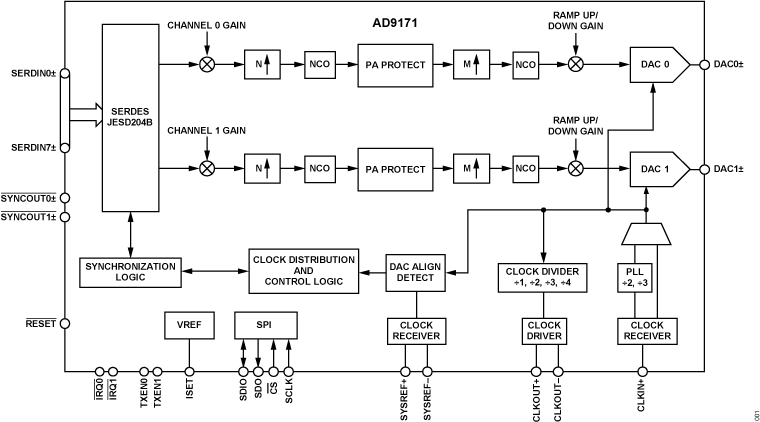
The AD9171 is a high performance, dual, 16-bit digital-to-analog converter (DAC) that supports DAC sample rates to 6.2 GSPS. The device features an 8-lane, 15.4 Gbps JESD204B data input port, a high performance, on-chip DAC clock multiplier, and digital signal processing capabilities targeted at single-band direct to radio frequency (RF) wireless applications.
The AD9171 features one complex data input channels per RF DAC. Each data input channel includes a configurable gain stage, an interpolation filter, and a channel numerically controlled oscillator (NCO) for flexible, frequency planning. The device supports up to a 516 MSPS complex data rate per input channel.
The AD9171 is available in a 144-ball BGA_ED package.
PRODUCT HIGHLIGHTS
- Supports one complex data input channel per RF DAC at a maximum complex input data rate of 513 MSPS with 12-bitresolution and 516 MSPS with 16-bit resolution options. There is one independent NCO per input channel.
- Low power dual converter decreases the amount of power consumption needed in high bandwidth and multichannel applications.
APPLICATIONS
- Wireless communications infrastructure
- Single-band base station radios
- Instrumentation, automatic test equipment (ATE)
Applications
Wireless Communication Solutions
- Wireless Infrastructure Solutions
Aerospace and Defense Systems
- Electronic Surveillance and Countermeasures
- Unmanned Aerial Vehicles (UAV)
- Military Communication Solutions
- Avionic Systems
Instrumentation and Measurement Solutions
- Signal Generator (Audio through RF) Solutions
Radio Frequency (RF) Solutions
- Radio Frequency (RF) Solutions
AD9172
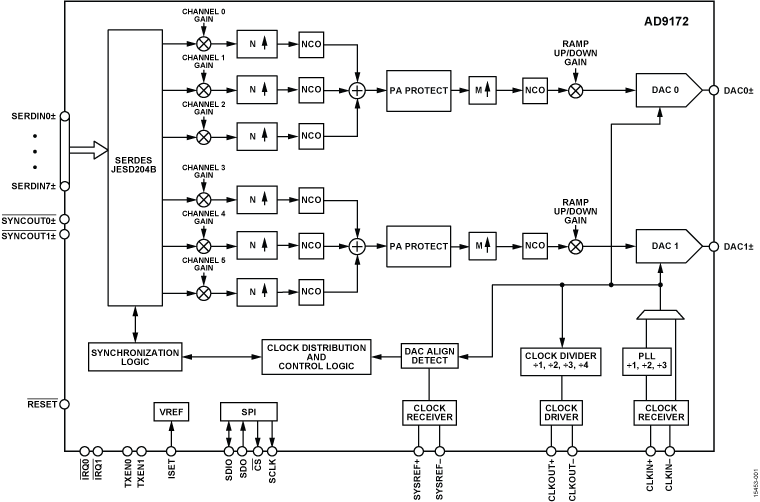
The AD9172 is a high performance, dual, 16-bit digital-to-analog converter (DAC) that supports DAC sample rates to 12.6 GSPS. The device features an 8-lane, 15 Gbps JESD204B data input port, a high performance, on-chip DAC clock multiplier, and digital signal processing capabilities targeted at single-band and multiband direct to radio frequency (RF) wireless applications.
The AD9172 features three complex data input channels per RF DAC that are bypassable. Each data input channel includes a configurable gain stage, an interpolation filter, and a channel numerically controlled oscillator (NCO) for flexible, multiband frequency planning. The device supports up to a 1.5 GSPS complex data rate per input channel and is capable of aggregating multiple complex input data streams up to a maximum complex data rate of 1.5 GSPS. Additionally, the AD9172 supports ultrawide bandwidth modes bypassing the channelizers to provide maximum data rates of up to 3.08 GSPS (with 16-bit resolution) and 4.1 GSPS (with 12-bit resolution).
The AD9172 is available in a 144-ball BGA_ED package.
PRODUCT HIGHLIGHTS
- Supports single-band and multiband wireless applications with three bypassable complex data input channels per RF DAC at a maximum complex input data rate of 1.5 GSPS. One independent NCO per input channel.
- Ultrawide bandwidth channel bypass modes supporting up to 3 GSPS data rates with 16-bit resolution and 4 GSPS with 12-bit resolution.
- Low power dual converter decreases the amount of power consumption needed in high bandwidth and multichannel applications.
APPLICATIONS
- Wireless communications infrastructure
- Multiband base station radios
- Microwave/E-band backhaul systems
- Instrumentation, automatic test equipment (ATE)
- Radars and jammers
Applications
Wireless Communication Solutions
- Wireless Infrastructure Solutions
Instrumentation and Measurement Solutions
- Signal Generator (Audio through RF) Solutions
- Communications Test Equipment Solutions
- Electronic Test and Measurement Solutions
Aerospace and Defense Systems
- Phased Array Radar
- Military Communication Solutions
- Unmanned Aerial Vehicles (UAV)
- Electronic Surveillance and Countermeasures
Radio Frequency (RF) Solutions
- Radio Frequency (RF) Solutions
AD9173
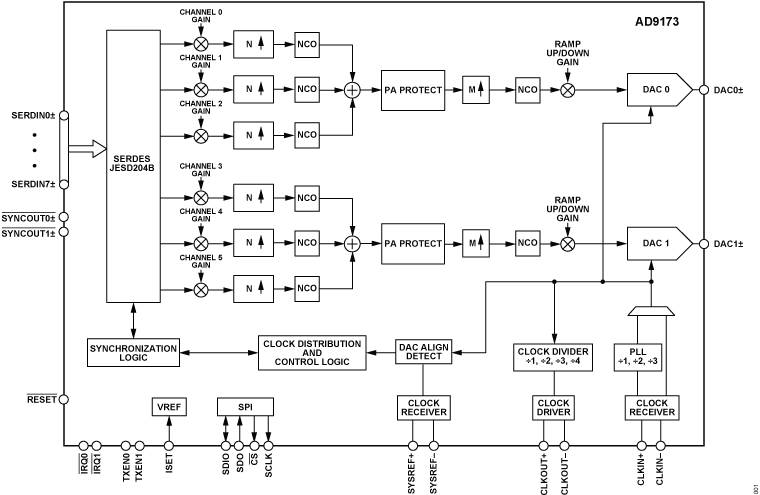
The AD9173 is a high performance, dual, 16-bit digital-to-analog converter (DAC) that supports DAC sample rates to 12.6 GSPS. The device features an 8-lane, 15.4 Gbps JESD204B data input port, a high performance, on-chip DAC clock multiplier, and digital signal processing capabilities targeted at single-band and multiband direct to radio frequency (RF) wireless applications.
The AD9173 features three complex data input channels per RF DAC that are bypassable. Each data input channel includes a configurable gain stage, an interpolation filter, and a channel numerically controlled oscillator (NCO) for flexible, multiband frequency planning. The device supports up to a 1.54 GSPS complex data rate per input channel and is capable of aggregating multiple complex input data streams up to a maximum complex data rate of 1.54 GSPS. Additionally, the AD9173 supports ultrawide bandwidth modes bypassing the channelizers to provide maximum data rates of up to 3.08 GSPS (with 11-bit resolution using 16-bit serializer/deserializer (SERDES) packing) and 3.4 GSPS (with 11-bit resolution using 12-bit SERDES packing).
The AD9173 is available in a 144-ball BGA_ED package.
APPLICATIONS
- Wireless communications infrastructure
- Multiband base station radios
- Microwave/E-band backhaul systems
- Instrumentation, automatic test equipment (ATE)
PRODUCT HIGHLIGHTS
- Supports single-band and multiband wireless applications with three bypassable complex data input channels per RF DAC at a maximum complex input data rate of 1.54 GSPS with 11-bit resolution and 1.23 GSPS with 16-bit resolution. One independent NCO per input channel.
- Ultrawide bandwidth channel bypass modes supporting up to 3.08 GSPS data rates with 11-bit resolution, 16-bit SERDES packing and 3.4 GSPS with 11-bit resolution, 12-bit SERDES packing.
- Low power dual converter decreases the amount of power consumption needed in high bandwidth and multichannel applications.
Applications
Wireless Communication Solutions
- Wireless Infrastructure Solutions
Aerospace and Defense Systems
- Electronic Surveillance and Countermeasures
- Unmanned Aerial Vehicles (UAV)
- Military Communication Solutions
- Avionic Systems
Instrumentation and Measurement Solutions
- Signal Generator (Audio through RF) Solutions
AD9177
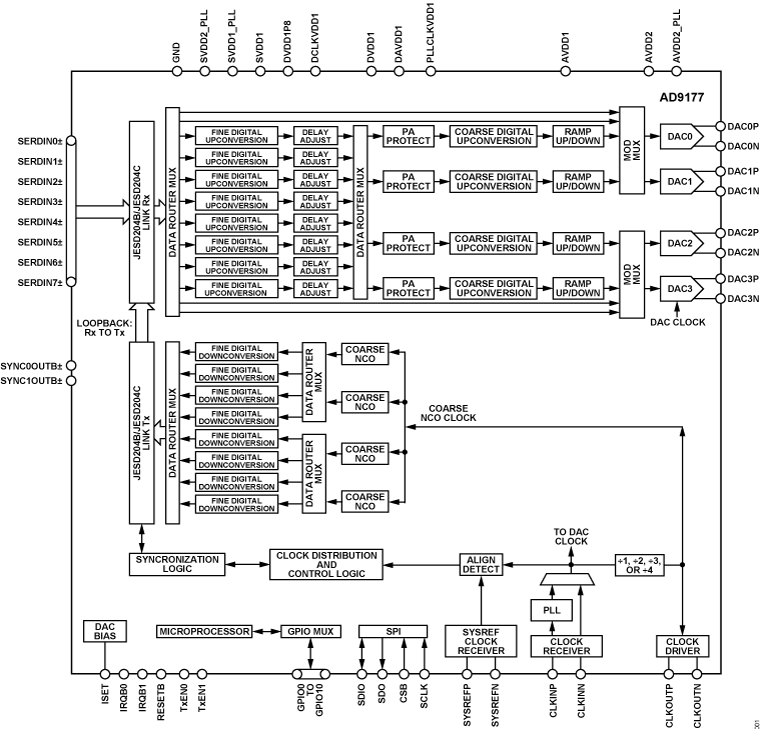
The AD9177 is a highly integrated device with four 16-bit, 12 GSPS maximum sample rate, RF digital-to-analog converter (DAC) cores supporting up to eight baseband channels. The device is well suited for applications requiring wideband DACs to process signals of wide instantaneous bandwidth. The device features an 8-lane, 24.75 Gbps JESD204C or 15.5 Gbps JESD204B data receiver (JRx) port, an on-chip clock multiplier, and digital signal processing (DSP) datapaths capable of processing complex signals for wide-band or multiband direct to RF applications, phase array radar systems, and electronic warfare applications. The DSP datapaths can be bypassed to allow a direct connection between the data receiver port and the DAC cores.
For direct digital synthesis (DDS) applications, the AD9177 can be operated without a data receiver port to generate multiple sine wave tones of varying frequencies. The main numerically controlled oscillator (NCO) block inside each of the four course digital upconverters (DUCs) contains one 48-bit NCO and a bank of thirty one 32-bit NCOs, each with an independent phase accumulator. Similarly, the main NCO block inside each of the course and fine digital downconverters (DDCs) in the receive datapath contains a bank of sixteen 48-bit NCOs that can be looped into the transmit datapath for processing ahead of the course DUCs and DAC outputs. Combined with general-purpose input/output (GPIO) controls for frequency hopping, preconfigurable profile selection, and the ability to synchronize the NCOs to a common trigger using the SYSREF input port, this bank allows phase coherent fast frequency hopping (FFH) for applications where multiple devices are synchronized or where NCO frequencies are continuously adjusted during operation.
APPLICATIONS
- Wireless communications infrastructure
- Microwave point-to-point, E-band, and 5G mm wave
- Broadband communications systems
- DOCSIS 3.1 and 4.0 CMTS
- Phased array radar and electronic warfare
- Electronic test and measurement systems
Applications
Aerospace and Defense Systems
- Military Communication Solutions
RF Transceiver Products
AD9081
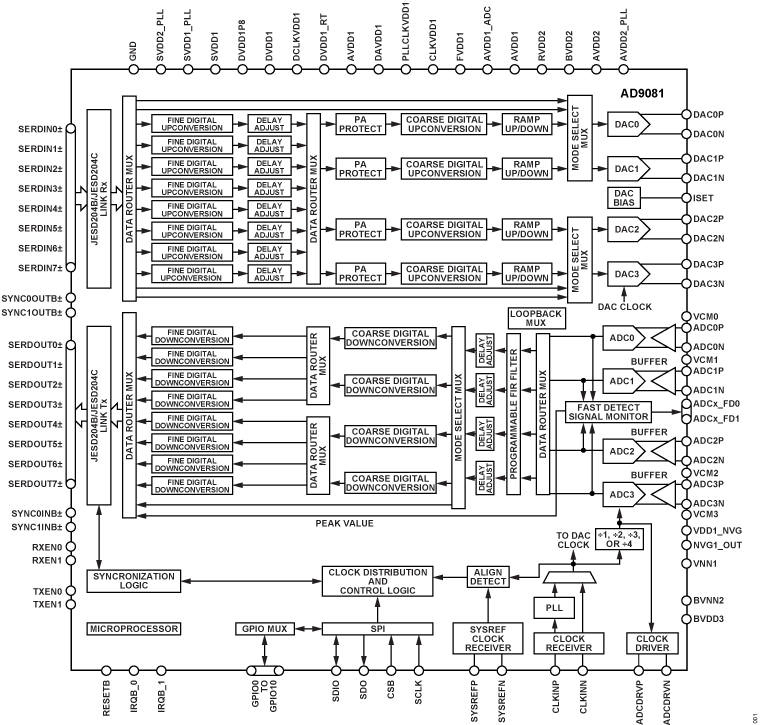
The AD9081 mixed signal front end (MxFE®) is a highly integrated device with four 16-bit, 12 GSPS maximum sample rate, RF digital-to-analog converter (DAC) cores, and four 12-bit, 4 GSPS rate, RF analog-to-digital converter (ADC) cores. The AD9081 is well suited for applications requiring both wideband ADCs and DACs to process signal(s) that have wide instantaneous bandwidth. The device features eight transmit and eight receive lanes that support 24.75 Gbps/lane JESD204C or 15.5 Gbps/lane JESD204B standards. The device also has an on-chip clock multiplier, and a digital signal processing (DSP) capability targeted at either wideband or multiband direct to RF applications. The DSP datapaths can be bypassed to allow a direct connection between the converter cores and the JESD204 data transceiver port. The device also features low latency loopback and frequency hopping modes targeted at phase array radar system and electronic warfare applications. Two models for the AD9081 are offered. The 4D4AC model supports the full instantaneous channel bandwidth, whereas the 4D4AB model supports a maximum instantaneous bandwidth of 600 MHz per channel by automatically configuring the DSP to limit the instantaneous bandwidth at startup.
APPLICATIONS
- Wireless communications infrastructure
- Microwave point-to-point, E-band and 5G mmWave
- Broadband communications systems
- DOCSIS 3.1 and 4.0 CMTS
- Phased array radar and electronic warfare
- Electronic test and measurement systems
Applications
Aerospace and Defense Systems
- Aircraft Communication Systems
- Avionic Systems
- Missiles and Precision Munitions
- Phased Array Radar
- Military Communication Solutions
- Electronic Surveillance and Countermeasures
Wireless Communication Solutions
- mmWave Communication Solutions
- Wireless Infrastructure Solutions
Instrumentation and Measurement Solutions
- Radio Frequency (RF) Signal and Vector Network Analyzer Solutions
- Data Acquisition Solutions
- Electronic Test and Measurement Solutions
Radio Frequency (RF) Solutions
- Radio Frequency (RF) Solutions
AD9082
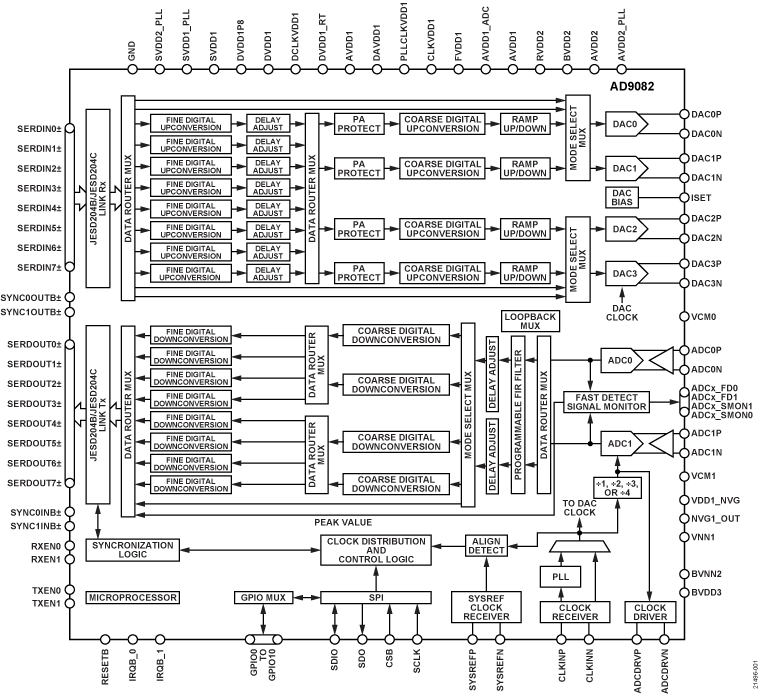
The AD9082 mixed signal front-end (MxFE®) is a highly integrated device with a 16-bit, 12 GSPS maximum sample rate, RF digital-to-analog converter (DAC) core, and 12-bit, 6 GSPS maximum sample rate, RF analog-to-digital converter (ADC) cores. The AD9082 is well suited for applications requiring both wideband ADCs and DACs to process signal(s) having wide instantaneous bandwidth. The device features eight transmit lanes and eight receive lanes that support 24.75 Gbps/lane JESD204C or 15.5 Gbps/lane JESD204B standards. The device also has an on-chip clock multiplier and digital signal processing (DSP) capability targeted at either wideband or multiband, direct to RF applications. The DSP datapaths can be bypassed to allow a direct connection between the converter cores and the JESD204B/C data transceiver port. The device also features low latency loopback, frequency hopping modes, and datapath multiplexer (mux) configurations useful for phase array radar system and electronic warfare applications. Two models for the AD9082 are offered. The 4D2AC model supports four DACs and two ADCs. The 2D2AC model supports two DACs and two ADCs.
APPLICATIONS
- Wireless communications infrastructure
- Microwave point-to-point, E-band and 5G mmWave
- Broadband communications systems
- DOCSIS 3.1 and 4.0 CMTS
- Phased array radar and electronic warfare
- Electronic test and measurement systems
Applications
Aerospace and Defense Systems
- Missiles and Precision Munitions
- Phased Array Radar
- Military Communication Solutions
- Electronic Surveillance and Countermeasures
Instrumentation and Measurement Solutions
- Radio Frequency (RF) Signal and Vector Network Analyzer Solutions
- Data Acquisition Solutions
- Electronic Test and Measurement Solutions
Wireless Communication Solutions
- Wireless Infrastructure Solutions
Gigabit Multimedia Serial Link (GMSL) Technology
- Gigabit Multimedia Serial Link (GMSL) Solutions
Radio Frequency (RF) Solutions
- Radio Frequency (RF) Solutions
AD9371
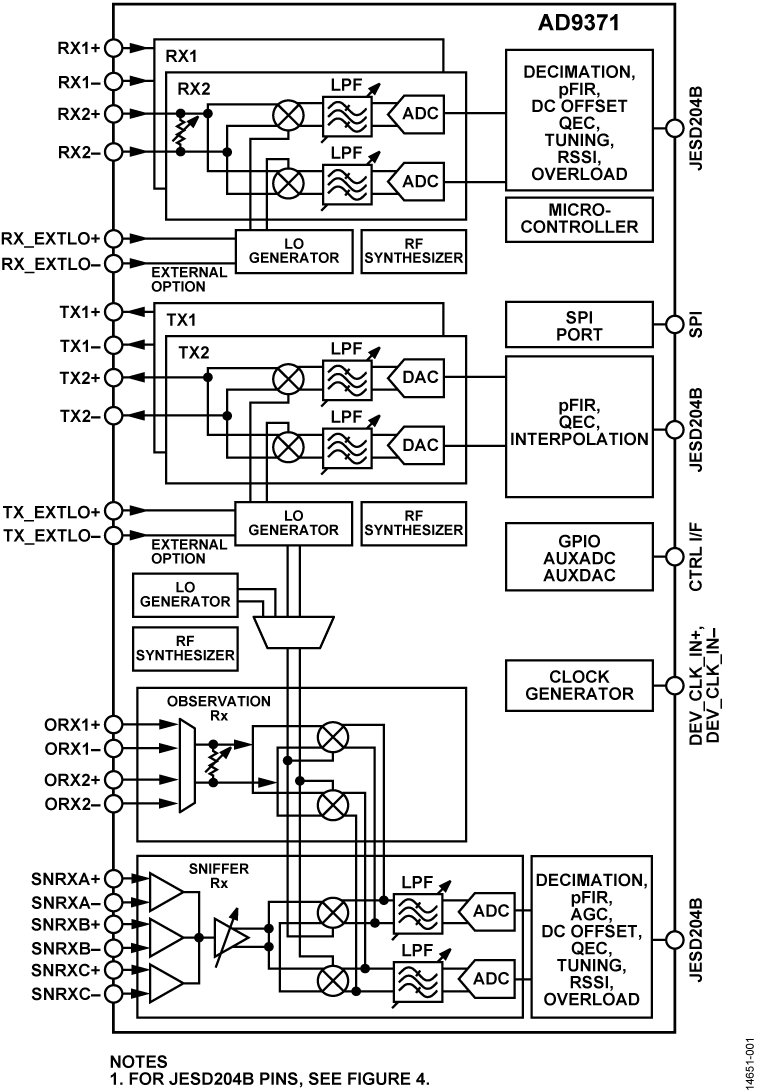
The AD9371 is a highly integrated, wideband RF transceiver offering dual channel transmitters and receivers, integrated synthesizers, and digital signal processing functions. The IC delivers a versatile combination of high performance and low power consumption required by 3G/4G micro and macro BTS equipment in both FDD and TDD applications. The AD9371 operates from 300 MHz to 6000 MHz, covering most of the licensed and unlicensed cellular bands. The IC supports receiver bandwidths up to 100 MHz. It also supports observation receiver and transmit synthesis bandwidths up to 250 MHz to accommodate digital correction algorithms.
The transceiver consists of wideband direct conversion signal paths with state-of-the-art noise figure and linearity. Each complete receiver and transmitter subsystem includes dc offset correction, quadrature error correction (QEC), and programmable digital filters, eliminating the need for these functions in the digital baseband. Several auxiliary functions such as an auxiliary analog- to-digital converter (ADC), auxiliary digital-to-analog converters (DACs), and general-purpose input/outputs (GPIOs) are integrated to provide additional monitoring and control capability.
An observation receiver channel with two inputs is included to monitor each transmitter output and implement interference mitigation and calibration applications. This channel also connects to three sniffer receiver inputs that can monitor radio activity in different bands.
The high speed JESD204B interface supports lane rates up to 6144 Mbps. Four lanes are dedicated to the transmitters and four lanes are dedicated to the receiver and observation receiver channels.
The fully integrated phase-locked loops (PLLs) provide high performance, low power fractional-N frequency synthesis for the transmitter, the receiver, the observation receiver, and the clock sections. Careful design and layout techniques provide the isolation demanded in high performance base station applications. All voltage controlled oscillator (VCO) and loop filter components are integrated to minimize the external component count.
A 1.3 V supply is required to power the core of the AD9371, and a standard 4-wire serial port controls it. Other voltage supplies provide proper digital interface levels and optimize transmitter and auxiliary converter performance. The AD9371 is packaged in a 12 mm × 12 mm, 196-ball chip scale ball grid array (CSP_BGA).
Applications
- 3G/4G micro and macro base stations (BTS)
- 3G/4G multicarrier picocells
- FDD and TDD active antenna systems
- Microwave, nonline of sight (NLOS) backhaul systems
Applications
Aerospace and Defense Systems
- Missiles and Precision Munitions
- Avionic Systems
- Phased Array Radar
- Military Communication Solutions
- Unmanned Aerial Vehicles (UAV)
- Electronic Surveillance and Countermeasures
Instrumentation and Measurement Solutions
- Signal Generator (Audio through RF) Solutions
- Communications Test Equipment Solutions
- Radio Frequency (RF) Signal and Vector Network Analyzer Solutions
AD9375
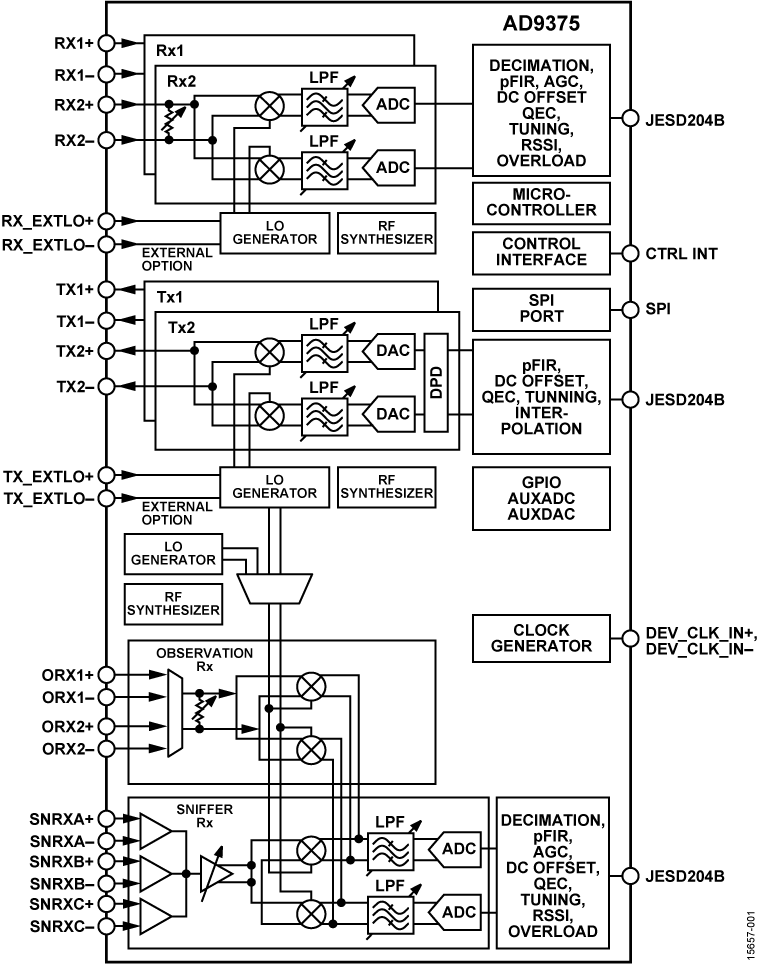
The AD9375 is a highly integrated, wideband radio frequency (RF) transceiver offering dual-channel transmitters (Tx) and receivers (Rx), integrated synthesizers, a fully integrated digital predistortion (DPD) actuator and adaptation engine, and digital signal processing functions. The IC delivers a versatile combination of high performance and low power consumption required by 3G/4G small cell and massive multiple input, multiple output (MIMO) equipment in both frequency division duplex (FDD) and time division duplex (TDD) applications. The AD9375 operates from 300 MHz to 6000 MHz, covering most of the licensed and unlicensed cellular bands. The DPD algorithm supports linearization on signal bandwidths up to 40 MHz depending on the power amplifier (PA) characteristics (for example, two adjacent 20 MHz carriers). The IC supports Rx bandwidths up to 100 MHz. It also supports observation receiver (ORx) and Tx synthesis bandwidths up to 250 MHz to accommodate digital correction algorithms.
The transceiver consists of wideband direct conversion signal paths with state-of-the-art noise figure and linearity. Each complete Rx and Tx subsystem includes dc offset correction, quadrature error correction (QEC), and programmable digital filters, eliminating the need for these functions in the digital baseband. Several auxiliary functions such as an auxiliary analog-to-digital converter (ADC), auxiliary digital-to-analog converters (DACs), and general-purpose input/outputs (GPIOs) are integrated to provide additional monitoring and control capability.
An ORx channel with two inputs is included to monitor each Tx output and implement calibration applications. This channel also connects to three sniffer receiver (SnRx) inputs that can monitor radio activity in different bands.
The high speed JESD204B interface supports lane rates up to 6144 Mbps. Four lanes are dedicated to the transmitters and four lanes are dedicated to the receiver and observation receiver channels.
The fully integrated phase-locked loops (PLLs) provide high performance, low power, fractional-N frequency synthesis for the Tx, the Rx, the ORx, and the clock sections. Careful design and layout techniques provide the isolation demanded in high performance base station applications. All voltage controlled oscillator (VCO) and loop filter components are integrated to minimize the external component count.
The device contains a fully integrated, low power DPD actuator and adaptation engine for use in PA linearization. The DPD feature enables use of high efficiency PAs, significantly reducing the power consumption of small cell base station radios while also reducing the number of JESD204B lanes necessary to interface with baseband processors.
A 1.3 V supply is required to power the AD9375 core, and a standard 4-wire serial port controls it. Other voltage supplies provide proper digital interface levels and optimize transmitter and auxiliary converter performance. The AD9375 is packaged in a 12 mm × 12 mm, 196-ball chip scale ball grid array (CSP_BGA).
Applications
- 3G/4G small cell base stations (BTS)
- 3G/4G massive MIMO/active antenna systems
Applications
Aerospace and Defense Systems
- Avionic Systems
- Phased Array Radar
Wireless Communication Solutions
- Wireless Infrastructure Solutions
AD9986
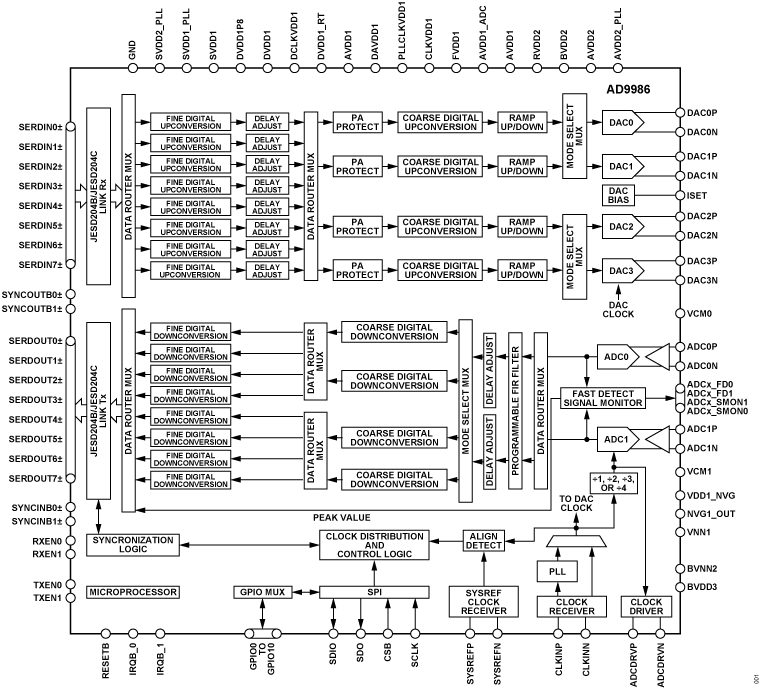
The AD9986 is a highly integrated device with a 16-bit, 12 GSPS maximum sample rate RF DAC core, and a 12-bit, 6 GSPS rate RF ADC core. The AD9986 supports four transmitter channels and two receiver channels with four transmitter, two receiver (4T2R) configuration. The AD9986 is well suited for 2-antenna and 4-antenna transmitter applications requiring a wide bandwidth observation receiver path for the digital predistortion. The AD9986 supports up to a 6 GSPS complex transmit and receive data rate in single channel mode. The maximum radio channel bandwidth supported is 1.2 GHz and 2.4 GHz for the transmit and receive paths, respectively (4T2R). The AD9986 features a 16 lane, 24.75 Gbps JESD204C or 15.5 Gbps JESD204B serial data port, an on-chip clock multiplier, and digital signal processing capability targeted at multiband, direct-to-RF radio applications.
APPLICATIONS
- Wireless communications infrastructure
- W-CDMA, LTE, LTE-A, Massive-MIMO
- Microwave point-to-point, E-band, and 5G mm Wave
- Broadband communications systems
- DOCSIS 3.1 and 4.0 CMTS
- Communications test and measurement system
Applications
Wireless Communication Solutions
- mmWave Communication Solutions
- Wireless Infrastructure Solutions
AD9988
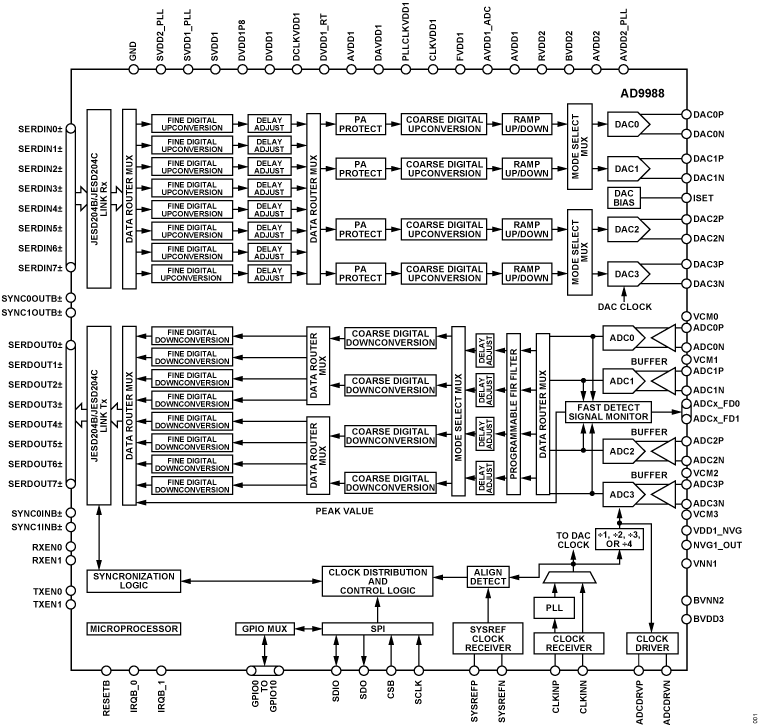
The AD9988 is a highly integrated device with four 16-bit, 12 GSPS maximum sample rate, RF digital-to-analog converter (DAC) cores, and four 12-bit, 4 GSPS rate, RF analog-to-digital converter (ADC) cores. The device supports four transmitter channels and four receiver channels with a 4T4R configuration. This product is well suited for four-antenna TDD transmitter applications, where the receiver path can be shared between receiver and observation modes. The GPIO pins can be configured and toggled to support different user modes, while phase coherency is maintained. The maximum radio channel bandwidth supported is 1.2 GHz in a 4T4R configuration and a sample resolution of 16 bits. The AD9988 features a 16-lane 24.75 Gbps JESD204C or 15.5 Gbps JESD204B serial data port that allows up to eight lanes per transmit/receive link, an on-chip clock multiplier, and digital signal processing capability targeted at multiband direct to RF radio applications.
APPLICATIONS
- Wireless communications infrastructure
- W-CDMA, LTE, LTE-A, massive multiple input multiple output (MIMO)
- Point to point microwave, E-band, and 5G mmWave
- Broadband communications systems
- DOCSIS 3.0+ cable modem termination system (CMTS)
- Communication test and measurement systems
Applications
Wireless Communication Solutions
- mmWave Communication Solutions
- Wireless Infrastructure Solutions
ADRV9009
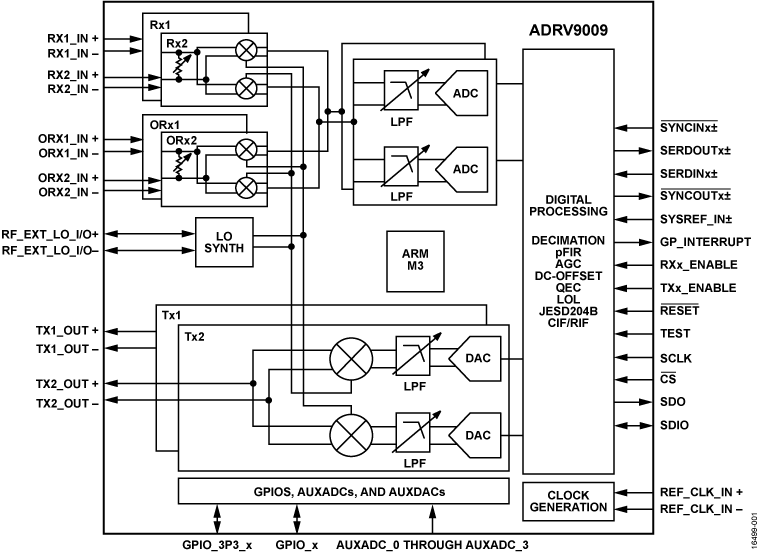
The ADRV9009 is a highly integrated, radio frequency (RF), agile transceiver offering dual transmitters and receivers, integrated synthesizers, and digital signal processing functions. The IC delivers a versatile combination of high performance and low power consumption demanded by 3G, 4G, and 5G macro cell time division duplex (TDD) base station applications.
The receive path consists of two independent, wide bandwidth, direct conversion receivers with state-of-the-art dynamic range. The device also supports a wide bandwidth, time shared observation path receiver (ORx) for use in TDD applications. The complete receive subsystem includes automatic and manual attenuation control, dc offset correction, quadrature error correction (QEC), and digital filtering, thus eliminating the need for these functions in the digital baseband. Several auxiliary functions, such as analog-to-digital converters (ADCs), digital-to-analog converters (DACs), and general-purpose inputs/outputs (GPIOs) for the power amplifier (PA), and RF front-end control are also integrated.
In addition to automatic gain control (AGC), the ADRV9009 also features flexible external gain control modes, allowing significant flexibility in setting system level gain dynamically.
The received signals are digitized with a set of four high dynamic range, continuous time Σ-Δ ADCs that provide inherent antialiasing. The combination of the direct conversion architecture, which does not suffer from out of band image mixing, and the lack of aliasing, relaxes the requirements of the RF filters when compared to traditional intermediate frequency (IF) receivers.
The transmitters use an innovative direct conversion modulator that achieves high modulation accuracy with exceptionally low noise.
The observation receiver path consists of a wide bandwidth, direct conversion receiver with state-of-the-art dynamic range.
The fully integrated phase-locked loop (PLL) provides high performance, low power, fractional-N RF frequency synthesis for the transmitter (Tx) and receiver (Rx) signal paths. An additional synthesizer generates the clocks needed for the converters, digital circuits, and the serial interface. A multichip synchronization mechanism synchronizes the phase of the RF local oscillator (LO) and baseband clocks between multiple ADRV9009 chips. Precautions are taken to provide the isolation required in high performance base station applications. All voltage controlled oscillators (VCOs) and loop filter components are integrated.
The high speed JESD204B interface supports up to 12.288 Gbps lane rates, resulting in two lanes per transmitter and a single lane per receiver in the widest bandwidth mode. The interface also supports interleaved mode for lower bandwidths, thus reducing the total number of high speed data interface lanes to one. Both fixed and floating point data formats are supported. The floating point format allows internal AGC to be invisible to the demodulator device.
The core of the ADRV9009 can be powered directly from 1.3 V regulators and 1.8 V regulators, and is controlled via a standard 4-wire serial port. Comprehensive power-down modes are included to minimize power consumption in normal use. The ADRV9009 is packaged in a 12 mm × 12 mm, 196-ball chip scale ball grid array (CSP_BGA).
Applications
- 3G, 4G, and 5G TDD macrocell base stations
- TDD active antenna systems
- Massive multiple input, multiple output (MIMO)
- Phased array radar
- Electronic warfare
- Military communications
- Portable test equipment
Applications
Aerospace and Defense Systems
- Avionic Systems
- Missiles and Precision Munitions
- Electronic Surveillance and Countermeasures
- Unmanned Aerial Vehicles (UAV)
- Military Communication Solutions
- Phased Array Radar
- Missiles and Precision Munitions Solutions
Instrumentation and Measurement Solutions
- Radio Frequency (RF) Signal and Vector Network Analyzer Solutions
- Communications Test Equipment Solutions
- Signal Generator (Audio through RF) Solutions
Clock Products
HMC7044
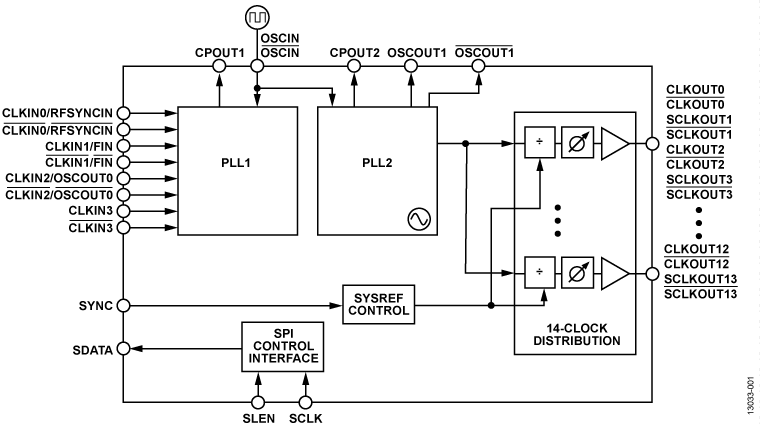
The HMC7044 is a high performance, dual-loop, integer-N jitter attenuator capable of performing reference selection and generation of ultralow phase noise frequencies for high speed data converters with either parallel or serial (JESD204B type) interfaces. The HMC7044 features two integer mode PLLs and overlapping on-chip VCOs that are SPI-selectable with wide tuning ranges around 2.5 GHz and 3 GHz, respectively. The device is designed to meet the requirements of GSM and LTE base station designs, and offers a wide range of clock management and distribution features to simplify baseband and radio card clock tree designs. The HMC7044 provides 14 low noise and configurable outputs to offer flexibility in interfacing with many different components including data converters, field-programmable gate arrays (FPGAs), and mixer local oscillators (LOs).
The DCLK and SYSREF clock outputs of the HMC7044 can be configured to support signaling standards, such as CML, LVDS, LVPECL, and LVCMOS, and different bias settings to offset varying board insertion losses.
Applications
- JESD204B clock generation
- Cellular infrastructure (multicarrier GSM, LTE, W-CDMA)
- Data converter clocking
- Microwave baseband cards
- Phase array reference distribution
Applications
Aerospace and Defense Systems
- Missiles and Precision Munitions
- Phased Array Radar
- Electronic Surveillance and Countermeasures
- Military Communication Solutions
Wireless Communication Solutions
- Wireless Infrastructure Solutions
HMC7043
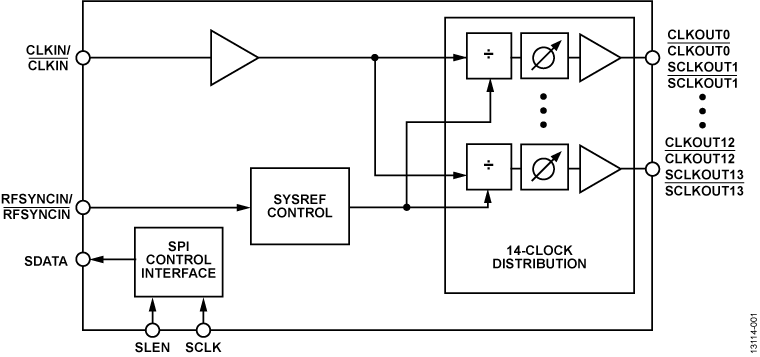
The HMC7043 is designed to meet the requirements of multicarrier GSM and LTE base station designs, and offers a wide range of clock management and distribution features to simplify baseband and radio card clock tree designs.
The HMC7043 provides 14 low noise and configurable outputs to offer flexibility in interfacing with many different components in a base transceiver station (BTS) system, such as data converters, local oscillators, transmit/receive modules, field programmable gate arrays (FPGAs), and digital front-end ASICs. The HMC7043 can generate up to seven DCLK and SYSREF clock pairs per the JESD204B/JESD204C interface requirements.
The system designer can generate a lower number of DCLK and SYSREF pairs, and configure the remaining output signal paths for independent phase and frequency. Both the DCLK and SYSREF clock outputs can be configured to support different signaling standards, including CML, LVDS, LVPECL, and LVCMOS, and different bias conditions to adjust for varying board insertion losses.
One of the unique features of the HMC7043 is the independent flexible phase management of each of the 14 channels. All 14 channels feature both frequency and phase adjustment. The outputs can also be programmed for 50 Ω or 100 Ω internal and external termination options.
The HMC7043 device features an RF SYNC feature that synchronizes multiple HMC7043 devices deterministically, that is, ensures that all clock outputs start with the same edge. This operation is achieved by rephrasing the nested HMC7043 or SYSREF control unit/divider, deterministically, and then restarting the output dividers with this new phase.
The HMC7043 is offered in a 48-lead, 7 mm × 7 mm LFCSP package with an exposed pad connected to ground.
Applications
- JESD204B/JESD204C clock generation
- Cellular infrastructure (multicarrier GSM, LTE, W-CDMA)
- Data converter clocking
- Phase array reference distribution
- Microwave baseband cards
Applications
Aerospace and Defense Systems
- Missiles and Precision Munitions
- Phased Array Radar
- Electronic Surveillance and Countermeasures
AD9528
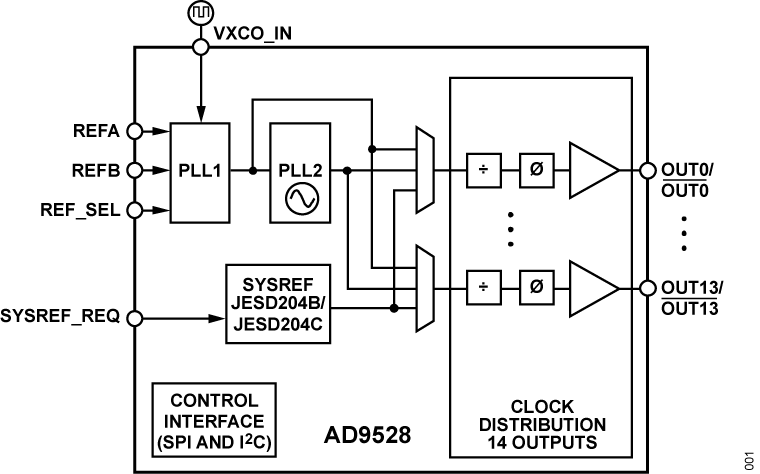
The AD9528 is a two-stage PLL with an integrated JESD204B/JESD204C SYSREF generator for multiple device synchronization. The first stage phase-locked loop (PLL) (PLL1) provides input reference conditioning by reducing the jitter present on a system clock. The second stage PLL (PLL2) provides high frequency clocks that achieve low integrated jitter as well as low broadband noise from the clock output drivers. The external VCXO provides the low noise reference required by PLL2 to achieve the restrictive phase noise and jitter requirements necessary to achieve acceptable performance. The on-chip VCO tunes from 3.450 GHz to 4.025 GHz. The integrated SYSREF generator outputs single shot, N-shot, or continuous signals synchronous to the PLL1 and PLL2 outputs to time align multiple devices.
The AD9528 generates six outputs (Output 0 to Output 3, Output 12, and Output 13) with a maximum frequency of 1.25 GHz, and eight outputs with a maximum frequency of up to 1 GHz. Each output can be configured to output directly from PLL1, PLL2, or the internal SYSREF generator. Each of the 14 output channels contains a divider with coarse digital phase adjustment and an analog fine phase delay block that allows complete flexibility in timing alignment across all 14 outputs. The AD9528 can also be used as a dual input flexible buffer to distribute 14 device clock and/or SYSREF signals. At power-up, the AD9528 sends the VCXO signal directly to Output 12 and Output 13 to serve as the power-up ready clocks.
Applications
- High performance wireless transceivers
- LTE and multicarrier GSM base stations
- Wireless and broadband infrastructure
- Medical instrumentation
- Clocking high speed ADCs, DACs, DDSs, DDCs, DUCs, MxFEs; supports JESD204B/JESD204C
- Low jitter, low phase noise clock distribution
- ATE and high performance instrumentation
Applications
Aerospace and Defense Systems
- mmWave Sensing and Imaging
- Military Communication Solutions
- Missiles and Precision Munitions
- Phased Array Radar
- Electronic Surveillance and Countermeasures
Wireless Communication Solutions
- Wireless Infrastructure Solutions
Healthcare Solutions
- Ultrasound Solutions
AD9525
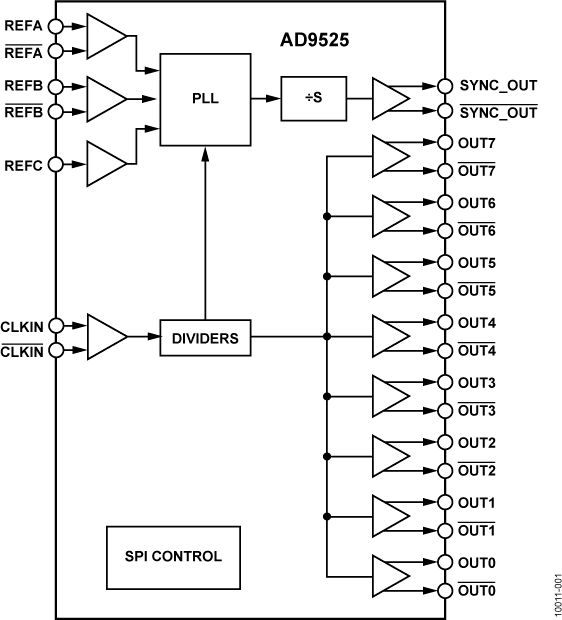
The AD9525 is designed to support converter clock requirements for long-term evolution (LTE) and multicarrier GSM base station designs.
The AD9525 provides a low power, multioutput, clock distribution function with low jitter performance, along with an on-chip PLL that can be used with an external VCO or VCXO. The VCO input and eight LVPECL outputs can operate up to a frequency of 3.6 GHz. All outputs share a common divider that can provide a division of 1 to 6.
The AD9525 offers a dedicated output that can be used to provide a programmable signal for resetting or synchronizing a data converter. The output signal is activated by a SPI write.
The AD9525 is available in a 48-lead LFCSP and can be operated from a single 3.3 V supply. The external VCXO or VCO can have an operating voltage of up to 5.5 V.
The AD9525 operates over the extended industrial temperature range of −40°C to +85°C.
Applications- LTE and multicarrier GSM base stations
- Clocking high speed ADCs, DACs
- ATE and high performance instrumentation
- 40/100Gb/s OTN Line Side Clocking
- Cable/DOCSIS CMTS Clocking
- Test and Measurement
Applications
Wireless Communication Solutions
- Wireless Infrastructure Solutions
Aerospace and Defense Systems
- Electronic Surveillance and Countermeasures
Educational Materials & Discussions
Latest Resources
-
FPGA Interoperability Reports
Intel AN-949 (AD9081/AD9082 Tx Path JESD204C Interoperability with Stratix 10)
-
FPGA Interoperability Reports
Intel AN-927 (AD9081/AD9082 Rx Path JESD204C Interoperability with Stratix 10)
-
FPGA Interoperability Reports
AD9217 and Intel Stratix 10 Interoperability report and Reference Design
Webcast
- Streamlining Flexible System Design using RF ADCs with DSP
- Designing Wideband Frontends for GSPS Converters
- ADI Clocks: Optimizing and Supporting JESD204B Interfaces
- High-Performance GSPS Data Converters Improve RADAR & EW Architectures
- Demystifying the JESD204B High-Speed Data Converter-to-FPGA Interface
Technical Articles
- MS-2503: Slay Your System Dragons with JESD204B PDF
- Understanding JESD204B Link Parameters
- Understanding Layers in the JESD204B Specification: A High Speed ADC Perspective, Part 2
- JESD204B Survival Guide PDF
- Prototyping Systems: JESD204B Converters and FPGAs
- Why there's no need to fear JESD204B
- Pair The Right JESD204B Converter With Your FPGA
- Synchronize Multiple ADCs With JESD204B
- Link Synchronation and Alignment in JESD204B: Understanding Control Characters
- LVDS Is Dead? Long Live LVDS & JESD204b
- JESD204B: Critical Link In The FPGA-Converter Chain
- Kick Start Your Designs with JESD204B
- Faster JESD204B Standard Presents Verification Challenges
- What is JESD204 and why should we pay attention to it?
- Understand the digital-output options for high-speed ADCs
- The JESD204/A/B Standard – "Where the Rubber Meets the Road"
Video
- AD-FMCDAQ2-EBZ Wideband RF DAQ Rapid Prototyping FMC Module
- High Speed ADC FMC Development Board with JESD204B
- JESD204B and Why It Should Matter to You (Part 1 of 3)
- Rapid JESD204B Data Converter-to-FPGA Prototyping (Part 2 of 3)
- Implementing JESD204B A/D Converters-to-FPGA Designs (Part 3 of 3)
- Rapid Prototyping with JESD204B using FMC and Xilinx FPGAs
- A Look at the JESD204B Serial Interface EYE Diagram
Tutorial
FPGA Interoperability Reports
- Intel AN-916 (AD9081/AD9082 JESD204C Interoperability with Stratix 10)
- AD9213/Stratix 10 Interoperability Report
- Intel AN-915 (AD9208/AD9689/AD9694/AD9695, Stratix 10)
- Intel AN890 - AD917x/Stratix10 JESD204B Interoperability Report
- PolarFire FPGA and AD9371 Interoperability Testing
- ComCores JESD204B IP and AD9152 Interoperability Report
- Validating ADI Converters Inter-operability with Xilinx FPGA and JESD204B/C IP PDF
- JESD204B Interoperative Report (AD9250 Xilinx Kintex7)