
ADP1741

ADP1741
PRODUCTION2 A, Low VIN, Dropout, CMOS Linear Regulator
- Part Models
- 1
- 1ku List Price
- Starting From $2.02
Viewing:
Overview
- Maximum output current: 2 A
- Input voltage range: 1.6 V to 3.6 V
- Low shutdown current: 2 μA
- Low dropout voltage: 160 mV @ 2 A load
- Initial accuracy: ±1%
- Accuracy over line, load, and temperature: ±2%
- 7 fixed output voltage options with soft start (ADP1740): 0.75 V to 2.5 V
- Adjustable output voltage options with soft start (ADP1741): 0.75 V to 3.3 V
- High PSRR
65 dB @ 1 kHz
65 dB @ 10 kHz
54 dB @ 100 kHz - 23 μV rms at 0.75 V output
- Stable with small 4.7 μF ceramic output capacitor
- Excellent load and line transient response
- Current-limit and thermal overload protection
- See data sheet for additional features
The ADP1740 / ADP1741 are CMOS, low dropout linear regulators that operate from 1.6 V to 3.6 V and provide up to 2 A of output current. These Low VIN / VOUT LDOs are ideal for regulation of nanometer FPGA geometries operating from 2.5V down to 1.8V I/O rails, and powering core voltages down to 0.75V. Using an advanced proprietary architecture, they provide high power supply rejection, low noise, and achieve excellent line and load transient response with just a small 4.7 µF ceramic output capacitor.
The ADP1740 is available in seven fixed output voltage options. The ADP1741 is an adjustable version that allows output voltages ranging from 0.75 V to 3.3 V via an external divider.The ADP1740 / ADP1741 allow an external soft start capacitor to be connected to program the startup. A digital power-good output allows power system monitors to check the health of the output voltage.
The ADP1740 / ADP1741 are available in a 16-lead, 4 mm × 4 mm LFCSP, making them not only very compact solutions, but also providing excellent thermal performance for applications that require up to 2 A of output current in a small, low profile footprint.
APPLICATIONS
- Server computers
- Memory components
- Telecommunications equipment
- Network equipment
- DSP/FPGA/microprocessor supplies
- Instrumentation equipment/data acquisition systems
Documentation
Data Sheet 1
Application Note 2
Technical Articles 1
Evaluation Design File 1
Frequently Asked Question 1
Video 1

Brochure 2
Circuit Note 1
Analog Dialogue 2
ADI has always placed the highest emphasis on delivering products that meet the maximum levels of quality and reliability. We achieve this by incorporating quality and reliability checks in every scope of product and process design, and in the manufacturing process as well. "Zero defects" for shipped products is always our goal. View our quality and reliability program and certifications for more information.
| Part Model | Pin/Package Drawing | Documentation | CAD Symbols, Footprints, and 3D Models |
|---|---|---|---|
| ADP1741ACPZ-R7 | 16-Lead LFCSP (4mm x 4mm w/ EP) |
| Part Models | Product Lifecycle | PCN |
|---|---|---|
|
Jul 22, 2025 - 25_0055 Gold Wire to Copper Wire Conversion(PCA) |
||
| ADP1741ACPZ-R7 | PRODUCTION | |
|
May 5, 2014 - 14_0020 Conversion of 4x4mm body Size LFCSP Package Outlines from Punch to Sawn and Transfer of Assembly Site to Amkor Philippines. |
||
| ADP1741ACPZ-R7 | PRODUCTION | |
|
Nov 8, 2012 - 12_0290 ADP1740/ADP1741, ADP1752/ADP1753, ADP1754/ADP1755 Data Sheet Correction |
||
| ADP1741ACPZ-R7 | PRODUCTION | |
This is the most up-to-date revision of the Data Sheet.
Software Resources
Can't find the software or driver you need?
Request a Driver/SoftwareHardware Ecosystem
| Parts | Product Life Cycle | Description |
|---|---|---|
| ADP1740 | PRODUCTION | 2 A, Low VIN Dropout, Linear Regulator |
Tools & Simulations
LTspice
Models for the following parts are available in LTspice:
- ADP1741
ADI Linear Regulator Design Tool and Parametric Search
Microsoft Excel download tool from ADIsimPower to generate a power supply design complete with a schematic, bill of materials, and performance specifications.
Open ToolLTspice® is a powerful, fast and free simulation software, schematic capture and waveform viewer with enhancements and models for improving the simulation of analog circuits.
Evaluation Kits

ADP1741 Evaluation Board
Resources


AD9625 Evaluation and Synchronization
Resources
Software


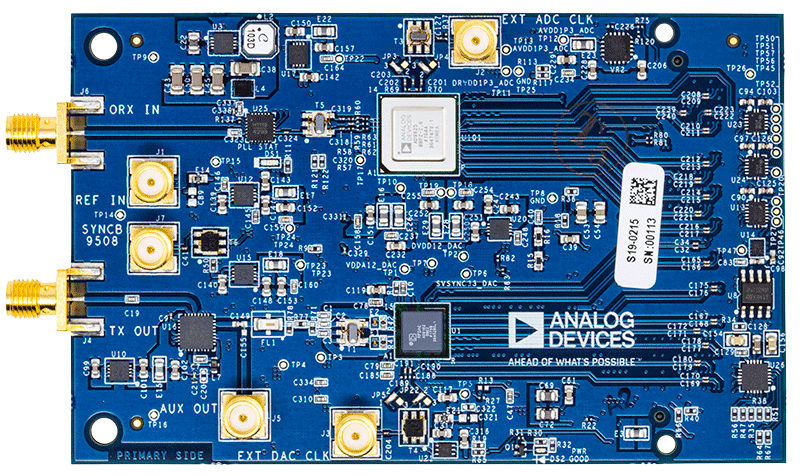

Direct RF to Baseband Transmit Radio
Resources


ADL5567 & AD9625 Analog Signal Chain Evaluation and ADF4355-2 Wideband Synthesizer with VCO
Resources


ADA4961 & AD9680 Analog Signal Chain Evaluation and AD9528 Converter Synchronization
Resources
Software


ADA4961 & AD9625 Analog Signal Chain Evaluation and Converter Synchronization
Resources
Software
Reference Designs


Robust, Multivoltage, High Efficiency, 25 W Universal Power Supply Module with 6 V to 14 V Input