Quantic X-Microwave

Analog Devices RF and microwave components are available as drop-in X-MWblocks®
from Quantic X-Microwave.

Get the X-MWblock® drop-in module for this part.

ADRF5730

RECOMMENDED FOR NEW DESIGNS

0.5 dB LSB, 6-Bit, Silicon Digital Attenuator, 100 MHz to 40 GHz

Viewing:

Overview

  • Ultrawideband frequency range: 100 MHz to 40 GHz
  • Attenuation range: 0.5 dB steps to 31.5 dB
  • Low insertion loss with impedance match
    • 2.1 dB up to 18 GHz
    • 2.9 dB up to 26 GHz
    • 4.8 dB up to 40 GHz
  • Attenuation accuracy with impedance match
    • ±(0.10 + 1.0% of attenuation state) up to 18 GHz
    • ±(0.15 + 0.8% of attenuation state) up to 26 GHz
    • ±(0.35 + 2.5% of attenuation state) up to 40 GHz
  • Typical step error with impedance match
    • ±0.18 dB up to 18 GHz
    • ±0.23 dB up to 26 GHz
    • ±0.51 dB up to 40 GHz
  • High input linearity
    • P0.1dB insertion loss state: 30 dBm
    • P0.1dB other attenuation states: 27 dBm
    • IP3: 50 dBm typical
  • High RF input power handling: 27 dBm average, 30 dBm peak
  • Tight distribution in relative phase
  • No low frequency spurious signals
  • SPI and parallel mode control, CMOS/LVTTL compatible
  • RF settling time (0.1 dB of final RF output): 250 ns
  • 24-terminal, 4 mm × 4 mm LGA package
  • Pin compatible with ADRF5720, low frequency cutoff version

The ADRF5730 is a silicon, 6-bit digital attenuator with 31.5 dB attenuation control range in 0.5 dB steps.

This device operates from 100 MHz to 40 GHz with better than 4.8 dB of insertion loss and excellent attenuation accuracy. The ADRF5730 has a radio frequency (RF) input power handling capability of 27 dBm average and 30 dBm peak for all states.

The ADRF5730 requires a dual supply voltage of +3.3 V and −3.3 V. The device features serial peripheral interface (SPI), parallel mode control, and complementary metal-oxide semiconductor (CMOS)-/low voltage transistor to transistor logic (LVTTL)-compatible controls.

The ADRF5730 is pin-compatible with the ADRF5720 low frequency cutoff version, which operates from 9 kHz to 40 GHz.

The ADRF5730 RF ports are designed to match a characteristic impedance of 50 Ω. For wideband applications, impedance matching on the RF transmission lines can further optimize high frequency insertion loss, return loss, and attenuation accuracy characteristics. Refer to the Electrical Specifications section, the Typical Performance Characteristics section, and the Applications Information section for more details.

The ADRF5730 comes in a 24-terminal, 4 mm × 4 mm, RoHS-compliant, land grid array (LGA) package and operates from −40°C to +105°C.

Applications

  • Industrial scanners
  • Test and instrumentation
  • Cellular infrastructure: 5G millimeter wave
  • Military radios, radars, electronic counter measures (ECMs)
  • Microwave radios and very small aperture terminals (VSATs)

ADRF5730
0.5 dB LSB, 6-Bit, Silicon Digital Attenuator, 100 MHz to 40 GHz
ADRF5730 Functional Block Diagram ADRF5730 Pin Configuration
Add to myAnalog

Add product to the Products section of myAnalog (to receive notifications), to an existing project or to a new project.

Create New Project
Ask a Question

Documentation

Learn More
Add to myAnalog

Add media to the Resources section of myAnalog, to an existing project or to a new project.

Create New Project

Software Resources


Hardware Ecosystem

Parts Product Life Cycle Description
ADRF5720 RECOMMENDED FOR NEW DESIGNS 0.5 dB LSB, 6-Bit, Silicon Digital Attenuator, 9 kHz to 40 GHz
ADRF5721 RECOMMENDED FOR NEW DESIGNS 2 dB LSB, 4-Bit, Silicon Digital Attenuator, 9 kHz to 40 GHz
ADRF5731 RECOMMENDED FOR NEW DESIGNS 2 dB LSB, 4-Bit, Silicon Digital Attenuator, 100 MHz to 40 GHz
Modal heading
Add to myAnalog

Add product to the Products section of myAnalog (to receive notifications), to an existing project or to a new project.

Create New Project

Tools & Simulations

ADIsimRF

ADIsimRF is an easy-to-use RF signal chain calculator. Cascaded gain, noise, distortion and power consumption can be calculated, plotted and exported for signal chains with up to 50 stages. ADIsimRF also includes an extensive data base of device models for ADI’s RF and mixed signal components.

Open Tool

IBIS Model 1

S-Parameter 1


Evaluation Kits

eval board
EVAL-ADRF5730

ADRF5730 Evaluation Board

Product Details

The ADRF5730-EVALZ is a 4-layer evaluation board. Each copper layer is 0.7 mil (0.5 oz) and separated by dielectric materials.

All RF and dc traces are routed on the top copper layer whereas the inner and bottom layers are grounded planes that provide a solid ground for the RF transmission lines. Top dielectric material is 8 mil Rogers RO4003, offering optimal high frequency performance. The middle and bottom dielectric materials provide mechanical strength. The overall board thickness is 62 mil, which allows 2.4 mm RF launchers to be connected at the board edges.

ADXBAND16EBZ

16Tx/16Rx Direct X-Band Sampled Phased-Array/RADAR/SATCOM Development Platform

Features and Benefits

ADXBAND16EBZ Digitizing Card
  • Multi-Channel, Wideband System Development Platform Using Apollo (AD9084)
  • Mates With Xilinx VCU118 Evaluation Board (Not Included)
  • 16x RF Receive (Rx) Channels
    • Total 16x 8GSPS to 20GSPS ADC
    • Digital Down Converters (DDCs), Each Including Complex Numerically-Controlled Oscillators (NCOs)
    • Programmable Finite Impulse Response Filters (pFIRs)
    • Complex Finite Impulse Response Filters (CFIRs)
  • 16x RF Transmit (Tx) Channels
    • Total 16x 8GSPS to 28GSPS DAC
    • Digital Up Converters (DUCs), Each Including Complex Numerically-Controlled Oscillators (NCOs)
    • Programmable Finite Impulse Response Filters (pFIRs)
    • Complex Finite Impulse Response Filters (CFIRs)
  • Flexible Rx & Tx RF Front-Ends
    • Rx: Filtering, Amplification, Digital Step Attenuation for Gain Control
    • Tx: Filtering, Amplification
  • Flexible Clock Distribution
    • On-Board Clock Distribution from Single External 400MHz Reference
    • Support for External Converter Clock per AD9084 via solder rework
  • On-Board Power Regulation from Single 12V Power Adapter (Included)
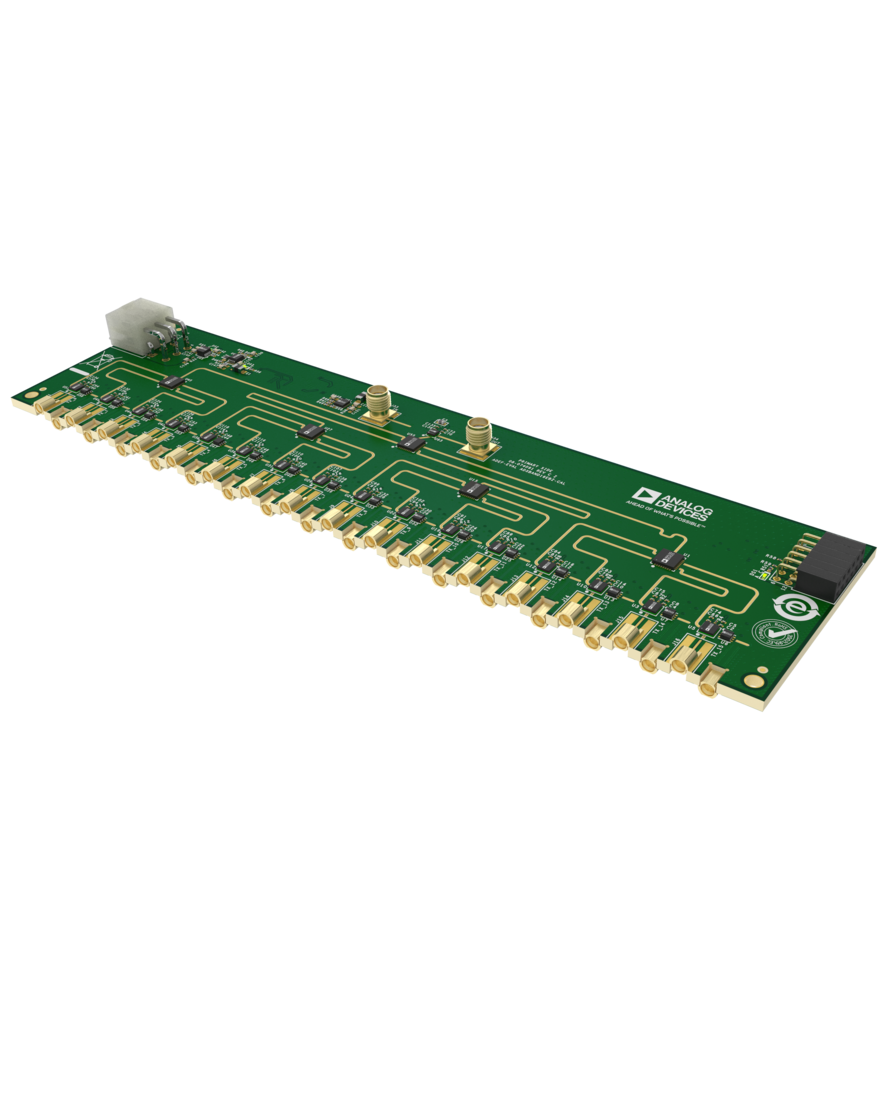
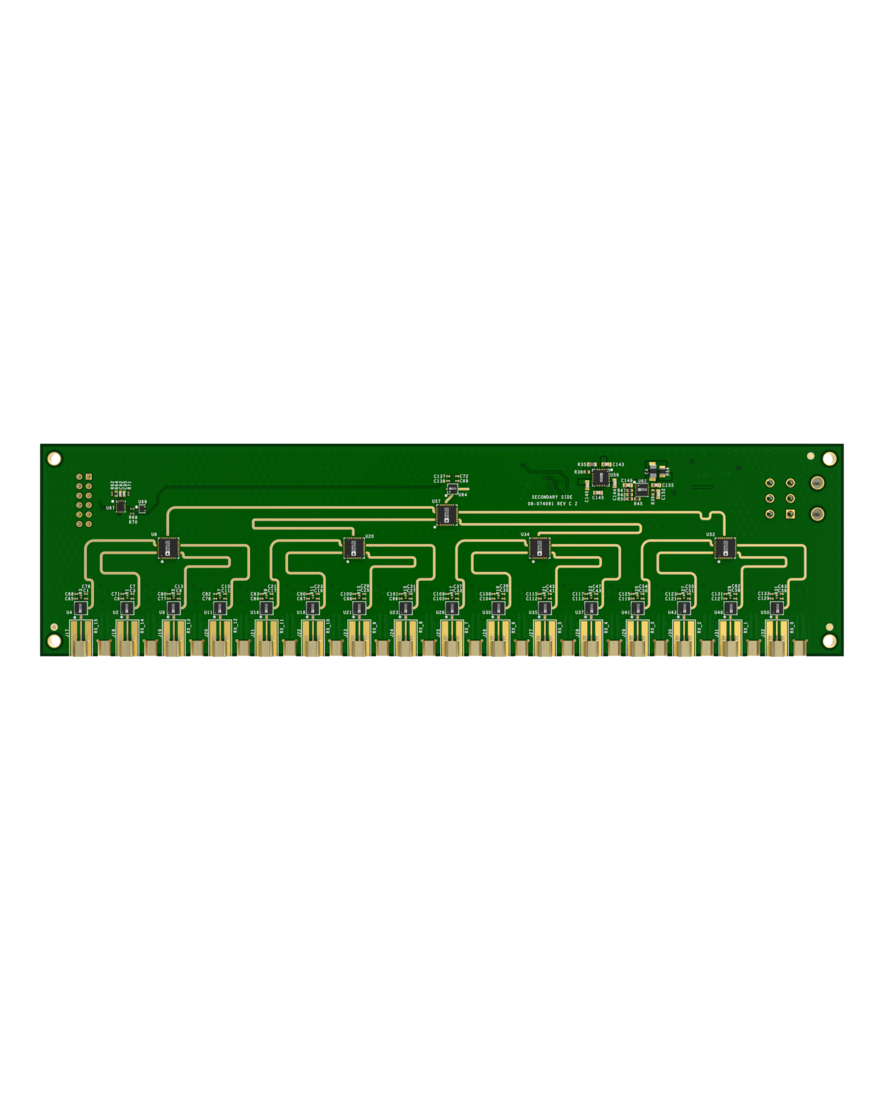
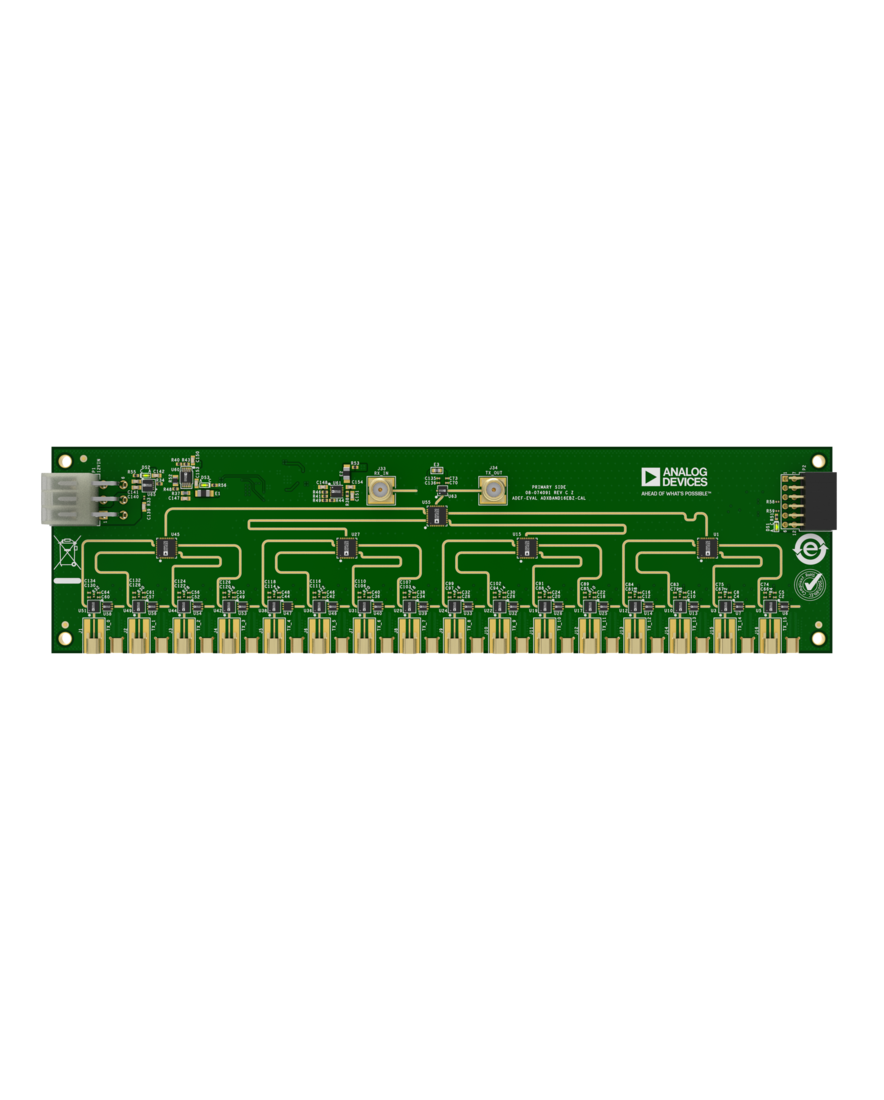
16Tx / 16Rx Calibration Board
  • Mates to ADXBAND16EBZ Digitizing Card & VCU118 PMOD Interface (Cable Included)
  • Provides Both Individual Adjacent Channel Loopback and Combined Channel Loopback Options
  • Combined Tx Channels Out Option
  • Combined Rx Channels In Option
Software Features and Benefits

Easy Control Tools and Platform Interfaces to Simplify Software Framework Developments:

  • IIO Oscilloscope GUI
  • MATLAB Add-Ons & Example Scripts
  • Example HDL Builds including JESD204C Bring-Up
  • Embedded Software Solutions for Linux and Device Drivers
Software Reference Design Examples for ADEF Applications to Reduce Prototyping Time:
  • Multi-Chip Synchronization for Power-Up Phase Determinism
  • System-Level Amplitude/Phase Alignment Using NCOs
  • Low-Latency ADC-to-DAC Loopback Bypassing JESD Interface
  • pFIR Control for Broadband Channel-to-Channel Amplitude/Phase Alignment
  • Fast-Frequency Hopping

Product Details

The ADXBAND16EBZ contains four AD9084 mixed‑signal front‑end devices, including the RF front end, clocking, and power circuitry. The ADXBAND16EBZ serves as a complete system solution targeting common applications such as phased‑array radars, wideband systems, and ground‑based SATCOM. Its primary target application is a 16‑Tx/16‑Rx direct X‑band sampling phased array.

The platform is intended as a testbed for demonstrating multi‑chip synchronization, as well as implementing system‑level calibrations, beamforming algorithms, and other signal‑processing techniques. The system is designed to interface with the VCU118 Evaluation Board from Xilinx®, which features the Virtex® UltraScale+™ XCVU9P FPGA, along with provided reference software, HDL code, and MATLAB system‑level interfaces.

A 16‑Tx/16‑Rx Calibration Board can be used to develop system‑level calibration algorithms, including demonstrations of power‑up phase determinism. The Calibration Board provides improvements in combined‑channel dynamic range, spurious performance, and phase noise, and can be controlled via a MATLAB add‑on when connected to the PMOD interface of the VCU118.

EVAL-ADRF5730
ADRF5730 Evaluation Board
ADRF5730 Evaluation Board - Angle View ADRF5730 Evaluation Board - Top View ADRF5730 Evaluation Board - Bottom View
ADXBAND16EBZ
16Tx/16Rx Direct X-Band Sampled Phased-Array/RADAR/SATCOM Development Platform

Latest Discussions

Recently Viewed