


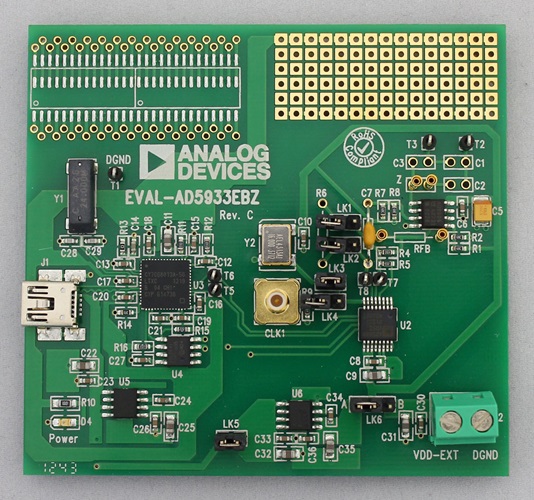


Overview
Design Resources
Design & Integration File
- Schematic
- Bill of Materials
- Gerber Files
- PADS Files
- Assembly Drawing
Evaluation Hardware
Part Numbers with "Z" indicate RoHS Compliance. Boards checked are needed to evaluate this circuit.
- EVAL-AD5933EBZ ($82.26) High Accuracy Impedance Measurements Using 12-Bit Impedance Converters
Device Drivers
Software such as C code and/or FPGA code, used to communicate with component's digital interface.
Features & Benefits
- High accuracy impedance measurement
- Complex impedance measurments using internal frequency generator
- Measure up to several hundred k-ohms
Product Categories
Markets and Technologies
Parts Used
Documentation & Resources
-
UG-364: Evaluating the AD5933 1 MSPS, 12-Bit Impedance Converter Network Analyzer2/27/2012PDF1202 kB
-
Fundamentals of Direct Digital Synthesis (DDS)2/14/2015PDF173 kB
-
CN-0217: High Accuracy Impedance Measurements Using 12-Bit Impedance Converters7/26/2011PDF253 kB
Circuit Function & Benefits
The circuit shown in Figure 1 yields accurate impedance measurements extending from the low ohm range to several hundred kΩ and also optimizes the overall accuracy of the AD5933/AD5934.

Figure 1. Optimized Signal Chain for Impedance Measurement Accuracy (Simplified Schematic, All Connections and Decoupling Not Shown)
Circuit Description
Table 1. Output Series Resistance, ROUT, vs. Excitation Range for VDD = 3.3 V Supply Voltage
| Range | Output Excitation Amplitude | Output Resistance, ROUT |
| Range 1 | 1.98V p-p | 200 Ω typ |
| Range 2 | 0.97V p-p | 2.4 kΩ typ |
| Range 3 | 0.383V p-p | 1.0 kΩ typ |
| Range 4 | 0.198V p-p | 600 Ω typ |
This output impedance impacts the impedance measurement accuracy, particularly in the low kΩ range, and should be taken into account when calculating the gain factor. Please refer to the AD5933 or AD5934 data sheets for more details on gain factor calculation. A simple buffer in the signal chain prevents the output impedance from affecting the unknown impedance measurement. A low output impedance amplifier should be selected with sufficient bandwidth to accommodate the AD5933/AD5934 excitation frequency. An example of the low output impedance achievable is shown in Figure 2 for the AD8605/ AD8606/ AD8608 family of CMOS op amps. The output impedance for this amplifier for an AV of 1 is less than 1 Ω up to 100 kHz, which is the maximum operating range of the AD5933/AD5934.

Matching the DC Bias of Transmit Stage to Receive Stage
The four programmable output voltage ranges in the AD5933/ AD5934 have four associated bias voltages (Table 2). For example, the 1.98 V p-p excitation voltage has a bias of 1.48 V. However, the current-to-voltage (I-V) receive stage of the AD5933/AD5934 is set to a fixed bias of VDD/2 as shown in Figure 1. Thus, for a 3.3 V supply, the transmit bias voltage is 1.48 V, while the receive bias voltage is 3.3 V/2 = 1.65 V. This potential difference polarizes the impedance under test and can cause inaccuracies in the impedance measurement.
One solution is to add a simple high-pass filter with a corner
frequency in the low Hz range. Removing the dc bias from the
transmit stage and re-biasing the ac signal to VDD/2 keeps the
dc level constant throughout the signal chain.
Table 2. Output Levels and Respective DC Bias for VDD = 3.3 V Supply Voltage
| Range | Output Excitation Amplitude | Output DC Bias Level |
| 1 | 1.98V p-p | 1.48V |
| 2 | 0.97V p-p | 0.76V |
| 3 | 0.383V p-p | 0.31V |
| 4 | 0.198V p-p | 0.173V |
Selecting an Optimized I-V Buffer for the Receive Stage
The current-to-voltage (I-V) amplifier stage of the AD5933/AD5934 can also add minor inaccuracies to the signal chain. The I-V conversion stage is sensitive to the amplifier's bias current, offset voltage, and CMRR. By selecting the proper external discrete amplifier to perform the I-V conversion, the user can choose an amplifier with lower bias current and offset voltage specifications along with excellent CMRR, making the I-V conversion more accurate. The internal amplifier can then be configured as a simple inverting gain stage.
Selection of resistor RFB still depends on the gain through the
system as described in the AD5933/AD5934 data sheet.
Optimized Signal Chain for High Accuracy Impedance Measurements
Figure 1 shows a proposed configuration for measuring low
impedance sensors. The ac signal is high-pass filtered and rebiased
before buffering with a very low output impedance
amplifier. The I-V conversion is completed externally before the
signal returns to the AD5933/AD5934 receive stage. Key
specifications that determine the required buffer are very low
output impedance, single-supply capability, low bias current,
low offset voltage, and excellent CMRR performance. Some
suggested parts are the ADA4528-1, AD8628/AD8629, AD8605, and AD8606. Depending on board layout, use a single-channel
or dual-channel amplifier. Use precision 0.1% resistors for both
the biasing resistors (50 kΩ) and gain resistors (20 kΩ and RFB)
to reduce inaccuracies.
Common Variations
Switching Options for System Applications
For this particular circuit, the ZUNKNOWN and RCAL were interchanged manually. However, in production, a low on-resistance switch should be used. The choice of the switch
depends on how large the unknown impedance range is and
how accurate the measurement result needs to be. The examples
in this document use just one calibration resistor, and so a low
on-resistance switch such as the ADG849 can be used as shown
in Figure 13. Multichannel switch solutions such as the quad ADG812 can also be used. The errors caused by the switch
resistance on the ZUNKNOWN are removed during calibration, but by choosing a very low RON switch, the effects can be further minimized.

Figure 13. Switching Between RCAL and Unknown Z Using the ADG849 UltraLow RON SPDT Switch (Simplified Schematic, All Connections and Decoupling Not Shown)
Circuit Evaluation & Test
Example 1: Low Impedance Range
Table 3. Low Impedance Range Setup for VDD = 3.3 V Supply Voltage
| Parameter | Value |
| V p-p | 1.98V (Range 1) |
| Number of Settling Time Cycles | 15 |
| MCLK | 16 MHz |
| RCAL | 20.1Ω |
| RFB | 20.0Ω |
| Excitation Frequency Range | 30 kHz to 30.2 kHz |
| Unknown Impedances | R1 = 10.3Ω, R2 = 30.0Ω, C3 = 1 µF (ZC = 5.3Ω< at 30 kHz) |
The results of the low impedance measurements are shown in Figure 3, Figure 4, and Figure 5. Figure 5 is for the 10.3 Ω measurement and is shown on an expanded vertical scale.
The accuracy achieved is very much dependent on how large the unknown impedance range is relative to the calibration resistor, RCAL. Therefore, in this example, the unknown impedance of 10.3 Ω measured 10.13 Ω, an approximate 2% error. Choosing an RCAL closer to the unknown impedance achieves a more accurate measurement; that is, the smaller the unknown impedance range is centered around RCAL is, the more accurate the measurement. Consequently, for large unknown impedance ranges, it is possible to switch in various RCAL resistors to break up the unknown impedance range using external switches. The RON error of the switch is removed by calibration during the RCAL gain factor calculation. Using a switch to select various RFB values can optimize the dynamic range of the signal seen by the ADC.
Also note that to achieve a wider range of measurements a 200 mV p-p range was used. If the unknown Z is a small range, a larger output voltage range can be used to optimize the ADC dynamic range.

Figure 3. Measured Low Impedance Magnitude Results


Example 2: kΩ Impedance Range
Using an RCAL of 99.85 kΩ, a wide range of unknown impedances were measured according to the setup conditions listed
in Table 2. Figure 6 to Figure 10 document accuracy results.
To improve the overall accuracy, select an RCAL value closer to the unknown impedance. For example, in Figure 9, an RCAL closer to the ZC value of 217.5 kΩ is required. If the unknown impedance range is large, use more than one RCAL resistor.
| Parameter | Value |
| V p-p | 0.198V (Range 4) |
| Number of Settling Time Cycles | 15 |
| MCLK | 16 MHz |
| RCAL | 99.85 kΩ |
| RFB | 100 kΩ |
| Excitation Frequency Range | 30 kHz to 50 kHz |
| Unknown Impedances | R0 = 99.85 kΩ R1 = 29.88 kΩ R2 = 14.95 kΩ R3 = 8.21 kΩ R4 = 217.25 kΩ C5 = 150 pF (ZC = 26.5 kΩ at 40 kHz) C6 = 47pF (ZC = 84.6 kΩ at 40 kHz) |

Figure 6. Magnitude Result for ZC = 47 pF, RCAL = 99.85 kΩ


Example 3: Parallel R-C (R||C) Measurement
An R||C type measurement was also made using the configuration, using an RCAL of 1 kΩ, an R of 10 kΩ, and a C of 10 nF, measured across a frequency range of 4 kHz to 100 kHz. The magnitude and phase results versus ideal are plotted in Figure 11 and Figure 12.
Table 5. R||C Impedance Range Setup for VDD = 3.3 V Supply Voltage
| Parameter | Value |
| V p-p | 0.383V (Range 3) |
| Number of Settling Time Cycles | 15 |
| MCLK | 16 MHz |
| RCAL | 1 kΩ |
| RFB | 1 kΩ |
| Excitation Frequency Range | 4 kHz to 100 kHz |
| Unknown Impedance R||C |
R = 10 kΩ C = 10 nF |

Figure 11. Magnitude Results for ZC = 10 kΩ||10 nF, RCAL = 1 kΩ


Setup and Test
The evaluation software is that used on
the EVAL-AD5933EBZ application board. Please refer to the
technical note available on the CD provided for details on the
board setup. Note that there are alterations to the schematic.
Link connections on the EVAL-AD5933EBZ board are listed
below in Table 4. Also note that the location for RFB is located
at R3 on the evaluation board, and the location for ZUNKNOWN is C4.
Table 6. Link Connections for EVAL-AD5933EBZ
| Link Number | Default Position |
| LK1 | Open |
| LK2 | Open |
| LK3 | Insert |
| LK4 | Open |
| LK5 | Insert |
| LK6 | A |