MAX32690

RECOMMENDED FOR NEW DESIGNS

Arm Cortex-M4 with FPU Microcontroller and Bluetooth LE 5 for Industrial and Wearables

Viewing:

Overview

  • Ultra-Efficient Microcontroller for Battery-Powered Applications
    • 120MHz Arm Cortex-M4 Processor with FPU
    • Ultra-Low-Power, 32-Bit RISC-V (RV32) Coprocessor Available to Offload Data Processing
    • Multiple Internal Low-Power Oscillators
    • 32.768kHz RTC Clock (Requires External Crystal)
    • 3.25MB Internal Flash, 1MB Internal SRAM
    • 85μW/MHz ACTIVE Mode at 1.1V
    • 1.8V and 3.3V I/O with No Level Translators
    • External Flash and SRAM Expansion Interfaces
  • Bluetooth 5.2 LE Radio
    • Fully Open-Source Bluetooth 5.2 Stack Available
    • High-Throughput (2Mbps) Mode
    • Long-Range (125kbps and 500kbps) Modes
    • Rx Sensitivity: -97dBm; Tx Power: +4.5dBm
    • Single-Ended Antenna Connection (50Ω)
    • 32MHz External Crystal Required
  • Optimal Peripheral Mix Provides Platform Scalability
    • 16-Channel DMA
    • Up to Five Quad-SPI Controllers/Targets
    • Up to Four UARTs with Flow Control
    • Up to Three I2C Interfaces
    • I2S Interface
    • Up to Eight External Channel, 12-Bit 1Msps SAR ADCs with Temperature Sensor Channel
    • USB 2.0 Hi-Speed Device
    • Up to 16 Pulse Train Engines
    • Up to Four 32-Bit/Dual 16-Bit Timers with 8mA High Drive
    • Up to Two 32-Bit/Dual 16-Bit Low-Power Timers
    • Two CAN 2.0B Controllers
    • Up to Four Micropower Comparators
    • 1-Wire Controller
  • Cryptographic Tool Box (CTB) for IP/Data Security
    • AES-128/192/256, SHA-2 Engine, MAA, TRNG
  • Extensive Security Features
    • Arm Memory Protection Unit (MPU)
    • Memory Decryption Integrity Unit (MDIU) for External SPI Memory
    • Physically Unclonable Function (PUF)
    • 128-Bit Unique Serial Number (USN)
  • Optional Secure Communications Protocol Bootloader (SCPBL)
MAX32690
Arm Cortex-M4 with FPU Microcontroller and Bluetooth LE 5 for Industrial and Wearables
MAX32690 Simplified Block Diagram MAX32690 TQFN Pin Configuration MAX32690 WLP Pin Configuration
Add to myAnalog

Add product to the Products section of myAnalog (to receive notifications), to an existing project or to a new project.

Create New Project
Ask a Question

Documentation

Learn More
Add to myAnalog

Add media to the Resources section of myAnalog, to an existing project or to a new project.

Create New Project

Software Resources


Tools & Simulations


Evaluation Kits

eval board
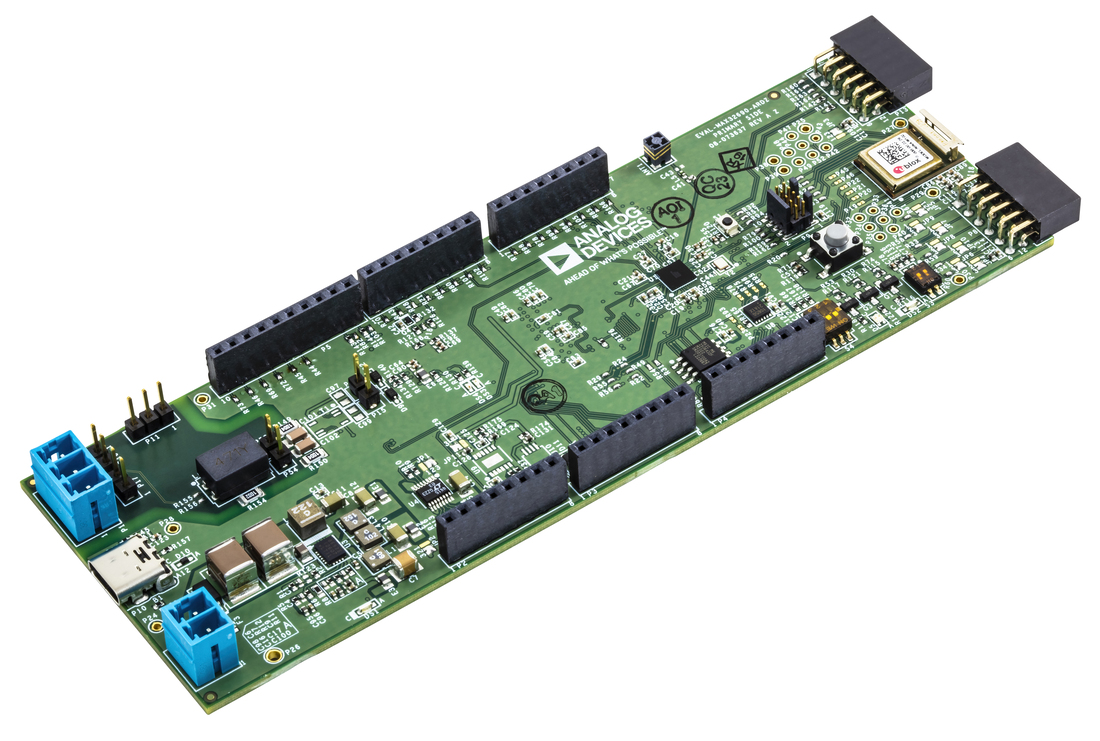
AD-APARD32690-SL

Arduino Form-factor Development Platform Based on MAX32690 ARM Cortex-M4 Microcontroller

Features and Benefits

  • Allows prototyping of intelligent, secure, and connected industrial field devices
  • Arduino Mega-compatible form factor
  • Two Pmod™-compatible connectors
  • ARM Cortex-M4 Ultra Efficient Microcontroller with integrated Bluetooth 5.2 LE
  • WiFi connectivity
  • Long-range, single-pair 10BASE-T1L Ethernet interface
  • Built-in security for root-of-trust, mutual authentication, data confidentiality and integrity, secure boot, and secure communications
  • Open-source software stack

Product Details

The AD-APARD32690-SL is a platform for prototyping intelligent, secure, and connected field devices. It has an Arduino Mega-compatible form factor and two Pmod™-compatible connectors.

The system includes the MAX32690 ARM Cortex-M4 with FPU-Based Microcontroller and Bluetooth LE 5.2. The MCU is coupled with external RAM (2 x 512 Mb) and Flash (64 Mb) memories to meet the requirements of the most demanding applications. The MAXQ1065 security coprocessor enables state of the art security features such as for root-of-trust, mutual authentication, data confidentiality and integrity, secure boot, and secure communications.

A 10 Mbps single-pair Ethernet link using the ADIN1110 10BASE-T1L MAC/PHY, enables remote data acquisition and system configuration. The 10BASE-T1L interface also supports Single-pair Power over Ethernet (SPoE) and be used for powering the system via an Arduino shield implementing the required power circuitry.

WiFi connectivity is provided via the on-board NINA-W102 multiradio wireless MCU module with internal antenna.

Power can be supplied either via the USB-C connector or via a 2-pin terminal block. The supported input voltage range is 5 V to 28 V.

The system is accompanied by an open-source software stack and associated collateral, enabling a complete experience from evaluation, and prototyping, all the way to production firmware and application development. The open-source software stack also includes drivers and example applications for a wide variety of ADCs, DACs, sensors, and other devices commonly used in industrial applications, further accelerating the development process. An external programmer such as the MAX32625PICO DAPLink, or any other similar programmer supporting the SWD interface, enables firmware programming and debug. The system’s firmware is based on Analog Devices’ open-source no-OS framework which includes all the tools required for embedded code development and debugging as well as libraries, enabling host-side connectivity for system configuration and data transfer over the UART, USB, WiFi, and 10BASE-T1L interfaces.

APPLICATIONS

  • Factory automation
  • Process control
  • Intelligent buildings
  • Secure field instruments
  • Internet of Things

eval board
MAX32690EVKIT

MAX32690 Evaluation Kit

Features and Benefits

  • Bluetooth SMA Connector with a Hinged 2.4GHz Whip Antenna
  • 3-Pin Terminal Block for CAN Bus 2.0
  • Selectable On-Board High-Precision Voltage Reference
  • On-Board HyperRAM
  • Stereo Audio Codec with Line-In and Line-Out 3.5mm Jacks
  • 128 x 128 (1.45in) Color TFT Display
  • USB 2.0 Micro-B Interface to the MAX32690
  • USB 2.0 Micro-B to Serial UART
  • Board Power Provided by either USB Port
  • Jumpers to Enable Optional Pull-Up Resistors on I2C port
  • All GPIOs Signals Accessed through 0.1in Headers
  • Three Analog Inputs Accessed through 0.1in Headers with Optional Filtering
  • SWD 10-Pin Header
  • On-Board 3.3V, 1.8V, and 1.1V LDO Regulators
  • Individual Power Measurement on All IC Rails through Jumpers
  • Two General-Purpose LEDs and One General-Purpose Push Button Switch

Product Details

The MAX32690 evaluation kit (EV kit) provides a platform for evaluating the capabilities of the MAX32690 microcontroller, which is an advanced system-on-chip (SoC). It features an Arm® Cortex®-M4F CPU for efficient computation of complex functions and algorithms, and the latest generation Bluetooth® 5 Low Energy (Bluetooth LE) radio designed for wearable and hearable fitness devices, portable and wearable wireless medical devices, industrial sensors/networks, internet of things (IoT), and asset tracking.

eval board
EVAL-ESS1-SYS

Scalable BMS Kit for Cell and Pack Monitoring

Features and Benefits

  • Accurate voltage and current measurement
  • Highly scalable and ease of integration
  • Robust isoSPI capability implementable in daisy chain high count
  • Inclusive passive balancing with individual pulse-width modulation
  • Isolated power supply between microcontroller and battery monitoring devices
  • High voltage and current supply measurement
  • Fast overcurrent (OC) measurement
  • Redundancy measurement
  • Modular BMS Solution

Product Details

The EVAL-ESS1-SYS Solution Kit contains all the necessary building blocks to create a complete BMS solution stack.

The accompanying PC-based graphical user interface provides an intuitive interface that allows the user to configure the BMS signal chain components and view cell and stack voltage and current measurement results.

The package includes one application processor (AD-APARD32690-SL), one dual isoSPI adapter (EVAL-ADBMS6822), two 16-cell battery monitors (EV-ADES1830CCSZ), two 16-cell battery emulators (DC2472A), and one battery pack monitor (EVAL-ADBMS2950-BASIC).

Upon purchase, the EVAL-ESS1-SYS kit comes with the following boards and accessories:

Boards

  • 2x EV-ADES1830CCSZ 16-Channel Battery Cell Monitor
  • 2x DC2472A Battery Cell Emulator with harness fitted
  • 1x EVAL-ADBMS2950-BASIC Battery Pack Monitor
  • 1x EVAL-ADBMS6822 Dual isoSPI Adapter
  • 1x AD-APARD32690-SL ARM Cortex M4 Controller Board
  • 1x AD-USB2.0T1L-EBZ
  • 1x MAX32625PICO Programming Adapter with 10-pin SWD cable

Cables and Other Accessories

  • 1x RJ45-to-RJ45
  • 2x DuraClik-to-RJ45 Twisted Pair Cables
  • 3x DuraClik isoSPI Twisted Pair Cables
  • 3x USB Type A to Micro-B Cable
  • 1x USB A to C-Type Cable
  • 1x T1L STP Cable

APPLICATIONS

  • IoT Battery Management
  • Industrial Machine Vision
  • Power Tools
  • Mobile Robotics Battery Management
  • Industrial Equipment Battery Monitoring
  • Adaptive Battery Type System Monitoring
  • Portable Energy Storage Systems

eval board
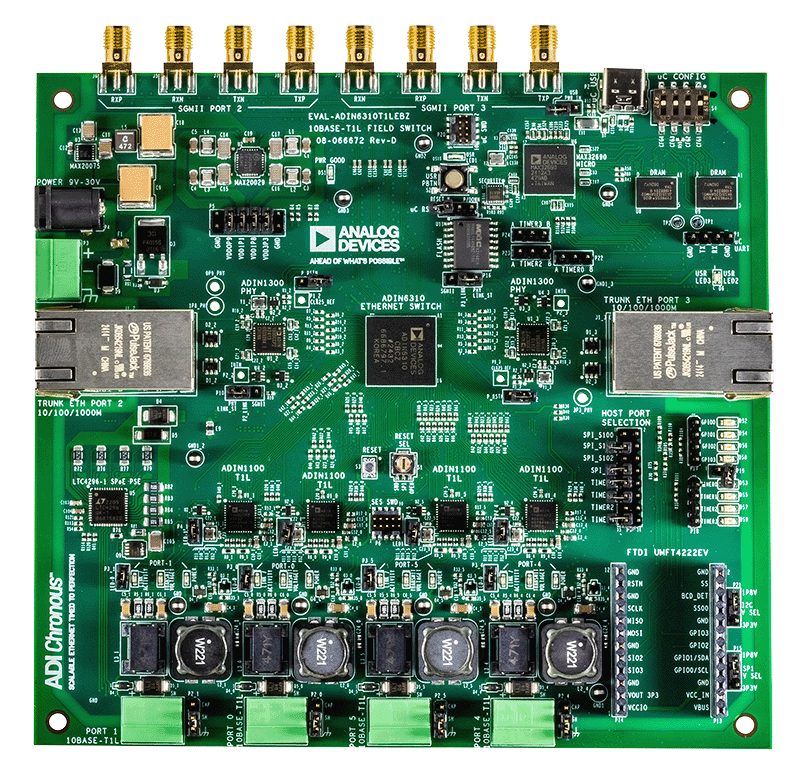
EVAL-ADIN6310T1LEBZ

ADIN6310 Field Switch Reference Design User Guide

Features and Benefits

  • 6 port Ethernet switch ADIN6310
    • 2Gb trunk ports; SGMII by SMA or ADIN1300 by RGMII
    • 4 spur 10BASE-T1L ports, ADIN1100 by RGMII
  • IEEE 802.3cg-compliant SPoE PSE controller, LTC4296-1
    • Power Class 12
    • Power classification by SCCP (not enabled)
  • Arm® Cortex®-M4 microcontroller, MAX32690
    • External flash and RAM
  • Zephyr open source software project
  • Unmanaged mode with basic switch and PSE power
    • VLAN IDs 1-10 enabled on all ports
    • Power coupled to 10BASE-T1L cable for all spur ports
    • DIP switch options to enable other features (Time Sync, LLDP, IGMP Snooping)
  • Managed mode using switch evaluation package TSN/Redundancy evaluations
  • Time sensitive networking (TSN) capable
    • Scheduled traffic (IEEE 802.1Qbv)
    • Frame preemption (IEEE 802.1Qbu)
    • Per stream filtering and policing (IEEE 802.1Qci)
    • Frame replication and elimination for reliability (IEEE 802.1CB)
  • IEEE 802.1AS 2020 time synchronization
  • Redundancy capabilities
    • High availability seamless redundancy (HSR)
    • Parallel redundancy protocol (PRP)
    • Media redundancy protocol (MRP)
  • Host interface hardware strapping with jumpers, choice of
    • Single/Dual/Quad SPI interface
    • 10Mbps/100Mbps/1000Mbps Ethernet port (Port 2/Port 3)
    • SGMII/100BASE-FX/1000BASE-KX
    • Header for direct SPI access (Single/Dual/Quad)
  • Scale port count by cascading by RJ45 or SGMII/1000BASE-KX/ 100BASE-FX
  • PHY strapping by surface-mount configuration resistors
    • Default state is software power down for spur Ports
  • Switch firmware manages PHY operation over MDIO
  • Operates from a single, external 9V to 30V supply
  • LED indicators on GPIO, TIMER pins

Product Details

This user guide describes the ADIN6310 Field switch evaluation board with support for four 10BASE-T1L spur ports and two standard Gigabit capable Ethernet trunk ports. The hardware includes single-pair power over Ethernet (SPoE) LTC4296-1 circuit with optional serial communication classification protocol (SCCP) support. The default operation of the hardware is an unmanaged mode where the MAX32690 Arm Cortex-M4 microcontroller configures the switch into a basic switching mode and the PSE configured for Class 12 operation. Enhance the unmanaged switch operation by the DIP switch (S4), which provides ability to enable features such as time synchronization, LLDP, or IGMP snooping by default. Disable the PSE by using the DIP switch, default is enabled.

For more extensive switch evaluation, refer to the TSN switch evaluation package available from the ADIN6310 product page. This evaluation package provides ability to exercise the TSN functionality in addition to Redundancy features.

eval board
AD-EthernetAPLDevice-SL

Complete Ethernet-APL Field Device Platform

Features and Benefits

  • DIN B compatible design allows easy prototyping of Ethernet-APL field devices
  • Designed and certified for Intrinsic safety (I.S.), Ex ia IIC Ga
  • Tested for Ethernet-APL compliance (IEEE 802.3cg-2019)
  • Functional Safety ready (SIL-2) with hardware diagnostics and FMEDA documentation
  • Highly efficient solution maximizing power available to the field device
  • Extensive security features: built-in security for hardware root-of-trust, data confidentiality and integrity, and secure communications
  • Open-source software stack
  • Supports PROFINET, Ethernet-IP, MQTT
  • The kit includes 3 boards, I.S. certified boards and a third one to enable access to the RISC-V JTAG debugger.
  • Programmers for ARM and RISC-V included

Product Details

AD-EthernetAPLDevice-SL is a complete Ethernet-APL field platform designed for prototyping intelligent, secure, and connected field devices.

The platform is certified for intrinsic safety (Ex ia IIC Ga) and tested for Ethernet-APL compliance. It is also functional safety ready (SIL2), featuring the MAX42500 voltage monitor, with integrated windowing watchdog, the MAX6613 temperature sensor, the ADFS7124-4 sigma-delta ADC functional safety approved to SC3, and complete FMEDA documentation.

The system integrates the MAX32690—a dual-core ARM Cortex-M4 with FPU and a RISC-V co-processor. This MCU is paired with external RAM (512 Mb) and Flash (64 Mb) to meet the demands of high-performance applications.

A 10 Mbps single-pair Ethernet link, enabled by the ADIN1110 10BASE-T1L MAC/PHY, supports remote data acquisition and system configuration.

The platform is APL-compliant and powered via Single-Pair Power over Ethernet (SPoE), supporting an input voltage range of 9 V to 15 V. It is recommended to use the DEMO-ADIN1100D2Z as both the power source and media converter for Ethernet signals (10BASE-T1L ↔ 10BASE-T).

The kit includes a third, non-intrinsically safe board that provides access to the RISC-V JTAG interface for debugging.

An open-source software stack and supporting collateral are included, enabling seamless experience from evaluation and prototyping to production firmware and application development. The stack includes drivers and example applications for a wide range of ADCs, DACs, sensors, and other industrial components, accelerating development.

The platform supports Zephyr (with an available board definition) and is also supported in Code Fusion Studio.

An example PROFINET stack software application is available to enable easy evaluation and system prototyping (myanalog.com registration required).

APPLICATIONS

  • Process automation
  • Factory automation
  • Field instruments
  • Internet of Things

eval board
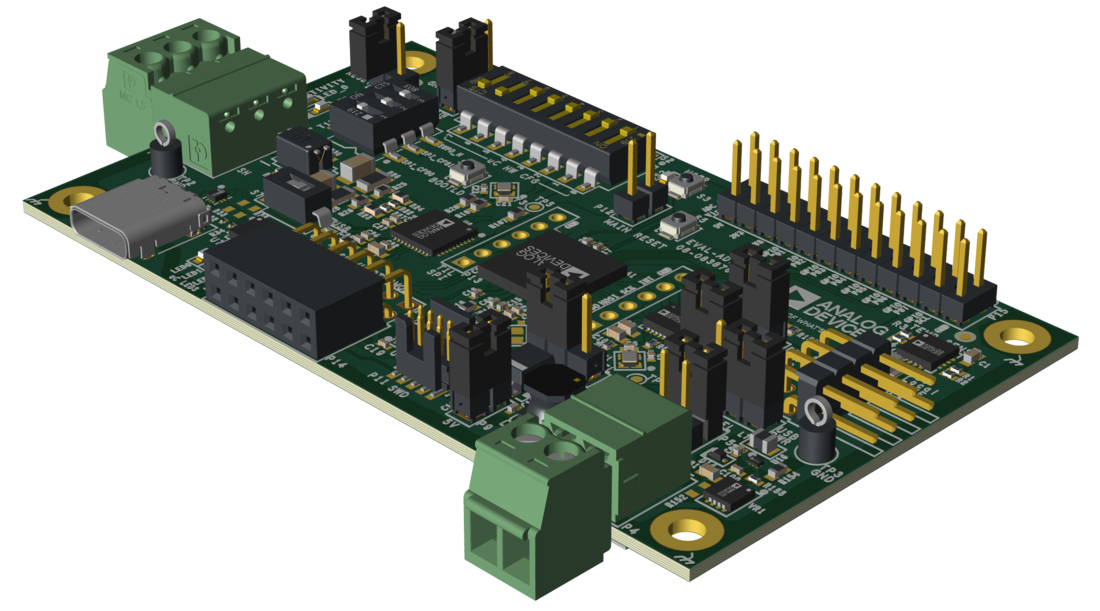
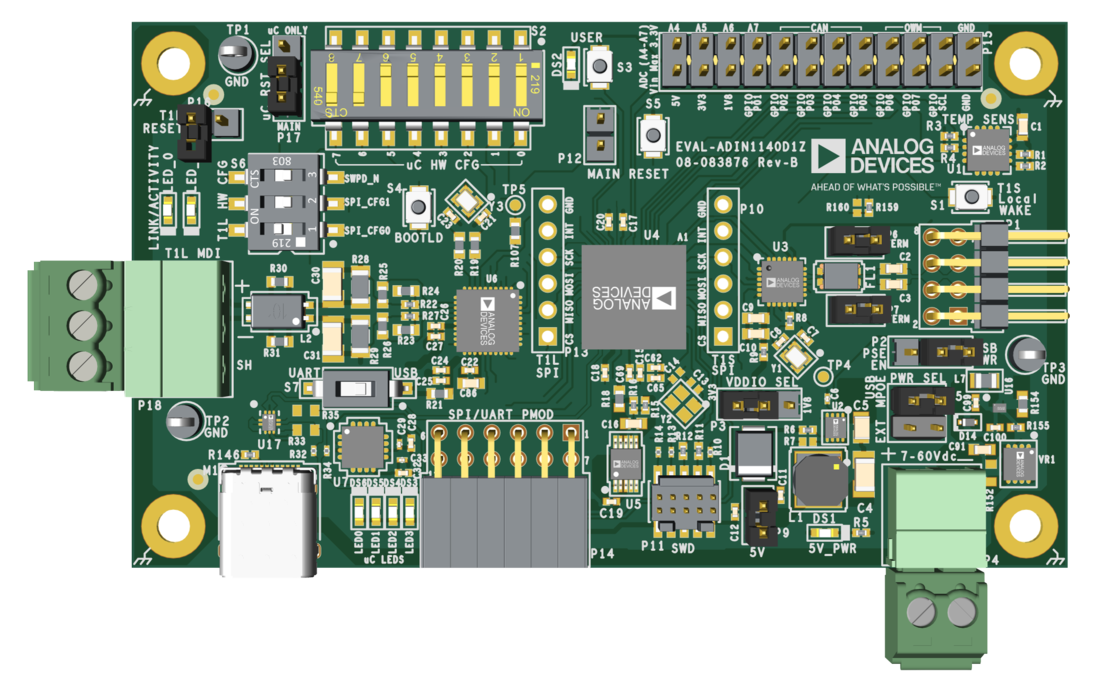
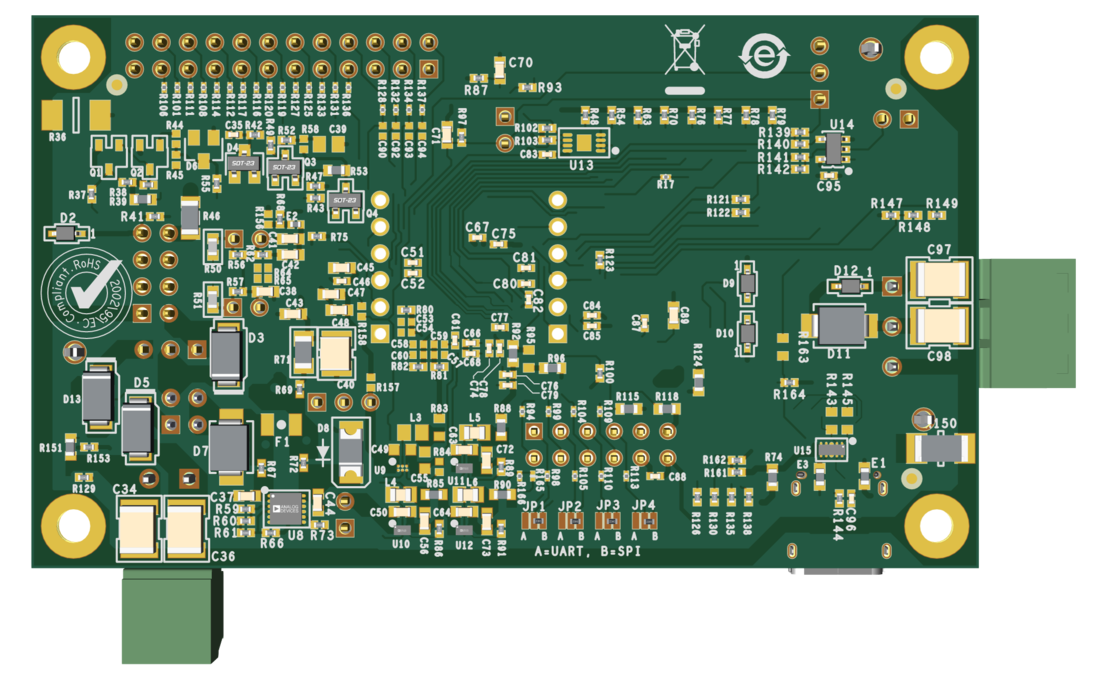
EVAL-ADIN1140D1Z

Evaluating the ADIN1140 10BASE-T1S Industrial Multidrop Evaluation Platform Board

Features and Benefits

  • User friendly evaluation for the ADIN1140 MAC-PHY features
  • 10BASE-T1S to 10BASE-T1L media converter
  • USB to 10BASE-T1S bridge
  • LwIP web server and MQTT operation
  • On-board Arm® Cortex®-M4 MAX32690 microcontroller

Product Details

The EVAL-ADIN1140D1Z is a platform for evaluating the ADIN1140 10BASE-T1S MAC-PHY, which provides half-duplex 10Mbps Single Pair Ethernet (SPE) connectivity to devices compliant with the IEEE 802.3cg Ethernet standard.

The EVAL-ADIN1140D1Z includes firmware that enables it to function as a USB to 10BASE-T1S media converter, a 10BASE-T1L to 10BASE-T1S media converter, or as a sensor node supporting MQTT communication.

When used as a USB to 10BASE-T1S media adapter, simply connect the evaluation board to a host PC via USB. Once connected, the PC recognizes the board as a new network adapter. This adapter can then be configured to access the 10BASE-T1S network connected to it.

When configured as a 10BASE-T1L to 10BASE-T1S media converter, the Ethernet frames flows seamlessly from the 10BASE-T1L port to the 10BASE-T1S port and vice versa using on-board MAX32690.

When configured as a sensor node, the board runs an MQTT application and a web server that can be accessed via the board’s IP address. The board publishes its on-board temperature sensor data and other board information over MQTT, which can be viewed using the provided Windows application.

Full specifications on the ADIN1140 are available in the ADIN1140 data sheet available from Analog Devices, Inc., and must be consulted with ADIN1140 tech ref, ADIN1140 register control manual, and this user guide when using the EVAL-ADIN1140D1Z evaluation board.

AD-APARD32690-SL
Arduino Form-factor Development Platform Based on MAX32690 ARM Cortex-M4 Microcontroller
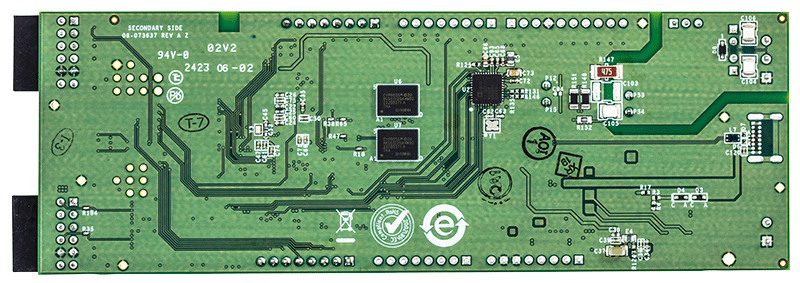
AD-APARD32690-SL Block Diagram EVAL-MAX32690 ARDZ Angle EVAL-MAX32690-ARDZ Top EVAL-MAX32690-ARDZ Bottom
MAX32690EVKIT
MAX32690 Evaluation Kit
MAX32690EVKIT - Top View MAX32690EVKIT - Bottom View
EVAL-ESS1-SYS
Scalable BMS Kit for Cell and Pack Monitoring
EVAL-ESS1-SYS Kit Photo Angle View EVAL-ESS1-SYS-KIT Board Photo Top View EV-ADES1830 Board Photo Angle View EVAL-ADBMS2950 BASIC Board Photo Angle View EVAL-ADBMS6822 Board Photo Angle View EVAL-MAX32690-ARDZ Board Photo Angle View DC2472A Board Photo Angle View EVAL-ESS1-SYS Block Diagram
EVAL-ADIN6310T1LEBZ
ADIN6310 Field Switch Reference Design User Guide
EVAL-ADIN6310T1LEBZ Evaluation Board Photo Angle View EVAL-ADIN6310T1LEBZ Evaluation Board Photo Top View EVAL-ADIN6310T1LEBZ Evaluation Board Photo Bottom View
AD-EthernetAPLDevice-SL
Complete Ethernet-APL Field Device Platform
AD-EthernetAPLDevice-SL Eval Board Top Angle View AD-EthernetAPLDevice-SL Hockeypuck Block Diagram
EVAL-ADIN1140D1Z
Evaluating the ADIN1140 10BASE-T1S Industrial Multidrop Evaluation Platform Board
EVAL-ADIN1140D1Z Eval Board Angle View EVAL-ADIN1140D1Z Eval Board Top View EVAL-ADIN1140D1Z Eval Board Bottom View

Latest Discussions

Recently Viewed