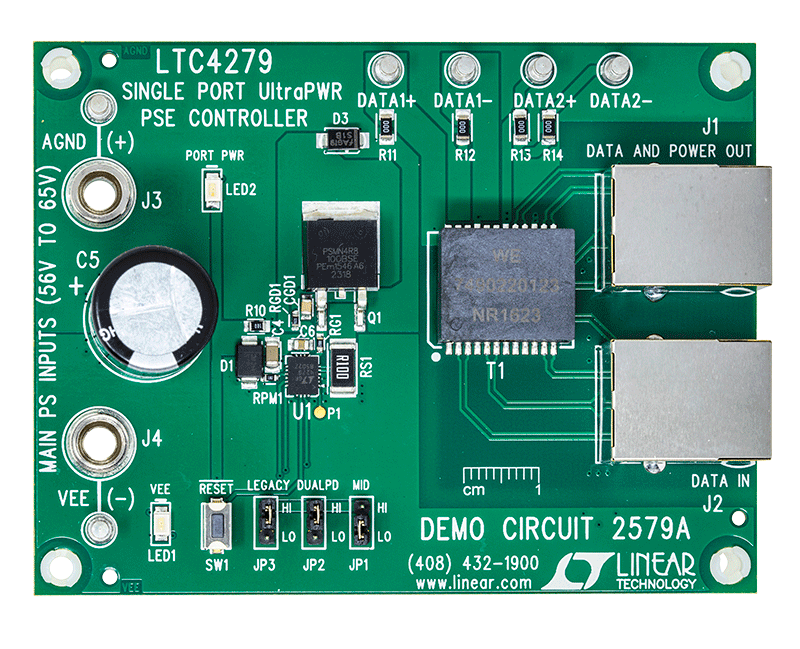
LTC4279
PRODUCTIONSingle Port PoE/PoE+/LTPoE++ PSE Controller
- Part Models
- 4
- 1ku List Price
- Starting From $4.75
Overview
- Compliant with IEEE 802.3at Type 1 and 2
- Supports LTPoE++® Up to 90W
- Supports Dual-Signature PDs
- Fully Autonomous Operation without Microcontroller
- Very Low Power Dissipation
- 0.1Ω Sense Resistance
- Low RDS(ON) External MOSFET
- Very High Reliability 4-Point PD Detection
- 2-Point Forced Voltage and Forced Current
- Robust Short-Circuit Protection
- Cable Surge Protected ±80V OUT pin
- Classification Dependent ICUT and ILIM Current Thresholds
- Supports 2-Pair and 4-Pair Output Power
- UltraPWR Mode Supports Custom PDs up to 123W
- Pin-Selectable Detection Backoff Timer for Midspans
- Pin Programmable Legacy PD Detection
- Pin Programmable Maximum Power Mode
- Status LED Pin
- Available in 20-Pin QFN and 16-Pin SO Packages
The LTC4279 is an autonomous single port power sourcing equipment (PSE) controller designed for use in IEEE 802.3at Type 1, Type 2 and LTPoE++ compliant Power over Ethernet (PoE) systems. The LTC4279 provides fully autonomous IEEE 802.3 and LTPoE++ compliant operation without a microcontroller. The LTC4279 simplifies PSE implementation, requiring only a single supply and a small number of passive support components.
The LTC4279 delivers lowest-in-industry heat dissipation by utilizing a low-RDS(ON) external MOSFET and a 0.1Ω sense resistor, eliminating the need for expensive heat sinks and increasing efficiency.
PD discovery uses a proprietary dual-mode 4-point detection mechanism ensuring excellent immunity from false PD detection. Midspan PSEs are supported with physical layer classification and a 2.5 second backoff timer.
Legacy and custom PDs are supported with pin-selectable LEGACY and UltraPWR modes. LEGACY mode detects and powers pre-IEEE specification PDs. UltraPWR mode aggressively turns on and powers custom PDs requiring high inrush and/or operational currents.
Applications
- PoE PSE Endpoints (Switch/Router)
- PoE Midspan Power Injectors
- Power Forwarders
- Femto Cells
- Security Systems
Documentation
Data Sheet 1
User Guide 2
Video 1
Product Selector Card 1
ADI has always placed the highest emphasis on delivering products that meet the maximum levels of quality and reliability. We achieve this by incorporating quality and reliability checks in every scope of product and process design, and in the manufacturing process as well. "Zero defects" for shipped products is always our goal. View our quality and reliability program and certifications for more information.
| Part Model | Pin/Package Drawing | Documentation | CAD Symbols, Footprints, and 3D Models |
|---|---|---|---|
| LTC4279IS#PBF | 16-Lead SOIC (Narrow 0.15 Inch) | ||
| LTC4279IS#TRPBF | 16-Lead SOIC (Narrow 0.15 Inch) | ||
| LTC4279IUFD#PBF | 20-Lead QFN (4mm x 5mm x 0.75mm w/ EP) | ||
| LTC4279IUFD#TRPBF | 20-Lead QFN (4mm x 5mm x 0.75mm w/ EP) |
| Part Models | Product Lifecycle | PCN |
|---|---|---|
|
Oct 24, 2024 - 24_0246 Migrating Bottom Trace Code Marking to Top Side Laser Marking for SOIC_N Package |
||
| LTC4279IS#PBF | PRODUCTION | |
| LTC4279IS#TRPBF | PRODUCTION | |
|
Oct 12, 2022 - 22_0252 Epoxy Change from Henkel 8290 to 8290A for 16-Lead SOIC Package |
||
| LTC4279IS#PBF | PRODUCTION | |
| LTC4279IS#TRPBF | PRODUCTION | |
|
Aug 6, 2022 - 22_0173 Laser Top Mark Conversion for SOICN14 and SOICN16 Packages Assembled on ADPG [PNG] |
||
| LTC4279IS#PBF | PRODUCTION | |
| LTC4279IS#TRPBF | PRODUCTION | |
This is the most up-to-date revision of the Data Sheet.
Software Resources
Can't find the software or driver you need?
Request a Driver/SoftwareHardware Ecosystem
| Parts | Product Life Cycle | Description |
|---|---|---|
| LTC4274 | PRODUCTION | Single PoE+ PSE Controller |
| LTC4274A/LTC4274C | PRODUCTION | Single PoE/PoE+/LTPoE++ PSE Controller |
Tools & Simulations
LTspice 1
Models for the following parts are available in LTspice:
- LTC4279
LTspice® is a powerful, fast and free simulation software, schematic capture and waveform viewer with enhancements and models for improving the simulation of analog circuits.