ADL8102

RECOMMENDED FOR NEW DESIGNS

GaAs, pHEMT, MMIC, Low Noise Amplifier, 1 GHz to 22 GHz

Viewing:

Overview

  • Single positive supply (self biased)
  • Gain: 27 dB typical at 9 GHz to 19 GHz
  • OP1dB: 13.5 dB typical at 1 GHz to 9 GHz
  • OIP3: 25 dBm typical at 1 GHz to 9 GHz
  • Noise figure: 2.5 dB typical at 9 GHz to 19 GHz
  • RoHS-compliant, 3 mm × 3 mm, 16-lead LFCSP

The ADL8102 is a gallium arsenide (GaAs), monolithic microwave integrated circuit (MMIC), pseudomorphic high electron mobility transistor (pHEMT), low noise wideband amplifier that operates from 1 GHz to 22 GHz.

The ADL8102 provides a typical gain of 27 dB at 9 GHz to 19 GHz, a 2.5 dB typical noise figure from 9 GHz to 19 GHz, a typical output third-order intercept (OIP3) of 25 dBm at 1 GHz to 9 GHz, and a saturated output power (PSAT) of up to 15.5 dBm, which requires only 110 mA from a 5 V supply voltage. The ADL8102 also features inputs and outputs that are internally matched to 50 Ω. The RFIN and RFOUT pins are internally AC-coupled, and the bias inductor is also integrated, which makes it ideal for surface-mounted technology (SMT)-based, high capacity microwave radio applications.

The ADL8102 is housed in an RoHS-compliant, 3 mm × 3 mm, 16-lead LFCSP package.

APPLICATIONS

  • Telecommunications
  • Satellite communications
  • Military radar
  • Weather radar
  • Civil radar
  • Electronic warfare
  • ADL8102
    GaAs, pHEMT, MMIC, Low Noise Amplifier, 1 GHz to 22 GHz
    ADL8102 - Functional Block Diagram ADL8102 - Pin Configuration
    Add to myAnalog

    Add product to the Products section of myAnalog (to receive notifications), to an existing project or to a new project.

    Create New Project
    Ask a Question

    Documentation

    Learn More
    Add to myAnalog

    Add media to the Resources section of myAnalog, to an existing project or to a new project.

    Create New Project

    Software Resources

    Can't find the software or driver you need?

    Request a Driver/Software

    Tools & Simulations


    Evaluation Kits

    eval board
    EVAL-ADL8102

    Evaluating the ADL8102 Wideband, Low Noise Amplifier, Single Positive Supply, 1 GHz to 20 GHz

    Features and Benefits

  • 2-layer Rogers 4350B evaluation board
  • End launch, 2.9 mm RF connectors
  • Through calibration path (depopulated)
  • Product Details

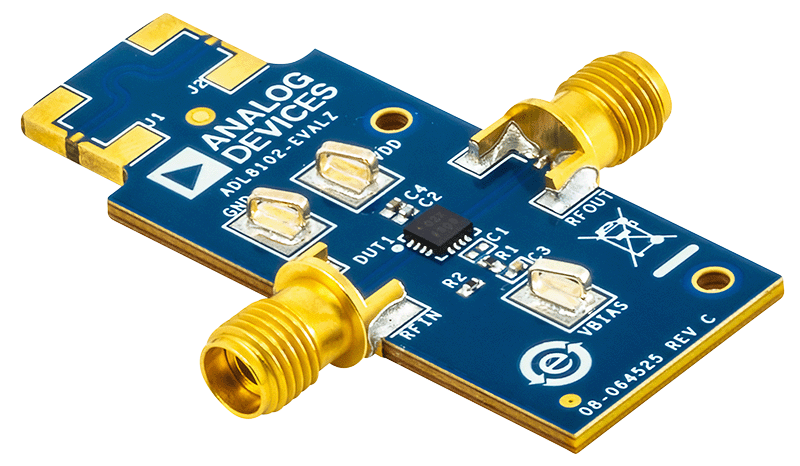
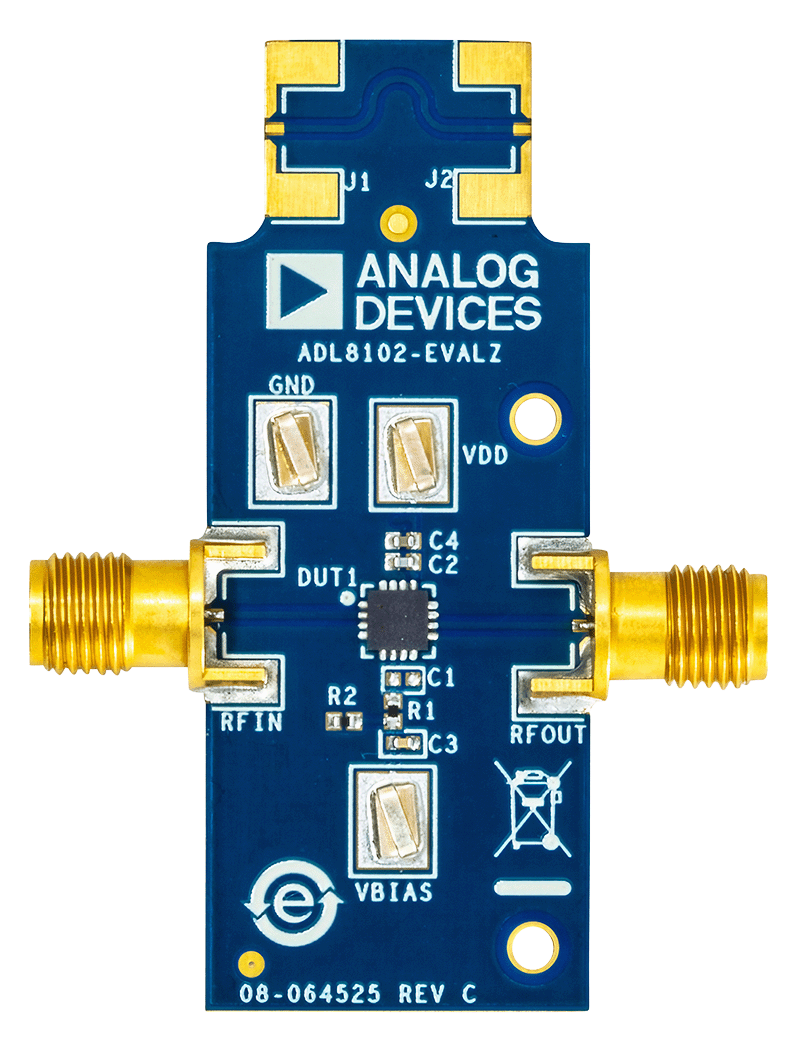
    The ADL8102-EVALZ is a 2-layer printed circuit board (PCB) fabricated from 10 mil thick, Rogers 4350B, and copper clad.

    The RFIN and RFOUT ports on the ADL8102-EVALZ are populated with 2.9 mm, female coaxial connectors, and the corresponding RF traces have a 50 Ω characteristic impedance. The ADL8102-EVALZ is populated with components suitable for use over the entire −40°C to +85°C operating temperature range.

    To calibrate board trace losses, a through calibration path, THRUCAL, is provided between the J1 and J2 connectors. J1 and J2 must be populated with RF connectors to use the through calibration path. For the through calibration path performance, see Table 1 and Figure 3 in the user guide.

    Access the ADL8102-EVALZ ground path and the VDD pin through the surface-mount technology (SMT) test point connectors, GND, and VDD. A supplementary test point for VBIAS is included for simple access on the RBIAS pin (for the test point locations, see Figure 5) in the user guide.

    The RF traces on the ADL8102-EVALZ are 50 Ω, grounded, coplanar waveguide. The package ground leads and the exposed pads connect directly to the ground plane. Multiple vias connect the top and bottom ground planes with particular focus on the area directly beneath the ground paddle to provide adequate electrical conduction and thermal conduction.

    The power-supply decoupling capacitors on the ADL8102-EVALZ represent the configuration used to characterize and qualify the device.

    Full specifications on the ADL8102 are available in the ADL8102 data sheet available from Analog Devices, Inc., and must be consulted with the user guide when using the ADL8102-EVALZ evaluation board.

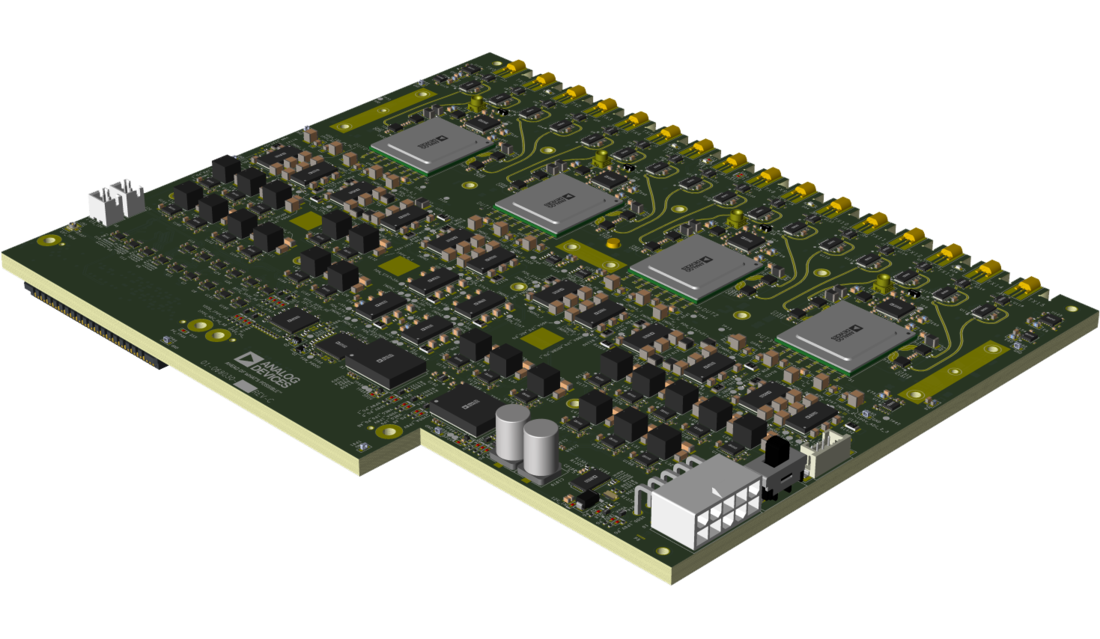
    ADXBAND16EBZ

    16Tx/16Rx Direct X-Band Sampled Phased-Array/RADAR/SATCOM Development Platform

    Features and Benefits

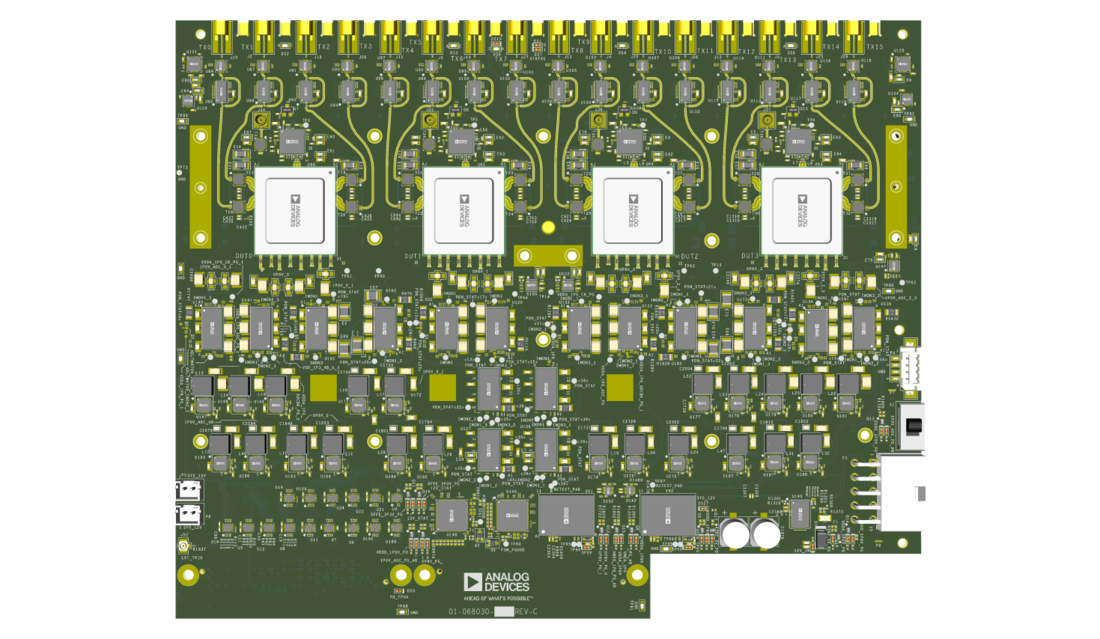
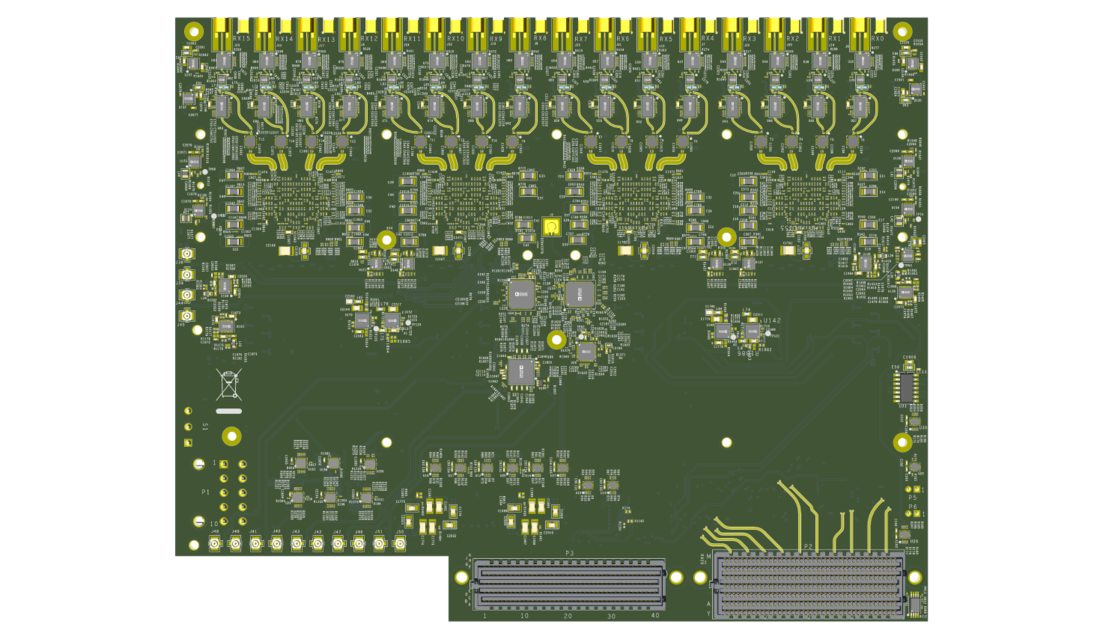
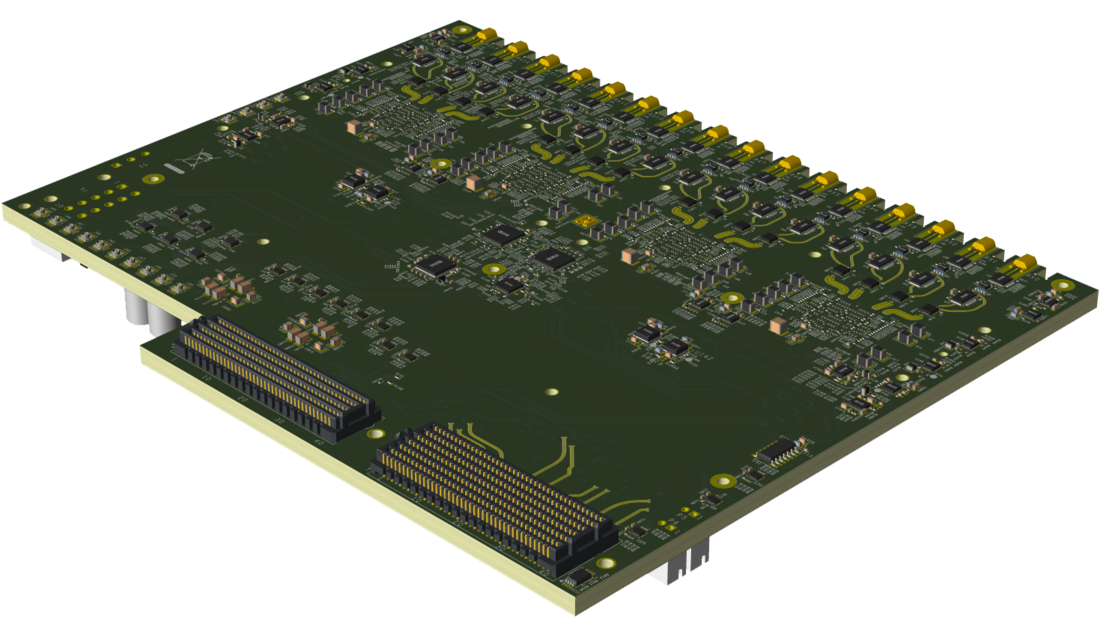
    ADXBAND16EBZ Digitizing Card
    • Multi-Channel, Wideband System Development Platform Using Apollo (AD9084)
    • Mates With Xilinx VCU118 Evaluation Board (Not Included)
    • 16x RF Receive (Rx) Channels
      • Total 16x 8GSPS to 20GSPS ADC
      • Digital Down Converters (DDCs), Each Including Complex Numerically-Controlled Oscillators (NCOs)
      • Programmable Finite Impulse Response Filters (pFIRs)
      • Complex Finite Impulse Response Filters (CFIRs)
    • 16x RF Transmit (Tx) Channels
      • Total 16x 8GSPS to 28GSPS DAC
      • Digital Up Converters (DUCs), Each Including Complex Numerically-Controlled Oscillators (NCOs)
      • Programmable Finite Impulse Response Filters (pFIRs)
      • Complex Finite Impulse Response Filters (CFIRs)
    • Flexible Rx & Tx RF Front-Ends
      • Rx: Filtering, Amplification, Digital Step Attenuation for Gain Control
      • Tx: Filtering, Amplification
    • Flexible Clock Distribution
      • On-Board Clock Distribution from Single External 400MHz Reference
      • Support for External Converter Clock per AD9084 via solder rework
    • On-Board Power Regulation from Single 12V Power Adapter (Included)
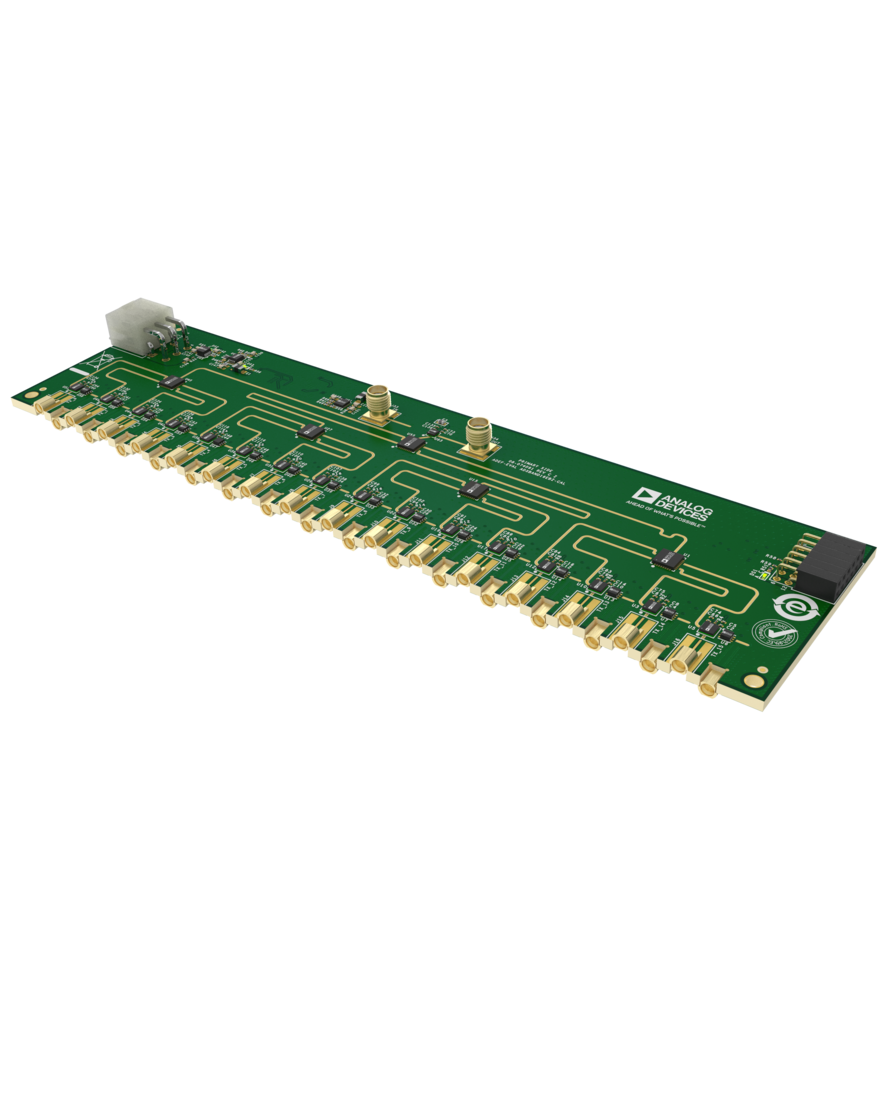
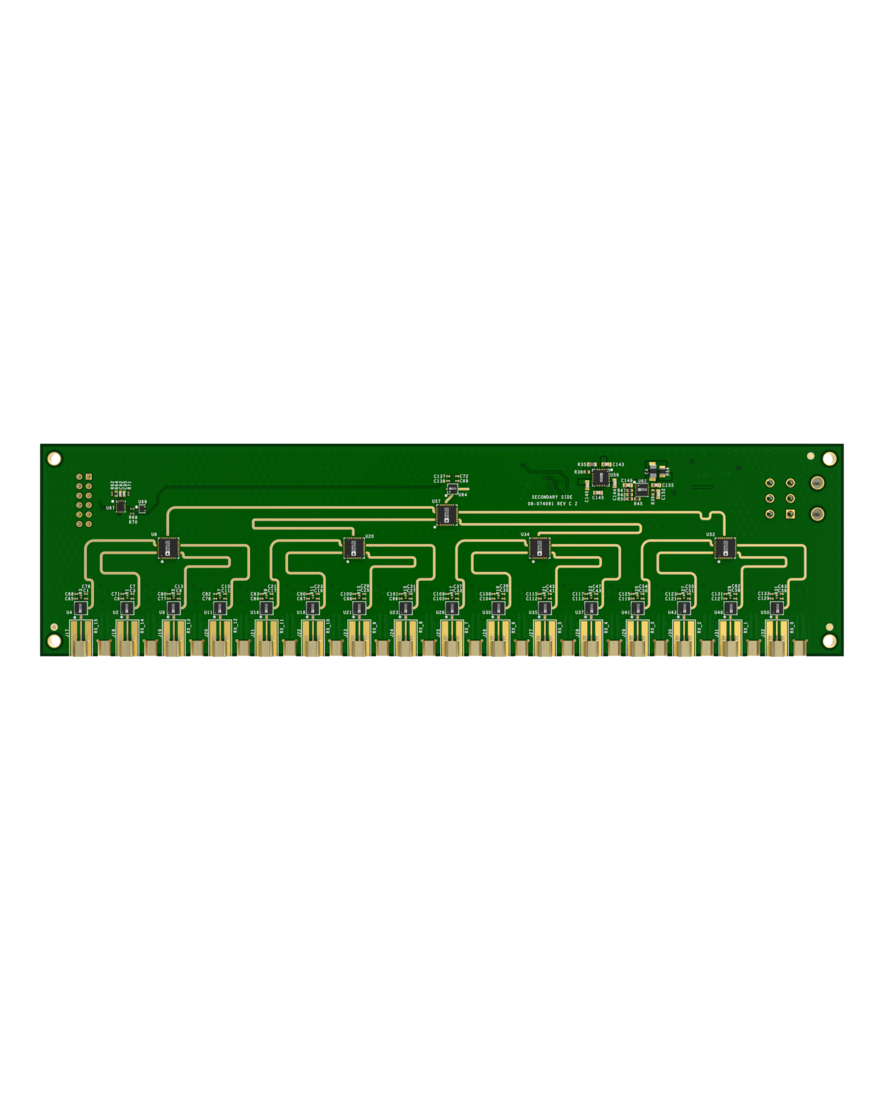
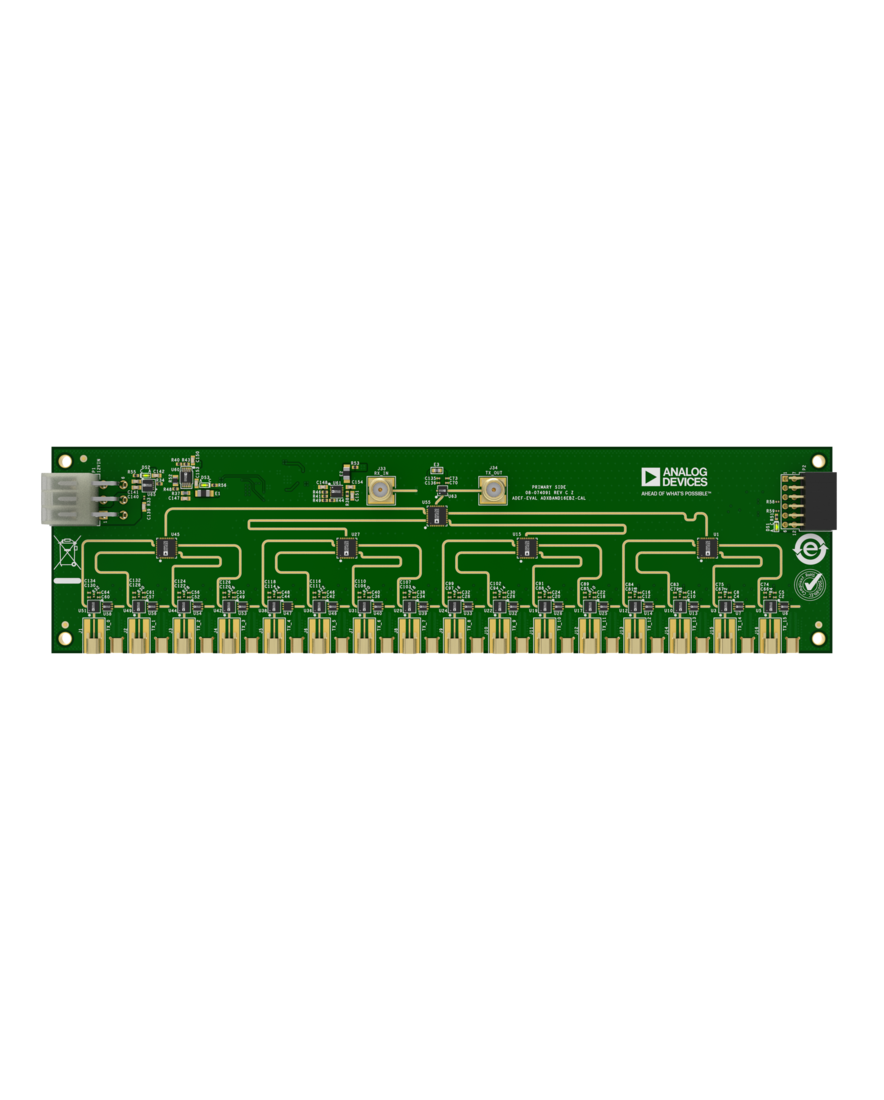
    16Tx / 16Rx Calibration Board
    • Mates to ADXBAND16EBZ Digitizing Card & VCU118 PMOD Interface (Cable Included)
    • Provides Both Individual Adjacent Channel Loopback and Combined Channel Loopback Options
    • Combined Tx Channels Out Option
    • Combined Rx Channels In Option
    Software Features and Benefits

    Easy Control Tools and Platform Interfaces to Simplify Software Framework Developments:

    • IIO Oscilloscope GUI
    • MATLAB Add-Ons & Example Scripts
    • Example HDL Builds including JESD204C Bring-Up
    • Embedded Software Solutions for Linux and Device Drivers
    Software Reference Design Examples for ADEF Applications to Reduce Prototyping Time:
    • Multi-Chip Synchronization for Power-Up Phase Determinism
    • System-Level Amplitude/Phase Alignment Using NCOs
    • Low-Latency ADC-to-DAC Loopback Bypassing JESD Interface
    • pFIR Control for Broadband Channel-to-Channel Amplitude/Phase Alignment
    • Fast-Frequency Hopping

    Product Details

    The ADXBAND16EBZ contains four AD9084 mixed‑signal front‑end devices, including the RF front end, clocking, and power circuitry. The ADXBAND16EBZ serves as a complete system solution targeting common applications such as phased‑array radars, wideband systems, and ground‑based SATCOM. Its primary target application is a 16‑Tx/16‑Rx direct X‑band sampling phased array.

    The platform is intended as a testbed for demonstrating multi‑chip synchronization, as well as implementing system‑level calibrations, beamforming algorithms, and other signal‑processing techniques. The system is designed to interface with the VCU118 Evaluation Board from Xilinx®, which features the Virtex® UltraScale+™ XCVU9P FPGA, along with provided reference software, HDL code, and MATLAB system‑level interfaces.

    A 16‑Tx/16‑Rx Calibration Board can be used to develop system‑level calibration algorithms, including demonstrations of power‑up phase determinism. The Calibration Board provides improvements in combined‑channel dynamic range, spurious performance, and phase noise, and can be controlled via a MATLAB add‑on when connected to the PMOD interface of the VCU118.

    EVAL-ADL8102
    Evaluating the ADL8102 Wideband, Low Noise Amplifier, Single Positive Supply, 1 GHz to 20 GHz
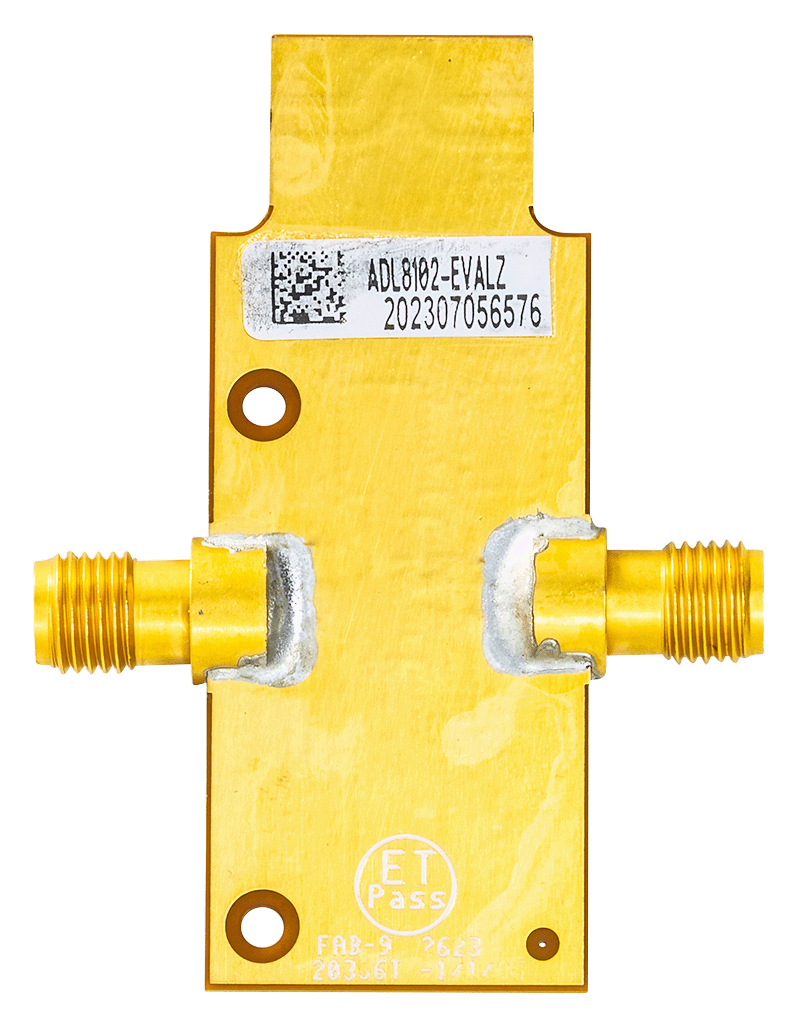
    ADL8102 Evaluation Board - Angle ADL8102 Evaluation Board - Top ADL8102 Evaluation Board - Bottom
    ADXBAND16EBZ
    16Tx/16Rx Direct X-Band Sampled Phased-Array/RADAR/SATCOM Development Platform

    Latest Discussions

    No discussions on ADL8102 yet. Have something to say?

    Start a Discussion on EngineerZone®

    Recently Viewed