Using Safety Application Notes to Aid Safety Designs—Part 1: Getting Started

2026年05月04日

Figure 1


要約

Among Analog Devices’ industrial functional safety (FS) portfolio are the FS-enabled parts, whose safety application notes are publicly accessible on their product pages. These safety application notes provide a component's FS information such as failure rate, failure mode distribution (FMD), and pin failure mode and effects analysis (FMEA). Such notes also give system integrators easy access to important information to aid their safety-related system design. For this reason, this first part of the series discusses the recommended sanity checks system integrators need to do before using a component's safety application note.

Introduction

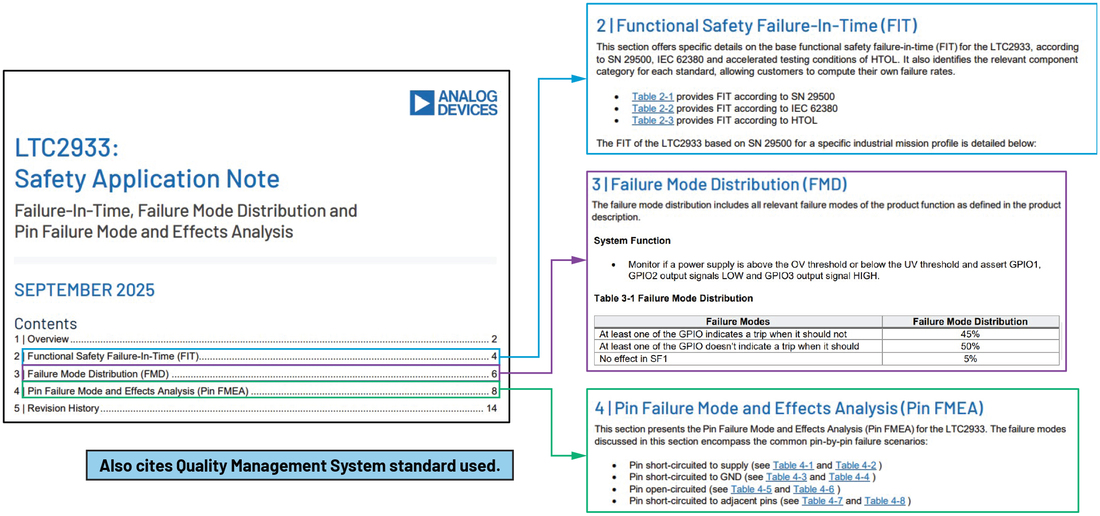
The Know Your Safety Application Notes series1,2,3 from Analog Devices gives an overview of the safety application notes for ADI functional safety (FS) integrated circuits (ICs)—non-FS-compliant devices or standard products recommended for FS applications due to their functions, features, and extensive user experience. As shown in Figure 1, ADI’s safety application notes detail a component’s development process, its failure rate prediction calculated from three reliability prediction methods, failure mode distribution (FMD) in terms of the IC’s system function(s), and its pin failure mode and effects analysis (FMEA) covering short-to-supply, short-to-ground, short-to-adjacent pins, and open-pin failures.

Figure 1. The LTC2933’s safety application note.

This second article series about ADI’s safety application notes aims to guide system integrators in using these notes to aid their technical safety analyses. Furthermore, this first part focuses on the next step system integrators need to take when using a safety application note for their ADI component.

Checking the Conditions Used for Reliability Predictions

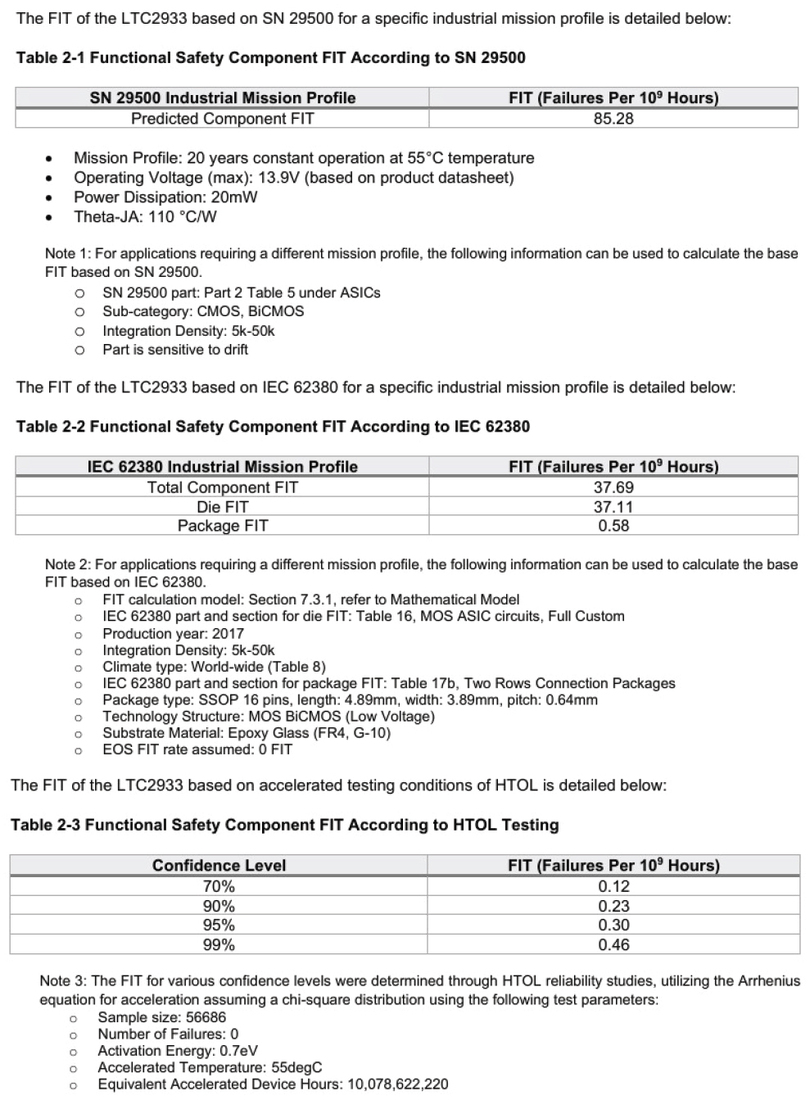
ADI’s safety application notes provide reliability predictions based on three methods: failure rate calculated by using SN29500, IEC 62380, and the Arrhenius equation by using high temperature operating life (HTOL) data. For each reliability prediction method shown in Figure 2, notes exist under the tables summarizing the calculated failure rate to show the conditions used. This includes information like mission profile, operating voltage, power dissipation, thermal specification based on the package used, confidence level in the case of Arrhenius HTOL, and other reliability prediction method required inputs that can be derived from a product’s data sheet as well as design-related data like integration density, technology structure, etc. This information is made available so system integrators who are familiar with reliability predictions can recalculate an IC’s failure rates at their own convenience when operating conditions assumed in the initial calculations are different. Part 1 of the Know Your Safety Application Notes shows where ADI’s reliability database can be found as well as offers insights into how to change the confidence level of a reliability prediction. If similar conditions are used and the assumed conditions are directly applicable, then system integrators can readily use the safety application note’s reliability predictions data.

Figure 2. The LTC2933’s failure rate information.

Checking the Conditions Used for FMD

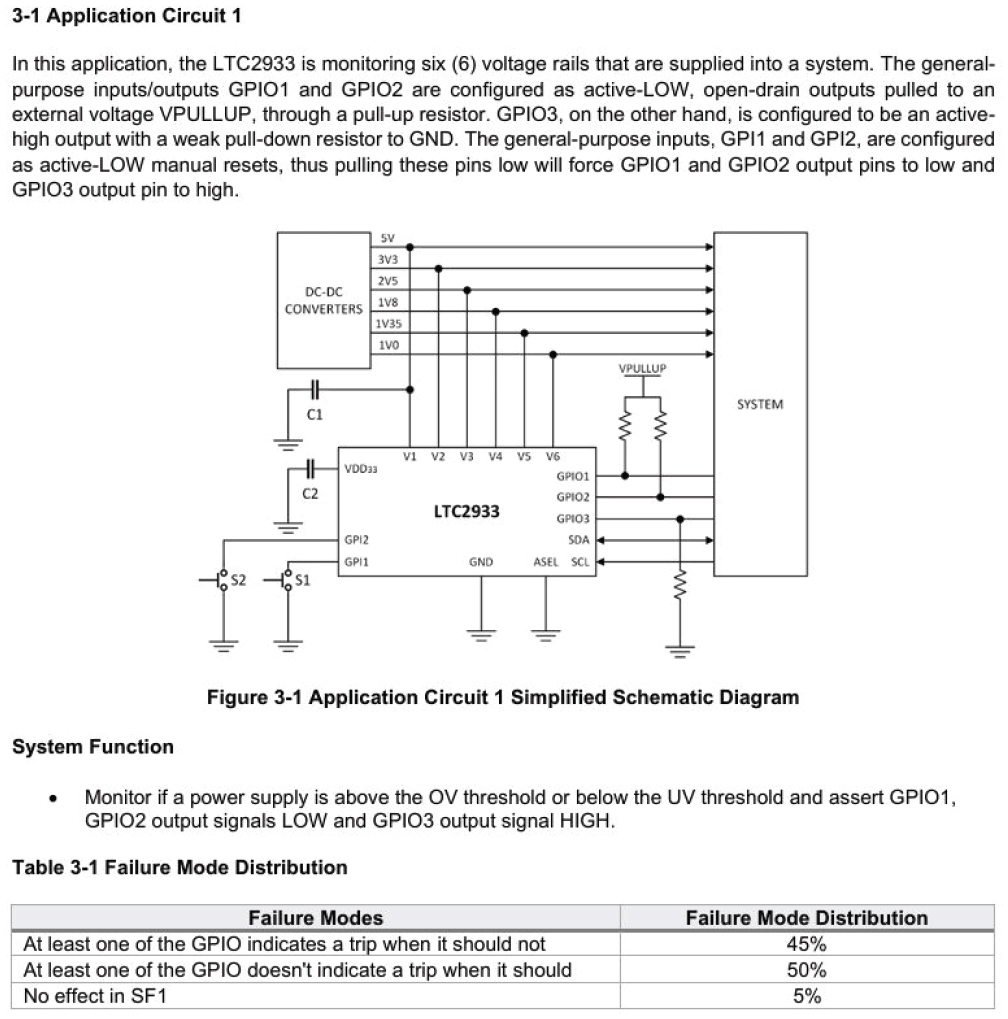
Aside from system function, the FMD section of an ADI safety application note also shows the application circuit assumed. This is shown in Figure 3. It is important that system integrators check whether the IC used in their application is like the assumed application circuit. Otherwise there may be some modifications that need to be made in the analysis. For instance, looking at Figure 3, perhaps you are only using four of the six LTC2933 channels.

Figure 3. The LTC2933’s FMD information.

Checking the Conditions Used for the Pin FMEA

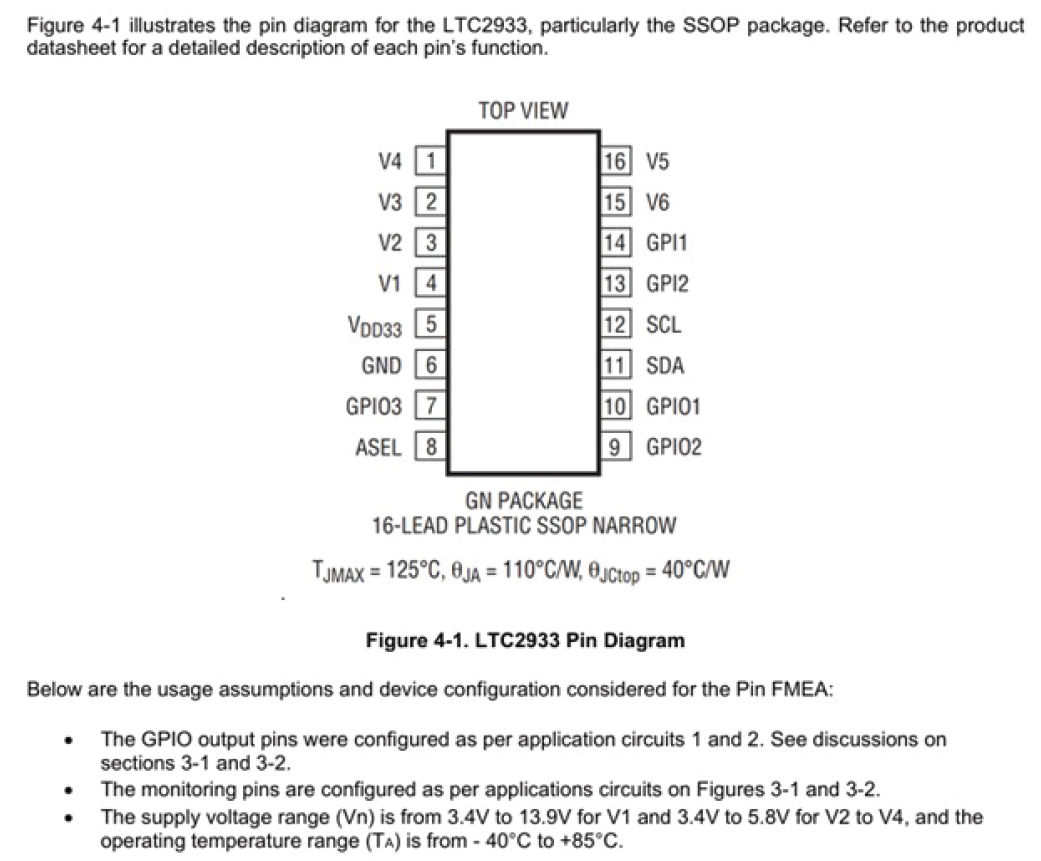
The pin FMEA section of a safety application note, as shown in Figure 4, shows the component’s package used, the assumed device configuration and device configuration, and the tables showing the analysis. System integrators need to ensure that a similar pinout arrangement and device configuration as per application circuit assumed is used so they can use such analysis in their design.

Figure 4. The LTC2933’s pin FMEA information.

In some cases, additional diagnostics or other safety measures may be available at the system level that the analysis at ADI did not assume.

Post-Sanity Check Activities

After having a run of sanity checks for the safety application note, system integrators may either find that the information is readily applicable in their application or they may find some needed modifications. In case the latter is true, they may reach ADI through ADI Support Channels.

Conclusion

In summary, ADI’s FS-enabled ICs’ safety application notes serve as a vital resource for system integrators, providing granular reliability data and failure analysis necessary to aid FS design. However, the effectiveness of these documents depends on a diligent sanity check process, where integrators must verify that the mission profiles, application circuits, and pin configurations assumed in the notes align with their specific system requirements. By confirming these conditions—or reaching out to ADI for further technical support when discrepancies arise—engineers can help ensure that the failure rates and FMD data they integrate into their safety analysis are both accurate and robust, ultimately leading to more reliable industrial safety-related systems.

References

1 Bryan Borres. “Know Your Safety Application Notes—Part 1: Failure Rates.” Analog Devices, Inc., August 2025.

2 Bryan Borres. “Know Your Safety Application Notes—Part 2: Failure Mode Distribution.” Analog Dialogue, Vol. 59, October 2025.

3 Bryan Borres. “Know Your Safety Application Notes—Part 3: Pin FMEA.” Analog Devices, Inc., November 2025.

著者について

Bryan Angelo Borres
Bryan Angelo Borresは、アナログ・デバイセズのシニア・アプリケーション・エンジニアです。TÜV認定の機能安全エンジニアとして、産業分野向けの機能安全対応製品を開発する複数のプロジェクトに参画。また、システム・インテグレータがIEC 61508などの産業分野向け機能安全規格に準拠した電源のアーキテクチャを設計できるよう支援しています。これまで約7年間にわたり、効率が高く堅牢性に優れるパワー・エレクトロニクス・システムの設計に...
myAnalogに追加

myAnalog のリソース セクション、既存のプロジェクト、または新しいプロジェクトに記事を追加します。

新規プロジェクトを作成

この記事に関して

製品

産業向けソリューション
製品カテゴリ

資料


技術記事
最新メディア 21
Title
Subtitle
さらに詳しく
myAnalogに追加

myAnalog のリソース セクション、既存のプロジェクト、または新しいプロジェクトに記事を追加します。

新規プロジェクトを作成