

LTC3549
PRODUCTION250mA Low VIN Buck Regulator in 2mm × 3mm DFN
- Part Models
- 2
- 1ku List Price
- Starting From $2.22
Overview
- 1.6V to 5.5V Input Voltage Range
- Internal Soft-Start
- Low Ripple Burst Mode® Operation
- Output Ripple: <20mVP-P
- IQ: 50µA
- 2.25MHz Constant-Frequency Operation
- High Effi ciency: Up to 93%
- 250mA Output Current (VIN = 1.8V, VOUT = 1.2V)
- 450mA Peak Inductor Current
- No Schottky Diode Required
- Low Dropout Operation: 100% Duty Cycle
- 0.611V Reference Voltage
- Stable with Ceramic Capacitors
- Shutdown Mode Draws <1µA Supply Current
- Current Mode Operation for Excellent Line and Load Transient Response
- Overtemperature Protection
- Available in a Low Profi le (0.75mm) 6-Lead (2mm × 3mm) DFN Package
The LTC3549 is a high efficiency, monolithic synchronous buck regulator using a constant-frequency, current mode architecture. The output voltage is adjusted via an external resistor divider.
A fixed switching frequency of 2.25MHz is supported. This switching frequency allows the use of small surface mount inductors and capacitors, including ceramics.
Supply current during Burst Mode operation is only 50µA dropping to < 1µA in shutdown. The 1.6V to 5.5V input voltage range makes the LTC3549 ideally suited for single cell Li-Ion, Li-Metal and 2-cell alkaline, NiCd or NiMH battery-powered applications. 100% duty cycle capability provides low dropout operation, extending battery life in portable systems. Burst Mode operation can be user-enabled, increasing efficiency at light loads, further extending battery life.
The internal synchronous switch increases efficiency and eliminates the need for an external Schottky diode. Internal soft-start offers controlled output voltage rise time at startup without the need for external components.
Applications
- 2 AA-Cell Applications
- Cellular Phones
- Digital Cameras
- MP3 Players
Documentation
Data Sheet 1
User Guide 1
Technical Articles 1
ADI has always placed the highest emphasis on delivering products that meet the maximum levels of quality and reliability. We achieve this by incorporating quality and reliability checks in every scope of product and process design, and in the manufacturing process as well. "Zero defects" for shipped products is always our goal. View our quality and reliability program and certifications for more information.
| Part Model | Pin/Package Drawing | Documentation | CAD Symbols, Footprints, and 3D Models |
|---|---|---|---|
| LTC3549EDCB#TRMPBF | 6-Lead DFN (2mm x 3mm w/ EP) | ||
| LTC3549EDCB#TRPBF | 6-Lead DFN (2mm x 3mm w/ EP) |
This is the most up-to-date revision of the Data Sheet.
Software Resources
Can't find the software or driver you need?
Request a Driver/SoftwareHardware Ecosystem
| Parts | Product Life Cycle | Description |
|---|---|---|
| Ideal Diodes and PowerPath Controllers 1 | ||
| LTC4359 | RECOMMENDED FOR NEW DESIGNS | Ideal Diode Controller with Reverse Input Protection |
| Power System Management (PSM) & Sequencers 1 | ||
| LTC2974 | RECOMMENDED FOR NEW DESIGNS | 4-Channel PMBus Power System Manager Featuring Accurate Output Current Measurement |
| Supervisory Circuits & Reset ICs 1 | ||
| LTC2935 | PRODUCTION | Ultra-Low Power Supervisor with Power-Fail Output, Selectable Thresholds |
| Switching Regulators & Controllers 1 | ||
| LTC3880 | RECOMMENDED FOR NEW DESIGNS | Dual Output PolyPhase Step-Down DC/DC Controller with Digital Power System Management |
Tools & Simulations
LTspice 1
Models for the following parts are available in LTspice:
- LTC3549
LTpowerCAD 1
Design tools for the following parts are available in LTpowerCAD:
- LTC3549
LTspice® is a powerful, fast and free simulation software, schematic capture and waveform viewer with enhancements and models for improving the simulation of analog circuits.
LTpowerCAD® is a power supply design program which selects power stage components, provides detailed power efficiency, shows quick loop Bode plot stability and load transient analysis, and can export to LTspice for simulation.
Evaluation Kits
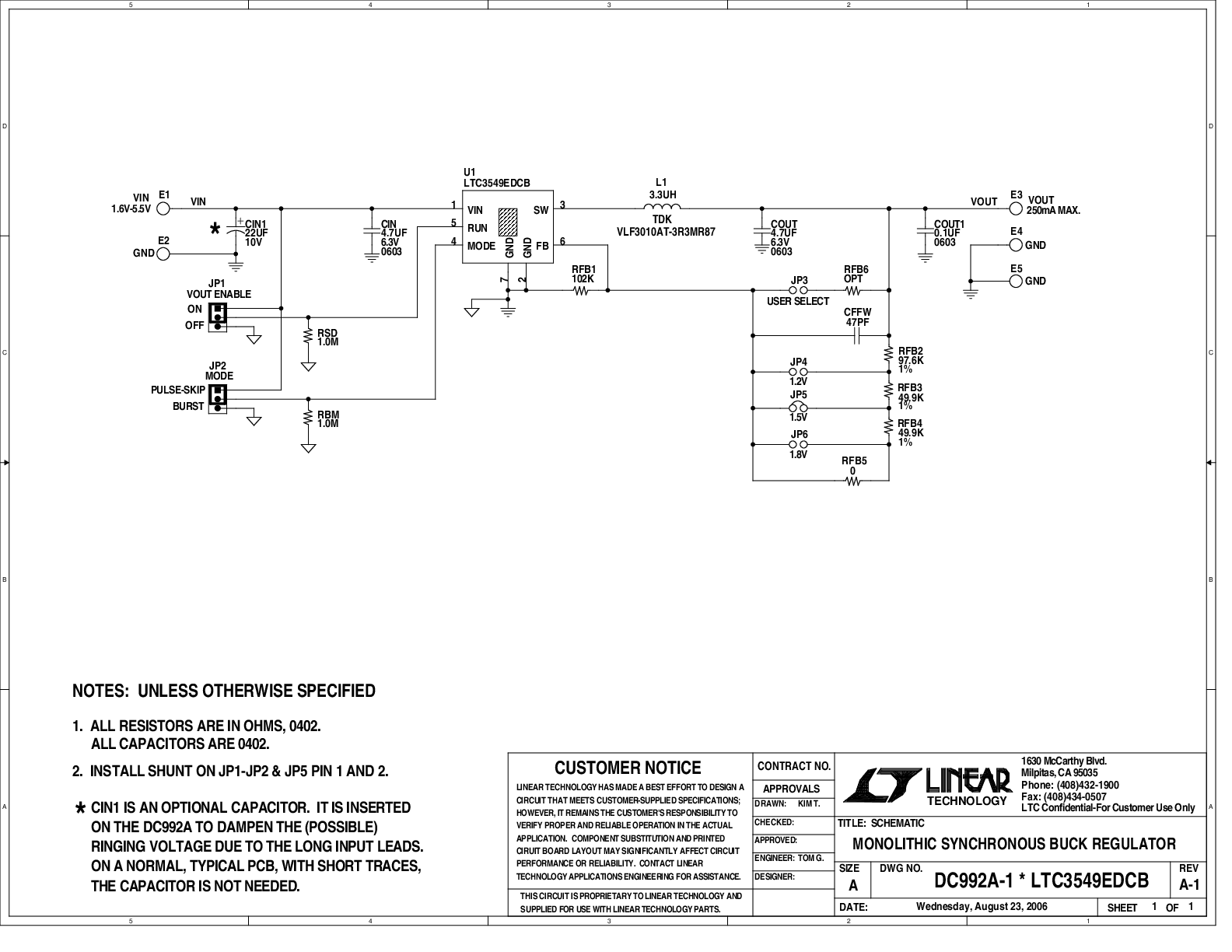
LTC3549EDCB Demo Board
Resources
Latest Discussions
No discussions on LTC3549 yet. Have something to say?
Start a Discussion on EngineerZone®