ADL8105

RECOMMENDED FOR NEW DESIGNS

GaAs, pHEMT, MMIC, Low Noise Amplifier, 5 GHz to 20 GHz

Viewing:

Overview

  • Single positive supply (self biased)
  • Gain: 27 dB typical at 12 GHz to 17 GHz
  • OP1dB: 18 dB typical at 12 GHz to 17 GHz
  • OIP3: 30.5 dBm typical at 12 to GHz to 17 GHz
  • Noise figure: 1.8 dB typical at 12 GHz to 17 GHz
  • RoHS-compliant, 2 mm × 2 mm, 8-lead LFCSP

The ADL8105 is a gallium arsenide (GaAs), monolithic microwave integrated circuit (MMIC), pseudomorphic high electron mobility transistor (pHEMT), low noise wideband amplifier that operates from 5 GHz to 20 GHz.

The ADL8105 provides a typical gain of 27 dB at 12 GHz to 17 GHz, a 1.8 dB typical noise figure from 12 GHz to 17 GHz, a typical output third-order intercept (OIP3) of 30.5 dBm at 12 GHz to 17 GHz, and a saturated output power (PSAT) of up to 20.5 dBm, requiring only 90 mA from a 5 V supply voltage. The power dissipation can be lowered at the expense of OIP3 and output power (POUT). The ADL8105 also features inputs and outputs that are internally matched to 50 Ω. The RFIN and RFOUT pins are internally ac-coupled, and the bias inductor is also integrated, making it ideal for surface-mounted technology (SMT)-based, high capacity microwave radio applications.

The ADL8105 is housed in an RoHS-compliant, 2 mm × 2 mm, 8-lead LFCSP package.

APPLICATIONS

  • Telecommunications
  • Satellite communications
  • Military radar
  • Weather radar
  • Electronic warfare
  • Instrumentation
  • ADL8105
    GaAs, pHEMT, MMIC, Low Noise Amplifier, 5 GHz to 20 GHz
    ADL8105 Functional Block Diagram ADL8105 Pin Configuration
    Add to myAnalog

    Add product to the Products section of myAnalog (to receive notifications), to an existing project or to a new project.

    Create New Project
    Ask a Question

    Documentation

    Learn More
    Add to myAnalog

    Add media to the Resources section of myAnalog, to an existing project or to a new project.

    Create New Project

    Software Resources

    Can't find the software or driver you need?

    Request a Driver/Software

    Tools & Simulations

    S-Parameter 1


    Evaluation Kits

    eval board
    EVAL-ADL8105

    Evaluating the ADL8105 Wideband, High Linearity, Low Noise Amplifier, 5 GHz to 20 GHz

    Features and Benefits

    • 4-layer Rogers 4350B and Isola 370HR evaluation board
    • End launch, 2.9 mm RF connectors
    • Through calibration path (depopulated)

    Product Details

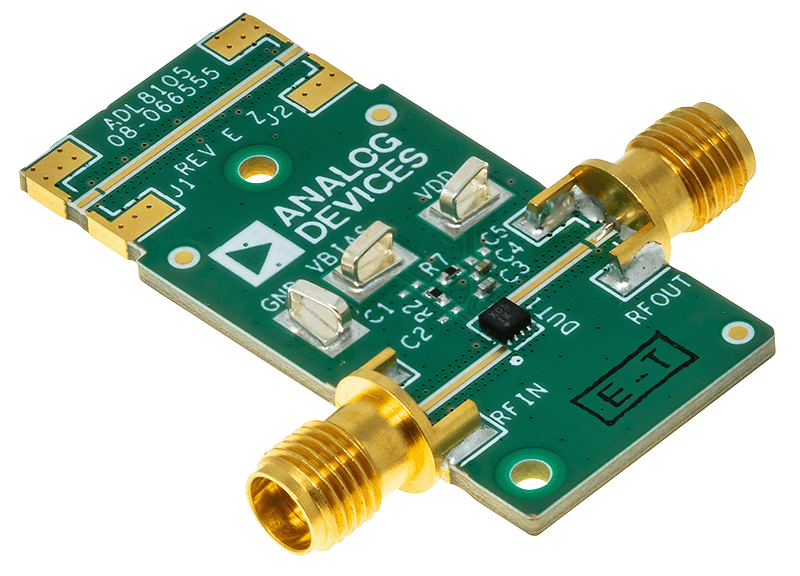
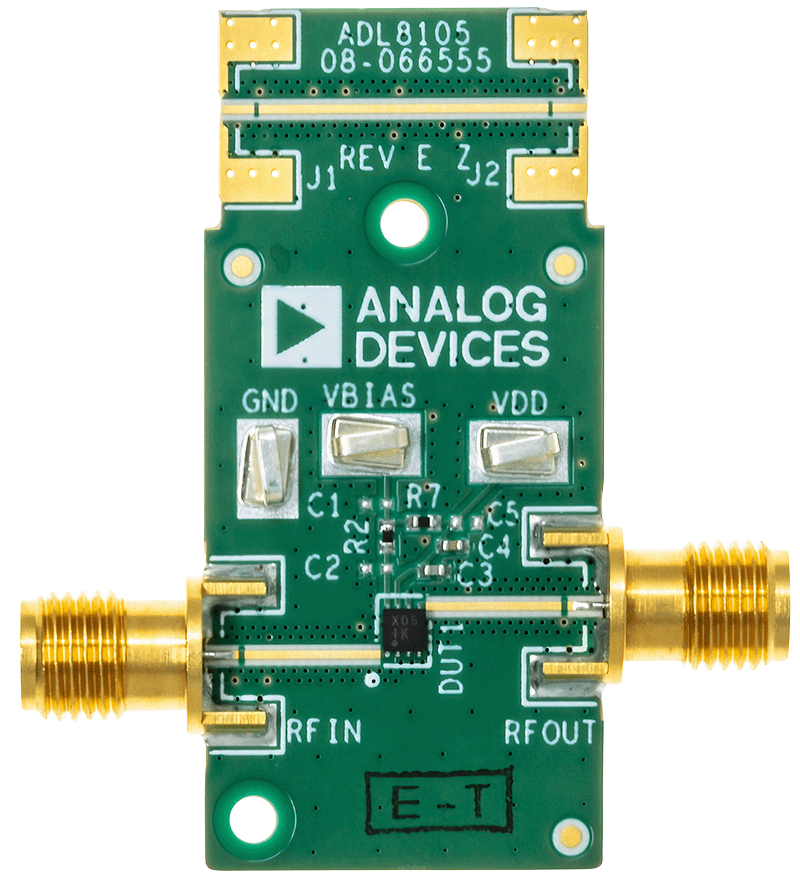
    The ADL8105-EVALZ consists of a 4-layer printed circuit board (PCB) fabricated from 10 mil thick, Rogers 4350B and Isola 370HR, copper clad, forming a nominal thickness of 62 mils. The RFIN and RFOUT ports on the ADL8105-EVALZ are populated with 2.9 mm, female coaxial connectors, and the corresponding RF traces have a 50 Ω characteristic impedance. The ADL8105-EVALZ is populated with components suitable for use over the entire −40°C to +85°C operating temperature range of the ADL8105. To calibrate board trace losses, a through calibration path is provided between the J1 and J2 connectors. J1 and J2 must be populated with RF connectors to use the through calibration path. Refer to Table 1 and Figure 3 in the user guide for the through calibration path performance.

    Access the ADL8105-EVALZ ground path and the VDD pin through the surface-mount technology (SMT) test point connectors, GND and VDD. A supplementary test point for VBIAS is included for simple access on the RBIAS pin (see Figure 5 for the test point locations).

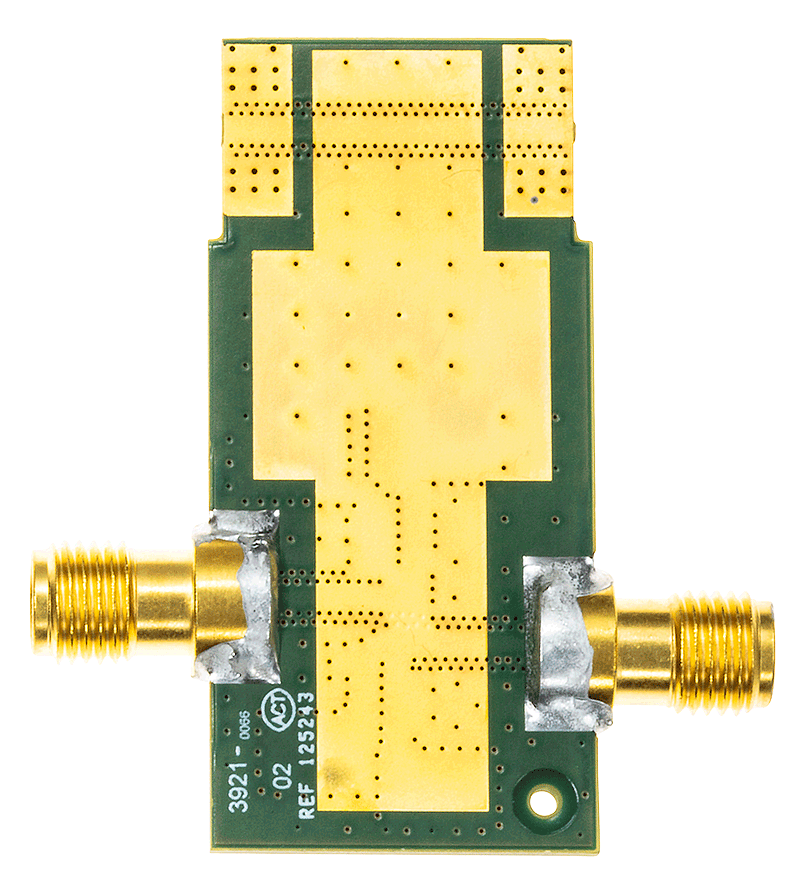
    The RF traces on the ADL8105-EVALZ are 50 Ω, grounded, coplanar waveguide. The package ground leads and the exposed pad connect directly to the ground plane. Multiple vias connect the top and bottom ground planes with particular focus on the area directly beneath the ground paddle to provide adequate electrical conduction and thermal conduction to the heat sink.

    The power supply decoupling capacitors on the ADL8105-EVALZ represent the configuration used to characterize and qualify the device.

    For full details on the ADL8105, see the ADL8105 data sheet, which must be consulted in conjunction with the user guide when using the ADL8105-EVALZ.

    eval board
    EVAL-ADMX7103

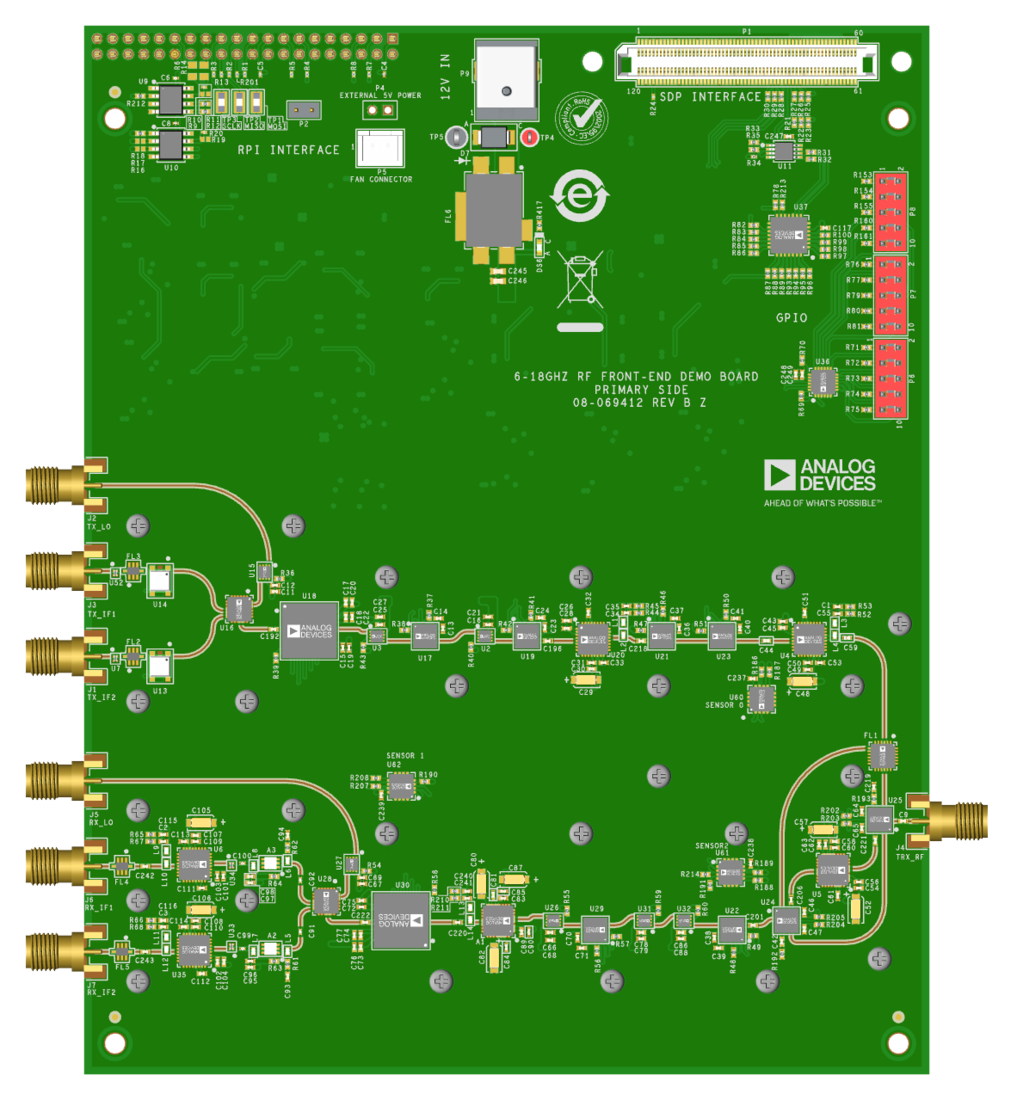
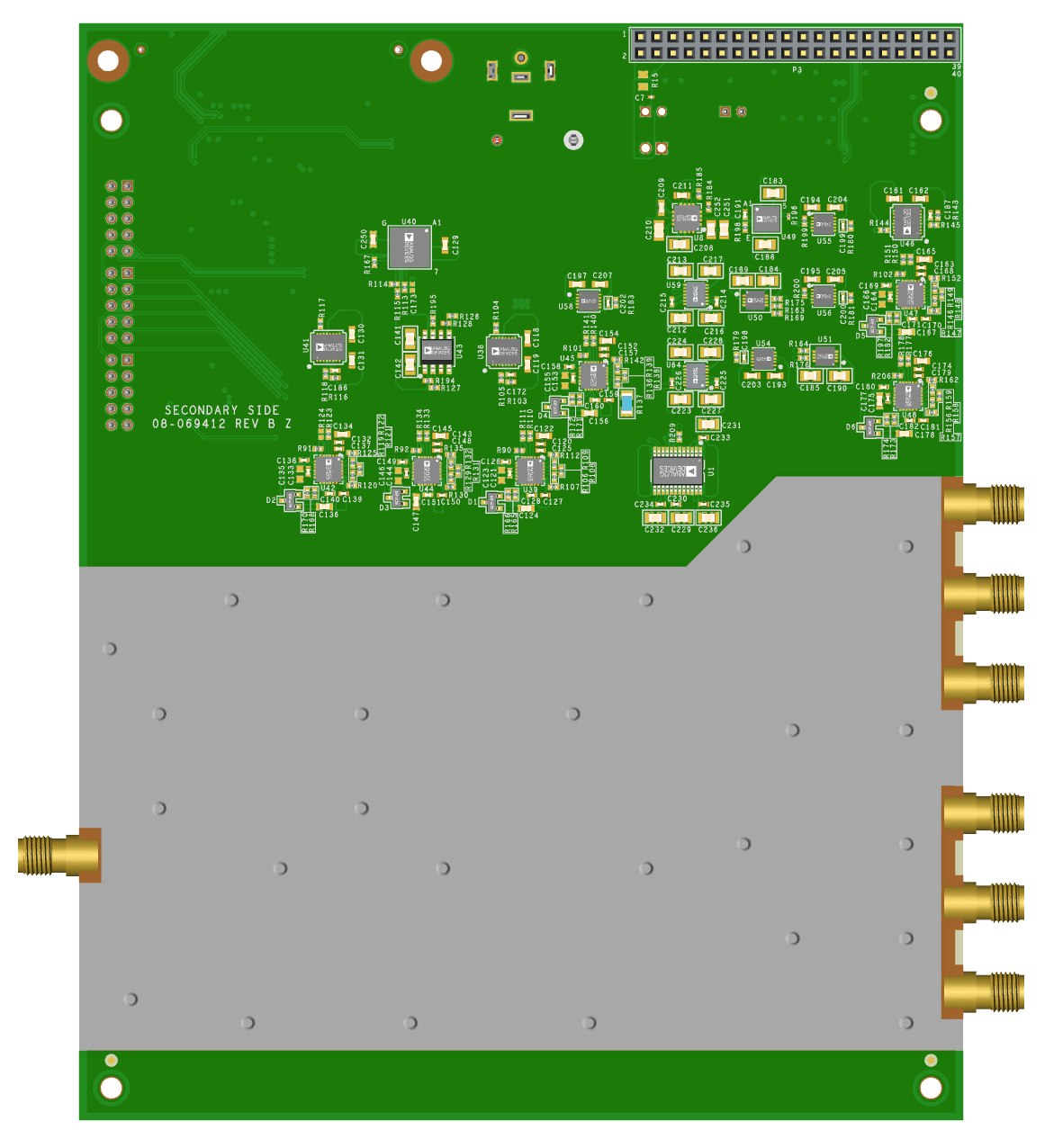
    ADMX7103-EBZ: 6G FR3 Radio Front-End

    Features and Benefits

    • FR3 TX and RX RF front end board
    • RF carriers 6GHz to 18GHz
    • Power management and biasing
    • 4GHz iBW (with tunable filter enabled)
    • EVM < −50 dB
    • High dynamic range
    • Programmable using an SPI interface
    • TX P1dB: 27dBm
    • TX LO nulling capability
    • RX noise figure: 3.5dB at 12GHz
    • Tunable filters for spur rejection
    • Calibration using temperature sensors

    Product Details

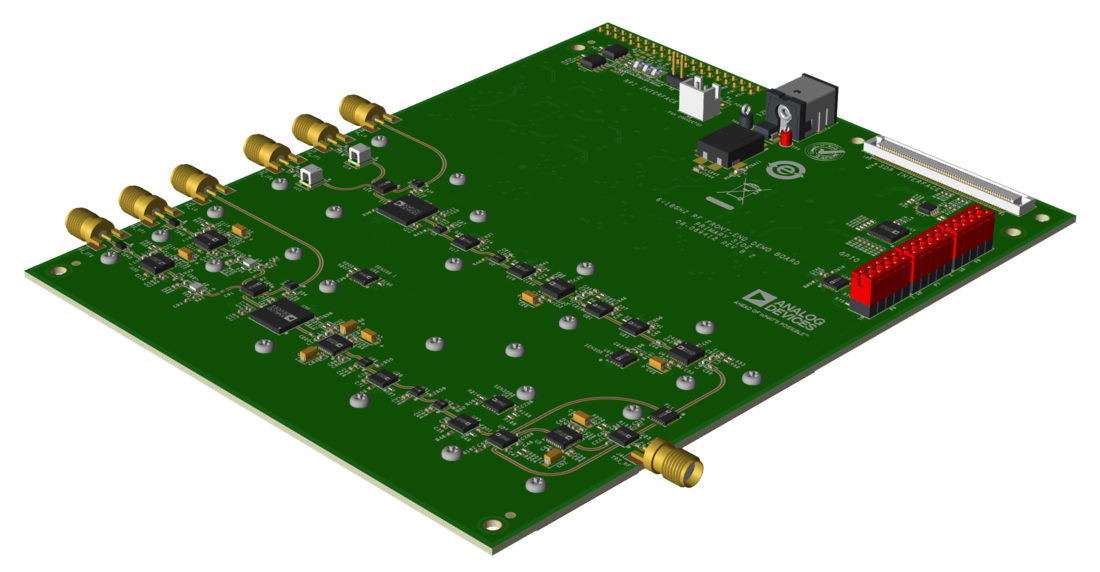
    The ADMX7103-EBZ is a 6G, Frequency Range 3 (FR3), radio front end (RFFE) reference design that supports frequencies from 6GHz to18GHz and instantaneous bandwidths up to 4GHz. The FR3 RFFE includes transmit (TX) and receive (RX) modes for signal generation and spectrum analysis applications, respectively. Each TX and RX path has dedicated local oscillator (LO) inputs to support time division duplex (TDD) and frequency-divison duplex (FDD) operation. The design supports both 5G and 6G signal generation and a spectrum analyzer/demodulator. In-phase/quadrature (I/Q) intermediate frequency (IF) ports are provided for TX inputs and RX outputs.

    EVAL-ADL8105
    Evaluating the ADL8105 Wideband, High Linearity, Low Noise Amplifier, 5 GHz to 20 GHz
    ADL8105 Evaluation Board - Angle ADL8105 Evaluation Board - Top ADL8105 Evaluation Board - Bottom
    EVAL-ADMX7103
    ADMX7103-EBZ: 6G FR3 Radio Front-End
    EVAL-ADMX7103 Evaluation Board Angle View EVAL-ADMX7103 Evaluation Board Top View EVAL-ADMX7103 Evaluation Board Bottom View

    Latest Discussions

    Recently Viewed