
AN-2633: Analog Devices, Inc. Solution for Branch Circuit Applications Using the ADEMA12x, the ADE91xx, and the Daisy-Chain Interface
Introduction
Analog Devices solution for branch circuit monitoring (BCM) leverages (a) daisy-chain SPI, (b) analog‐to‐digital converter (ADC) synchronization capabilities of the ADE91xx and the ADEMA12x product families, and (c) software metrology running on host microcontroller unit (MCU), to offer a modular and simplified architecture for system scalability. The solution also includes integrated data and power isolation at the point of high voltage, which reduces bill of materials and makes it safer to interact with the system. Analog Devices high-precision solution for BCM is compatible with contactless current sensors, including current transformers (CTs) and Rogowski coils. For seamless integration of Rogowski coils, the ADEMA12x includes an integrator and second-order high-pass filter (HPF) which eliminate the need for external components.
The application note details the configuration, provides an overview of the family of products and software services, and mentions the benefits of this solution over other existing architectures. The applications include power distribution units (PDUs), circuit breakers/panels, and distributed load monitoring.
BCM: Enabling High-Growth Applications
The BCM is becoming essential as power consumption surges due to the expansion of data centers, smart buildings, and industrial automation. These sectors demand high energy usage and minimal downtime, making real-time power monitoring critical. Key drivers of BCM adoption include the push for energy efficiency, regulatory compliance, smart building investments, and rapid industrial growth.
Traditional monitoring methods require extensive manual intervention and fail to track power usage accurately across branch circuits, prompting the development of BCM to prevent circuit overloads and improve reliability. Key requirements of a BCM solution include:
- Precision and synchronization across all measurement channels.
- Real-time energy measurement and remote management.
- Architecture scalability and safety against high voltage.
- Bill of Material Reduction.
- Reliable performance over extended lifetime.
BCM systems are also enabling metering systems to evolve into management systems by offering granular insights into power distribution, enabling load balancing, demand response, and dynamic pricing. Technological advancements, particularly the integration of IoT and AI, have enhanced BCM capabilities, allowing predictive maintenance and real-time fault detection. This shift supports better decision-making and operational efficiency, refining energy data and helping manage costs and planning future expansions.
Real-time monitoring is vital for production/industrial and hyperscale processing environments at data centers, where energy demand fluctuates with load and speed. These trends underscore BCM role in modern energy management and infrastructure resilience.
Design Overview
Analog Devices products use:
- ADE91xx (2-/3-channel isolated or non-isolated Σ-Δ ADC with serial port interface (SPI))
- ADEMA12x (4-/7-channel non-isolated Σ-Δ ADC with SPI)
- ADC drivers
The daisy-chain SPI and ADC synchronization capabilities of the ADE91xx and the ADEMA12x enables many different BMC applications across sectors mentioned. For detailed guide on how to design a multiple ADC system, refer to the AN-2625: Designing with Multiple ADE ADCs | Analog Devices.
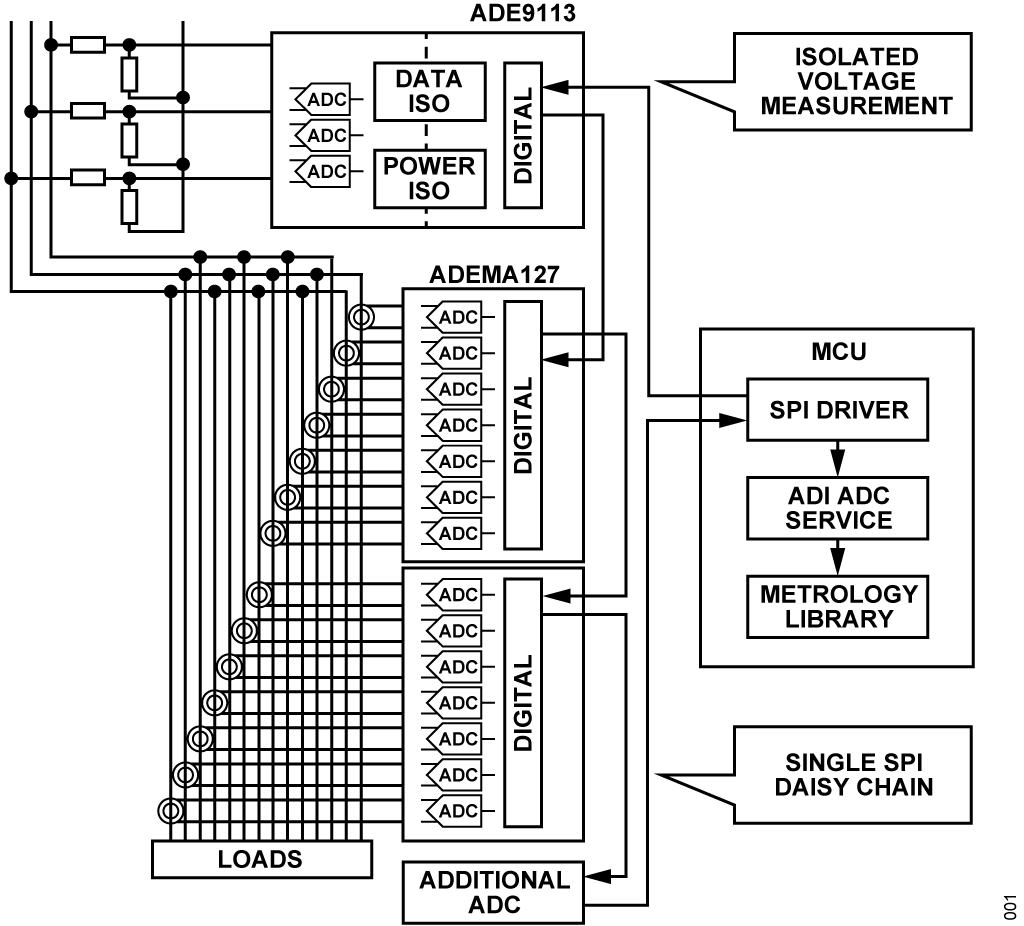
The design in Figure 1 uses one ADE9113 for an isolated 3-phase voltage measurement and two ADEMA127 ADCs for 14 current measurements (7 current measurements per ADC). The ADE9113 and the ADEMA127 are connected to the customers host MCU running software metrology via a daisy-chain SPI.
Benefits of the Design
There are many benefits to the design. These include:
- Fully isolated design by using the ADE9113.
- Does not need any other isolation in the signal path.
- Only one SPI port is required due to the daisy-chain configuration.
- Fully synchronized voltage and current measurements for accurate power and energy calculations across all channels.
- Built-in filters/compensation in the ADEMA12x for the following different current sensors:
- Current transformers.
- Rogowski coils.
- Compatibility with software metrology.
- Easily scalable to add more current channels:
- Add more ADEMA12x ADCs to the daisy-chain to add more current measurement channels.
- See AN-2625 for more details.
Part Descriptions
ADEMA127/ADEMA124
The ADEMA127/ADEMA124 is a 7-channel/4-channel simultaneously sampling 24-bit ΣΔ ADC, ideal for use in polyphase or split-phase energy metering applications.
The ADEMA127/ADEMA124 includes:
- Independent hardware and digital signal processing (DSP) filters enabling gain, phase, and offset compensation on each ADC channel.
- Bespoke compensation and DSP features, which include an integrator and second-order HPF to allow streamlined Rogowski sensor integration.
- Flexible SPI interface for configuration and data retrieval. The daisy-chain SPI interface allows multiple compatible ADCs to be serviced simultaneously by a single SPI port, which saves pins on the host MCU.
| Feature | Performance | System Benefit |
| Analog input range | ±1.2V peak differential | Support Class 0.2 meters |
| SNR/Dynamic range | Up to 98dB at 64kSPS | High-precision metering applications; enables power quality or non-intrusive load monitoring (NILM) platform |
| Output data rates | 64kSPS, 32kSPS, 16kSPS, 8kSPS, 4kSPS, 2kSPS, 1kSPS, 500SPS, 250SPS | Flexible output data rates |
| Channel drift | 2 ppm/°C (Typical) 10 ppm/°C (Max) |
Meter accuracy over wider temperature range |
| Operating temperature | −40°C to +125°C | Wide operating temperature for more robust use cases |
| Rogowski coil support | Digital integrator and HPF integrated | Lower system cost |
| Gain and phase calibration | Gain ±2 Phase calibration ± 0.99 samples |
Correct for CT variation |
| Power consumption | 14mW (typical) – 4-channel | Higher efficiency; supports tamper detect |
| Fast startup | 0.5ms after supply up | Circuit breakers/protection relays |
See the ADEMA127/ADEMA124 data sheet for detailed features and specifications.
ADE9103/ADE9112/ADE9113
The ADE9113 is a precision simultaneously sampling Σ-Δ ADC for both DC and AC polyphase shunt-based energy metering applications. The ADE9113 has the following characteristics:
- Integrates safety certified signal and power galvanic isolation with three simultaneously sampling fully differential 24-bit Σ-Δ ADC channels.
- Includes bidirectional, SPI supports a daisy-chain capability, allowing access to all registers while reducing the required MCU pin count.
| Feature | Specification | System Benefit |
| Dynamic range | 5000:1 86dB SNR |
ADC performance at 4kSPS (±31.25mV) |
| Output data rates | 32kSPS, 8kSPS, 4kSPS, 2kSPS, 1kSPS | Faster and more flexible output rate |
| Operating temperature | −40°C to +125°C | Wide operating temperature for more robust use cases |
| Input offset | ±10µV (maximum) | ±31.25mV input range |
| Offset drift | ±2nV/°C (typical) | AC and DC measurements |
| ADC gain drift over temperature | ±23ppm/°C (maximum) | |
| Power consumption | 26.5mW (typical) | From single 3.3V supply |
| Withstand isolation voltage | 5kVrms | According to UL 1577 |
See the ADE9113 data sheet for detailed features and specifications.
Results
CT Specifications
CT specifications for CT used in energy accuracy over power factor (PF) and temperature have the following results:
- Turns ratio: 1:2500
- Maximum current rating: 80 ARMS
- Temperature range: −40°C to +70°C
- Accuracy: 1%
Test Sweep Parameters
Test sweep parameters used for energy accuracy over PF and temperature results are shown in Table 3.
| Parameter | Values |
| Voltage | 230VRMS |
| Current | 0.02ARMS to 80ARMS |
| Power factor | +1, −0.5, +0.5 |
| Temperature | −40°C, +25°C , +70°C |
| Energy accumulation time | 20 seconds |
Energy Accuracy Over PF and Temperature
Results for energy accuracy over PF and temperature are shown in Figure 2 to Figure 4.
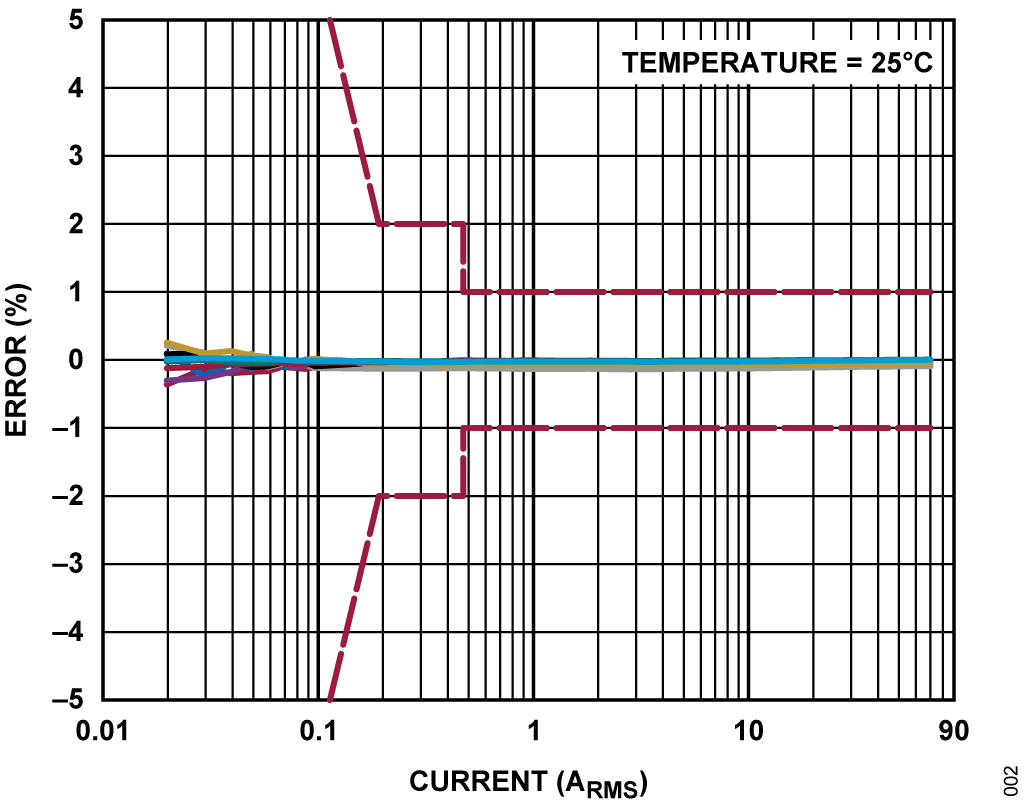
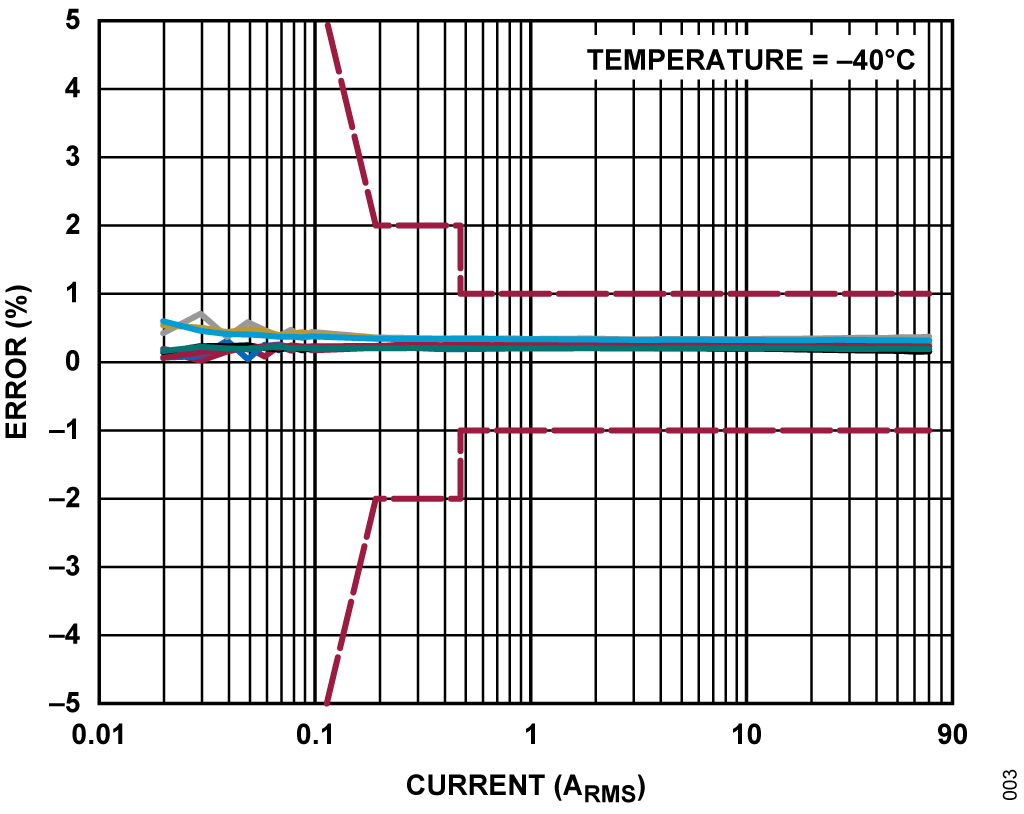
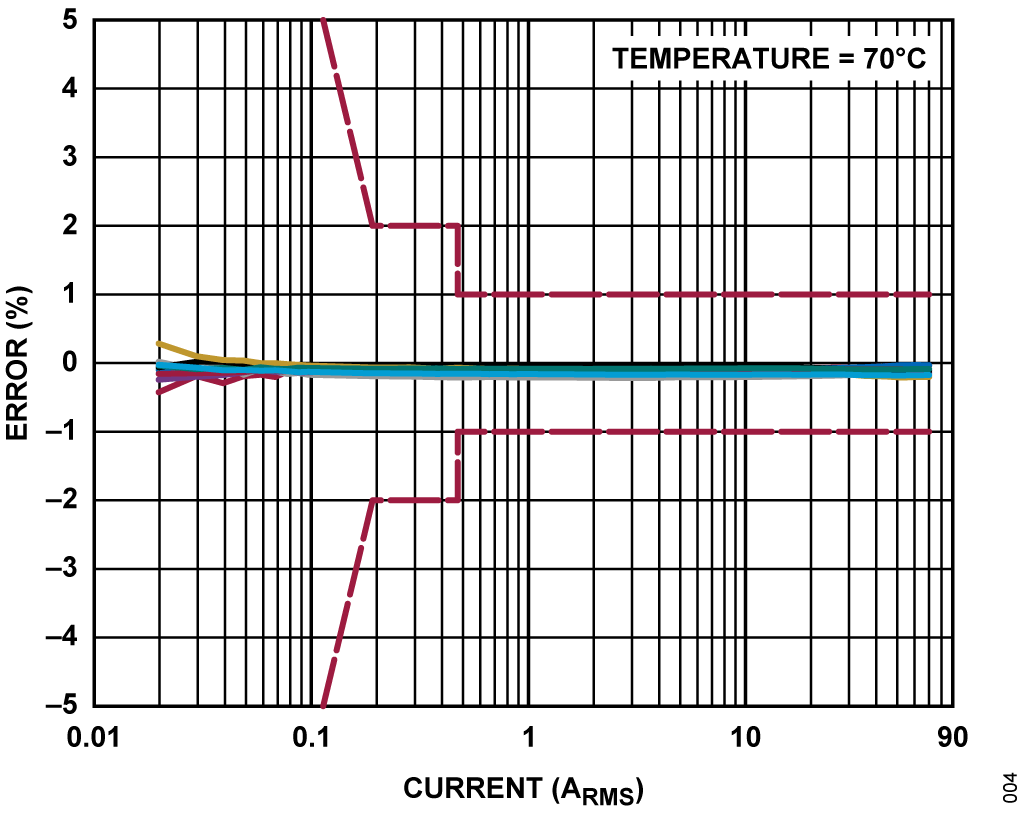
Note that the ADEMA12x and the ADE91xx ADCs can support up to class 0.2% metrology and is rated to −40°C to +125°C.
Drivers and Services
ADC Service
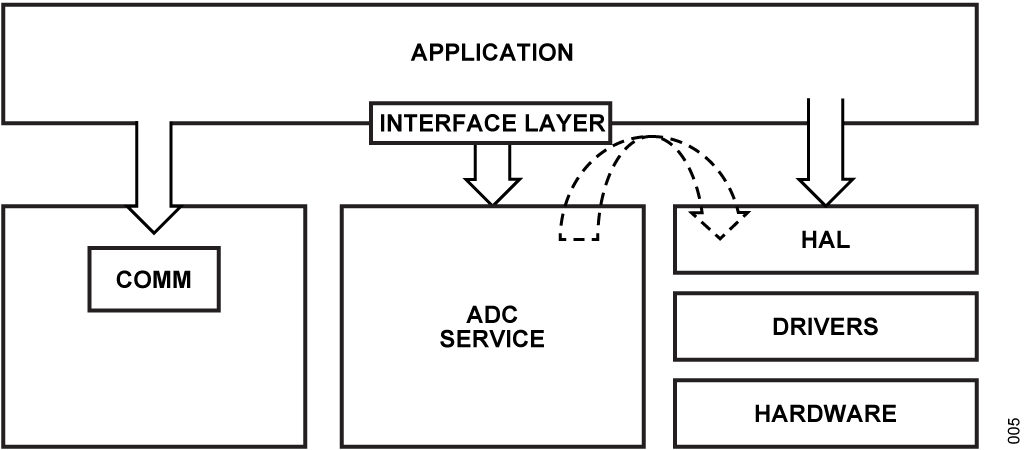
ADC service offers a set of application programming interface (APIs) for interfacing with Analog Devices metrology ADCs, enabling collection of waveform samples over SPI for more complex systems with multiple different parts. It handles command assembly, response parsing, and manages sample storage using a circular buffer. The service verifies response CRCs and flags any errors detected.
Additionally, it also provides drivers and helper APIs for configuring data path features such as gain phase and offset. Our ADC service provides a set of APIs to communicate with Analog Devices metering ADCs and collect waveform samples: analogdevicesinc/energyadc-service.
Drivers are ideal for the following:
- Single ADC or base capabilities
- Advanced configurations
Key Features
Key features of ADC service are the following:
- Configuration management:
- Device initialization: ensures ADCs are correctly set up and communication channels are established.
- Advanced parameter configuration: allows configuration of ADC settings for specific applications, for example, the digital integrator.
- MCU to ADC communication:
- Data reads and writes: functions to read and control the ADC(s).
- Sample acquisition: functions to collect and store waveform samples.
- Seamless daisy chain support:
- Simple initialization to support communication with one or more ADCs in SPI daisy chain mode.
- Error management:
- Monitors ADC errors and flags them for resolution.
- Repeat last known good sample on detection of a CRC error.
Design Resources
- ADEMA12x data sheet: ADEMA124/ADEMA127 (Rev. A)
- ADE91xx data sheet: ADE9103/ADE9112/ADE9113 (Rev. A)
- ADEMA12x evaluation board: EVAL-ADEMA127 Evaluation Board | Analog Devices
- ADE91xx evaluation board: EVAL-ADE9113 Evaluation Board | Analog Devices
- AN-2625 application note: Designing with Multiple ADE ADCs | Analog Devices
- EngineerZone™: ez.analog.com/energy-metering/