

LT3697
PRODUCTIONUSB 5V, 2.5A Output, 35V Input Buck with Cable Drop Compensation
- Part Models
- 4
- 1ku List Price
- Starting From $4.20
Overview
- Accurate 5V Output
- Programmable Cable Drop Compensation
- Programmable Output Current Limit
- Adjustable Output from 5.0V to 6.1V
- Dual Input Feedback Permits Regulation on Output of USB Switch
- Active Load Reduces Output Overshoot
- FLT Flag Indicates Overcurrent on the USB Output
- 1.5ms FLT Flag Delay Filters Hot Plug Events
- USB Output Current Monitor
- Wide Input Rage: Operation from 5V to 35V
- Withstands Input Transient to 60V
- 2.5A Maximum Output Current
- Survives Output Short to GND and Car Battery
- Adjustable Switching Frequency: 300kHz to 2.2MHz
- Synchronizable from 300kHz to 2.2MHz
- Small, Thermally Enhanced 16-Lead MSOP Package
The LT3697 is a 35V, 2.5A step-down switching regulator designed to power 5V USB applications. A precise output voltage and programmable cable drop compensation maintain accurate 5V regulation at the USB socket connected to the end of a long cable. The accurate, programmable current limit can eliminate the need for a USB power switch and improve system reliability. The provided 180mA active load reduces output overshoot during load transients. Dual feedback allows regulation on the output of a USB switch and limits cable drop compensation to a maximum of 6.1V output, protecting USB devices during fault conditions. A separate 5V output can be taken from the SYS terminal to power auxiliary circuitry such as a USB hub controller. The LT3697 also provides a load current monitor output and an overcurrent fault indicator.
The LT3697 operates from 300kHz to 2.2MHz and withstands input voltage transients up to 60V. The device's output survives shorts to ground and to the battery. A current mode topology is used for fast transient response and good loop stability. Shutdown reduces input supply current to less than 1μA. The LT3697 is available in a 16-lead MSOP package with an exposed pad for low thermal resistance.
Applications
- Automotive USB
- Industrial USB
Documentation
Data Sheet 1
User Guide 1
ADI has always placed the highest emphasis on delivering products that meet the maximum levels of quality and reliability. We achieve this by incorporating quality and reliability checks in every scope of product and process design, and in the manufacturing process as well. "Zero defects" for shipped products is always our goal. View our quality and reliability program and certifications for more information.
| Part Model | Pin/Package Drawing | Documentation | CAD Symbols, Footprints, and 3D Models |
|---|---|---|---|
| LT3697EMSE#PBF | 16-Lead MSOP w/ EP | ||
| LT3697EMSE#TRPBF | 16-Lead MSOP w/ EP | ||
| LT3697IMSE#PBF | 16-Lead MSOP w/ EP | ||
| LT3697IMSE#TRPBF | 16-Lead MSOP w/ EP |
| Part Models | Product Lifecycle | PCN |
|---|---|---|
|
Feb 14, 2025 - 25_0016 Bond Wire Change from Gold to Copper Wire (Notification Only) |
||
| LT3697EMSE#PBF | PRODUCTION | |
| LT3697EMSE#TRPBF | PRODUCTION | |
| LT3697IMSE#PBF | PRODUCTION | |
| LT3697IMSE#TRPBF | PRODUCTION | |
|
Jun 5, 2024 - 24_0003 Epoxy Change from Henkel 8290 to 8290A for MSOP Package (2) |
||
| LT3697EMSE#PBF | PRODUCTION | |
| LT3697EMSE#TRPBF | PRODUCTION | |
| LT3697IMSE#PBF | PRODUCTION | |
| LT3697IMSE#TRPBF | PRODUCTION | |
|
Feb 4, 2020 - 20_0132 Laser Top Mark for 16-Lead MSOP Packages Assembled in ADPG and UTAC |
||
| LT3697EMSE#PBF | PRODUCTION | |
| LT3697EMSE#TRPBF | PRODUCTION | |
| LT3697IMSE#PBF | PRODUCTION | |
| LT3697IMSE#TRPBF | PRODUCTION | |
This is the most up-to-date revision of the Data Sheet.
Software Resources
Can't find the software or driver you need?
Request a Driver/SoftwareHardware Ecosystem
| Parts | Product Life Cycle | Description |
|---|---|---|
| Hot Swap Controllers 1 | ||
|
LTC4362-1 LTC4362-2 |
1.2A Overvoltage/Overcurrent Protector | |
Tools & Simulations
LTspice 1
Models for the following parts are available in LTspice:
- LT3697
LTspice® is a powerful, fast and free simulation software, schematic capture and waveform viewer with enhancements and models for improving the simulation of analog circuits.
Evaluation Kits
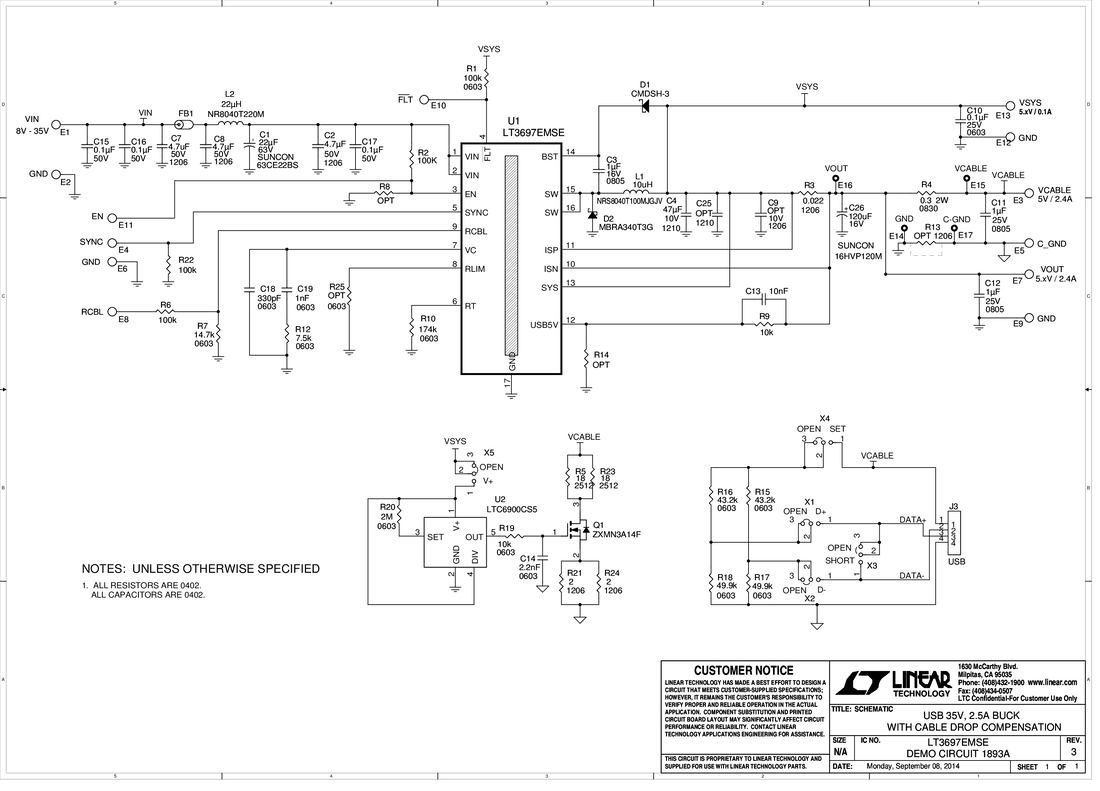
LT3697EMSE Demo Board | 8V ≤ VIN ≤ 35V; VOUT = 5V at 2.4A