Addressing Power Supply Systematic Failures—Part 2: Improving Electromagnetic Immunity

Addressing Power Supply Systematic Failures—Part 2: Improving Electromagnetic Immunity
Jul 15 2026
Read other articles in this series.
Key Takeaways
|
Abstract
Electromagnetic immunity is a critical requirement for power supplies in safety‑related systems because electromagnetic disturbances can lead to dangerous failures if safety functions are compromised. Functional safety standards and related electromagnetic compatibility (EMC) standards such as IEC 61508, IEC 61000‑1‑2, and IEC 61326‑3‑1 demand higher immunity levels, stricter test margins, and robust design measures to ensure reliable system operation under harsh electromagnetic environments. While traditional discrete components such as ferrite beads, RC snubbers, transient-voltage suppressors (TVS), and metal oxide varistors (MOV) provide useful baseline protection, they often fall short when dealing with high‑energy surges, tight voltage tolerances, and increasing system complexity. To address these challenges, Analog Devices offers advanced integrated solutions—including surge stoppers, ideal diode controllers, eFuses, and high‑side drivers—that significantly enhance electromagnetic immunity and simplify compliance with functional safety requirements.
Introduction
Power supplies have stringent electromagnetic compatibility (EMC) requirements because they are the first block in the electrical path, acting as the primary interface between the noisy power grid and sensitive electronics. As the first stage, they are both the largest source of noise and the primary barrier against incoming interference. Examples of EMC standards relevant to power supplies can be seen in Table 1. This includes standards addressing electromagnetic interference (EMI), as well as electromagnetic susceptibility (EMS), which focuses on immunity.
| Standard Reference Number | Description |
| EN 55032 and EN 55011 | Conducted and radiated EMI emitted by the power supply |
| IEC/EN 61000-3-2 | Limits to the harmonic currents that can be taken from the input line |
| IEC/EN 61000-3-3 | Limits to the voltage fluctuations that the power supply can cause to the line input voltage |
| IEC/EN 61000-4-2 | Immunity to electrostatic discharge |
| IEC/EN 61000-4-3 | Immunity to radiated radio frequencies |
| IEC/EN 61000-4-4 | Immunity to fast transient voltages on the input lines |
| IEC/EN 61000-4-5 | Immunity to lightning surges on the input lines |
| IEC/EN 61000-4-6 | Immunity to conducted radio frequencies |
| IEC/EN 61000-4-8 | Immunity to power mains frequency magnetic fields |
Under EMC, we have EMI and EMS. EMS (electromagnetic susceptibility) is otherwise known as electromagnetic immunity, which is important in functional safety. A safety-related system (SRS) with great vulnerability to electromagnetic disturbance may have its safety function lost when needed, thus causing a dangerous failure. With such, the basic functional safety standard IEC 615083 provides guidance and requirements for electromagnetic immunity.
What Does IEC 61508 Say About Electromagnetic Immunity?
The basic functional safety standard IEC 61508 specifies electromagnetic disturbance as one of the environmental stresses that SRS shall be tolerant against. Regardless of safety integrity level (SIL), employing measures to increase immunity to EMI is mandatory. Depending on the SIL, required levels of effectiveness can range from low to high. Low effectiveness may refer to the application of a noise filter at the power supply or critical ports, as well as using shielding. Meanwhile, high effectiveness may refer to using a filter against the worst EMI.3,4
How Does Functional Safety Affect Electromagnetic Immunity Requirements?
IEC 61508 provides EMC requirements as shown in Table 2. It references IEC 61000-1-2 and IEC 61326-3-1 standards for the corresponding electromagnetic immunity limits and safety margins.3,4
| IEC 61508 | Description |
| Part 2 Section 7.2.3.3 Item f | Design requirements shall contain details about the required electromagnetic immunity levels |
| Part 2 Section 7.3.2.2 Item f | Validation planning shall consider electromagnetic immunity performance criteria to be applied |
| Part 2 Annex A Table A.16 and A.18 | Measures against electromagnetic disturbances are mandatory regardless of SIL, with corresponding levels of effectiveness |
| Part 2 E.1 Items m and n | Test requirements for safety functions, including integrated circuits with or without additional safety margins |
Notably, IEC 61000-1-25 provides a methodology to achieve functional safety in SRS considering EMC, where it shows examples of conditions to increase the test severity compared to the requirements in the basic standard. This is done to increase the level of confidence regarding immunity against electromagnetic disturbance when having higher SIL requirements. Meanwhile, the IEC 61326-3-1,6 an EMC standard for electrical equipment for measurement, control, and laboratory use in industrial applications, provides immunity requirements for SRS. We have the enclosure port, AC and DC input and output ports, input/output control ports, which shows that complying with higher SIL increases the severity of certain test parameters by a corresponding factor with respect to the basic standard. Furthermore, both standards specified the application of a performance criterion DS,6 which specifies a required operation for safety-related functions and nonsafety-related functions, as opposed to the usual performance A, B, and C of EMC standards.4-7
With functional safety compliance, an SRS is required to comply with more stringent EMC requirements to improve robustness against electromagnetic disturbance and ensure that safety functions will work when demanded or as designed. Aside from this, an SRS may not fail immediately when exposed to high levels of stress, but its reliability may be impacted, which can result in its lifetime being shortened, thus no longer meeting the reliability assumptions during the safety analysis. For this reason, employing different techniques to protect downstream components from electromagnetic disturbances has become the norm.
Improving Electromagnetic Immunity Using Different Solutions
There are different ways to improve immunity from electromagnetic disturbances. Table 3 shows examples of such external discrete solutions alongside their purpose.
| Solution | Pros | Cons |
| Ferrite Beads | Attenuate high‑frequency and fast voltage spikes when used below the self‑resonant frequency. | Provide limited energy absorption and can create unwanted resonances if operated near or above the self-resonant frequency or not paired with capacitors. |
| RC Snubber | Low‑cost damping elements that reduce ringing by slowing edge rates and dissipating energy. | Introduce signal loss and power dissipation, making them unsuitable for high‑speed or high‑current paths. |
| Voltage Suppressors | Clamp fast low‑voltage transients very quickly and precisely, making them excellent for protecting sensitive electronics. | Have limited surge‑energy capability due to form‑factor constraints and significant junction capacitance that can impact fast systems. |
| Voltage-Dependent Resistor | Absorb high‑energy surges effectively and offer broad clamping capability across a wide voltage range. | Exhibit high leakage near breakdown and add substantial capacitance, requiring decoupling or additional circuitry in high‑speed designs. |
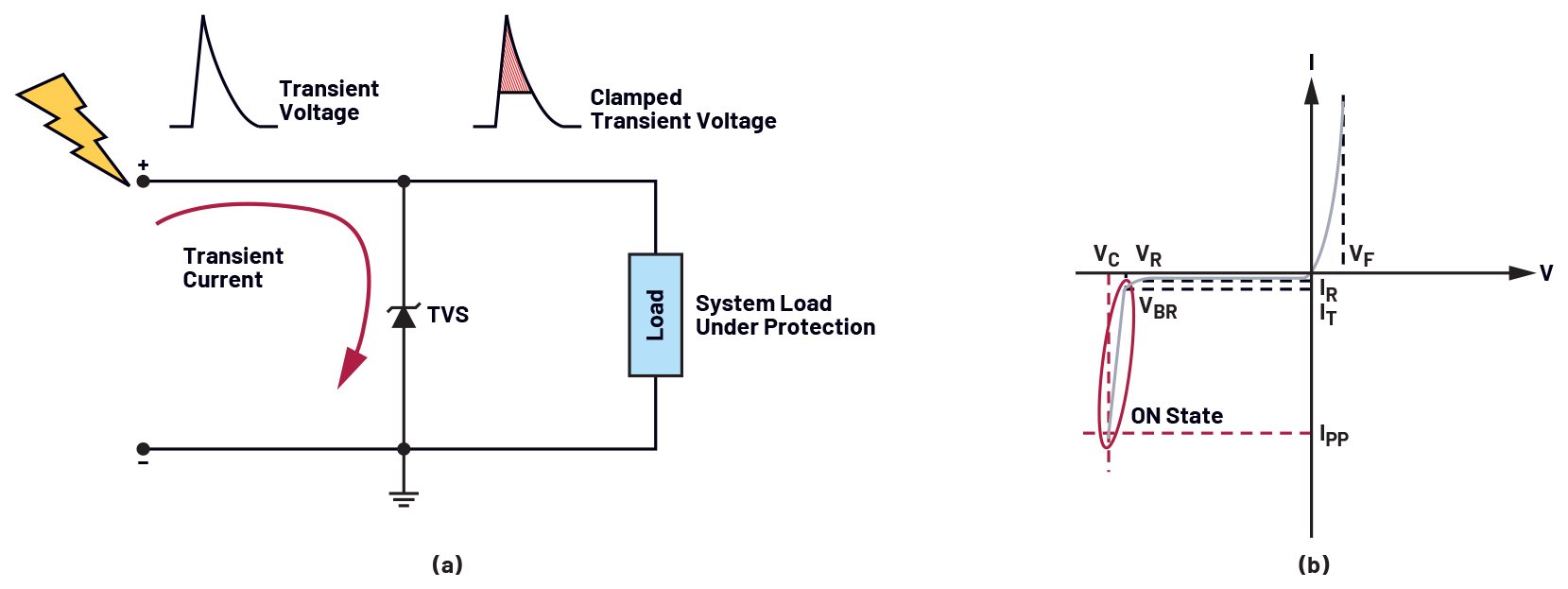
One of the most used discrete surge-protection devices is the transient-voltage suppressor (TVS) diode. A TVS diode—typically connected in parallel with the protected load—clamps overvoltage spikes and dissipates transient energy (Figure 1a). In normal operation, it remains nonconductive, but when an instantaneous high-energy transient causes the voltage across its terminals to exceed its breakdown voltage (VBR), the device avalanches and rapidly shunts surge current to ground, limiting the voltage to its specified clamping level (VC) and protecting downstream circuitry (Figure 1b).8
Once the surge subsides and the line voltage falls back below the breakdown threshold, the TVS diode quickly returns to its high-impedance state, restoring normal circuit operation. This reversible behavior makes TVS diodes highly effective for protecting sensitive electronics against electrostatic discharge (ESD), lightning-induced transients, and switching surges.9 There are downsides to this approach. The clamping can convert an AC signal to have a large DC component that then easily passes through any subsequent AC filtering.
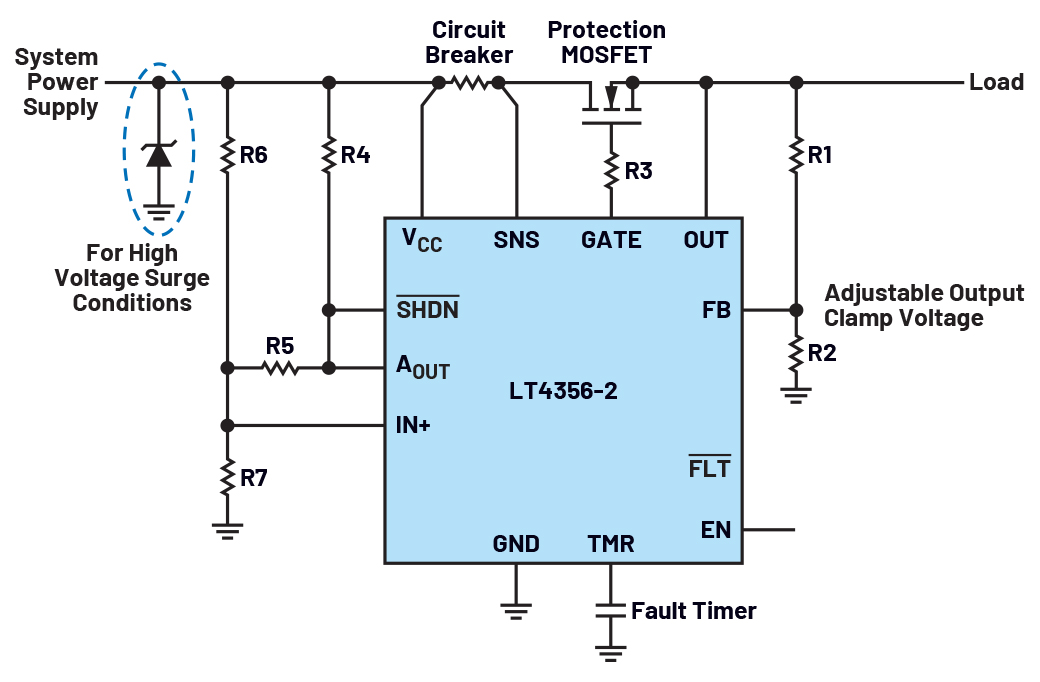
In cases where the load’s maximum voltage rating makes it challenging to select a suitable TVS diode, especially when residual surge voltage at the system level remains high, a surge stopper can be added as a secondary series clamp to regulate the output to a safer voltage level (Figure 2). This approach improves system robustness by preventing excessive stress on the TVS diode and downstream components during high-energy surge events. Using a two-stage protection scheme separates surge energy absorption from precise voltage limiting, resulting in a more robust and reliable solution that is well-suited for meeting IEC surge immunity requirements.
Optimizing Electromagnetic Immunity Performance with Integrated Solutions
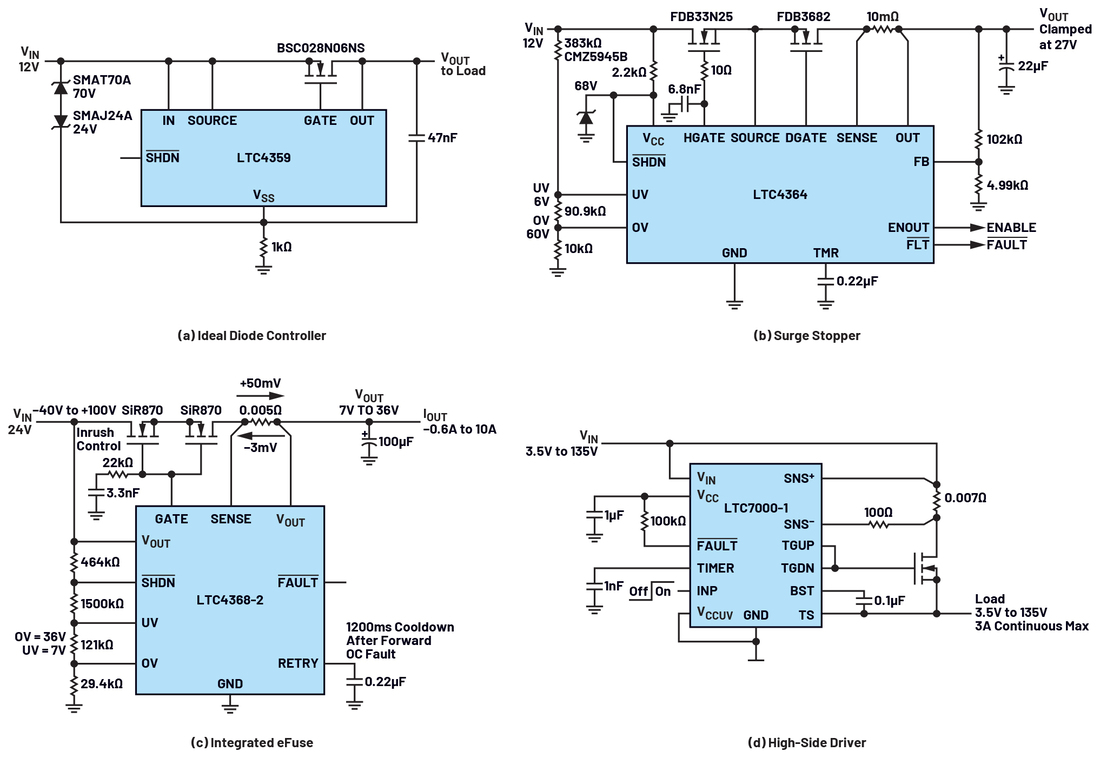
As EMC and functional safety requirements become more stringent, discrete protection components alone are often insufficient to guarantee predictable behavior under severe electromagnetic stress. High-energy surge, tight voltage margins, and increasing system complexity can expose the limitations of passive solutions particularly with higher residual voltages, uncontrolled energy dissipation, and a growing component count. These challenges are best addressed with protection that goes beyond passive clamping. Analog Devices offers a portfolio of integrated power-protection solutions that actively manage voltage, current, and power during abnormal operating conditions, significantly improving electromagnetic immunity robustness while simplifying system design as shown in Figure 3.
Ideal Diode Controller
Standard Schottky diode ORing introduces significant forward voltage drops and heat, but, more importantly, it allows large transient currents during supply switchover that contributes to conducted EMI. Ideal diode controllers, such as the LTC4359, replace traditional diodes with low-loss MOSFET control. These controllers regulate a small forward voltage drop across the MOSFET, ensuring smooth current delivery without oscillation. In the event of a source failure or input short, a high-speed pull-down minimizes reverse current transients, preventing noise from propagating back to the power bus.
Surge Stopper
Traditional TVS-based protection shunts energy to ground, often leaving a high residual voltage that necessitates oversized downstream filters. Surge stoppers, including the LT4356 and LTC4364, take a different approach by actively regulating the downstream voltage. During overvoltage events, these devices control a series-pass MOSFET to limit output voltage and current, dramatically reducing residual surge stress on sensitive loads. These devices drive a series-pass MOSFET to throttle the output voltage to a safe, predefined level during a spike. This suppresses the residual surge that often leaks through passive clamps, making it easier to meet surge immunity requirements without oversized downstream filters.
Integrated eFuses
Electronic fuses (eFuses), including the LTC4368 and MAX17617/MAX17617A, integrate programmable current limiting, controlled inrush, thermal protection, overvoltage and undervoltage protection, and fault reporting in a single device. By actively controlling startup behavior and limiting fault current during overload or short-circuit conditions, these eFuses reduce voltage droop, suppress current transients, and prevent fault-induced disturbances from propagating onto the power bus.
High-Side Drivers
The LTC700x family of high-side gate drivers provides robust control of external N-channel MOSFETs for high-voltage and high-current power domains. With features including fast fault response, wide operating voltage range, and precise gate control, these devices enable clean turn-on and turn-off behavior while limiting inrush current and fault-induced transients. When paired with current-sense circuitry or upstream protection, LTC7000x devices form a flexible and scalable solution for managing power distribution.
Conclusion
As electromagnetic disturbance levels continue to rise and functional safety requirements become more stringent, power supplies must incorporate protection methods that go beyond basic discrete components. Integrated power-path control, active surge regulation, and programmable fault management provide more predictable behavior and greater robustness when subjected to EMC test conditions. Analog Devices’ portfolio of surge stoppers, ideal diode controllers, eFuses, and high-side drivers delivers proven solutions for improving electromagnetic immunity performance in safety-related systems.
References
1"Guide to EMC Standards for Power Supplies." TDK-Lambdas Americas, March 2025.
2"IEC/EN61000 Standards for Power Supplies." Advanced Energy, 2019.
3"IEC 61508-2. Functional Safety of Electrical/Electronic/Programmable Electronic Safety-Related Systems—Part 2: Requirements for Electrical/Electronic/Programmable Electronic Safety-Related Systems." International Electrotechnical Commission, April 2010.
4"Functional Safety and EMI." exida, 2018.
5"IEC 61000-1-2. Electromagnetic Compatibility (EMC)—Part 1-2: General—Methodology for the Achievement of Functional Safety of Electrical and Electronic Systems Including Equipment with Regard to Electromagnetic Phenomena." International Electrotechnical Commission, April 2016.
6"IEC 61326-3-1. Electrical Equipment for Measurement, Control and Laboratory Use—EMC Requirements—Part 3-1: Immunity Requirements for Safety-Related Systems and for Equipment Intended to Perform Safety-Related Functions (Functional Safety)—General Industrial Applications." International Electrotechnical Commission, May 2017.
7"IEEE Standard for Techniques and Measures to Manage Functional Safety and Other Risks with Regard to Electromagnetic Disturbances." IEEE, April 2021.
8"Practical Aspects of EMI Protection." Analog Devices, Inc., August 2002.
9Vikky K. "How to Select a TVS Diode to Suppress Transients in Electrical Circuits?" Embedded Hardware Design, December 2024.
About the Authors
Bryan Angelo Borres is a TÜV-certified functional safety engineer who focuses on industrial functional safety. As a senior functional safety engineer, he helps component designers and system integrators design functionally
Camille Bianca Gomez is a product applications engineer at Multimarket Power—East. She joined Analog Devices in March 2022 and obtained her bachelor’s degree in electronics engineering from De La Salle University—Laguna
Related to this Article
Products
RECOMMENDED FOR NEW DESIGNS
Surge Stopper
RECOMMENDED FOR NEW DESIGNS
Ideal Diode Controller with Reverse Input Protection
RECOMMENDED FOR NEW DESIGNS
Surge Stopper with Ideal Diode
Fast 150V Protected High Side NMOS Static Switch Driver with PassThru
3V to 80V, 7A, Power-Limiter with OV/Surge, UV, Reverse Polarity and Loss of Ground Protection
100V UV/OV and Reverse Protection Controller with Bidirectional Circuit Breaker