
ADPS43634-RD Instrumentation Power Solution


Overview
Design Resources
Design & Integration File
- Schematic
- PCB Layout
- Bill of Materials
- Allegro Layout Files
Description
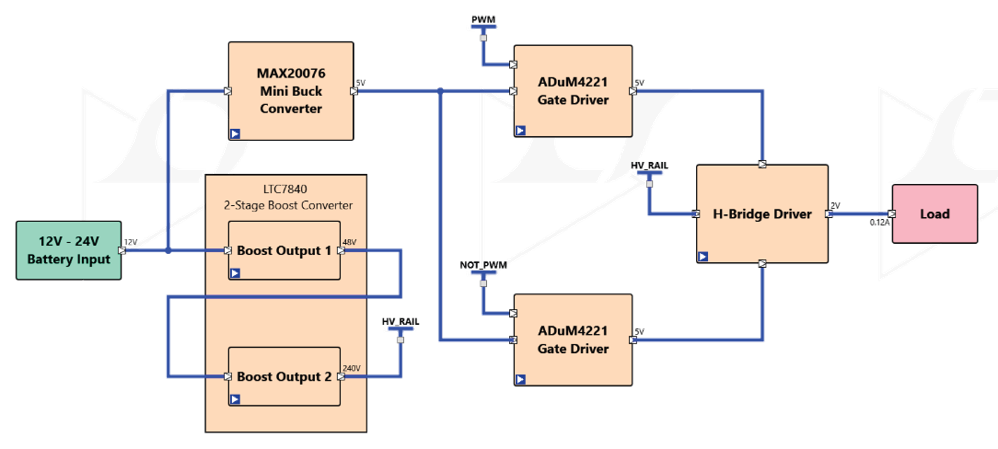
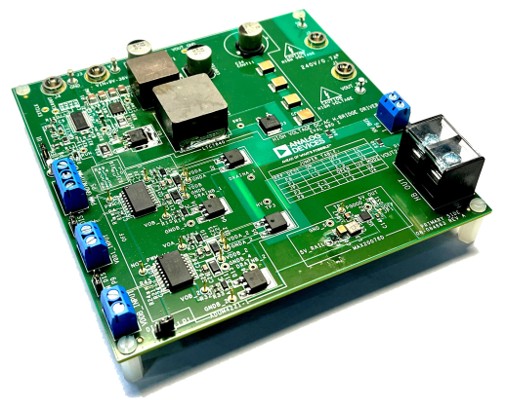
Advanced lighting applications for props increasingly use electroluminescent (EL) paints to illuminate surfaces. This solution implements a multi-topology power solution providing a complete and integrated platform for delivering high-voltage AC output from a low-voltage DC source. The system accepts a digital sinusoidal pulse-width modulation (sPWM) input, enabling flexible control of the output frequency to accommodate a wide range of application-specific requirements. At the front end, the step-up converter boost a 12 V DC input sourced from either a regulated supply or a battery to approximately 240 V DC. This high-voltage DC bus feeds the H-bridge inverter stage, which generates an AC output with a peak-to-peak swing of up to 480 V AC. The resulting high-voltage AC output with programmable frequency control enables efficient driving of electroluminescent (EL) paint and related materials. Its flexible architecture also supports motor drives and other applications requiring controlled high-voltage AC operation.
Applications
- EL (Electroluminescence) Paint Driver
- Motor Driver
- Class D Amplifier
- Inverter for Solar Panel
Features & Benefits
- Precise voltage and frequency control enables compatibility with different EL paint types and brightness requirements.
- Adjustable output parameters provide creative flexibility while maintaining high efficiency and reliable operation.
- Supports analog and digital control options, simplifying integration with microcontroller‑based lighting systems.
- Scalable power architecture accommodates a wide load range, making it suitable for various prop sizes and applications.
- Compact, high‑performance alternative to traditional EL drivers, offering ease of use, adaptability, and long‑term operational efficiency for demanding entertainment environments.
Electrical Specifications:
- Input Voltage: 12 VDC – 24 VDC
- Output Waveform: Sinusoidal AC
- Output Voltage (Peak): 140 Vpk – 340 Vpk
- Output Voltage (Target): 150 V ±30 V
- Output Frequency: ~1000 Hz nominal
- Frequency Adjustment Range: 950 Hz – 1050 Hz
- Output Power (Reference): 30 W
- Expected Load Range: 25 W – 200 W
- Output Characteristics: Variable voltage, variable frequency
System & Control Requirements:
- Output Control & Dimming: Adjustable voltage & frequency with PWM and/or voltage dimming
- Digital & External Control: Digital control preferred; accepts external PWM/SPWM
- Adjustment & Flexibility: Parameter tuning with passive component switching
- Scalability: Wide power range support
- Integration Readiness: MCU‑friendly interface
Product Categories
Markets and Technologies
Parts Used
Documentation & Resources
-
ADPS43634-RD Design Files8/13/2026ZIPundefined
-
LTpowerCAD® and LTpowerPlanner®11/17/2017
-
ADPS43634-RD LTPowerPlanner8/12/2026LTP3undefined
Support & Training
Search our knowledge base for answers to your technical questions. Our dedicated team of Applications Engineers are also available to answer your technical questions.