

LTM8002
RECOMMENDED FOR NEW DESIGNS40VIN, 2.5A Silent Switcher µModule Regulator
- Part Models
- 5
- 1ku List Price
- Starting From $13.58
Overview
- Complete Step-Down Switch Mode Power Supply
- Low Noise Silent Switcher® Architecture
- Wide Input Voltage Range: 3.4V to 40V
- Wide Output Voltage Range: 0.97V to 18V
- Wide Temperature Range: –40°C to 150°C (H-Grade)
- 2.8A Continuous for 5VOUT, 12VIN, 2MHz at 105°C (H-Grade)
- 3.5A Peak
- FMEA Compliant Pinout
Output Stays at or Below Regulation Voltage During Adjacent Pin Short or if a Pin Is Left Floating - Selectable Switching Frequency: 200kHz to 3MHz
- External Synchronization
- Low Quiescent Current: 25µA (5VOUT)
- Programmable Soft-Start
- Tiny, Low Profile 6.25mm × 6.25mm × 2.22mm BGA Package
The LTM8002 is a 40VIN, 2.5A step-down µModule® (power module) regulator. Included in the package are the switching controller, power switches, inductor, and all support components. Operating over an input voltage range of 3.4V to 40V, the LTM8002 supports an output voltage range of 0.97V to 18V and a switching frequency range of 200kHz to 3MHz, each set by a single resistor. Only the input and output filter capacitors are needed to finish the design.
The low profile package enables utilization of unused space on the bottom of PC boards for high density point of load regulation. The LTM8002 is packaged in a thermally enhanced, compact over-molded ball grid array (BGA) package suitable for automated assembly by standard surface mount equipment. The LTM8002 is available with SnPb or RoHS compliant terminal finish.
Documentation
Video 2


Product Selection Guide 1
Brochure 2
Book & eBook 1
Webcast 1
ADI has always placed the highest emphasis on delivering products that meet the maximum levels of quality and reliability. We achieve this by incorporating quality and reliability checks in every scope of product and process design, and in the manufacturing process as well. "Zero defects" for shipped products is always our goal. View our quality and reliability program and certifications for more information.
| Part Model | Pin/Package Drawing | Documentation | CAD Symbols, Footprints, and 3D Models |
|---|---|---|---|
| LTM8002HY | 49-Lead BGA (6.25mm x 6.25mm x 2.22mm) | ||
| LTM8002HY#PBF | 49-Lead BGA (6.25mm x 6.25mm x 2.22mm) | ||
| LTM8002HY-3.3#PBF | 49-Lead BGA (6.25mm x 6.25mm x 2.22mm) | ||
| LTM8002IY#PBF | 49-Lead BGA (6.25mm x 6.25mm x 2.22mm) | ||
| LTM8002IY-3.3#PBF | 49-Lead BGA (6.25mm x 6.25mm x 2.22mm) |
| Part Models | Product Lifecycle | PCN |
|---|---|---|
|
Jul 21, 2021 - 21_0159 Ink Mark to Laser Mark Conversion for µModule |
||
| LTM8002HY | PRODUCTION | |
| LTM8002HY#PBF | PRODUCTION | |
| LTM8002HY-3.3#PBF | PRODUCTION | |
| LTM8002IY#PBF | PRODUCTION | |
| LTM8002IY-3.3#PBF | PRODUCTION | |
|
Feb 28, 2020 - 20_0123 Micro-Module, Test Site Transfer from Analog Devices Singapore to Analog Devices Penang, Malaysia |
||
| LTM8002HY | PRODUCTION | |
| LTM8002HY#PBF | PRODUCTION | |
| LTM8002HY-3.3#PBF | PRODUCTION | |
| LTM8002IY#PBF | PRODUCTION | |
| LTM8002IY-3.3#PBF | PRODUCTION | |
|
Aug 7, 2019 - 19_0162 Notification of ADI Penang as an Alternate Assembly Site and Mold Compound Change for LTM8002 |
||
| LTM8002HY | PRODUCTION | |
| LTM8002HY#PBF | PRODUCTION | |
| LTM8002HY-3.3#PBF | PRODUCTION | |
| LTM8002IY#PBF | PRODUCTION | |
| LTM8002IY-3.3#PBF | PRODUCTION | |
|
Apr 11, 2019 - 19_0067 Notification of Wafer Fab Location Change for 0.35 BCD Process |
||
| LTM8002HY | PRODUCTION | |
| LTM8002HY#PBF | PRODUCTION | |
| LTM8002HY-3.3#PBF | PRODUCTION | |
| LTM8002IY#PBF | PRODUCTION | |
| LTM8002IY-3.3#PBF | PRODUCTION | |
This is the most up-to-date revision of the Data Sheet.
Software Resources
Can't find the software or driver you need?
Request a Driver/SoftwareTools & Simulations
LTspice
Models for the following parts are available in LTspice:
- LTM8002
LTpowerCAD
Design tools for the following parts are available in LTpowerCAD:
- LTM8002
LTspice® is a powerful, fast and free simulation software, schematic capture and waveform viewer with enhancements and models for improving the simulation of analog circuits.
Evaluation Kits
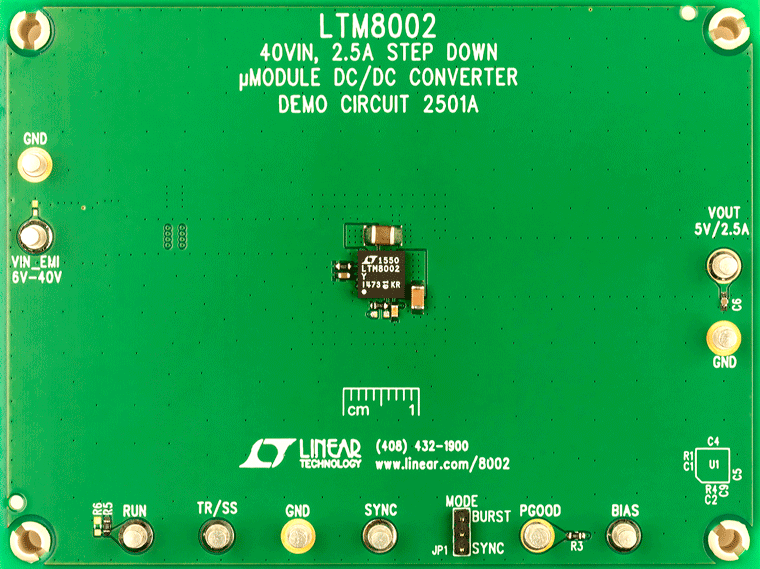
LTM8002 40VIN, 2.5A Step-Down µModule Regulator