
Measuring Harmonic Energy With a Solid-state Energy Meter
In recent years, the energy metering industry has slowly adopted electronic solutions to replace the century-old electromechanical technology. The advantages of electronic solutions are numerous. First, they bring the industry into the digital age, and enable the implementation of value-added services such as automatic meter reading (AMR) multi-tariff billing, maximum demand and power quality monitoring.
Electronic meters also allow a more accurate active power measurement by including the harmonics. Indeed, the growing complexity of household electrical equipment generates higher levels of harmonics that should be accounted for in the active power measurement. Electromechanical solutions measure the harmonic power only up to the 5th harmonic, while electronic solutions can give an accurate estimate up to and above the 63rd harmonic.
Electronic solutions are inherently precise. However, differences in the electronic system architecture can impact the accuracy of the harmonic active power measurement. This article summarises the strengths and weaknesses of three major electronic energy meter implementations.
Why Is Harmonic Power Important?
The harmonic active power is the active power generated by the harmonic frequencies of the fundamental frequency – 60 Hz in North America and 50 Hz in Europe. If these harmonics are present on both the voltage input and load current, harmonic active power is generated - see Equation 1.
Non-linear loads like home entertainment equipment, high efficiency lights, desktop computers and adjustable speed drives (ASD) used in heat pumps or air conditioners are sources of harmonic load currents in low voltage installations. Test conditions for static energy meters listed in IEC 62053-21 (previously IEC 61036) accurately represent the current drawn by non-linear loads. But these tests do not mention the presence of harmonics on the voltage input, implying by definition of the active power calculation that no harmonic power is present.
However, a common side effect of non-linear loads is the distortion of the line voltage, leading to the appearance of harmonics on the voltage input. For example, the resultant harmonic power has been measured in the field up to 9.3% of the total active power flow with signals up to the 50th harmonic1. Such numbers demonstrate that the ability to measure the harmonic active power is as critical as the traditional accuracy performances used to classify energy meters. Defining and realising test equipment capable of simulating these conditions is challenging – but the basic characteristics of an electronic energy meter are often sufficient to determine if a solution can measure the harmonic active power and to what extent it can do so. These criteria should be used as a standard of quality in addition to the accuracy class of the meter when choosing an electronic energy meter.
Measuring Harmonic Power
The main challenge when measuring the harmonic power is to make sure that the system can measure harmonics on the voltage and current inputs. The important characteristics of the electronic system are:
- Analog input bandwidth
The analog input bandwidth defines the frequency limit above which the signal is attenuated by more than 3 dB (29.2%). A small analog input bandwidth means that higher orders of harmonics will not be correctly analysed. For example, a 500Hz analog input bandwidth limits the harmonic measurement up to the 10th order for a 50 Hz installation. It is best to require an analog input bandwidth greater than 4kHz, as all harmonics lower than the 63rd will be correctly processed by the system in both Europe and North America.
- Sampling and digital signal processing frequency
The sampling frequency (Fs) is the speed at which the analog-todigital converter (ADC) is sampling the input signal. It should be noted that most, if not all, electronic energy meters now use ADCs. The Nyquist theorem says that if the input signal contains frequencies higher than Fs/2, the signal cannot be correctly interpreted, as the sampling process changes its digital equivalent frequency. This behaviour is known as aliasing. With the analog input bandwidth requirement in mind, the sampling frequency should be at least twice the desired input bandwidth of 4 kHz: 8 kilo-samples per second (ksps).
Not All Electronic Energy Meters Are the Same
From a high level perspective, meters from different manufacturers have similar architectures. They are usually comprised of an analog front end to interface with the voltage and current sensors; analog-to-digital converters to change the real world signal into digital information; digital signal processing to compute the energy information; a microprocessor (MCU) to manage the system and its peripherals; and finally an undefined number of peripherals like a display, an infra-red port, or other communication media. (See Figure 1.) But when one looks more closely, critical choices made in the implementation of this architecture determine the behavioural differences of the systems in the presence of harmonic power.
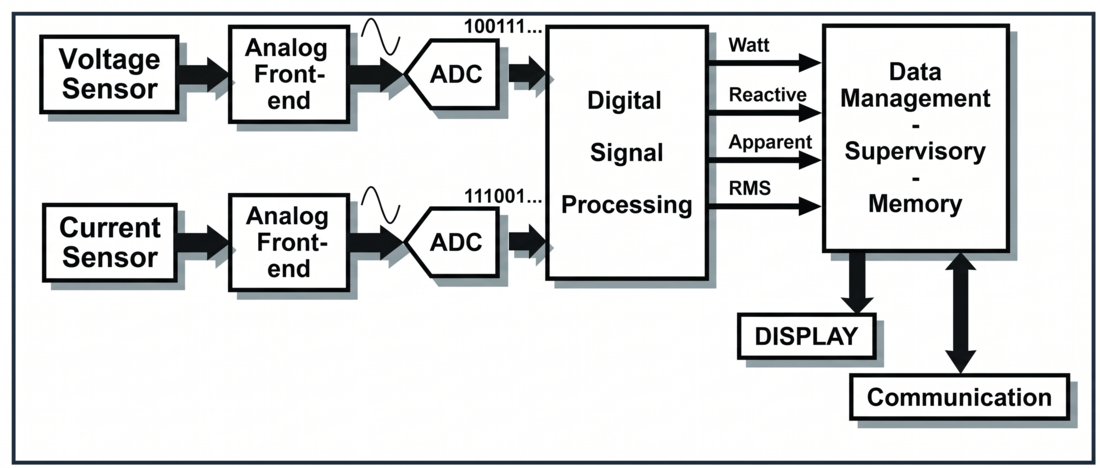
1. Multi-chip
In this case, the emphasis is on choosing the best performance at the right price, and all the functions are realised with individual electronic components for each function listed in Figure 1. This architecture is the most expensive and is often used in 3-phase applications. In terms of performance, the ADCs are the critical elements and the DSP is chosen to handle the signal processing required for the energy calculation. For 3-phase energy meters, a 6-channel ADC with simultaneous sampling, such as the AD73360L from Analog Devices, is the preferred choice. It exceeds the requirements for accuracy measurement with a sampling frequency up to 64ksps and an analog input bandwidth greater than 4 kHz. This solution leaves the signalprocessing algorithm in the hands of the meter manufacturer.
2. MCU with built-in ADC
This architecture is attractive because the ADCs, digital signal processing and management functions can be combined in one component. Only a few extra analog components are needed to perform the signal conditioning for the ADCs’ inputs. It leads to a compact design where the energy data processing is still the responsibility of the meter manufacturer.
However, several limitations should be stressed:
- An MCU used in this architecture has limited digital signal processing (DSP) capabilities. As a result, it can only process the ADC inputs at a low sampling rate – e.g. 1 to 2 ksps – therefore limiting the harmonic content included in the active energy measurement.
- Limited DSP capabilities result in a lack of filtering for energy measurement. Poor filtering affects the stability and reproducibility of results under test conditions where harmonics are present. This stability is valuable in production as it shortens calibration and test time.
- Such a compact design will not easily accommodate changing specifications like AMR add-on, rms or reactive energy measurements. It will require a complete re-engineering of the energy meter to optimise the new MCU code for each new function added.
3. Energy Metering IC with low cost MCU
As proposed by the ADE family of products from Analog Devices, the energy meter architecture can be partitioned differently by combining the ADC and the digital signal processing in one component. It has the advantage of relieving the MCU from any real time signal processing and allows the use of a simple, low cost 8-bit MCU for the management and communication tasks. From an energy measurement perspective it also has the following advantages:
- ADE parts have a high sampling rate – 800 ksps – and an analog input of 14 kHz, enabling the signal processing of harmonic power up to the 230th.
- Products in the ADE family allow direct interface to current and voltage sensors without additional analog front end.
- Extensive filtering is done in the ADE parts, providing stable and repeatable energy measurements.
Conclusion
Including harmonics in the active energy calculation improves billing accuracy and grid management as the number of nonlinear loads in household appliances increases. In the absence of a standard procedure requiring the measurement of harmonic power, a qualitative evaluation of electronic energy meters can help to decide if a solution is capable of harmonic power measurement. (See Table I.) With the latest advances in integrated circuit development, as proposed by the ADE family of products from Analog Devices, energy meter designers can now provide harmonic energy measurements at a low cost and satisfy the emerging requirements from energy providers.
| Criteria | Analog input bandwidth ≥4kHz | Sampling and Digital signal processing frequency ≥ 8ksps | Filtering for stability and repeatability |
| ADC + DSP/MCU | ✓ | ✓ | ✓ |
| MCU with Embedded ADC | |||
| Energy Metering IC (ADE) + MCU | ✓ | ✓ | ✓ |
References
1 J Lundquist, MHJ Bollen, “Harmonic Active Power Flow in Low and Medium Voltage Distribution Systems”, IEEE Pes WM2000, Singapore 2000.关于作者
关联至此文章
产品
单相电能计量IC,集成8052 MCU、RTC和LCD驱动器
单相电能计量IC,集成8052 MCU、RTC和LCD驱动器
单相电能计量IC,集成8052 MCU、RTC和LCD驱动器
三相、多功能电能计量IC,具有防窃电检测功能和低功耗模式
三相、多功能电能计量IC,可测量各相的有功和无功功率
三相、多功能电能计量IC
多相、多功能电能计量IC,可测量各相的有功和无功功率
单相电能计量IC,集成8052 MCU、RTC和LCD驱动器
单相电能计量IC,集成8052 MCU、RTC和LCD驱动器
单相电能计量IC,集成8052 MCU、RTC和LCD驱动器
单相电能计量IC,集成8052 MCU、RTC和LCD驱动器
单相电能计量IC,集成8052 MCU、RTC和LCD驱动器
带di/dt输入(串行接口)单相电能计量IC
Please see the ADE7756.
集成脉冲输出的电能计量IC
单相电能计量IC,内置故障检测
单相电能计量IC,集成8052 MCU、RTC和LCD驱动器
三项多功能电能计量IC(含各项信息)
内置振荡器和空载指示单相电能计量IC
单相电能计量IC,集成振荡器
集成振荡器和反向功率指示的单相电能计量IC
单相有功和视在功率计量IC
Polyphase Energy Metering IC with Pulse Output
带串行接口单相电能计量IC
Single Phase Product-to-Frequency Converter for Multiple Applications
内置故障检测和振荡器的单相电能计量IC
单相电能计量IC,集成8052 MCU、RTC和LCD驱动器
三相、三线和四线电能计量IC,内置脉冲输出
带di/dt输入(串行接口)单相电能计量IC
电能计量IC,内置故障和零线断线检测
三相电能计量IC,内置相位压差指示
提供串行端口的多相位、 多功能电能计量IC
单相电能计量IC,集成8052 MCU、RTC和LCD驱动器
低功耗、三相电能计量IC,内置脉冲输出
内置振荡器仅累积正功率单相电能计量IC
带内置故障检测和零线断线检测功能的电能计量IC
Please see the ADE7754.