
Reactive Energy Measurement Made Simple
The amount and complexity of household and industrial electrical equipment have been increasing, thanks to economic development and improved standards of living. Ballast lighting, computer monitors, air conditioners and industrial machines are welcome additions to our lives, but come with an additional burden. Utilities are concerned that inductive and capacitive loads are unaccounted for in KWh-only billing using traditional electromechanical meters, especially in a competitive, deregulated environment.
Analog Devices’ new energy metering ICs – the ADE7753 and ADE7758 – now allow utility companies to obtain accurate energy usage information more easily than ever before. Reactive energy, caused by nonlinear loads, requires energy suppliers to supply more volt-amps to customers than they can measure with a conventional watt-hour (active energy) meter. The ability to measure reactive energy enables utility companies to prevent revenue loss and improve power-generation capacity management
Like all of Analog Devices’ energy ICs, the ADE7753 and ADE7758 are based on ADI’s industry leading, high-resolution analog-to-digital converter (ADC) technologies combined with a fixed-function DSP. The DSP performs all the necessary energy measurement calculations, allowing a low-cost microprocessor to be used for data management and supervisory functions. This architecture simplifies meter designs that previously relied on microprocessors to perform complex computations. The reduction in extensive code development significantly reduces cost and time-to-market.
About the ADE7758/ADE7753
The ADE7758, which features second-order sigma-delta ADCs, is designed for mid-range three-phase energy meters. For each phase, the chip measures reactive, active and apparent energy; as well as rms voltage and rms current. These measurements are accessed via a serial interface that allows a fully automated digital calibration. The ADE7758 interfaces with a variety of sensors, including current transformers and di/dt current sensors, such as Rogowski coils. Like other products in the ADE family, the ADE7758 provides accurate active energy measurements with less than 0.1 percent gain error over a current dynamic range of 1000:1. Its reactive energy measurement also surpasses the Class 2 IEC61268 accuracy requirement of VAR-hr meters.
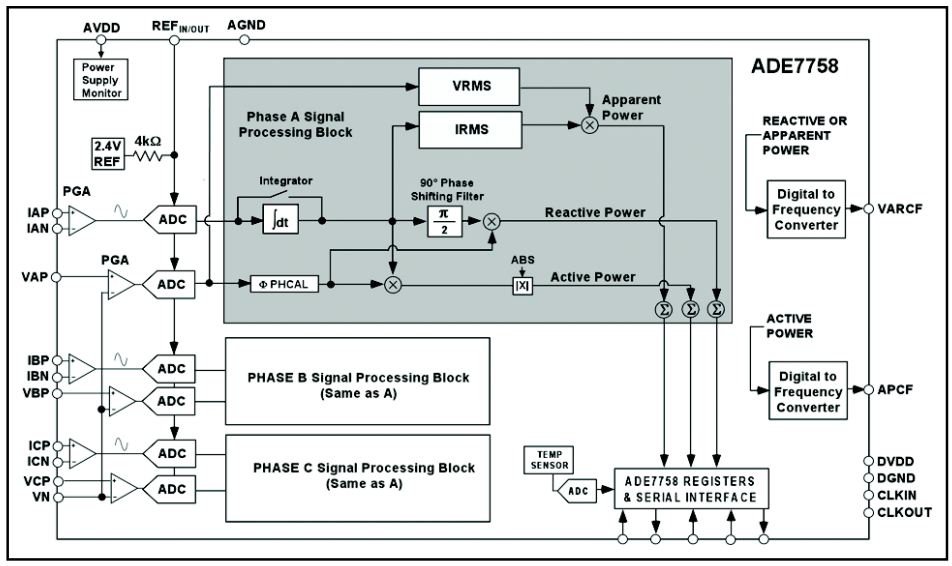
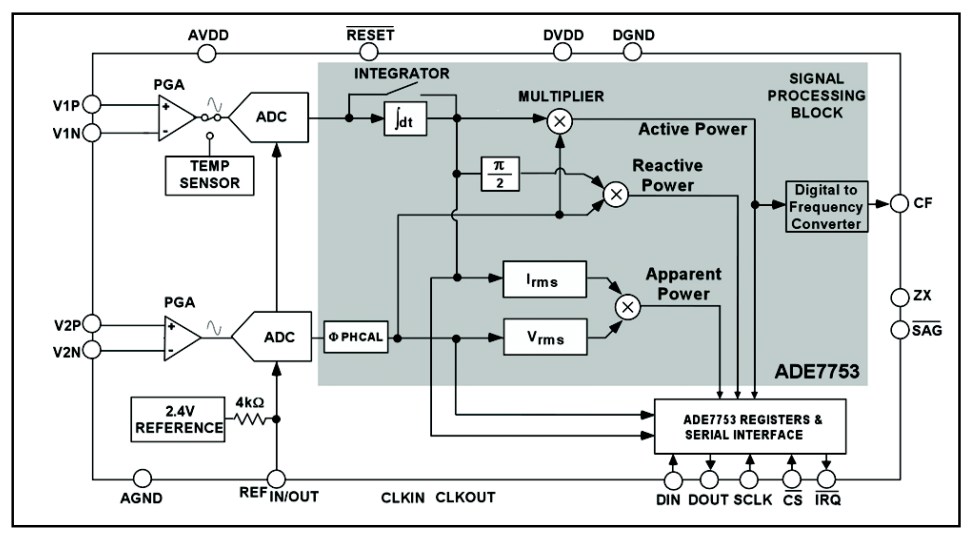
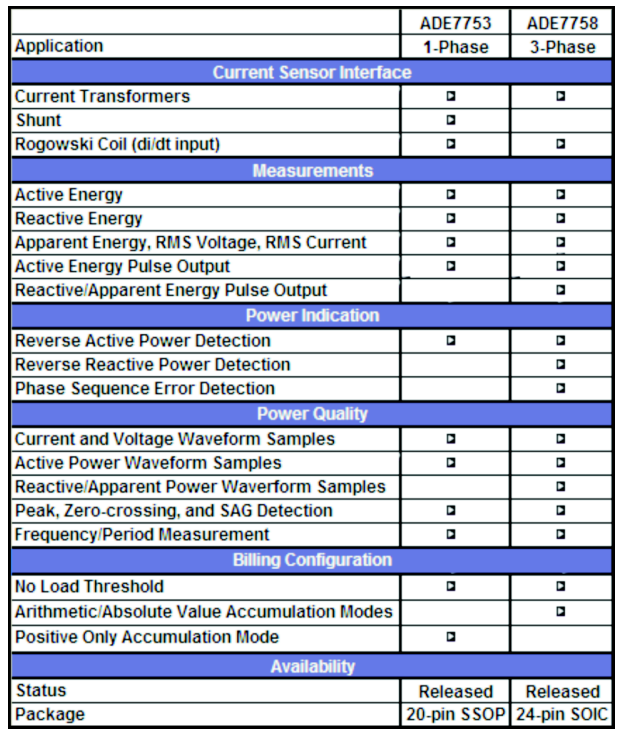
Key features of both chips include:
- Power line supervisory features, such as line period measurement, SAG, peak detection, peak level recording and missing zero-crossing.
- Zero-crossing detection.
- Active power no-load threshold, offset compensation and pulse output.
- Reactive power offset compensation and reactive power pulse output (ADE7758 only).
The ADE7758 consumes 70 mW, while the ADE7753, for single-phase connections, consumes only 25 mW. Both devices are designed to operate over a temperature range of minus 40 degrees C to 85 degrees C and require a single 5-volt supply. To facilitate migration from existing designs to new meter designs, the ADE7753 and ADE7758 are pin-to-pin compatible with previously released ICs in the ADE family.
Pricing and Availability
The ADE7753 is available in a 20-lead SSOP package and is priced at $2.52 per unit in 1,000-piece quantities. Available in a 24-lead SOIC package, the ADE7758 is priced at $6.88 per unit in l,000-piece quantities. Evaluation and software kits are available to facilitate performance and functionality verification. Both devices are available in production volume quantities. For more information, please visit: https://www.analog.com/ADE7753 or https://www.analog.com/ADE7758.
ADI in Energy Metering
Analog Devices is the current market share leader of energy metering ICs with an installed base of over 75 million devices in energy meters worldwide. The increasing demand for more accurate energy measurement data, and real-time access to that data, is accelerating global deployment of digital metering technology. ADI’s energy metering ICs directly facilitate the replacement of older electromechanical meters with new electronic meters by simplifying the design of these new highly accurate systems.
Electronic meters can also perform more sophisticated measurements, such as recording energy usage at different billing rates and reducing power failure detection time. Extensive expertise in data conversion technologies and mixed-signal design is the foundation for Analog Devices’ development of high-performance chips that enable customers to develop low-cost system architectures.