
MAXREFDES1277


Overview
Design Resources
Description
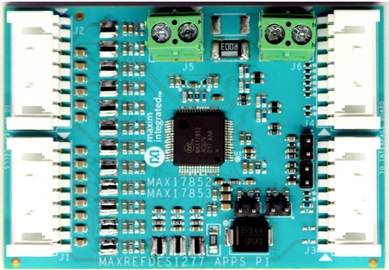
The MAXREFDES1277 reference design enables quick evaluation of the MAX17852/53 for 48V two-Wheeler battery management applications (BMS).
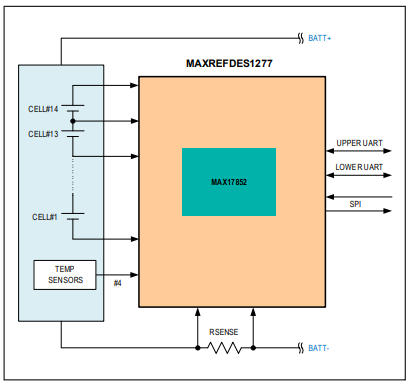
This design showcases capabilities of the MAX17852/53 like individual 14-cell voltage measurements, pack voltage, temperature (up to four sensors using general purpose inputs/outputs [GPIOs]), pack current (MAX17852 only) measurement, and passive cell balancing.
The MAX17852/53 supports ASIL-D requirements for cell voltage, temperature, current, communication, and failure mode effects analysis (FMEA).
Features & Benefits
- 3 to 14 cell voltage measurement with ±2mV accuracy at 5°C to 40°C
- Supports flexi pack configuration
- Pack current measurement using external current sense resistor
- Passive cell balancing up to 300mA with internal switch with odd or even cell balancing scheme (single cell or group)
- Auto cell balancing configuration with undervoltage (UV) threshold and timer options
- Manual cell balancing configuration
- Four configurable auxiliary inputs for temperature, voltage, or GPIO
- Internal die temperature measurement
- Individually configurable safety alert
- Overvoltage (OV), undervoltage, overtemperature and undertemperature faults
- One cell-mismatch alert
- Selectable universal asynchronous receiver- transmitter (UART) or serial peripheral interface (SPI)
- UART configurations with packet error checking (PEC)
- Dual UART configuration with redundancy
- Single UART configuration
- Single-side component placement
- Compatible with MAX17852EVKIT software along with MINIQUSB board
Details Section
The MAXREFDES1277 reference design enables quick evaluation of the MAX17852/53 for 48V two-Wheeler battery management applications (BMS).
This design showcases capabilities of the MAX17852/53 like individual 14-cell voltage measurements, pack voltage, temperature (up to four sensors using general purpose inputs/outputs [GPIOs]), pack current (MAX17852 only) measurement, and passive cell balancing.
The MAX17852/53 supports ASIL-D requirements for cell voltage, temperature, current, communication, and failure mode effects analysis (FMEA).
Other features include the following:
- 3 to 14 cell voltage measurement with ±2mV accuracy at 5°C to 40°C
- Supports flexi pack configuration
- Pack current measurement using external current sense resistor
- Passive cell balancing up to 300mA with internal
switch with odd or even cell balancing scheme
(single cell or group)
- Auto cell balancing configuration with undervoltage (UV) threshold and timer options
- Manual cell balancing configuration
- Four configurable auxiliary inputs for temperature, voltage, or GPIO
- Internal die temperature measurement
- Individually configurable safety alert
- Overvoltage (OV), undervoltage, overtemperature and undertemperature faults
- One cell-mismatch alert
- Selectable universal asynchronous receivertransmitter (UART) or serial peripheral interface (SPI)
- UART configurations with packet error checking (PEC)
- Dual UART configuration with redundancy
- Single UART configuration
- Single-side component placement
- Compatible with MAX17852EVKIT software along with MINIQUSB board
Table 1 shows an overview of the design specification.
| Parameter | Symbol | Min | Typ | Max |
| Operating Range | VIN | 9V | 65V | |
| Current Consumption | ||||
| Active Mode | 5.4mA | |||
| Standby Mode | 2.3mA | |||
| Shutdown Mode | 0.1µA | |||
| Number of Channels | 14 | |||
| Measuring Range Per Channel | 0V | 5V | ||
| Voltage Accuracy (5°C to 40°C) | 2mV | |||
| Current Measurement at Gain = 256 | 5mA Resolution | |||
| Auxiliary Inputs (J7, J8, J9, J10) | 0V | 5V | ||
| Cell Balancing Current (Per Channel) | Up to 300mA | |||
| Communication Interface | ||||
| UART | 2Mbps | |||
| SPI | 10Mhz |
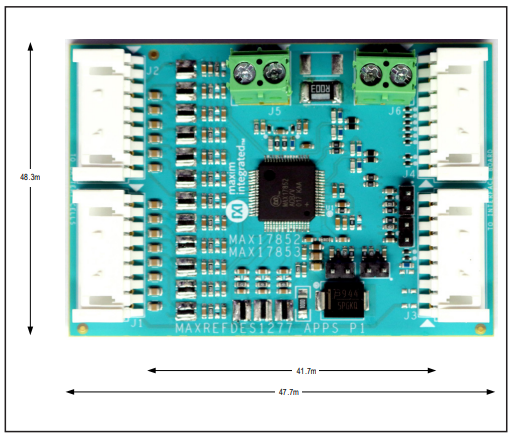
This document describes the hardware shown in Figure 1.
Documentation & Resources
-
MAXREFDES1277 Design Files11/21/2021ZIP1 M
Support & Training
Search our knowledge base for answers to your technical questions. Our dedicated team of Applications Engineers are also available to answer your technical questions.