依靠创新的力量影响我们周围的世界


SIGNALS+ 在线快讯订阅
持续关注Signals+,了解有关连接、数字健康、电气化和智能工业的最新见解、信息和想法并加以利用。


Dara O’Sullivan


 关闭详情
DETERMINISTIC CONNECTIVITY: ADVANCING HUMANOIDS TOWARD REAL-WORLD DEPLOYMENT
KEY TAKEAWAYS
|
Humanoid robots have captured the world’s imagination for decades. Advances in artificial intelligence (AI), perception, and computing are bringing them closer to practical use in factories, warehouses, healthcare environments, and other human-centered settings. Yet one critical question remains:
What separates a robot that can demonstrate a task from one that can perform it safely, reliably, and repeatedly in the real world?
The answer may have less to do with intelligence itself and more to do with coordination.
As humanoids move from experimental platforms to deployable systems, success increasingly depends on how effectively their sensing, computing, communication, and motion functions work together. Collectively, these functions form the robot’s sense-to-action chain. Deterministic connectivity helps keep that chain synchronized by ensuring information arrives at the right time, in the right order, and with predictable timing.
HUMANOID DEPLOYMENT IN DYNAMIC WORK ENVIRONMENTS
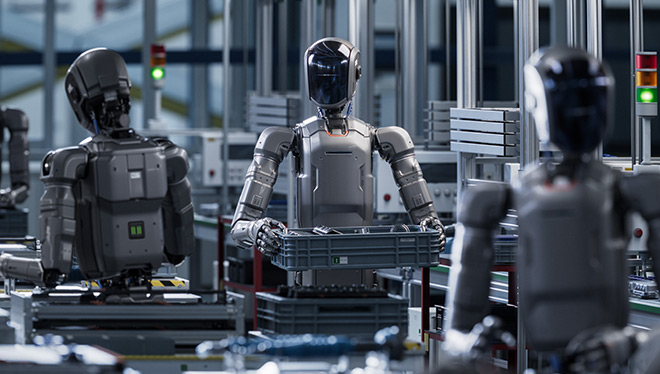
Unlike traditional industrial robots operating in highly structured environments, humanoids are expected to work where people already work. They must navigate changing conditions, interact with unfamiliar objects, and adapt to unexpected situations. Translating decisions into precise physical action requires the entire sense-to-action chain to operate as one coordinated system.
A humanoid may contain dozens of joints, multiple cameras, distributed processors, and complex control systems. Even small timing inconsistencies can affect balance, stability, and task execution. This system-level challenge is where Analog Devices, Inc. (ADI) brings expertise across sensing, motion control, power, safety, and connectivity to help enable the precision and reliability required for deployment.
THE HIDDEN COMPLEXITY OF HUMAN-LIKE MOTION

Consider the robotic hand.
In many ways, it is a robot within a robot. To grasp an object, turn a handle, or manipulate a tool, its multiple joints, sensors, actuators, and feedback systems must continuously exchange and act on information.
Humans perform these actions almost effortlessly because the nervous system synchronizes sensing and motion with remarkable precision. Humanoid robots face a similar synchronization challenge. If grip-force data arrives too late, an object may slip. If motor commands arrive inconsistently, movement may become unstable. The challenge is not simply moving data quickly but delivering it predictably so each part of the system responds in coordination.
Now scale that challenge across an entire humanoid body, with sensing and motion systems distributed throughout the arms, legs, torso, and hands. The importance of communication and synchronization becomes impossible to ignore.
WHY DETERMINISTIC CONNECTIVITY MATTERS
Speed and bandwidth often dominate discussions about communication systems. For humanoid robotics, however, predictability can be just as important. Deterministic connectivity refers to architectures that deliver data in a synchronized, reliable, and predictable manner. Rather than moving information as quickly as possible, they ensure it arrives when expected.
This distinction is critical in real-time robotic systems. A single movement depends on a rapid sequence: the robot detects its position and surroundings, processors calculate a response, and motion systems execute the command. These events must occur within tightly controlled timing windows. Deterministic connectivity keeps perception, decision-making, and action aligned, helping the robot behave more consistently as a complete system.
The need becomes even greater as humanoid architectures adopt distributed intelligence. Processing no longer occurs only in a central computer; it is increasingly distributed across the robot. That approach can improve scalability and responsiveness, but it also makes system-wide synchronization essential.
FROM IMPRESSIVE DEMONSTRATIONS TO REAL DEPLOYMENT
Demonstrations showcase capability under controlled conditions, with carefully defined tasks and limited variables. Real-world deployment is different. Robots must operate continuously amid changing environments, unexpected events, and imperfect conditions. They must recover from errors, maintain stability, and deliver consistent results over time.
For customers evaluating humanoid robotics, repeatability may matter more than peak performance. A capability demonstrated once has limited value if it cannot be reproduced throughout daily operation. Deterministic connectivity, distributed intelligence, precise sensing, and stable motion control are therefore not isolated engineering choices. Together, they provide the coordinated foundation for dependable robot-level behavior in practical deployment.
ADI’s role is to help bridge the gap between capability and deployment by enabling trusted subsystems that support repeatable performance in demanding real-world environments.
The future of humanoid robotics will be defined not just by intelligence, but by dependability.
BUILDING THE NEXT GENERATION OF HUMANOID ROBOTS
As AI expands what humanoids can perceive, understand, and accomplish, system complexity will continue to grow. Success will depend on architectures that can transform vast amounts of information into precise, predictable actions. Distributed intelligence, deterministic connectivity, and tightly synchronized control will be essential building blocks.
Humanoid robotics is often portrayed as an AI revolution. In reality, it is also a systems-engineering challenge. The most consequential advances may come not from any single technology, but from integrating the complete sense-to-action chain into a unified real-time system. Deterministic connectivity sits at the center of that challenge, helping transform intelligence into action that is predictable, safe, and trustworthy. As humanoids move beyond demonstrations and into workplaces, reliability may prove to be the ultimate differentiator.
To learn more about the ADI technology helping to advance humanoid demonstrations to real-world deployment, visit our Humanoid Robotics solutions page.