The Crystal Clear Truth About Critical Transconductance

2026-05-11

Figure 1


摘要

This article focuses on critical transconductance for crystal oscillators with a Pierce architecture, covering its physical meaning and providing exact step-by-step derivations.

Introduction

Crystal oscillators are essential for precise timing in electronic systems, and most engineers are familiar with their basic principles. Formulas for critical and optimum transconductance are widely used in design, yet their origins often remain opaque. This article aims to uncover that reasoning. Starting from fundamental concepts such as the crystal’s impedance and the Pierce oscillator topology, encompassing oscillator feedback strategies, and proceeding through the derivations step by step. This will demonstrate how these formulas emerge from circuit analysis, allowing the reader to not only know the formulas but also understand exactly where they come from and why they matter.

Setting the Frequency

A crystal is a small piece of quartz that exploits the piezoelectric effect: an applied electric field induces mechanical vibration, and mechanical stress generates an electric response. It can be modeled electrically as seen in Figure 1.

Figure 1. Quartz crystal equivalent electrical model.

The crystal itself can exhibit series resonance at the frequency:

Equation 1.

It also exhibits antiresonance (when in parallel mode) at the frequency:

Equation 2.

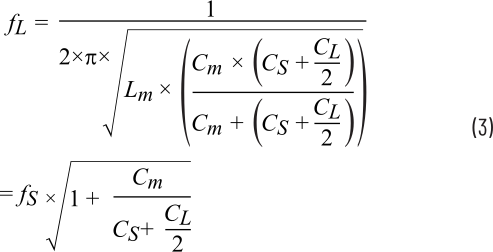
When an extra capacitor CL is added in parallel with the crystal, the crystal is loaded, and the oscillating frequency becomes:

Equation 3.

Typically, Cm « CS, which means the series and parallel resonance frequencies (fS and fP) are very close. Interestingly, the loaded oscillation frequency always falls between fS and fP.

A widely used topology for crystal oscillators is the Pierce configuration (Figure 2).

Figure 2. Pierce oscillator circuit.

The resistor RF biases the inverter into its linear region, setting the DC operating point without significantly affecting the AC loop behavior. For AC analysis, its influence is negligible and will be omitted. Throughout this article, the inverter is modeled as an ideal transconductance (Gm).

Oscillator Families: Positive Feedback vs. Negative Resistance

Harmonic oscillators fall into two main categories: positive feedback oscillators and negative resistance oscillators.

Positive feedback oscillators operate by feeding a portion of the output signal back to the input with the correct amplitude and phase to satisfy the Barkhausen stability criterion:

Equation 4.

where A is the gain and B is the feedback transfer function. This approach is typically used when the gain and feedback paths are explicitly defined, as in Wien bridge or ring oscillators.

Negative resistance oscillators, however, aim to cancel out the resistive (lossy) elements in the circuit, allowing energy to transfer freely between reactive components. The condition for oscillation becomes:

Equation 5.

This perspective is more intuitive when a resonator is present, such as an LC tank or a crystal. Common examples include Hartley, Colpitts, and Clapp oscillators.

Though conceptually different and relying on distinct analytical viewpoints, both approaches describe the same physical phenomenon.

Why Critical Gm Matters in Crystal Oscillators

Among the key design parameters in crystal oscillator circuits, the transconductance plays a central role. If Gm is too low, the oscillator simply won’t start. A failure that can be both subtle and frustrating. To ensure a reliable startup, Gm must exceed a threshold known as the critical Gm.

The Thumb Rule Trap

A simplified expression sometimes encountered for estimating critical transconductance is:

Equation 6.

This approximation loosely stems from the Barkhausen criterion and resonance behavior. At series resonance, the crystal’s impedance simplifies to Z ≈ Rm (neglecting CS), and the loop gain is approximated as A × B = Gm × Rm > 1. However, this model does not reflect the Pierce oscillator topology and produces results that are not only incorrect but also directly contrary to the intended behavior. As shown later, an increase in Rm actually demands a higher Gm.

Generating a Negative Resistance

As noted earlier, because the circuit includes a resonator, the negative-resistance approach is the more suitable method of analysis. A simple way to create a negative resistance is to look at the input impedance of the topology, as shown in Figure 3.

Figure 3. Negative impedance generation.

Calculate the dynamic impedance seen at VX to prove it is of the form

Equation 7.

which created a negative resistance equal to

Equation 8.

The AC circuit seen by the crystal is equivalent to the circuit in Figure 4.

Figure 4. Equivalent circuit.

Considering only the motional branch (assuming CS to be negligible), the oscillations will be achieved for Gm > 4 × Rm × (CL × ω)2.

The Conventional Approach

A convenient way to account for the shunt capacitance is to absorb it into the impedance seen by the crystal, Zx (see Figure 5).

Figure 5. Impedance seen from the crystal.

Using basic impedance transformation, derive:

Equation 9.

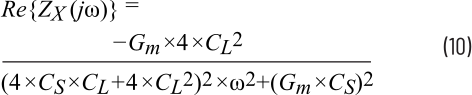
The real part of that impedance can be shown as:

Equation 10.

To offset the resistive losses, the negative resistance must equal the motional resistance:

Equation 11.

which leads to the following quadratic equation:

Equation 12

Calculating the discriminant Δ will allow us to determine if a real solution (∈ℝ) exists.

Equation 13

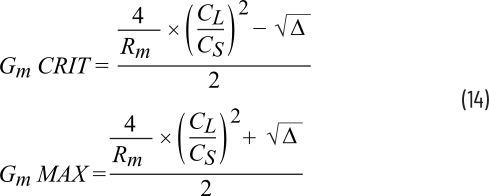
If the discriminant Δ is negative, the system has no real solutions. If Δ is positive, two values of Gm satisfy the equation, and oscillation is possible for any value in between. The lower bound is known as the critical transconductance Gm_CRIT, which is the minimum required for startup. The upper bound is the maximum transconductance Gm_MAX, beyond which stable oscillation cannot be sustained. Exact values can be determined using a numerical solver.

Equation 14

Solving the condition:

Equation 15

can determine the optimum transconductance, which corresponds to the point where the negative real part of the impedance seen by the crystal is maximized. This yields the expression:

Equation 16

As Gm increases from 0 toward +∞, the impedance seen by the crystal evolves in the complex plane. This progression illustrates the transition from critical Gm, through optimum Gm, up to maximum Gm. Outside this range, the losses cannot be compensated, and the system cannot sustain oscillations (see Figure 6).

Figure 6. Impedance in the complex plane.

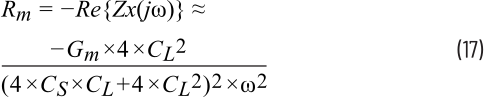
The value of interest is usually Gm_CRIT. Assuming Gm × CS2 « 4 × (CS × CL + CL2)2 × ω2, then the impedance ZX can be approximated as:

Equation 17

This simplification is sometimes referred to as the small Gm approximation. The physical intuition is that Rm is small (as crystals have very high quality factors, ranging from 10,000 to 100,000), and thus the associated losses are minimal. Consequently, the contribution of the negative impedance circuit (Gm) should be minimal. Under this assumption, the critical Gm can be expressed in a more compact form:

Equation 18

A Detour that Delivers Insight

The previous method treats the crystal as a general impedance, without distinguishing between its resistive and reactive components. An alternative approach exists that, while slightly longer to derive, offers deeper insight and practical benefits.

To begin, simplify the motional branch of the crystal by grouping its inductive and capacitive elements into a single reactance term, X. For consistency in notation, the shunt capacitance reactance is defined as jXS, with XS = -1/(CS × ω).

Figure 7. Alternate crystal model.

The impedance of the crystal (between A and B) can be written as:

Equation 19

The effective resistance between nodes A and B corresponds to the real part of the impedance seen across those points:

Equation 20

With the crystal connected to the load capacitor, the circuit can now be drawn as shown in Figure 8.

Figure 8. Alternate crystal model loaded.

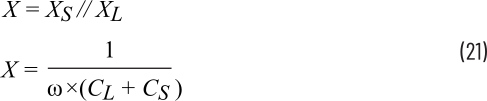
At resonance, the reactive components cancel each other out, hence:

Equation 21

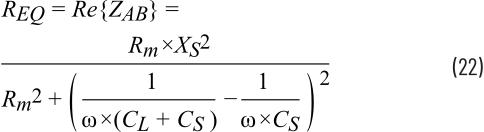
Inserting this result into the previous REQ equation give us:

Equation 22

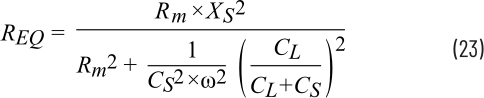
which can be simplified as:

Equation 23

If the assumption:

Equation 24

is true, the crystal’s equivalent resistance seen by the amplifier can be approximated as:

Equation 25

This formula provides a useful link between the crystal’s internal power dissipation, its motional resistance Rm, and the capacitance ratio CS/CL. Crystals have a maximum allowable power dissipation, beyond which long-term reliability may be compromised. The dissipated rms power can now be estimated as Prms = REQ × Irms2 to verify that the oscillator operates within safe drive levels.

Unfortunately, the term REQ is often referred to as equivalent series resistance (ESR) and used inconsistently in oscillator design. In some contexts, ESR refers to the effective resistance seen by the amplifier (what has been called REQ). In others, it denotes the motional resistance (electrical series resistance), which represents the intrinsic losses within the crystal itself (what has been called Rm). To add to the confusion, some vendors label Rm as ESR, while certain documents use ESR to describe Rm in the context of critical Gm calculations. Typically, CS is much smaller than CL, making Rm and REQ numerically close. This may explain why the distinction often goes unnoticed. Hopefully, this clarification helps the reader differentiate between the two and understand which value is appropriate in each context: calculating startup conditions, resonant frequency, or estimating drive level.

Returning to the equivalent circuit, the oscillator can now be represented as shown in Figure 9.

Figure 9. Another equivalent circuit.

Once again, to sustain oscillation, the negative resistance presented by the amplifier must cancel out the equivalent resistance seen from the crystal:

Equation 26

Rearranging Equation 26 gives the same expression previously derived for the critical transconductance:

Equation 27

The Power of Four

Ultimately, the critical Gm represents the precise mathematical threshold required for sustained oscillation. It ensures that the energy lost in the crystal is exactly compensated by the amplifier. However, to guarantee a reliable startup under real-world conditions, designers typically provide excess Gm. This accounts for variations in Rm, drive level dependencies, and startup dynamics. A safety factor of 4 is commonly applied in practice to ensure robust performance across temperature, aging, and process variations.

Conclusion

This article demonstrates why critical Gm is essential for crystal oscillator startup and stability. We explored the dependencies with Rm, CS, and CL, highlighted the common pitfall of relying solely on 1/Rm, and presented two complementary approaches to solving the problem. Each method offers unique insights: one provides a complete view of the operating range, while the other reveals a key relationship with drive level. Understanding these principles equips designers to move beyond rules of thumb and apply precise calculations that ensure reliable startup and robust performance under real-world conditions.

References

Frerking, Marvin E. Crystal Oscillator Design and Temperature Compensation. Litton Educational Publishing, Inc., 1978.

Razavi, Behzad. “The Crystal Oscillator.” IEEE Solid-State Circuits Magazine, Vol. 9, June 2017.

Vittoz, Eric, Marc Degrauwe, and Serge Bitz
High-Performance Crystal Oscillator Circuits: Theory and Application.” IEEE Journal of Solid-State Circuits, Vol. 23, June 1988.

关于作者

Jerome Rollet
Jerome Rollet是ADI公司数据中心和能源部的模拟设计高级工程师。他于2014年加入ADI公司,此前曾担任Maxim Integrated的技术人员。Jerome在电源管理和混合信号电路设计方面拥有17年的专业经验,涉足消费电子、工业和汽车电子等应用领域。他拥有格勒诺布尔理工学院电子工程硕士学位和格勒诺布尔阿尔卑斯大学微电子与纳米电子研究硕士学位。
添加至 myAnalog

将文章添加到 myAnalog 的资源部分、现有项目或新项目。

创建新项目

关联至此文章

行业解决方案
产品分类
最新视频 21
Title
Subtitle
了解更多
添加至 myAnalog

将文章添加到 myAnalog 的资源部分、现有项目或新项目。

创建新项目