



概览
设计资源
描述
The MAX16813 is a highly efficient, high-brightness (HB) LED driver that provides four integrated LED current-sink channels. An integrated current-mode switching controller drives a DC-DC converter that provides the necessary voltage to multiple strings of HB LEDs. The device accepts a wide 4.75V to 40V input voltage range and withstands direct automotive load-dump events. The wide input range allows powering HB LEDs for small- to medium-sized LCD displays in automotive and general lighting applications.
An internal current-mode switching DC-DC controller supports boost or single-ended primary inductor converter (SEPIC) topologies and operates in an adjustable frequency range between 200kHz and 2MHz. An integrated spread-spectrum mode helps reduce EMI. Current-mode control with programmable slope compensation provides fast response and simplifies loop compensation. An adaptive output-voltage control scheme minimizes power dissipation in the LED current-sink paths. The device has a separate p-channel drive (PGATE) pin that is used for output undervoltage protection. Whenever the output falls below the threshold, the external p-MOSFET is latched off, disconnecting the input source. Cycling the EN or the input supply is required to restart the converter.
The device consists of four identical linear current-sink channels, adjustable from 20mA to 150mA with an accuracy of ±3% using a single external resistor. Multiple channels can be connected in parallel to achieve higher current per LED string. The device also features a unique pulsed dimming control through a logic input (DIM), with minimum pulse width as low as 500ns. Protection features include output overvoltage, open-LED detection and protection, programmable shorted LED detection and protection, output undervoltage protection and detection, and overtemperature protection.
An LED driver in a SEPIC configuration using the MAX16813 is demonstrated for a 24V, 600mA output application. The device can drive up to 4 channels at once.
所用产品
详情
The MAX16813 is a highly efficient, high-brightness (HB) LED driver that provides four integrated LED current-sink channels. An integrated current-mode switching controller drives a DC-DC converter that provides the necessary voltage to multiple strings of HB LEDs. The device accepts a wide 4.75V to 40V input voltage range and withstands direct automotive load-dump events. The wide input range allows powering HB LEDs for small-to medium-sized LCD displays in automotive and general lighting applications.
An internal current-mode switching DC-DC controller supports boost or single-ended primary inductor converter (SEPIC) topologies and operates in an adjustable frequency range between 200kHz and 2MHz. An integrated spread-spectrum mode helps reduce EMI. Current-mode control with programmable slope compensation provides fast response and simplifies loop compensation. An adaptive output-voltage control scheme minimizes power dissipation in the LED current-sink paths. The device has a separate p-channel drive (PGATE) pin that is used for output undervoltage protection. Whenever the output falls below the threshold, the external p-MOSFET is latched off, disconnecting the input source. Cycling the EN or the input supply is required to restart the converter.
The device consists of four identical linear current-sink channels, adjustable from 20mA to 150mA with an accuracy of ±3% using a single external resistor. Multiple channels can be connected in parallel to achieve higher current per LED string. The device also features a unique pulsed dimming control through a logic input (DIM), with minimum pulse width as low as 500ns. Protection features include output overvoltage, open-LED detection and protection, programmable shorted LED detection and protection, output undervoltage protection and detection, and overtemperature protection.
An LED driver in a SEPIC configuration using the MAX16813 is demonstrated for a 24V, 600mA output application. The device can drive up to 4 channels at once. Table 1 shows an overview of the design specification.
| PARAMETER | SYMBOL | MIN | MAX |
| Input Voltage | VIN | 8V | 32V |
| Frequency | fSW | 350kHz | |
| Efficiency | η | 90% | |
| Duty Cycle | D | 20% | 80% |
| Output Voltage | VOUT | 19V | 24V |
| Output Voltage Ripple | ∆VOUT | 1.5% | |
| Output Current | IOUT | 0.1A | 0.6A |
| Output Power | POUT | 14W | |
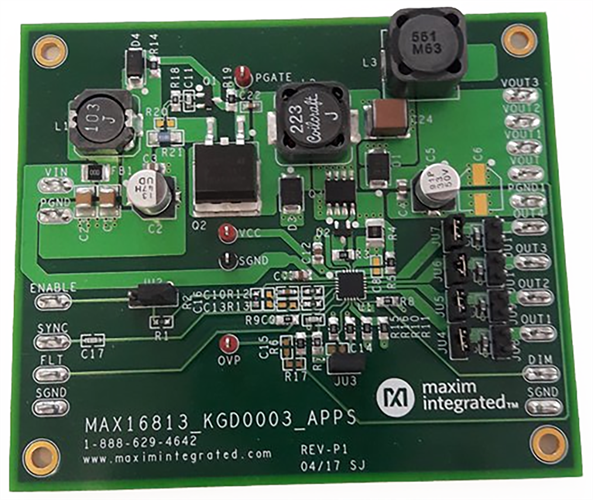
This document describes the hardware shown in Figure 1. It provides a detailed systematic technical guide to designing an LED driver in a SEPIC configuration using Maxim’s MAX16813 LED driver. The LED circuit has been built and tested, details of which follow later in this document.


The SEPIC converter is a type of DC-DC voltage converter (“regulator”) that can both step-up (“boost”) and step-down (“buck”) an input voltage. The traditional buck/ boost converter can do this too, but the SEPIC has many advantages that are discussed later in this document.
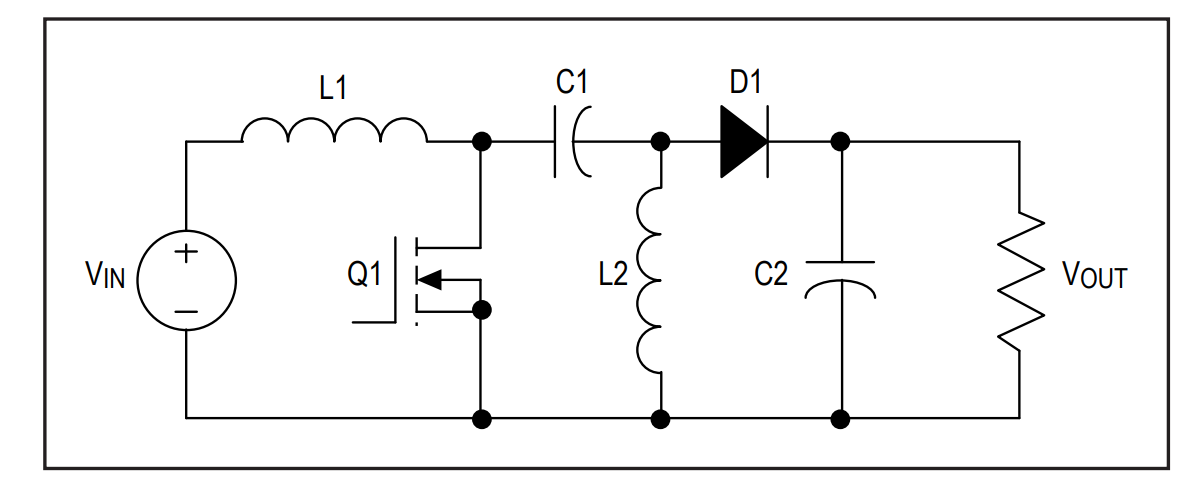
The SEPIC converter is originally based on the boost topology. In a boost when the switch is closed, the magnetic energy stored in the inductor (L1) increases and current flows through the switch to ground, the diode (D1) is reverse-biased. When the switch is open, the output capacitor (COUT) and the output load are the only paths for the stored magnetic energy in the inductors to flow. In this case, VOUT must be greater than VIN. Otherwise, D1 is always forward-biased and nothing prevents current flow from VIN to VOUT. The SEPIC eliminates this constraint by inserting a capacitor (C1) between L1 and D1.
This capacitor (C1) prevents any DC component from input to output. However, D1’s anode must connect to a known potential in order to operate. This is created by connecting D1’s anode to ground through an inductor (L2).
SEPIC Analysis
This section describes in detail how the SEPIC converter operates. The circuit can be broken up and examined using Kirchoff’s voltage and current laws. This topology primarily has two states: MOSFET closed and MOSFET open.
MOSFET (Q1) Closed
When the switch is closed, the magnetic energy stored in both inductors (L1 and L2) increases. The input current (IIN) builds up a field in L1. Capacitor C1 discharges, building up a field in L2. The diode is reverse-biased, so only the output capacitor supplies current to the load (Figure 2).
Voltage Loops
VIN + VL1 – VSW = 0
VIN + VL1 = 0 as VSW = 0
VL1 = -VIN
As the sum of all voltages around a loop must come to zero and the approximate voltage across the switch when closed is zero, the inverse of the input voltage must be across the inductor L1.
VSW + VC1 + VL2 = 0
VC1 + VL2 = 0
VC1 = -VL2
Using the same logic as the loop above, the capacitor sees the inverse of voltage across inductor L2.
VD = -(VL2 +VOUT), VL2 = -VC1 and VC1 = -VIN
VD = -(VIN + VOUT)
VIN is seen at C1 as on average there is 0V across both inductors. The diode must therefore be rated for the sum of input and output voltages.
Current Loops
IL1 – ISW1 – IC1 = 0
IL1 = ISW1 + IC1
As the currents flowing into a node must equal the currents flowing out, inductor L1 sees the sum of currents flowing through the MOSFET and the capacitor C1.
IC1 = -IL2
Using the same logic as above, C1 sees the inverse of the inductor L2’s current.
ID = 0
No current flows through the diode while it is reversebiased.
ILOAD = IC2
While the diode is reverse-biased only the capacitor C2 supplies current to the load.
MOSFET (Q1) Open
When the switch is open, the magnetic energy stored in L1 charges C1, as well as supplying the load. The current from L2 continues in a negative direction and supplies the load. In the off-cycle, C1 is charged so that it can recharge L2 during the on-cycle. See Figure 3 and Figure 4.
C1 has been charged to VIN. Due to Kirchoff’s voltage law, -VOUT is therefore across L1.
VL1 = -VOUT
Diode D1 is conducting, therefore inductor L2 sees VOUT across it.
VL2 = -VC2 = VOUT



Current Loops
As the MOSFET is now open, all current flowing into the circuit now flows into capacitor C1.
IIN = IC1
Current at C1 is also equal to the sum of the currents flowing from it.
IC1 = ID1 – IL2
When the switch is open, the diode supplies current to the load and capacitor C2.
ID1 = ILOAD + IC2
Now that the principle of the SEPIC operation is understood, a practical design example can be illustrated. This document is primarily concerned with the power stage design and is intended to complement the information contained in the MAX16813 data sheet.
Step 1: Choosing a Suitable Switching Frequency
The MAX16813 can operate at a switching frequency between 200kHz and 2MHz. A lower switching frequency optimizes the design for efficiency, whereas increasing the switching frequency allows for smaller inductive and capacitive components sizes and costs. A 350kHz switching frequency was chosen for this design. R13 sets the switching frequency according to the following expression:

Step 2: Setting the LED Current
The device features four identical constant-current sources used to drive multiple HB LED strings. The current through each one of the 4 channels is adjustable between 20mA and 150mA using an external resistor (RSETI) connected between SETI and SGND. Select RSETI using the following formula:

where IOUT is the desired output current for each of the four channels. In this design R15 and R16 combine in parallel to generate 150mA at the output. If more than 150mA is required in an LED string, use two or more of the current source outputs (OUT_) connected together in parallel, to drive the string.
Step 3: Choosing the External Switching MOSFET
For the SEPIC topology, the MOSFET driver must be rated for the sum of the maximum input and output voltages:
VDS = VIN + VOUT
where VDS is the drain-source voltage rating of QMAIN, VIN is the input voltage of the circuit, and VOUT is the output voltage across the LED strings. In this case VIN(MAX) is equal to 32V, VOUTMAX is equal to 30V, so an 80V rated n-channel MOSFET was used. It is recommended that the MOSFET VDS is rated 30% higher than equation above.
Step 4: OVP Configuration
A voltage-divider using resistors at the OVP pin is used to set the overvoltage protection voltage. This sets the maximum output channel voltage. The R6 and R7 resistors are used in this circuit, using the following equation:

An R6 = 261kΩ and an R7 = 10kΩ creates a 33V OVP voltage.
Step 5: Calculating and Selecting Inductor Values L1 and L2
Power circuit design for the SEPIC configuration is very similar to a conventional design with the output voltage referenced to the input supply voltage. For the SEPIC, the output is referenced to ground and the inductor is split into two parts. One of the inductors (L2) takes LED current as the average current and the other (L1) takes input current as the average current.
Use the following equations to calculate the average inductor currents (IL1AVG, IL2AVG) and peak inductor currents (IL1P, IL2P) in amperes:

The factor 1.1 provides a 10% margin to account for the converter losses:
IL2AVG = ILED
Assuming the peak-to-peak inductor ripple ∆IL is ±30% of the average inductor current:
∆IL1 = IL1AVG x 0.3 x 2
and:

and:

Calculate the minimum inductance values L1MIN and L2MIN in henries with the inductor current ripples set to the maximum value as follows:

where 0.3V is the peak current-sense voltage. Choose inductors that have a minimum inductance greater than the calculated L1MIN and L2MIN and current rating greater than IL1P and IL2P, respectively. The recommended saturation current limit of the selected inductor is 10% higher than the inductor peak current.
Step 6: Selecting Coupling Capacitor CS
Select the coupling capacitor CS so that the peak-to-peak ripple on it is less than 2% of the minimum input supply voltage. Doing so ensures that the second-order effects created by the series resonant circuit comprising L1, CS, and L2 do not affect the normal operation of the converter. Use the following equation to calculate the minimum value of CS:

where CS is the minimum value of the coupling capacitor in farads, ILED is the LED current in amperes, and the factor 0.02 accounts for 2% ripple.
Step 7: LED Dimming Control
The device features LED brightness control using an external PWM signal applied to DIM. A logic-high signal on the DIM input enables all four LED current sources and a logic-low signal disables them. If not using the dimming function, use a pullup resistor to connect DIM to the VCC pin.
The duty cycle of the PWM signal applied to DIM also controls the DC-DC converter’s output voltage. If the turn-on duration of the PWM signal is less than 24 oscillator clock cycles (DIM pulse-width increasing), the boost converter regulates its output based on feedback from the OVP input. While in this mode, the converter output voltage is regulated to 95% of the overvoltage threshold at the OVP pin. If the turn-on duration of the PWM signal is greater than or equal to 24 oscillator clock cycles (DIM pulse width increasing), the converter regulates its output so that the minimum voltage at OUT_ is 1V.
At power-up, if the converter has completed the soft-start period of 100ms (typ) and the PWM signal at the DIM pin is still low, the device regulates the output voltage based on the feedback signal coming from the OVP pin. Once a PWM pulse width greater than 24 oscillator clock cycles is applied, the converter regulates its output so that the minimum voltage at OUT_ is 1V. The converter output voltage is regulated to 95% of the overvoltage threshold at the OVP pin whenever the PWM signal at the DIM pin is forced low for a duration longer than 38ms (typ).
The output capacitor supplies the load when the switch is on, otherwise, it is being charged.
The function of the output capacitor is to reduce the converter output ripple to acceptable levels. The entire output-voltage ripple appears across the constant-current sink outputs because the LED string voltages are stable due to the constant current. For the device, limit the peak-to-peak output-voltage ripple to 200mV to get stable output current.
The ESR, ESL, and the bulk capacitance of the output capacitor contribute to the output ripple. In most of the applications, using low-ESR ceramic capacitors can dramatically reduce the output ESR and ESL effects. To reduce the ESL and ESR effects, connect multiple ceramic capacitors in parallel to achieve the required bulk capacitance. To minimize audible noise during PWM dimming, the amount of ceramic capacitors on the output is usually minimized. In this case, an additional electrolytic or tantalum capacitor provides most of the bulk capacitance.
Step 9: Diode Selection
Use a Schottky diode that produces the least forward drop and puts the least burden on the MOSFET during reverse recovery. A diode with considerable reverse-recovery time increases the MOSFET switching loss. Select a Schottky diode with a voltage rating 20% higher than the maximum SEPIC converter input plus output voltage. Unlike the boost topology, the diode sees VIN plus VOUT in the SEPIC configuration. The Schottky diode used in this circuit, like the MOSFET, is rated for 80V.
文件和资源
-
MAXREFDES1003 Design Files2021/11/8ZIP3 M
-
MAXREFDES1003: 150mA, 4-Channel LED Driver in SEPIC Configuration2021/11/8PDF360 K
支持与培训
搜索我们的知识库,获取技术问题答案。我们专门的应用工程师团队也会随时为您解答技术问题。