


製品概要
設計リソース
説明
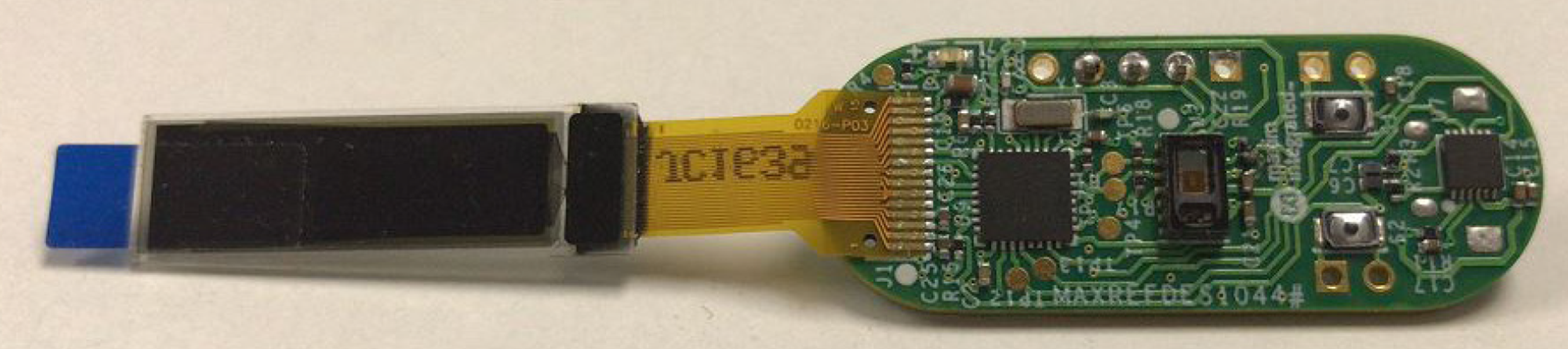
The MAXREFDES1044 is a reference design for the MAX30101 and several other Maxim® products that demonstrates how a small size, low cost, low power, high accuracy heart-rate monitor can be easily implemented. This design can monitor heart rate using red, infrared (IR), or green LEDs.
The MAX30101 is an integrated pulse oximetry and heartrate monitor module. It includes internal LEDs, photodetectors, optical elements, and low-noise electronics with ambient light rejection. Other Maxim components used in this design include two MAX8892 (a high PSRR, low-dropout, 150mA linear regulator) to supply 1.8V and 3.3V for the rest of the design and a MAX1555 single-cell lithium-ion (Li+) battery charger to charge a Li+ battery. Two MAX40200 (an ideal diode current-switch) are also included to allow either the battery or VBUS from the USB port to supply power. The MAX40200 ideal diode has a forward voltage drop that is an order of magnitude better than a Schottkey diode. The MAX6864 (a nanopower μP supervisory circuit with manual reset and a watchdog timer) is used to monitor the 3.3V supply voltage and reset the microcontroller if it drops below 3.1V. The design also contains an FTDI FT234 USB-to-serial UART interface and a STMicroelectronics® STM32L432KC low-power microcontroller.
機能と利点
使用されている製品
詳細
The MAXREFDES1044 is a reference design for the MAX30101 and several other Analog Devices products that demonstrates how a small size, low cost, low power, high accuracy heart-rate monitor can be easily implemented. This design can monitor heart rate using red, infrared (IR), or green LEDs.
The MAX30101 is an integrated pulse oximetry and heart rate monitor module. It includes internal LEDs, photodetectors, optical elements, and low-noise electronics with ambient light rejection. Other Analog Devices components used in this design include two MAX8892 (a high PSRR, low-dropout, 150mA linear regulator) to supply 1.8V and 3.3V for the rest of the design and a MAX1555 single-cell lithium-ion (Li+) battery charger to charge a Li+ battery. Two MAX40200 (an ideal diode current-switch) are also included to allow either the battery or VBUS from the USB port to supply power. The MAX40200 ideal diode has a forward voltage drop that is an order of magnitude better than a Schottkey diode. The MAX6864 (a nanopower µP supervisory circuit with manual reset and a watchdog timer) is used to monitor the 3.3V supply voltage and reset the microcontroller if it drops below 3.1V. The design also contains an FTDI FT234 USB-to-serial UART interface and a STMicroelectronics® STM32L432KC low-power microcontroller.
Table 1 shows an overview of the design specification.
| Parameter | Symbol | Min | Max |
| Battery Voltage | VBAT | 3.1V | 5V |
| USB Input Voltage | VUSB | 5V | |
| Standby Current | ISTANDBY | 200µA | |
| Average Operation Current | IOPERATION | 2mA | |
| Pulse Width | INT | 69µs | 411µs |
| ADC Resolution | 15 bits | 18 bits | |
| Sample Rate | SR | 50sps | 100sps |
| LED Current | ILED | 0 | 5 mA |
| Temperature Range | TOPERATION | −40°C | +85°C |
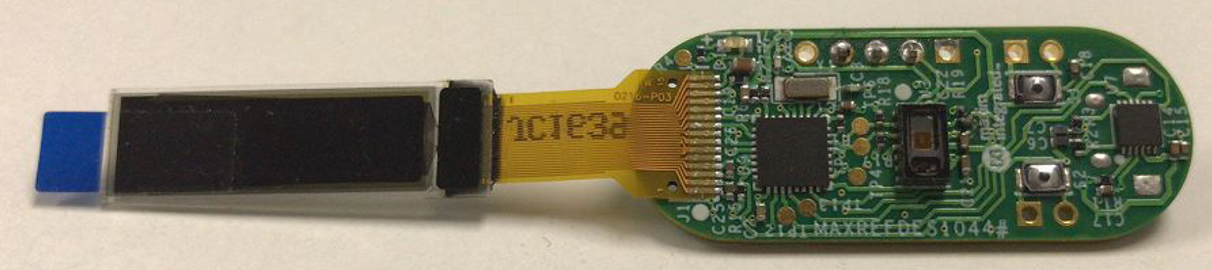
This document describes the hardware shown in Figure 1. It provides a detailed systematic technical guide to design in a small-size, low-cost, low-power, high-accuracy heart rate monitor. The design has been built and tested, details of which follow later in this document.


The MAX30101 is a high-sensitivity pulse oximeter and heart-rate sensor based on the theory of photoplethysmo gram (PPG). Using light, a PPG measures a change in the blood volume in tissue. With each cardiac cycle, the heart pumps blood to the periphery. Even though this pressure pulse is somewhat dampened by the time it reaches the skin, it is enough to distend the arteries and arterioles in the subcutaneous tissue. If the pulse oximeter is attached without compressing the skin, a pressure pulse can also be seen from the venous plexus as a small secondary peak. When a quantity of light goes through the tissue, the reflection and transmission quantity of light change due to change of blood quantity in arteries and arterioles.
In this Analog Devices design solution, the MAX30101 detects current through the photodiode (PD) driven by the light reflected. The MAX30101 contains internal LEDs, photo detectors, optical elements, and low-noise electronics with ambient light rejection. The detected current values are stored in the device’s FIFO page. The circular FIFO depth is 32 and can hold up to 32 samples of data. The sample size depends on the number of LED channels configured as active. As each channel signal is stored as a 3-byte data signal, the FIFO width can be 3 bytes, 6 bytes, 9 bytes, or 12 bytes in size.
For example, if HR mode is selected, only the red LED is active. The FIFO can store a maximum of 32 red LED current values. If SpO2 mode is selected, only the red LED and IR LEDs are active. The FIFO can store a maximum of 32 red LED current values and 32 IR LED current values. The MAX30101 provides a programmable ADC for LED pulse width, sample rate, and ADC range. In either mode (HR, SpO2, or multi-mode), read or write the register SpO2 Configuration (0x0A) for the ADC configuration. The MAX30101 has an I2C interface to communicate with the microcontroller unit (MCU) to receive commands and transmit current values.
Figure 2 shows the MAX30101 functional diagram.


This document demonstrates how to design a heart rate monitor for wearable devices. Before beginning the design process, consider the following two important fac tors for a wearable device:
- Small Size: Wearable devices should be designed as small as a watch or a wrist belt. As more and more functions are added on the limited space, the compo nent size determines how many functions the device can hold.
- Low Power: Wearable devices use a battery for the system power supply. Due to the limited size and energy density of the battery, low power consumption means the device can operate longer. An intelligent belt or watch has a battery capacity of approximately 50mAh to 200mAh. Wearable devices usually feature two modes: standby mode and normal operation mode. During an average lifetime of a heart-rate monitor belt, the belt measures every hour and each measurement takes 30 seconds to finish. For a cus tomer that participates in a daily sports activity for an hour, 4% of the battery energy is consumed during normal operation mode. The device consumes more than 90% of its battery energy in standby mode, so the standby current is an important parameter. For a 100mAh battery, if the standby current can be limited within 1mA and normal operation current is 10mA with a 100Hz sampling rate, the system can work for approximately 92 hours on a single charge.
Figure 3 shows the power consumption over different modes for an electronic watch or intelligent belt.


Step 1: Select the Parts
Microcontroller
When selecting a microcontroller (MCU) for a wearable device, keep in mind the advantages of MCUs that are small size, consume low power, have a large memory size, and strong processing capabilities. If a wearable device spends less time in normal operation mode, less power is consumed, which extends the battery lifetime. A large memory capacity and strong processing capabilities are required for wearable devices that demand quick calculations and measurements, such as for heart rates.
The STM32L432KC was chosen as the MCU for this reference design.
Optical Sensor
For small wearable devices, a small and low-power optical sensor module is the best choice, which is why we use the MAX30101. The MAX30101 includes three LEDs (red, IR, and green), and its shutdown current is 0.7µA (typ). The three LEDs are helpful for heart-rate applications that target various locations such as the wrist, finger, and ear.
Power Supply
A small battery such as a 90mAh to 120mAh Li+ battery is optimal. This is because typically the charge rate is 1C, which means the charge current is maximum 90mA to 120mA. Our board has the MAX1555, which has a 90mA charge current.
Step 2: Design the Heart-Rate Monitor
Design the heart-rate monitor as shown in Figure 4.


Optical Sense
The MAX30101 sends red, IR, and green light to the skin and gets the light by PD. An internal current-sense amplifier and ADC convert the current signal into digital data. Then the MCU reads the data from the MAX30101 through the I2C interface.
Power Supply
Our reference design can be supplied by both a battery and a USB port. When the USB power supply is present, the battery is charged and LED D1 is on. When the USB power supply is not present, the battery supplies the system.
The external reset in the MAX6864 monitors the MCU’s input voltage (VDD). Push the S1 button to manually reset the MCU.
Standby Mode and Normal Operation Mode
The reference design works in two modes: standby mode and normal operation mode (HR measurement and calculation).
The standby mode can be set by the MAXREFDES1044 GUI. During standby mode, the UART, I2C, and SPI interfaces are inactive, so the GUI no longer controls the board. The system sleeps and does not run any code. The total current in this mode is approximately 250µA. To wake up the system from standby mode, push the S2 button. See the Design Resources section to download the GUI software, MAXREFDES1044 QT.
During normal operation mode, the LED current is 2.6mA, the MAX30101 sampling rate is 100Hz, and the processor calculates the heart-rate data.
Program Download Interface
Download a new program onto the MCU through either ST-Link or a Micro-USB interface.
ST-LINK is used for STMicroelectronics STM32 micro controller families, and the J4 header is reserved for this function.
To use the Micro-USB interface, pull up pin 31 PH3/BOOT0 and restart the MCU by pushing the S1 but ton. The STM32 MCU then runs in bootloader mode. Connect the Micro-USB U8 to a PC computer and use the STM32 Flash Loader Demonstrator software from STMicroelectronics (www.st.com) to download the bin file program onto the MCU.
Main Loop
The MAXREFDES1044 firmware is based on an infinite loop design model. After power-up, the MCU configures itself, configures the communication function, activates the UART_DMA_RECEIVE, and goes into the infinite loop with “debug_step == Waiting_Mode” to wait for a command from the UART. The commands include the following:
- Sleep_mode for the standby test.
- Config_Mode to configure the MAX30101.
- Detection_Mode to measure the original heart-rate data using the MAX30101.
- OLED_Show_Mode for the OLED display test.
- Measure_Mode to measure the original heart-rate data using the MAX30101and calculate the heart rate data using the MCU.
- Wake_Up_Mode to wake up the MCU from a GPIO interrupt.
Figure 5 shows the main function flowchart for the commands. See the Design Resources section to download the MAXREFDES1044 firmware, MAXREFDES1044 ST.


MAX30101 Configuration and Measurement
The MAX30101 has an AFE to convert optical information to 15-bit to 18-bit current data. Figure 6 shows the complete command sequence for a multimode application.


Low-Power Configuration
Standby current is very important for the low-power configuration.
MCU
The MCU consumes a large amount of power in the system, especially if it works in a high frequency. Before the MCU enters standby mode, decrease the operation frequency to 100kHz. Program this configuration to occur as the last step before entering standby mode because the MCU operates slowly as the operation frequency decreases. Configure the MCU’s GPIO to the analog input mode, set I2C, UART, and SPI as inactive, and disable unused functions.
MAX30101 Sensor
The MAX30101 should be configured in shutdown mode, where the shutdown current is 0.7µA.
OLED
An OLED that has a programmable shutdown saves power. The MAXREFDES1044 uses the VG-2832 OLED with a shutdown current as low as 10µA and built-in software to enter shutdown mode after heart-rate measurement is complete.
Power Supply
The unused power rail can be disabled in standby mode. The 1.8V power rail in the MAXREFDES1044 can be disabled by pulling down the SHDN pin of the MAX8892 U12. Disabling the power rail saves 50µA of battery current in standby mode.
The FTDI FT234XD USB-UART interface chip is not active in standby mode (when the USB power supply is not present) because it is powered through a Micro-USB port. This saves significant power in standby mode.
Figure 7 shows the standby mode entry flowchart.


The MAXREFDES1044 GUI (MAXREFDES1044 QT) is based on a Microsoft® Windows® operating system. See the Design Resources section to download the MAXREFDES1044 GUI and use the master.exe file to execute the program. The MAXREFDES1044 board waits on the GUI’s command by using the UART.
In the GUI Master window, click “OLED Show” for an OLED show test. Set the MAX30101 parameters by clicking “Sensor Config,” and then click “Sensor Run” to start measurement (“Sensor Config” must be set before “Sensor Run”).
The board transfers data back to the GUI using the UART. The GUI saves the data in .csv format. Change the file name by typing on the edit line object of the filename. See Figure 8 for the GUI Master window.


関連資料
-
MAXREFDES1044 Design Files2021/02/15ZIP3 M
-
MAXREFDES1044: Heart-Rate Monitor Using the MAX301012021/02/15PDF358 K
サポートおよびトレーニング
技術的なご質問についての回答は、ナレッジベースを検索してください。また、アナログ・デバイセズのアプリケーション・エンジニアの専任チームが、技術的なご質問にお答えいたします。