Using the power of innovation to impact the world around us


SIGNALS+ NEWSLETTER SUBSCRIPTION
Stay updated and leverage Signals+ latest insights, information and ideas on Connectivity, Digital Health, Electrification, and Smart Industry.
Thank you for subscribing to ADI Signals+. A confirmation email has been sent to your inbox.
You'll soon receive timely updates on all the breakthrough technologies impacting human lives across the globe. Enjoy!
Close

 Close Details
ARTEMIS II: COMMERCIAL TECHNOLOGY POWERS HUMANITY’S RETURN TO DEEP SPACE
KEY TAKEAWAYS
|
Artemis II’s lunar flyby on April 6, 2026, marked a historic turning point: the first human flight beyond low Earth orbit (LEO) in over 50 years. The 10-day mission set records that captured our imagination, with a total Space Launch System (SLS) liftoff thrust of over 8.8 million pounds, propelling the Orion spacecraft and its four astronauts 252,756 miles from Earth—farther than any humans ever traveled.
Artemis II’s Orion spacecraft, named Integrity, performed a trans-lunar injection burn to depart Earth orbit and flew a free-return trajectory, using the Moon’s gravity to loop around its far side and swing the spacecraft back toward Earth without requiring additional propulsion burns. This navigational feat required precision, sensors, and data accuracy.


The Orion spacecraft passed within 6,545 kilometers (~4,067 miles) of the lunar surface. During the seven-hour flyby, the astronauts captured images of the Moon’s far side and experienced “Earthset.”
The second of three scheduled test flights, Artemis II validated critical SLS and spacecraft systems and crew operations that will enable sustained lunar exploration. This is a key step toward our long-term return to the Moon and future missions to Mars. The mission generated worldwide attention and an emotional response, reigniting public and strategic interest in human deep-space exploration. Yet, inside Orion’s Crew Module, fuselage, and the SLS rocket that carried it beyond LEO, another story unfolded—one of precision engineering, intelligent systems, RF communications, and the semiconductor technology that makes such missions possible.
PUSHING THE LIMITS OF SPACE TECHNOLOGY
“When Artemis II carried its crew around the Moon and back to Earth, it also carried Analog Devices, Inc. (ADI) technology, helping to ensure a safe, successful mission,” said Eliot Fine, Senior Product Line Manager, High-Reliability Aerospace at ADI.
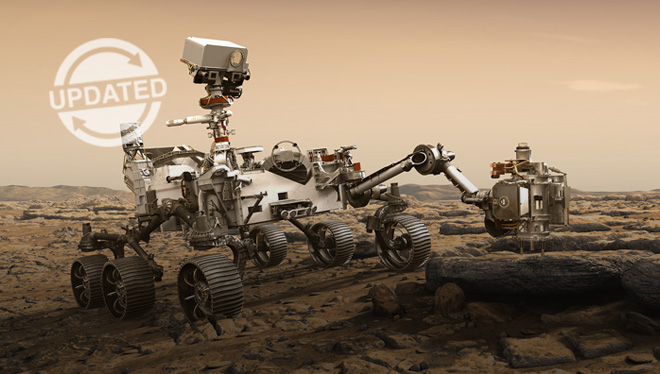
For over four decades, ADI has collaborated with NASA/JPL to develop radiation-hardened IC components and systems that withstand the extreme G-forces of launch and meet stringent quality standards to endure the harshest conditions of space. ADI’s AD590S temperature sensor flew on the Juno mission, which achieved orbital insertion around Jupiter in 2016, and supported the Mars Perseverance rover mission in 2020 with 63 critical components spanning RF, op amps, power management, precision sensing, and data conversion.

THE COMMERCIAL SPACE REVOLUTION
While rocket engines and heat shields capture headlines, a space mission’s success depends on the thousands of components—sensors, converters, and processors—all working in concert. Many of these critical components have already been proven in demanding commercial and industrial applications, from automotive systems to telecommunications infrastructure.
NASA’s approach to space exploration has evolved to leverage this commercial technology base. Driven by fiscal constraints, the agency increasingly sources commercial off-the-shelf (COTS) components from semiconductor leaders rather than exclusively commissioning custom-built hardware. “What NASA is seeking these days are ready solutions they can use with minimal adaptation,” Eliot explained. “Aerospace Prime partners then integrate these COTS components into mission systems.”
The Artemis program demonstrates this shift. NASA leverages ADI’s leading commercial sector core technology trends: precision analog, intelligent sensing, edge autonomy, and deterministic networking. ADI products appear throughout the mission, from engines and power systems to propulsion and core-stage boosters.
This indirect supply chain reflects the modern space industry’s structure: semiconductor companies enable prime contractors to deliver complete systems—whether for lunar missions or for the thousands of LEO satellites being launched today.
THE OFF-THE-SHELF ADVANTAGE
NASA’s embrace of commercial components reflects both economic necessity and technological maturity. Commercial space programs have driven volume production, helping to reduce costs while maintaining reliability. This shift enables faster mission cadence. Rather than waiting for years for custom component development, aerospace partners can select from proven commercial solutions that meet MIL-STD-883 and JANS qualification requirements.
The FY 2027 President’s Budget allocates $8.5 billion for exploration and prioritizes the transition to commercially provided transportation services to improve affordability and strengthen the U.S. industrial base.
TECHNOLOGY TRANSFER: FROM SPACE TO INDUSTRY
For semiconductor companies like ADI, serving the space market through commercial channels amplifies impact. Components designed for aerospace applications often incorporate innovations that later benefit terrestrial industries. The same fundamental challenges of processing signals accurately, managing power efficiently, maintaining reliable communications, and enabling intelligent autonomous systems define both space exploration and the industrial revolution happening here on Earth.
Precision analog sensing forms the foundation of both spacecraft monitoring and industrial automation. Sensor principles tracking propellant pressure also monitor pipeline systems in oil and gas. Temperature measurement precision required for spacecraft thermal control translates directly to semiconductor manufacturing, pharmaceutical production, and data center cooling. Vibration analysis detecting rocket engine anomalies applies to predictive maintenance in factories, wind turbines, and EV drivetrains.
Edge autonomy represents another convergence. Artemis spacecraft systems make split-second decisions about power routing and thermal management without waiting for instructions from Earth. Similarly, ADI’s customers deploy edge intelligence in autonomous vehicles, processing sensor data in milliseconds; in robotic systems that adapt to environmental changes in real time; and in industrial equipment that predicts failures before they occur.
Deterministic networking, which coordinates data flow between spacecraft subsystems, mirrors the time-sensitive networking revolutionizing factory automation. When an orbital maneuver requires precise coordination between navigation, propulsion, and attitude control systems, the underlying communication architecture must guarantee that critical commands arrive exactly when needed. The same determinism enables synchronized motion control in advanced manufacturing, where robotic arms, machine vision, and quality inspection systems must work in lockstep.
Communications technology serves both domains, from signal processing that maintains Earth-to-spacecraft contact across vast distances to 5G infrastructure, satellite communications, and high-speed industrial networks that enable Industry 4.0. ADI’s space-focused development efforts are in the RF and Microwave domain, developing highly integrated, silicon-based RF solutions to enable high-bandwidth radio transmit-and-receive payloads.
THE NEW SPACE ECONOMY
The commercial space industry is accelerating. Private companies launching LEO satellite constellations need thousands of components that balance space-grade reliability with commercial economics. Lunar landers, orbital facilities, and commercial crew vehicles all require the same core technologies: precision sensing, robust communications, intelligent power management, and radiation-tolerant processing.
LOOKING FORWARD
As the Artemis mission prepares to land humans on the lunar surface and plans for the Lunar Gateway space station and eventual Mars missions take shape, innovations driven by space programs won’t remain confined to space. Just as Apollo-era integrated circuits accelerated the semiconductor revolution that powers modern computing, Artemis-generation technologies—including the precision analog, intelligent edge processing, and deterministic networking that companies like ADI advance—will enable the next wave of terrestrial innovation.
Artemis II is more than a story of exploration and innovation. It’s about a technology cycle in which government investment in bold missions creates demand that commercial partners meet, developing capabilities that then transform industry, infrastructure, and daily life on Earth. The semiconductor components enabling Artemis through commercial supply chains simultaneously reshape the manufacturing, automotive, healthcare, energy, and communications sectors.
Space exploration and industrial innovation are now converging, showing how ambitious missions and practical commercial applications can advance together, each driving greater capability and broader benefit.