
MAXREFDES1276


Overview
Design Resources
Design & Integration File
- Schematic
- PCB Layout
- BIll of Materials
- Test Results
Description
MAXREFDES1276 is an ultra-miniature, no-opto flyback DC-DC converter that accepts input voltage from 18V to 36V and outputs 24V at 700mA, suitable for applications in small package solutions with high power density per unit area.
Due to its simplicity and low cost, the flyback converter is the preferred choice for low-to-medium isolated DC-DC power-conversion applications. However, the use of an optocoupler or an auxiliary winding on the flyback transformer for voltage feedback across the isolation barrier increases the number of components and design complexity. The MAX17690 eliminates the need for an optocoupler or auxiliary transformer winding and achieves ±5% output voltage regulation over line, load, and temperature variations.
The MAX17690 implements an innovative algorithm to accurately determine the output voltage by sensing the reflected voltage across the primary winding during the flyback time interval. By sampling and regulating this reflected voltage when the secondary current is close to zero, the effects of secondary-side DC losses in the transformer winding, the PCB tracks, and the rectifying diode on output voltage regulation can be minimized. The MAX17690 also compensates for the negative temperature coefficient of the rectifying diode.
Features & Benefits
- 4.5V to 60V input voltage range
- Programmable switching frequency from 50kHz to 250kHz
- Programmable input enable/UVLO feature
- Programmable input overvoltage protection
- Adjustable soft-start
- 2A/4A peak source/sink gate drive capability
- Hiccup mode short-circuit protection
- Fast cycle-by-cycle peak current limit
- Thermal shutdown protection
- Space-saving, 16-Pin, 3mm x 3mm TQFN package
- -40°C to +125°C operating temperature range
Parts Used
Details Section
MAXREFDES1276 is an ultra-miniature, no-opto flyback DC-DC converter that accepts input voltage from 18V to 36V and outputs 24V at 700mA, suitable for applications in small package solutions with high power density per unit area.
Due to its simplicity and low cost, the flyback converter is the preferred choice for low-to-medium isolated DC-DC power-conversion applications. However, the use of an optocoupler or an auxiliary winding on the flyback transformer for voltage feedback across the isolation barrier increases the number of components and design complexity. The MAX17690 eliminates the need for an optocoupler or auxiliary transformer winding and achieves ±5% output voltage regulation over line, load, and temperature variations.
The MAX17690 implements an innovative algorithm to accurately determine the output voltage by sensing the reflected voltage across the primary winding during the flyback time interval. By sampling and regulating this reflected voltage when the secondary current is close to zero, the effects of secondary-side DC losses in the transformer winding, the PCB tracks, and the rectifying diode on output voltage regulation can be minimized. The MAX17690 also compensates for the negative temperature coefficient of the rectifying diode.
Other features include the following:
- 4.5V to 60V input voltage range
- Programmable switching frequency from 50kHz to 250kHz
- Programmable input enable/UVLO feature
- Programmable input overvoltage protection
- Adjustable soft-start
- 2A/4A peak source/sink gate drive capability
- Hiccup mode short-circuit protection
- Fast cycle-by-cycle peak current limit
- Thermal shutdown protection
- Space-saving, 16-Pin, 3mm x 3mm TQFN package
- -40°C to +125°C operating temperature range
An isolated no-opto flyback DC-DC converter using the MAX17690 is demonstrated for a 24V DC output application. The power supply delivers up to 700mA at 24V. Table 1 shows an overview of the design specification.
| Parameter | Symbol | Min | Max |
| Input Voltage | VIN | 18V | 36V |
| Frequency | fSW | 162kHz | |
| Peak Efficiency at Full Load | ηMAX | 91.5% | |
| Output Voltage | Vo | 24V | |
| Output Voltage Ripple | ΔVO(SS) | 500mV | |
| Output Current | Io | 7mA | 700mA |
| Maximum Output Power | Po | 16.8W | |
This document describes the hardware shown in Figure 1. The power supply has been built and tested. Please refer to Design verification Testing document.
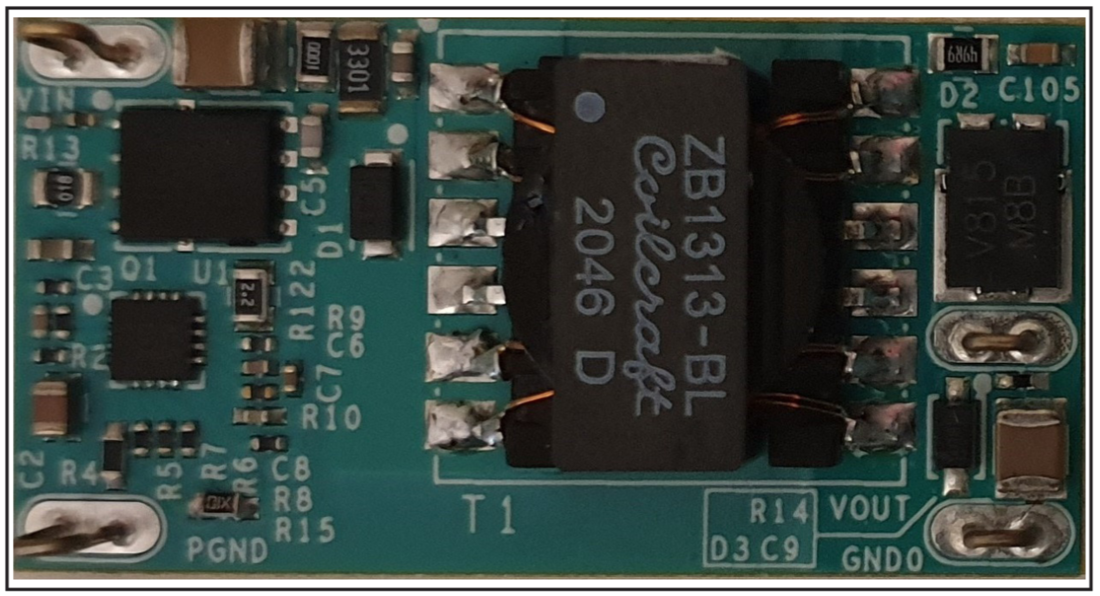
The Isolated No-Opto Flyback Converter
One of the drawbacks encountered in most isolated DC-DC converter topologies is that information relating to the output voltage on the isolated secondary side of the transformer must be communicated back to the primary side to maintain output voltage regulation. In a regular isolated flyback converter, this is normally achieved using an optocoupler feedback circuit or an additional auxiliary winding on the flyback transformer. Optocoupler feedback circuits reduce overall power-supply efficiency, and the extra components increase the cost and physical size of the power supply. In addition, optocoupler feedback circuits are difficult to reliably design due to their limited bandwidth, nonlinearity, high CTR variation, and aging effects. Feedback circuits employing auxiliary transformer windings also exhibit deficiencies. Using an extra winding adds to the flyback transformer's complexity, physical size, and cost, while load regulation and dynamic response are often poor.
The MAX17690 is a peak current-mode controller designed specifically to eliminate the need for optocoupler or auxiliary transformer winding feedback in the traditional isolated flyback topology, therefore reducing size, cost, and design complexity.
More information on the theory of operation of the isolated no-opto flyback converter can be found in the MAX17690 datasheet.
The rectifying diode on the secondary side of the flyback converter has a significant negative temperature coefficient (-1mV/°C to -2mV/°C), which will produce approximately 100mV to 200mV of variation in the output voltage over a rectifying diode operating junction temperature range of -25°C to +125°C. The MAX17690 compensates for temperature variations and a detailed description of how this temperature compensation is achieved can be found in the MAX17690 datasheet.
Designing the No-Opto Flyback Converter Using the MAX17690
The MAX17690 datasheet details a general procedure for designing a non-synchronous no-opto flyback converter. The components in this reference design are calculated broadly in line with the design procedures outlined in the datasheet general design procedure.
Documentation & Resources
-
MAXREFDES1276 Design Files5/8/2022ZIP1 M
Support & Training
Search our knowledge base for answers to your technical questions. Our dedicated team of Applications Engineers are also available to answer your technical questions.