
MAXREFDES1148


Overview
Design Resources
Design & Integration File
- Schematic
- PCB Layout
- Bill of Materials
- Test Results
Description
Power over Ethernet (PoE) is a technology that allows network cables to deliver power to a powered device (PD) via power-sourcing equipment (PSE) or midspan and has many advantages over traditional methods of delivering power. The MAXREFDES1148 reference design is a 36V~57V input to 5V/2.5A output flyback PoE PD power module to be used in Ethernet equipment that needs the 5V power supply to be isolated from the primary Ethernet power. PoE allows power and data to be combined, removing the need for altering the AC mains infrastructure and can be installed by non-electricians. PoE is an intelligent system that is designed with protection at the forefront, preventing overload, underpowering, and installation errors, while allowing simple scalability and reliability. A high-efficiency, no-opto isolated flyback converter minimizes power loss with efficiencies greater than 88%, allowing reductions in excessive heat, longer IC lifetime, and maximum power available to the PD. Ultra-small packaging and no Schottky diode reduce the overall design size.
Features & Benefits
- IEEE® 802.3af/at Compliance
- 2-Event Classification
- No Schottky-Synchronous Operation for High Efficiency and Reduced Cost
- Ultra-Compact Layout
- Peak Efficiency > 88%
- 3mm × 3mm, 16-Pin TQFN (MAX17690), 6-Lead SOT23 (MAX17606), and Thermally Enhanced, 3mm × 3mm, 10-Pin TDFN (MAX5969A) Packages
Details Section
Power over Ethernet (PoE) is a technology that allows net work cables to deliver power to a powered device (PD) via power-sourcing equipment (PSE) or midspan and has many advantages over traditional methods of delivering power. The MAXREFDES1148 reference design is a 36V~57V input to 5V/2.5A output flyback PoE PD power module to be used in Ethernet equipment that needs the 5V power supply to be isolated from the primary Ethernet power. PoE allows power and data to be combined, removing the need for altering the AC mains infrastructure and can be installed by non-electri cians. PoE is an intelligent system that is designed with protection at the forefront, preventing overload, underpowering, and installation errors, while allowing simple scalability and reliability. A high-efficiency, no-opto isolated flyback converter minimizes power loss with efficiencies greater than 88%, allowing reductions in excessive heat, longer IC lifetime, and maximum power available to the PD. Ultra-small packaging and no Schottky diode reduce the overall design size.
Other features include the following:
- IEEE® 802.3af/at Compliance
- 2-Event Classification
- No Schottky-Synchronous Operation for High Efficiency and Reduced Cost
- Ultra-Compact Layout
- Peak Efficiency > 88%
- 3mm × 3mm, 16-Pin TQFN (MAX17690), 6-Lead SOT23 (MAX17606), and Thermally Enhanced, 3mm × 3mm, 10-Pin TDFN (MAX5969A) Packages
This reference circuit uses the MAX5969A PD controller and the MAX17690 no-opto isolated flyback controller. A 1GbE RJ45 magnetic jack is also included and two diode bridges for separating DC power provided by an endspan or midspan PoE system. The MAX17690 is a no-opto peak current-mode controller for design of wide input-voltage flyback converters. The reference design operates over a 36V to 57V input voltage range, and provides up to 2.5A at 5V output. The switching frequency is programmable from 50kHz to 250kHz, allowing optimization of filter components and resulting in compact and cost-effective power conversion. This design is set to switch at 100kHz. Opto-coupler or third winding is not needed to derive feedback signal across isolation boundary.
The MAX17606 is the MOSFET driver. By replacing the secondary diode with a MOSFET, the MAX17606 improves the efficiency and makes the thermal management easier. Table 1 shows an overview of the design specification.
| Parameter | Symbol | Min | Typ | Max |
| Input Voltage | VIN | 37V | 48V | 57V |
| Output Voltage | VOUT | 5V | ||
| Output Current | IOUT | 2.5A | ||
| Output Power | POUT | 12.5W | ||
| Power Efficiency | η | 88% |
This document describes the hardware shown in Figure 1. It provides a detailed technical guide to design ing a complete interface for a PD to comply with the IEEE 802.3af/at standard in a PoE Class 3 system and provide an isolated, high-efficiency flyback converter.
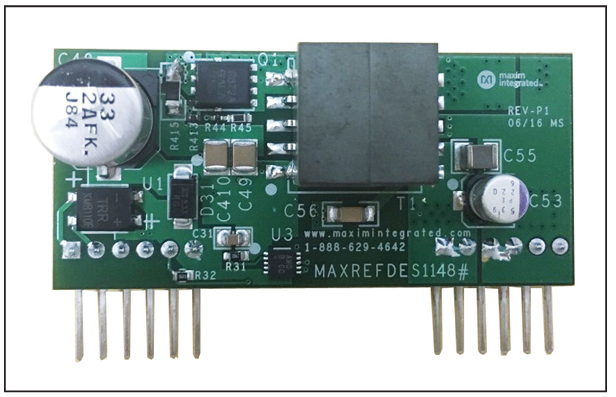
A PoE system delivers power and data to an end device (PD) typically through an RJ45 cable power from an endspan (PSE) or a midspan. The power is separated from the data through diode bridges to deliver a typical 48V for efficient power transfer, which is low enough to be considered a safe voltage and removes the need to rewire AC mains and saves cost.
Although this voltage is safe for humans, it still can dam age equipment if not properly delivered. This is where MAX5969A classification is required, ensuring the equipment can handle the power delivery. Before the PSE can enable power to a connected IP camera or other PD, it must perform a signature detection.
Signature Detection
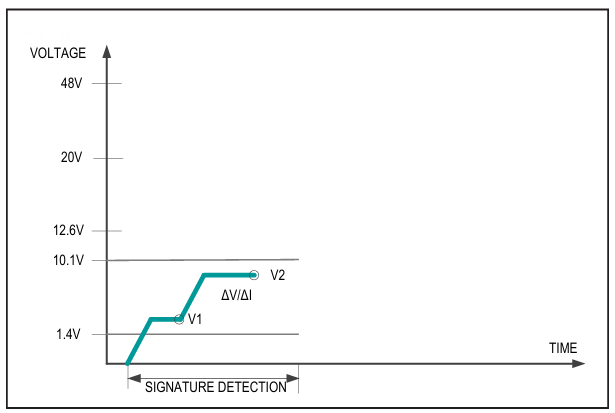
Signature detection uses a lower voltage to detect a characteristic signature of IEEE-compatible PDs (a 24.9kΩ resistance). Once this signature has been detected, the PSE knows that higher voltages can be safely applied. The PSE applies two voltages on VIN in the range 1.4V to 10.1V (1V step minimum) and then records the current measurements at the two applied voltages. The PSE then computes the change in current when each voltage was applied (ΔV/ΔI) to ensure the presence of the 24.9kΩ signature resistor. See Figure 2.
Classification
In classification mode, the PSE classifies the PD based on the power consumption required. This design is a Class 4 system and uses 2-event classification to efficiently manage power distribution. (The IEEE 802.3af/at standard defines only Class 0 to 4 and Class 5 for any special requirement.)
An external resistor (RCLS) of 30.9Ω connected from CLS to VSS sets the classification current. The PSE determines the class of a PD by applying a voltage at the PD input and measuring the current sourced from the PSE.
When the PSE applies a voltage between 12.6V and 20V, the MAX5969A exhibits a current of 36.4mA to 43.6mA. The PSE uses the classification current information to classify the power requirement of the MAX5969A PD. The classification current includes the current drawn by RCLS and the supply current of the MAX5969A so the total cur rent drawn by the PD is within the IEEE 802.3at/af standard figures. The classification current is turned off whenever the device is in power mode. See Table 2.
| Class | Maximum Power Used By PD (W) | RCLS (Ω) | VIN* (V) | Class Current Seen at VIN (mA) | IEEE 802.3af/at PSE Classification Current Specification (mA) | ||
| Min | Max | Min | Max | ||||
| 0 | 0.44 to 12.95 | 619 | 12.6 to 20 | 0 | 4 | 0 | 5 |
| 1 | 0.44 to 3.94 | 117 | 12.6 to 20 | 9 | 12 | 8 | 13 |
| 2 | 3.84 to 6.49 | 66.5 | 12.6 to 20 | 17 | 20 | 16 | 21 |
| 3 | 6.49 to 12.95 | 43.7 | 12.6 to 20 | 26 | 30 | 25 | 31 |
| 4 | 12.95 to 25.5 | 30.9 | 12.6 to 20 | 36 | 44 | 35 | 45 |
| 5 | < 25.5 | 21.3 | 12.6 to 20 | 52 | 64 | — | — |
*VIN is measured across the MAX5969A input VDD to VSS.
2-Event Classification
During 2-event classification, a Type 2 PSE probes PD for classification twice. In the first classification event, the PSE presents an input voltage between 12.6V and 20V and the MAX5969A presents the programmed load, ICLASS. The PSE then drops the probing voltage below the mark-event threshold of 10.1V and the MAX5969A presents the mark current, IMARK. This sequence is repeated one more time.
Power Mode
The final stage after detection and classification of a newly connected PD is to enable power. The 48V supply from the PSE is connected to the PD through the RJ45 cable. Once enabled, the PSE continues to monitor how much current is being delivered to the PD and cuts power to the cable if the power drawn is not within the correct range. This protects the PSE against overload and underpowering, and ensures that the PSE is disconnected from the cable if the PD is unplugged or faulted.
The MAX5969A enters power mode when VIN rises above the undervoltage lockout threshold (VON). When VIN rises above VON, the MAX5969A turns on the internal n-channel isolation MOSFET to connect GND to RTN. The opendrain power-good output (PG) remains low for a minimum of tDELAY until the power MOSFET fully turns on to keep the downstream DC-DC converter disabled during inrush. The PG open-drain output is connected to small-signal transistors to prevent the DC converters from powering up before the power from the PD is allowable.
Design Considerations for MAX5969A and MAX17690
MAX5969A
Place the input capacitor, classification resistor, and transient voltage suppressor as close as possible to the MAX5969A. Use large SMT component pads for power-dissipating devices such as the MAX5969A and the external diodes. Use short and wide traces for high-power paths.
The MAX5969A enters undervoltage lockout when the input voltage drops below 37.3V. When the input drops below this value the isolation MOSFET switches off, disconnecting the 48V from the buck converters. The MAX5969A exits undervoltage lockout when the input exceeds 37.3V, where the isolation MOSFET switches on again, connecting the MAX17690 converters.
MAX17690
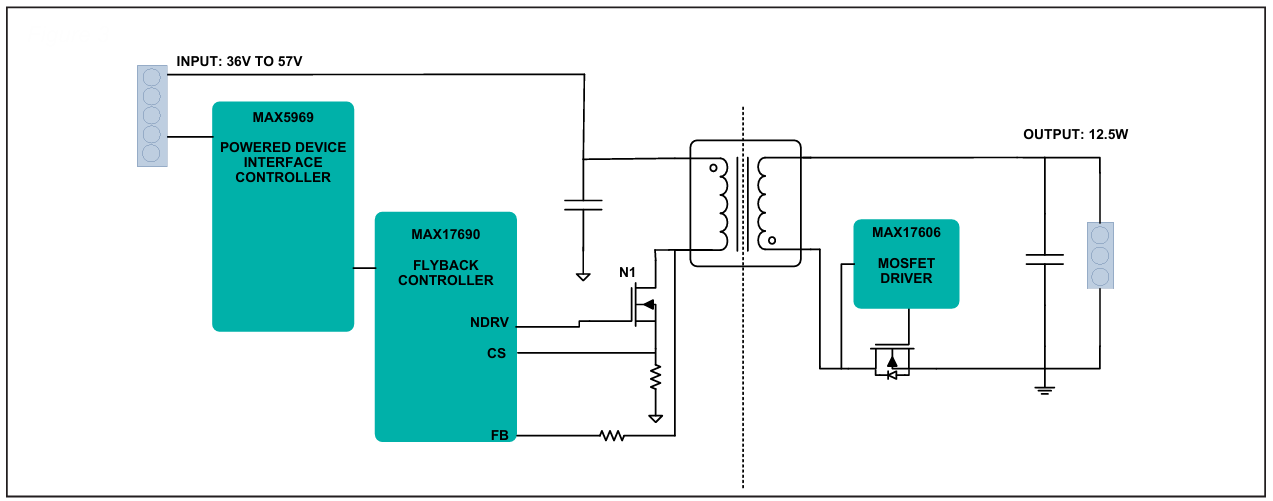
The MAX17690 is a peak current mode, fixed-frequency switching controller specifically designed for the isolated flyback topology operating in Discontinuous Conduction Mode (DCM). The device senses the isolated output voltage directly from the primary-side flyback waveform during the off-time of the primary switch. No auxiliary winding or optocoupler is required for output voltage regulation. Figure 3 shows the reference design block diagram.
The MAX17690 is designed to operate over a wide 4.5V to 60V supply range. The switching frequency is programmable from 50kHz to 250kHz. An EN/UVLO pin allows the user to turn on/off the power supply precisely at the desired input voltage. The MAX17690 provides an input overvoltage protection through the OVI pin. The MAX17690’s 7V internal LDO output makes it suitable for switching both logic-level and standard MOSFETs used in flyback converters. With 2A/4A source/sink currents, the MAX17690 is ideal for driving low RDS(ON) power MOSFETs with fast gate-transition times. The MAX17690 provides an adjustable soft-start feature to limit the inrush current during startup.
The MAX17690 provides temperature compensation for the output diode-forward-voltage drop. The device has robust hiccup-protection and thermal-protection schemes, and come in a space-saving, 16-pin, 3mm x 3mm TQFN package with a temperature range from −40°C to +125°C.
Step 1: Duty-Cycle Selection
Use the VINMIN and VINMAX from the selected specifications in the below equation to calculate the maximum duty cycle, DMAX.

Step 2: Switching Frequency Selection
Then calculate the switching frequency:

Step 3: Transformer Magnetizing Inductance and Turns Ratio
Once the switching frequency and duty cycle are selected, the transformer magnetizing inductance (LMAG) can be calculated from the energy balance equation given in the IC data sheet:

Step 4: Output Capacitor Selection
The output capacitor is usually sized to support a 50% step load of the maximum output current in the application, so the output voltage deviation is contained to ±3% of the output voltage change.

where ISTEP is the load current step, tRESPONSE is the response time of the controller, and ΔVOUT is the allowable output voltage deviation.

Consider DC bias and aging effects while selecting the output capacitor. DC bias on a ceramic capacitor has a dramatic effect on the capacitance value. Refer to the capacitor’s data sheet for capacitance vs. voltage graphs.
Step 5: Soft-Start Capacitor Selection
The capacitor connected between the SS pin and SGND programs the soft-start time. Internally generated 5μA of precise current source charges the soft-start capacitor. When the EN/UVLO voltage is above 1.215V (typ), the device initiates a soft-start sequence. During the soft-start time, the SS pin voltage is used as a reference for the internal error amplifier. The soft-start feature reduces the input inrush current during startup. The reference ramp up allows the output voltage to increase monotonically from zero to the target output value.
CSS = 5 × tSS
Set tSS = 5ms, so CSS = 25nF.
Documentation & Resources
Support & Training
Search our knowledge base for answers to your technical questions. Our dedicated team of Applications Engineers are also available to answer your technical questions.