
MAXREFDES1012


Overview
Design Resources
Description
Due to its simplicity and low cost, the flyback converter is the preferred choice for low-to-medium isolated DC-DC power-conversion applications. However, the use of an optocoupler or an auxiliary winding on the flyback transformer for voltage feedback across the isolation barrier increases the number of components and design complexity. The MAX17690 eliminates the need for an optocoupler or auxiliary transformer winding and achieves ±5% output voltage regulation over line, load, and temperature variations.
The MAX17690 implements an innovative algorithm to accurately determine the output voltage by sensing the reflected voltage across the primary winding during the flyback time interval. By sampling and regulating this reflected voltage when the secondary current is close to zero, the effects of secondary-side DC losses in the transformer winding, the PCB tracks, and the rectifying diode on output voltage regulation can be minimized.
The MAX17690 also compensates for the negative temperature coefficient of the rectifying diode.
Features & Benefits
- 4.5V to 60V Input Voltage Range
- Programmable Switching Frequency from 50kHz to 250kHz
- Programmable Input Enable/UVLO Feature
- Adjustable Soft-Start
- 2A/4A Peak Source/Sink Gate Drive Capability
- Hiccup Mode Short-Circuit Protection
- Fast Cycle-by-Cycle Peak Current Limit
- Thermal Shutdown Protection
- Space-Saving, 16-Pin, 3mm x 3mm TQFN Package
- -40°C to +125°C Operating Temperature Range
Parts Used
Details Section
Due to its simplicity and low cost, the flyback converter is the preferred choice for low-to-medium isolated DC-DC power-conversion applications. However, the use of an optocoupler or an auxiliary winding on the flyback transformer for voltage feedback across the isolation barrier increases the number of components and design complexity. The MAX17690 eliminates the need for an optocoupler or auxiliary transformer winding and achieves ±5% output voltage regulation over line, load, and temperature variations.
The MAX17690 implements an innovative algorithm to accurately determine the output voltage by sensing the reflected voltage across the primary winding during the flyback time interval. By sampling and regulating this reflected voltage when the secondary current is close to zero, the effects of secondary-side DC losses in the transformer winding, the PCB tracks, and the rectifying diode on output voltage regulation can be minimized.
The MAX17690 also compensates for the negative temperature coefficient of the rectifying diode.
Other features include the following:
- 4.5V to 60V Input Voltage Range
- Programmable Switching Frequency from 50kHz to 250kHz
- Programmable Input Enable/UVLO Feature
- Programmable Input Overvoltage Protection
- Adjustable Soft-Start
- 2A/4A Peak Source/Sink Gate Drive Capability
- Hiccup Mode Short-Circuit Protection
- Fast Cycle-by-Cycle Peak Current Limit
- Thermal Shutdown Protection
- Space-Saving, 16-Pin, 3mm x 3mm TQFN Package
- -40°C to +125°C Operating Temperature Range
An isolated no-opto flyback DC-DC converter using the MAX17690 and MAX17606 is demonstrated for a 5.3V DC output application. The power supply delivers up to 2A at 5.3V. Table 1 shows an overview of the design specification.
| PARAMETER | SYMBOL | MIN | MAX |
| Input Voltage | VIN | 8V | 20V |
| Frequency | fSW | 143.5kHz | |
| Peak Efficiency at Full Load | ηMAX | 0.914 | |
| Efficiency at Minimum Load | ηMIN | 0.6 | |
| Output Voltage | VOUT | 5.3V | |
| Output Voltage Ripple | ∆VO | 50mV | |
| Maximum Output Current | IOUT | 2A | |
| Maximum Output Power | POUT | 10.6W | |
This document describes the hardware shown in Figure 1. It provides a detailed systematic technical guide to designing an isolated no-opto flyback DC-DC converter using Maxim's MAX17690 controller. The power supply has been built and tested.


One of the drawbacks encountered in most isolated DC-DC converter topologies is that information relating to the output voltage on the isolated secondary side of the transformer must be communicated back to the primary side to maintain output voltage regulation. In a regular isolated flyback converter, this is normally achieved using an optocoupler feedback circuit or an additional auxiliary winding on the flyback transformer. Optocoupler feedback circuits reduce overall power-supply efficiency, and the extra components increase the cost and physical size of the power supply. In addition, optocoupler feedback circuits are difficult to design reliably due to their limited bandwidth, nonlinearity, high CTR variation, and aging effects. Feedback circuits employing auxiliary transformer windings also exhibit deficiencies. Using an extra winding adds to the flyback transformer's complexity, physical size, and cost, while load regulation and dynamic response are often poor.
The MAX17690 is a peak current-mode controller designed specifically to eliminate the need for optocoupler or auxiliary transformer winding feedback in the traditional isolated flyback topology, therefore reducing size, cost, and design complexity. It derives information about the isolated output voltage by examining the voltage on the primary-side winding of the flyback transformer.
Other than this uniquely innovative method for regulating the output voltage, the no-opto isolated flyback converter using the MAX17690 follows the same general design process as a traditional flyback converter. To understand the operation and benefits of the no-opto flyback converter, it is useful to review the schematic and typical waveforms of the traditional flyback converter (using the MAX17595), shown in Figure 2.
The simplified schematic in Figure 2 illustrates how information about the output voltage is obtained across the isolation barrier in traditional isolated flyback converters. The optocoupler feedback mechanism requires at least 10 components including an optocoupler and a shunt regulator, in addition to a primary-side bias voltage, VBIAS, to drive the photo-transistor. The error voltage FB2 connects to the FB pin of the flyback controller.
The transformer feedback method requires an additional winding on the primary side of the flyback transformer, a diode, a capacitor, and two resistors to generate a voltage proportional to the output voltage. This voltage is compared to an internal reference in a traditional flyback controller to generate the error voltage.


By including additional innovative features internally in the MAX17690 no-opto flyback controller, Maxim has enabled power-supply designers to eliminate the additional components, board area, complexity, and cost associated with both the optocoupler and transformer feedback methods. Figure 3 illustrates a simplified schematic and typical waveforms for an isolated no-opto flyback DC-DC converter using the MAX17690.
By comparing Figure 3 with Figure 2, it is evident that there is no difference in the voltage and current waveforms in the traditional and no-opto flyback topologies. The difference is in the control method used to maintain VOUT at its target value over the required load, line, and temperature range. The MAX17690 achieves this with minimum components by forcing the voltage VFLYBACK during the conduction period of DFR to be precisely the voltage required to maintain a constant VOUT. When QP turns off, DFR conducts and the drain voltage of QP, rises to a voltage VFLYBACK above VIN. After initial ringing due to transformer leakage inductance and the junction capacitance of DFR and output capacitance of QP, the voltage VFLYBACK is given by:
where:
VFLYBACK is the QP drain voltage relative to primary ground
VDFR(T) is the forward voltage drop of DFR, which has a negative temperature coefficient
ILS(t) is the instantaneous secondary transformer current
RS(T) is the total DC resistance of the secondary circuit, which has a positive temperature coefficient
nSP is the secondary to primary turns ratio of the flyback transformer
The voltage of interest is (VFLYBACK - VIN) since this is a measure of VOUT. An internal voltage to current amplifier generates a current proportional to (VFLYBACK - VIN). This current then flows through RSET to generate a ground referenced voltage, VSET, proportional to (VFLYBACK - VIN). This requires that:
Combining this equation with the previous equation for VFLYBACK, we have:


We need to consider the effect of the temperature dependence of VDFR and the time dependence of ILS on the control system. If VFLYBACK is sampled at a time when ILS is very close to zero, then the term ILS(t) × RS(T) is negligible and can be assumed to be zero in the previous expression. This is the case when the flyback converter is operating in, or close to, discontinuous conduction mode. It is very important to sample the VFLYBACK voltage before the secondary current reaches zero since there is a very large oscillation on VFLYBACK due to the resonance between the primary magnetizing inductance of the flyback transformer and the output capacitance of QP as soon as the current reaches zero in the secondary. The time at which VFLYBACK is sampled is set by resistor RVCM.
The VDFR term has a significant negative temperature coefficient that must be compensated to ensure acceptable output voltage regulation over the required temperature range. This is achieved by internally connecting a positive temperature coefficient current source to the VSET pin. The current is set by resistor RTC connected to ground. The simplest way to understand the temperature compensation mechanism is to think about what needs to happen in the control system when temperature increases. In an uncompensated system, as the temperature increases, VDFR decreases due to its negative temperature coefficient. Since VDFR decreases, VOUT increases by the same amount, therefore VFLYBACK remains unchanged. Since VSET is proportional to VFLYBACK, VSET also remains unchanged. Since there is no change in VSET there is no change in duty cycle demand to bring VOUT back down to its target value. What needs to happen in the temperature compensated case is, when VOUT increases due to the negative temperature coefficient of VDFR, VSET needs to increase by an amount just sufficient to bring VOUT back to its target value. This is achieved by designing VSET with a positive temperature coefficient. Expressed mathematically as:
where:
δVDFR/δT is the diodes forward temperature coefficient
δVTC/δT = 1.85mV/°C
VTC = 0.55V is the voltage at the TC pin at +25°C
Rearranging the above expression gives:
The effect of adding the positive temperature coefficient current, ITC, to the current in RFB is equivalent to adding a positive temperature coefficient voltage in series with VDFR on the secondary side of value:
Substituting from the previous expression, this becomes:
We can now substitute this expression into the expression for VOUT as follows:
and finally solve for RFB:
Values for RSET, VSET, and δVTC/δT can be obtained from the MAX17690 data sheet as follows:
RSET = 10kΩ
VSET = 1V
δVTC/δT = 1.85mV/°C
Values for VDFR and δVDFR/δT can be obtained from the output diode data sheet, and nSP is calculated when the flyback transformer is designed.
The value of RTC can then be calculated using the expression from earlier, restated below:
The calculated resistor values for RFB and RTC should always be verified experimentally and adjusted, if necessary, to achieve optimum performance over the required temperature range. Note that the reference design described in this document has only been verified at room temperature.
Finally, the internal temperature compensation circuitry requires a current proportional to VIN. RRIN should be chosen as approximately:
Setting the VFLYBACK Sampling Instant
The MAX17690 generates an internal voltage proportional to the on-time volt-second product. This enables the device to determine the correct sampling instant for VFLYBACK during the QP off-time. The RVCM resistor is used to scale this internal voltage to an acceptable internal voltage limit in the device.
Design Procedure for No-Opto Flyback Converter Using MAX17690
Now that the principle difference between a traditional isolated flyback converter using optocoupler or auxiliary transformer winding feedback and the isolated no-opto flyback converter using the MAX17690 is understood, a practical design example can be illustrated. The converter design process can be divided into three parts: the power stage design, the setup of the MAX17690 no-opto flyback controller, and closing the control loop. This document is intended to complement the information contained in the MAX17690 data sheet.
The following design parameters are used throughout this document:
| SYMBOL | FUNCTION |
| VIN | Input voltage |
| VUVLO | Undervoltage turn-on threshold |
| VOVI | Overvoltage turn-off threshold |
| tSS | Soft-start time |
| VOUT | Output voltage |
| ΔVO | Steady-state output ripple voltage |
| IOUT | Output current |
| POUT | Output power |
| η(MAX) | Target efficiency at maximum load |
| η(MIN) | Target efficiency at minimum load |
| PIN | Input power |
| fSW | Switching frequency |
| D | Duty cycle |
| nSP | Secondary-primary turns ratio |
Throughout the design procedure reference is made to the schematic. See the Design Resources section.
Part I: Designing the Power Components
Step 1: Calculate the Minimum Turns Ratio for the Flyback Transformer
The secondary-primary turns ratio, nSP, and the duty cycle, D, for the flyback converter are related by the flyback DC gain function as follows:
The converter's absolute minimum input voltage is the undervoltage lockout threshold (VIN falling), which is programmed with a resistor-divider for the MAX17690. At this voltage and at maximum output power, D should be less than or equal to 66% (the maximum duty cycle at which the MAX17690 can operate) to ensure reliable converter operation. For the current design, the undervoltage lockout threshold (VIN falling) occurs at 6.4V, so with D set at 66%, the absolute minimum turns ratio, nSP(MIN), for the flyback transformer is calculated as follows
This transformer turns ratio assumes that there are no DC voltage drops in the primary and/or secondary circuits. In practice, a larger transformer turns ratio must be chosen to account for these DC voltage drops. For the current design, a transformer turns ratio nSP = 0.5 was chosen.
Step 2: Estimate the Maximum and Minimum Duty Cycle Under Normal Operating Conditions
Normal input voltage operating conditions are defined as VIN(MIN) and VIN(MAX) on page 1. By using the flyback DC gain function again, the duty cycle is estimated as:
nSP and VOUT are fixed, DMAX occurs when VIN is a minimum, i.e., at VIN(MIN). For the current design, VIN(MIN) = 8V, so:
The MAX17690 derives the current, ΔILP, in the primary magnetizing inductance by measuring the voltage, ΔVRCS, across the current-sense resistor (RCS) during the on-time of the primary-side MOSFET. So:
ΔILP is a maximum at DMAX and VIN(MIN) and a minimum at DMIN and VIN(MAX), so:
and
Solving these two equations:
where ΔVRCS(MIN) and ΔVRCS(MAX) correspond to the minimum current limit threshold (20mV) and the maximum current limit threshold (100mV) of the MAX17690, respectively. So, for VIN(MIN) = 8V, VIN(MAX) = 20V, and DMAX = 0.57, we have:
Step 3: Calculate the Maximum Allowable Switching Frequency
The isolated no-opto flyback topology requires the primary side MOSFET to constantly maintain switching, otherwise there is no way to sense the reflected secondary-side voltage at the drain of the primary-side MOSFET. The MAX17690 achieves this by having a critical minimum on-time, tON(CRIT), for which it drives the MOSFET. At a given switching frequency, tON(MIN) corresponds to DMIN. From the MAX17690 data sheet, the critical minimum on-time tON(CRIT) for the NDRV pin is 235ns. We can therefore calculate the maximum allowable switching frequency to ensure that tON(MIN) > tON(CRIT) as follows:
Since DMIN is fixed by ΔVRCS(MIN), ΔVRCS(MAX), DMAX, VIN(MIN), and VIN(MAX), then tON(MIN) can be chosen arbitrarily larger than tON(CRIT) so that fSW is less than fSW(MAX). With tON(MIN) = 400ns, the switching frequency is as follows:
Note that the MAX17690 should always be operated in the 50kHz to 250kHz switching frequency range and tON(MIN) must be chosen accordingly to ensure that this constraint is met.
Step 4: Estimate the Primary Magnetizing Inductance
Maximum input power is given by:
For the discontinuous flyback converter all the energy stored in the primary magnetizing inductance, LP, during the MOSFET on-time is transferred to the output during the MOSFET off-time, i.e., the full power transfer occurs during one switching cycle. Therefore, because E = P x t, we have:
The maximum input energy must be stored in LP during the on-time of the MOSFET, so:
We also know that the peak current in LP, ΔILP(MAX) occurs at input voltage VIN(MIN) and MOSFET on-time tON(MAX), so:
and substituting:
Combining with the original P x t equation gives:
Finally, by rearranging we have an expression for the primary magnetizing inductance LP:
Estimating the power converter efficiency at 90% and with VIN(MIN) = 8V, DMAX = 0.57, VOUT = 5.3V, and fSW = 143kHz, then:
This inductance represents the maximum primary magnetizing inductance since it sets the current-limit threshold. Choosing a larger inductance sets the current-limit threshold at a lower value and could cause the converter to go into current limit at a value lower than IOUT, which would be undesirable. Assuming a ±10% tolerance for the primary magnetizing inductance gives:
Step 5: Recalculate DMAX, DMIN, and tON(MIN) Based on the Selected Value for LP
Rearranging the LP equation in Step 4 gives an expression for DMAX as follows:
Referring to Step 2:
and:
Step 6: Calculate the Peak and RMS Currents in the Primary Winding of the Flyback Transformer
The peak primary winding current occurs at VIN(MIN) and DMAX according to the following equation:
The RMS primary winding current can be calculated from ΔILP(MAX) and DMAX as follows:
Step 7: Calculate the Peak and RMS Currents in the Secondary Winding of the Flyback Transformer
The peak current in the flyback transformer’s secondary-side winding can be established by considering that the entire energy transferred from the primary-side winding to the secondary-side winding is delivered to the load during one switching period. Again, since E = P x t:
Substituting:
And rearranging:
Current flows in the secondary-side winding of the flyback transformer during the time the secondary-side rectifying device is conducting. This conduction time, tON(SEC), is calculated using the inductor volt-second equation:
where V = VOUT, L = LS, dI = ΔILS(MAX), and dt = tON(SEC), so:
The maximum duty cycle of the secondary-side rectifying device, DS(MAX), can now be calculated:
Finally, the RMS secondary winding current can be calculated from ΔILS(MAX) and DS(MAX) as follows:
Step 8: Summarize the Flyback Transformer Specification
All the critical parameters for the flyback transformer have been calculated and are summarized below. Using these parameters, a suitable transformer can be designed.
| PARAMETER | SYMBOL | VALUE |
| Primary Magnetizing Inductance | LP | 4µH ±10% |
| Primary Peak Current | ∆ILP(MAX) | 6.4A |
| Primary RMS Current | ILP(RMS) | 2.51A |
| Turns Ratio (NS/NP) | nSP | 0.5 |
| Secondary Peak Current | ∆ILS(MAX) | 12.15A |
| Secondary RMS Current | ILS(RMS) | 5.77A |
Step 9: Calculate Design Parameters for Secondary-Side Rectifying Device
Depending on the output voltage and current, a choice can be made for the secondary-side rectifying device. Generally, for output voltages above 12V at low currents (less than 1A), Schottky diodes are used, and for voltages less than 12V synchronous rectification (MOSFET) is used. The current design is a 5.3V/2A output converter, so we outline a procedure for selecting a suitable MOSFET for the synchronous switch.
Figure 4 shows a simplified schematic with the synchronous MOSFET, QS. The MAX17606 is a secondary-side synchronous driver and controller specifically designed for the isolated flyback topology operating in Discontinuous Conduction Mode (DCM) or Border Conduction Mode (BCM).


The important parameters to consider for the synchronous rectifying device are the same as those of a regular rectifying diode: peak instantaneous current, RMS current, voltage stress, and power losses. Since QS and LS are in series, they experience the same peak and RMS currents, so:
and
When QS is off, VIN reflected to the secondary side of the flyback transformer plus (VOUT + VQS(SAT)) is applied across the drain-source of QS, so:
QS has both conduction losses due to its RDS(ON) and switching losses. Allowing for reasonable design margin, we chose the Infineon BSZ040N04LSG for this design with the following specifications:
| PARAMETER | VALUE |
| Maximum Drain-Source Voltage | 40V |
| Continuous Drain Current | 40A |
| Drain-Source Resistance | 6.1mΩ |
| Minimum VGS Threshold VGSTH | 1.2V |
| Typical VGS Plateau VGSPL | 3.0V |
| Maximum QG(T) | 64nC |
| Typical QGD | 4.9nC |
| Total Output Capacitance COSS | 1100pF |
The power losses in the QS can be approximated as follows:
where:
PCON is the loss due to IQS(RMS) flowing through the drain-source on resistance of QS:
PCDS is the loss due to the energy in the drain-source output capacitance being dissipated in QS at turn-on:
and PSW is the turn-on voltage-current transition loss that occurs as the drain-source voltage decreases and the drain current increases during the turn-on transition:
where IDRV is the maximum drive current capability of the MAX17606’s GATE output and IQS(t-ON) is the instantaneous current in QS at turn-on. IQS(t-ON) is equal to IQS(MAX).
Step 10: Calculate Design Parameters for Primary-Side MOSFET
The important parameters to consider for the primary-side MOSFET (QP) are peak instantaneous current, RMS current, voltage stress, and power losses. Because QP and LP are in series they experience the same peak and RMS currents, so from Step 6:
and
When QP turns off, VOUT reflected to the primary side of the flyback transformer plus VIN(MAX) is applied across the drain source of QP. In addition, until QS starts to conduct, there is no path for the leakage inductance energy to flow through. This causes the drain-source voltage of QP to rise even further. The factor of (1.5) in the equation below represents this additional voltage rise; however, this factor can be higher or lower depending on the transformer and PCB leakage inductances:
Allowing for reasonable design margin, we chose the Vishay SQJA96EP for this design with the following specifications:
| PARAMETER | VALUE |
| Maximum Drain-Source Voltage | 80V |
| Continuous Drain Current | 30A |
| Drain-Source Resistance | 35.3mΩ |
| Minimum VGS Threshold VGSTH | 2.5V |
| Typical VGS Plateau VGSPL | 4V |
| Maximum QG(T) | 25nC |
| Typical QGD | 3nC |
| Total Output Capacitance COSS | 625pF |
The power losses in the QP can be approximated as follows:
where:
PCON is the loss due to IQP(RMS) flowing through the drain-source on resistance of QP:
PCDS is the loss due to the energy in the drain-source output capacitance being dissipated in QP at turn-on:
And PSW is the turn-on voltage-current transition loss that occurs as the drain-source voltage decreases and the drain current increases during the turn-on transition:
where IDRV is the maximum drive current capability of the MAX17690’s NDRV output and IQP(t-ON) is the instantaneous current in QP at turn-on. Because the flyback converter is operating in DCM, IQP(t-ON) is zero and so is PSW.
Step 11: Select the RCD Snubber Components
Referring to Figure 5, when QP turns off, ILP charges the output capacitance, COSS, of QP. When the voltage across COSS exceeds the input voltage plus the reflected secondary to primary voltage, the secondary-side diode (or synchronous switch) turns on. Since the diode (or synchronous switch) is now on, the energy stored in the primary magnetizing inductance is transferred to the secondary; however, the energy stored in the leakage inductance will continue to charge COSS since there is nowhere else for it to go. Since the voltage across COSS is the same as the voltage across QP, if the energy stored in the leakage inductance charges COSS to a voltage level greater than the maximum allowable drain-source voltage of QP, the MOSFET fails.
One way to avoid this situation arising is to add a suitable RCD snubber across the transformer’s primary winding. In Figure 5, the snubber is labeled RSN, CSN, and DSN. In this situation, when QP turns off, the voltage at Node A i:
When the secondary-side diode (or synchronous switch) turns on, the voltage at Node B is:


So, the voltage across the leakage inductance is:
So:
The average power dissipated in the snubber network is:
Substituting ΔtSN into this expression we have:
The leakage inductance energy is dissipated in RSN, so from:
We can calculate the required RSN as follows:
Over one switching cycle we must have:
So, we can calculate the required CSN as follows:
Generally, ΔVCSN should be kept to approximately 10% to 30% of VCSN. Figure 6 illustrates VCSN, ΔISN, and ΔtSN. The voltage across the snubber capacitor, VCSN, should be selected so that:
Choosing too large a value for VCSN causes the voltage on the QP drain to get too close to its maximum allowable drain-source voltage, while choosing too small a value results in higher power losses in the snubber resistor. A reasonable value should result in a maximum drain voltage on QP that is approximately 75% of its maximum allowable value. The worst-case condition for the snubber circuit occurs at maximum output power when:
Assuming the leakage inductance is 1.5% of the primary inductance, choosing VCSN = 39V and ΔVCSN = 7V, we get the following approximate values:
Finally, we consider the snubber diode, DSN. This diode should have at least the same voltage rating as the MOSFET, QP. Although the average forward current is very low, it must have a peak repetitive current rating greater than ΔILP(MAX).
Step 12: Calculate the Required Current-Sense Resistor
From Step 4 we have the maximum input power given by:
For the DCM flyback converter all the energy stored in the primary magnetizing inductance, LP, during the MOSFET on-time is transferred to the output during the MOSFET off-time, i.e., the full power transfer occurs during one switching cycle. Therefore, since E = P x t, we have:
The maximum input energy must be stored in LP during the primary-side MOSFET on-time, so:
Substituting the equations above:
and
From Step 2 we have:
A standard 16mΩ resistor was chosen for RCS.


Step 13: Calculate and Select the Input Capacitors
Figure 7 shows a simplified schematic of the primary side of the flyback converter and the associated current waveforms. In steady-state operation, the converter draws a pulsed high-frequency current from the input capacitor, CIN. This current leads to a high-frequency ripple voltage across the capacitor according to the following expression:
It is the ripple voltage arising from the amp-second product through the input capacitor.
During the QP on-time interval from t0 to t1, the capacitor is supplying current to the primary inductance LP of the flyback transformer and its voltage is decreasing. During the QP off-time time interval from t1 to t2, no current is flowing in LP, and current is being supplied to the capacitor from the input voltage source. According to the charge balance law, the decrease in capacitor voltage during time t0 to t1 must equal the increase in capacitor voltage during time t1 to t2. So:
And finally, since:
we have:
For maximum high-frequency ripple voltage requirement ΔVCIN, we can now calculate the required minimum CIN. There is high-frequency AC current flowing in CIN, as shown in the center waveform of Figure 7. The selected capacitor must be specified to tolerate the maximum RMS current, ICIN(RMS). From the simplified schematic:
Therefore:
where:
and from Step 6:
So:
An additional high-frequency ripple voltage is present due to this RMS current flowing through the ESR of the capacitor. Ceramic capacitors are generally used for limiting high-frequency ripple due to their high AC current capability and low ESR.


In addition to using a ceramic capacitor for high-frequency input ripple-voltage control as described above, an electrolytic capacitor is sometimes inserted at the input of a flyback converter to limit the input voltage deviation when there is a rapid output load change. A 100% load change gives rise to an input current transient of:
During this transient, there is a voltage drop across any series stray inductance, LIN(STRAY), that exists between the input voltage source and the input capacitor of the power supply. So from:
we have:
We now have two values for CIN. One for input high-frequency ripple-voltage control:
and a second for transient input voltage control:
If CIN(ELE) > CIN(CER), both ceramic and electrolytic capacitors must be used at the input of the power supply and ΔVCIN should be limited to approximately 75mV to keep the AC current in the ESR of the electrolytic capacitor within acceptable limits. Otherwise, CIN(ELE) is not required. In this case, the value of CIN(CER) can be significantly reduced since there is no longer any requirement to limit ΔVCIN to less than 75mV. Based on the current design specification with LIN(STRAY) approximated at 50nH:
and
Since CIN(ELE) < CIN(CER), an electrolytic capacitor is not required. We can now recalculate CIN(CER) based on a ΔVCIN = 280mV:
Allowing for a ±10% capacitor tolerance and a further reduction of capacitance of 48% due to the DC bias effect (operating a 50V ceramic capacitor at 20V), the final nominal value of input capacitance required is:
This is achieved by using four 10µF ceramic capacitor (Murata GRM32ER71H106KA12). The AC current in the capacitor is:
which is well within specification for the selected capacitor.
Step 14: Calculate and Select the Output Capacitor
High-frequency ripple voltage requirements are also used to determine the value of the output capacitor in a flyback converter. Figure 8 shows a simplified schematic of the secondary side of the flyback converter and the associated current waveforms.
In steady-state operation, the load draws a DC current from the secondary side of the flyback converter. By examining the secondary current waveforms, we see that CO is supplying the full output current IOUT to the load during the time interval from t2 to t3. During this time interval, the voltage across CO decreases. At time t3, QP has just turned off and the secondary rectifying diode DFR (or the secondary synchronous MOSFET QS) starts to conduct supplying current to the load and to CO. The charging and discharging of CO leads to a high-frequency ripple voltage at the output according to the following expression:
Again, as with the input capacitor, this is the ripple voltage arising from the amp-second product through the output capacitor.
By the capacitor charge balance law, the decrease in capacitor voltage during time t2 to t3 must equal the increase in capacitor voltage during time t1 to t2. When the capacitor is discharging, we have:
Finally, since:
We have:
For maximum high-frequency ripple voltage requirement ΔVCO, we can now calculate the required minimum CO.
CO ≈ 169.7µF.
As with the input capacitor, an additional high-frequency ripple voltage occurs at the output due to the output capacitor’s ESR and can be minimized by choosing a capacitor with low ESR.
Also, as with the input capacitor, there is high-frequency AC current flowing in CO as shown in the center waveform of Figure 8.. The selected capacitor must be specified to tolerate this maximum RMS current, ICO(RMS). From the simplified schematic:
Therefore:
where:
and from Step 7:
so:
If we allow for a ±20% capacitor tolerance and a further reduction of capacitance of 57% due to the DC bias effect (operating a 6.3V ceramic capacitor at 5V), our final nominal value is:
We can achieve this by placing five 100µF ceramic capacitors (Murata GRM32ER60J107ME20) in parallel. The minimum output capacitance using the above combination is 172µF. The AC current in each capacitor is:
which is well within specification for the selected capacitor.


Step 15: Summarize the Power Component Design
A first pass at calculating the power components in the no-opto flyback converter using MAX17690 has been completed. Referring to the schematic, a summary of the power components is listed below:
| POWER COMPONENT | QTY | DESCRIPTION |
| Flyback Transformer | 1 | PRI. INDUCTANCE = 4µH SEC-PRI TURNS RATIO = 0.5 PEAK. PRI CURRENT = 6.4A PRI. RMS CURRENT = 2.51A PEAK SEC. CURRENT = 12.15A SEC. RMS CURRENT = 5.77A SWITCHING FREQ. = 143kHz |
| Input Capacitor | 4 | CAPACITOR; SMT (1210); CERAMIC CHIP 10µF; 50V; 10%; X7R Murata GRM32ER71H106KA12 |
| Output Capacitors | 5 | CAPACITOR; SMT (1210); CERAMIC CHIP 100µF; 6.3V; 20%; X7R Murata GRM32ER60J107ME20 |
| Primary MOSFET | 1 | MOSFET; NCH; I-(30A); V-(80V) Vishay SQJA96EP |
| Synchronous MOSFET | 1 | MOSFET; NCH; I-(40A); V-(40V) Infineon BSZ040N04LSG |
Part II: Setting Up the MAX17690 No-Opto Flyback Controller
Step 16: Setting Up the Switching Frequency
The MAX17690 can operate at switching frequencies between 50kHz and 250kHz (subject to the considerations in Step 3). A lower switching frequency optimizes the design for efficiency, whereas increasing the switching frequency allows for smaller inductive and capacitive components sizes and costs. A switching frequency of 143kHz was chosen in Step 3. R9 sets the switching frequency according to the following expression:
where R9 is in kΩ and fSW is in Hz.
Step 17: Setting Up the Soft-Start Time
The capacitor C6 connected between the SS pin and SGND programs the soft-start time. A precision internal 5µA current source charges the soft-start capacitor C6. During the soft-start time, the voltage at the SS pin is used as a reference for the internal error amplifier during startup. The soft-start feature reduces inrush current during startup. Since the reference voltage for the internal error amplifier is ramping up linearly, so too is the output voltage during soft-start. The soft-start capacitor is chosen based on the required soft-start time (10ms) as follows:
where C6 is in nF and tSS is in ms. We chose a standard 47nF capacitor.
Step 18: Setting Up the UVLO and OVI Resistors
A resistor-divider network of R1, R3, and R2 from VIN to SGND sets the input undervoltage lockout threshold and the output overvoltage inhibit threshold. The MAX17690 does not commence its startup operation until the voltage on the EN/UVLO pin (R3/R2 node) exceeds 1.215V (typ). When the voltage on the OVI pin (R1/R3 node) exceeds 1.215V (typ), the MAX17690 stops switching, thus inhibiting the output. Both pins have hysteresis built in to avoid unstable turn-on/turn-off at the UVLO/EN and OVI thresholds. After the device is enabled, if the voltage on the UVLO/EN pin drops below 1.1V (typ), the controller turns off; after the device is OVI inhibited, it turns back on when the voltage at the OVI pin drops below 1.1V (typ). Whenever the controller turns on, it goes through the soft-start sequence. For the current design R1 = 10kΩ, R2 = 140kΩ, and R3 = 20kΩ give rise to an UVLO/EN threshold of 6.9V and an OVI threshold of 20.7V.
Step 19: Placing Decoupling Capacitors on VIN and INTVCC
The MAX17690 no-opto flyback controller compares the voltage VFLYBACK to VIN. This voltage difference is converted to a proportional current that flows in R5. The voltage across R5 is sampled and compared to an internal reference by the error amplifier. The output of the error amplifier is used to regulate the output voltage. The VIN pin should be directly connected to the input voltage supply. For robust and accurate operation, a ceramic capacitor (C2 = 1µF) should be placed between VIN and SGND as close as possible to the IC.
VIN powers the MAX17690’s internal low dropout regulator. The LDO’s regulated output is connected to the INTVCC pin. A ceramic capacitor (C3 = 2.2µF min) should be connected between the INTVCC and PGND pins for the stable operation over the full temperature range. Place this capacitor as close as possible to the IC.
Step 20: Setting Up the Feedback Components
RSET (R5), RFB (R4, R18), RRIN (R8), RVCM (R6), and RTC (R7) are critically important to achieving optimum output voltage regulation across all specified line, load and temperature ranges.
RSET resistor (R5): This resistor value is optimized based on the IC’s internal voltage to current amplifier and should not be changed.
RFB resistor (R4, R18): The feedback resistor is calculated according to the following equation:
Since we are using a synchronous MOSFET for rectification on the secondary side, we can assume that δVDFR / δT = 0, so:
From the MAX17690 data sheet, VSET = 1V. The two resistors R4 = 90.9kΩ and R18 = 18kΩ form RFB. Using one high value resistor and one low value resistor in series allows slight adjustment to the series resistance combination so that the output voltage can be fine-tuned to its required value, if necessary.
RRIN resistor (R8): The internal temperature compensation circuitry requires a current proportional to VIN. RRIN establishes this current and is calculated according to the following equation:
RVCM resistor (R6): The MAX17690 generates an internal voltage proportional to the on-time volt-second product. This enables the device to determine the correct sampling instant for VFLYBACK during the QP off-time. Resistor R6 is used to scale this internal voltage to an acceptable internal voltage limit in the device. To calculate the resistor, we must first calculate a scaling constant as follows:
After KC is calculated, the R6 value can be selected from the table below by choosing the resistance value that corresponds to the next largest KC.
| KC | R6 |
| 640 | 0Ω |
| 320 | 75kΩ |
| 160 | 121kΩ |
| 80 | 220Ω |
| 40 | Open |
In the present case, R6 = 121kΩ.
RTC resistor (R7): The value of RTC can then be calculated using the previous expression, restated below:
Since we are using a synchronous MOSFET for secondary-side rectification, we can assume that the temperature coefficient δVDFR/δT is zero so RTC should be infinite (i.e., open circuit).
This completes the setup of the MAX17690 no-opto flyback controller.
Part III: Closing the Control Loop
Step 21: Determine the Required Bandwidth
The bandwidth of the control loop determines how quickly the converter can respond to changes at its input and output. If we have a step change in output current, the voltage across the output capacitor decreases as shown in Figure 9.


The control loop detects this reduction in output voltage and increases the duty cycle of QP to supply more current to the output capacitor. The amount of time required by the control loop to increase the duty cycle from its minimum value to its maximum value is the response time, τRES, of the control loop. For the MAX17690 we have:
where fC is the bandwidth of the power converter. If we apply a switching load step of amplitude ΔISTEP, at a frequency of (1/τRES) and a 50% duty cycle then, to limit the output voltage deviation to ±ΔVOUT(STEP) we must have a minimum output capacitance of:
Combining the two previous equations, we have:
It is normal to specify ΔVOUT(STEP) for a load step from 50% to 100% of the maximum output current. We have already calculated CO(MIN) = 172µF in Step 14, fSW = 143kHz, so based on a 3% maximum ΔVOUT(STEP):
Step 22: Calculate the Loop Compensation
The MAX17690 uses peak current-mode control and an internal transconductance error amplifier to compensate the control loop. The control loop is modeled, as shown in figure 10, by a power modulator transfer function GMOD(S), an output-voltage feedback transfer function GFB(S), and an error amplifier transfer function GEA(S).


The power modulator has a pole located at fP(MOD) determined by the impedance of the output capacitor CO and the load impedance RL. It also has a zero at fZ(MOD) determined by the impedance of CO and the ESR of CO. The DC gain of the power modulator is determined by the peak primary current ΔILP and the current-sense resistor RCS. So:
and:
The output voltage feedback transfer function GFB(S) is independent of frequency and has a DC gain determined by VIN, VFLYBACK, and VSET as follows:
The MAX17690’s transconductance error amplifier should be set up in a configuration to compensate for the pole at fP(MOD) and the zero at fZ(MOD) of the modulator. This can be achieved by a Type II transconductance error amplifier compensation shown in Figure 11.
This compensation scheme type has a low frequency pole at fP-LF(EA) due to the very large output resistance RO (30MΩ to 50MΩ) of the operational transconductance amplifier (OTA). It has a zero at fZ(EA) determined by CZ and RZ of the compensation network, and it has an additional pole at fP(EA) determined by CP and RZ of the compensation network. So:

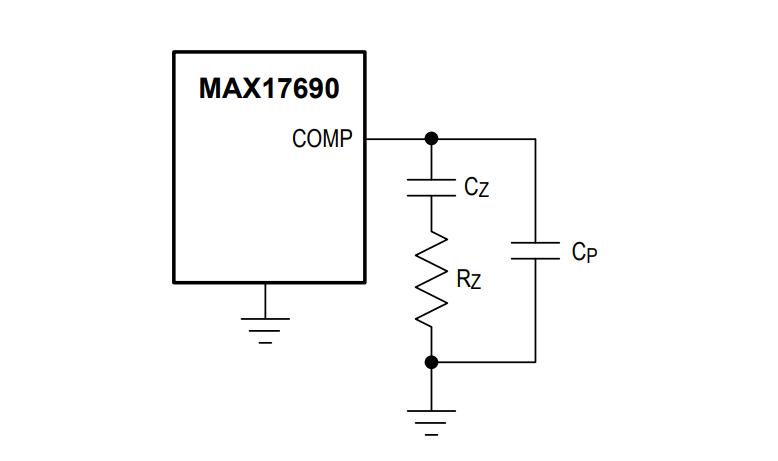
and:
To achieve stable operation, we must ensure that:
Set the closed-loop gain at fC equal to 1:
Place the zero in the error amplifier network at the same frequency as the pole in the power modulator transfer function:
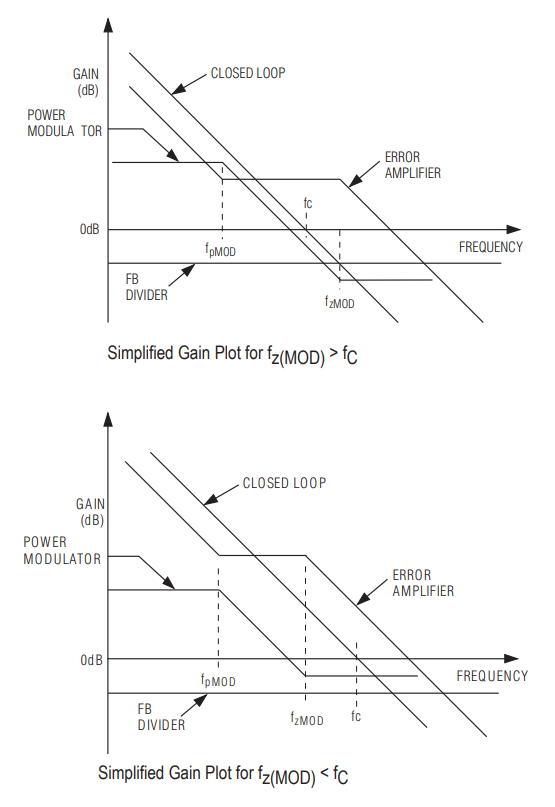
The frequency fZ(MOD) at which the zero occurs in the power modulator transfer function depends on the ESR of CO. If ceramic capacitors are used for CO, fZ(MOD) will be generally much higher than fC. However, if the ESR of CO is large, fZ(MOD) could be lower than fC. This is a very important point since both the gain of the power modulator at fC, and the gain of the error amplifier at fC depend on whether fZ(MOD) is greater than or less than fC. This is illustrated in Figure 12.
By examining the gain plots in Figure 12, we see that for fZ(MOD) > fC:
and for fZ(MOD) < fC:
For the current design, we have:
Since fZ(MOD) > fC:
and since GFB is independent of frequency, we have:
We can now set the closed-loop gain equal to 1 as follows:
Rearranging we can calculate:
Substituting ΔILP from Step 12:
Finally, we can calculate the remaining components, CZ and CP, in the error amplifier compensation network as follows:
and:

Documentation & Resources
-
MAXREFDES1012 Design Files7/9/2019ZIP2 M
Support & Training
Search our knowledge base for answers to your technical questions. Our dedicated team of Applications Engineers are also available to answer your technical questions.