
Switched-Capacitor Converters—Is the Lifetime of an MLCC a Concern?
摘要
To assess the lifetime of multilayer ceramic capacitors (MLCCs), which are widely used in switched-capacitor converter (SCC) designs, it is essential to analyze their rms currents and consider the expected ambient temperature of the system in which they’re used. This article shows how to properly simulate the ripple current through the capacitors within the power converter design. The formula for the estimated lifetime of capacitors is presented along with the calculation of the lifetime of the most stressed capacitors in the SCC design. Finally, it discusses the differences between several capacitor types and gives recommendations for proper capacitor type selection, with respect to improving their estimated lifetime.
Introduction
Analog Devices has released several switched-capacitor converter (SCC) controllers and has used this technology within several μModule® devices. Within the switched-capacitor power conversion, the whole energy from input to output is transferred via the dielectric of the capacitor(s) rather than through the inductor—hence the name inductorless converters. This can challenge the capacitors with increased rms currents. In the SCC design, the so-called flying capacitors (CFLY) are periodically switched between input and output capacitances, thus transferring the energy chunks from input to output in every switching cycle through them. These are the ones that are affected most by the rms ripple load stress.
Electrical designers typically opt for multilayer ceramic capacitors (MLCCs) from various manufacturers due to their cost-effectiveness, compact size, and ability to handle higher switching frequencies.
A valid concern is whether the increased rms ripple current poses a design weakness, especially with the recent release of high current SCC switchers like the LTC7825, which can deliver output currents up to 12 A.
Capacitors within SCCs
Figure 1 shows the typical scheme of the SCC design using the LTC7825 converter chip.


As can be seen, the main building blocks are the converter chip itself, and the CIN, COUT, CHIGH, CLOW, and CFLY capacitors. The rest of the capacitors (and other components) in the schematic are not directly involved in power conversion; they act only as supporting functions (for example, decoupling, timer, etc.).
Electrical Analysis of Capacitors within SCCs
This study will take the DC2933A-A demonstration board design and operate it at the maximum input and output conditions: 24 V input voltage and 12 A output load current. The output voltage is unregulated at the VIN/2 = 12 V, and the operating switching frequency is set to 400 kHz.
For this example calculation, assume the operating ambient temperature of the capacitors is 60°C.
From the documentation files for the demonstration board, the capacitors shown in Table 1 are used for the main positions.
| Position | Ref | Qty | Part Description | Manufacturer | Mfg PN | Note |
| COUT | C60 to C67 | 8 | 10 μF, X5R, 25 V, 20%, 0603 | Murata | GRM188R61E106MA73D | No substitution allowed |
| CHIGH | C24 to C31 | 8 | 10 μF, X5R, 25 V, 20%, 0603 | Murata | GRM188R61E106MA73D | No substitution allowed |
| CLOW | C33 to C40 | 8 | 10 μF, X5R, 25 V, 20%, 0603 | Murata | GRM188R61E106MA73D | No substitution allowed |
| CFLY | C41 to C56 | 16 | 10 μF, X5R, 25 V, 20%, 0603 | Murata | GRM188R61E106MA73D | No substitution allowed |
| CIN | C4 to C21, C129 | 19 | 2.2 μF, X5R, 50 V, 10%, 0603 | Murata | GRM188R61H225KE11D | |
| Taiyo Yuden | UMK107BBJ225KA-T | Substitution part | ||||
| C2, C3 | 2 | 68 μF, alum poly, 50 V, 20%, SMD 8.3 mm × 8.3 mm | Nichicon | GYA1H680MCQ1GS |
After the quick steady-state analysis of the SCC design, while neglecting the ripple and voltage drops on switching FETs, we can assess that the DC voltage across all but CIN capacitors is VIN/2, that is 12 V.
This allows for the evaluation of the DC bias effects on these capacitors.
For all the power-related capacitor positions (CHIGH, CLOW, CFLY, and COUT), the same 10 μF, 25 V part is used: manufacturer part number GRM188R61E106MA73D.
Using Murata’s proprietary MLCC Characteristics Viewer SimSurfing, the characteristic graphs in figures 2 and 3 can be obtained for the main capacitors under investigation.1


For these graphs, the operational point settings are: 12 VDC bias voltage, 50°C part temperature, 400 kHz frequency, and 0.2 VAC rms ripple current.
Note 1: The CIN capacitors will not be further investigated in this article; therefore, their characteristics are not shown here.
Note 2: The 0.2 VAC rms was selected as a parameter for the characteristic as a compromise between two other possible values: 10 mVAC and 1 VAC (which is unlikely to be seen on MLCCs at this power level).
Results from the capacitor’s characteristic graphs are: the effective capacitance (CEFF) is 1.562 μF and the equivalent serial resistance (ESR) is 4 mΩ.
These values are essential for simulating the SCC circuit and are used in the LTspice® simulation scheme to observe the ripple voltages and currents through the investigated main capacitors. See Figure 4.


Once the transient simulation reaches stable output conditions, plot the ripple voltages and currents of all investigated capacitors and measure their peak-to-peak and rms values, using the LTspice waveform viewer’s built-in measurement tool.


The results from the simulation are shown in Table 2.
| Position | Qty | VRIPPLE, P-P | VAC RMS | IRIPPLE, RMS | IRIPPLE, RMS Per 1 Capacitor |
| COUT | 8 | 112 mV p-p | 40 mV | 2.85 A | 0.35 A |
| CHIGH | 8 | 125 mV p-p | 44 mV | 3.14 A | 0.39 A |
| CLOW | 8 | 125 mV p-p | 44 mV | 3.14 A | 0.39 A |
| CFLY | 16 | 595 mV p-p | 210 mV | 14.98 A | 0.94 A |
From the waveforms and the summary table of capacitor ripple voltages and currents, the most stressed capacitor(s) are at the CFLY position, where the expected rms ripple current is 0.94 A per one capacitor. The other three capacitor positions have almost identical current and voltage stresses across them.
Note that for the CFLY capacitor, the prior estimation of 0.2 VAC rms was very close to the simulated result.
Now referring again to the manufacturers’ MLCC capacitor characteristics viewer (Sim-Surfing online tool), Figure 6 shows the expected temperature rise due to rms ripple current stress.


This graph shows that the 0.94 A ripple current of 400 kHz frequency will increase the temperature of the capacitor by 2°C.
A summary of this design investigation, based on simulation results, is:
- The CFLY capacitors are the most stressed capacitors in the SCC design.
- The CFLY capacitors’ voltage stress is half of the VIN voltage, which is 12 VDC superposed with 595 mV p-p ripple.
- The CFLY capacitors are each stressed with 0.94 A rms current ripple with 400 kHz main harmonics frequency, causing the internal temperature to increase by 2°C above the ambient 60°C.
MLCC Lifetime Calculation
For ceramic capacitors, the lifetime equation conforms to the Eyring model, and it depends only on two design factors: applied voltage and temperature.2,3 The temperature is a combination of system (ambient) temperature and temperature increase due to rms ripple current.
The lifetime of the MLCC can only be estimated with the highly accelerated life testing (HALT) using excessive voltages and temperatures and measuring the mean time to failure (MTTF) parameter of the batch of samples. Based on these accelerated life tests, the voltage and temperature acceleration constants are calculated (or empirically estimated). As a final step, the lifetime of the capacitor operating at relaxed voltage and temperature conditions is calculated.
As per Murata’s ceramic capacitors’ FAQ note,3 the simplified empirical formula for calculating the lifetime of MLCCs is as follows:

where:
- LA, LN—lifetime in accelerated and nominal conditions
- n—voltage acceleration constant
- TA, TN—temperature in accelerated and nominal conditions
- θ—temperature acceleration constant
For Class 2 MLCCs, where usually all power-related capacitors are chosen from, the acceleration constants are: n = 3 and θ = 8.
The investigated CFLY capacitors belong to the “Consumer Electronic & Industrial Equipment MLCC” product category, which as the following accelerated test conditions (Durability Test Specification, Section 16):4
- Test temperature (TA)—maximum operating temperature ±3°C
- Test voltage (VA)—150% of the rated voltage
- Test time (LA)—1000 ±12 hours
- The capacitors under investigation are 25 V and 85°C rated.
Note that for a different capacitor part number or type, the accelerated test conditions may differ and need to be checked with the manufacturer.
The above information provides all the data for calculating the estimated lifetime under the operational conditions 12 V and 62°C:
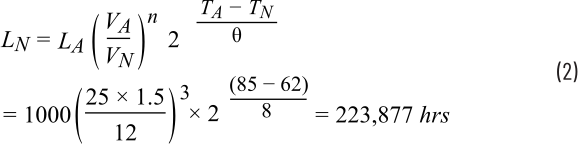
The estimated lifetime of the CFLY ceramic capacitors, operated at 12 V and 60°C ambient temperature, is more than 223 thousands of hours, or 25.5 years.
MLCC Lifetime Discussion
The lifetime formula in Equation 1 gives designers the clue that the proper derating of the MLCCs’ operating conditions (voltage and temperature) is the key to their long life expectancy. The greater the derating, the longer the capacitor’s lifespan.
Currently, the capacitors in question, CFLY, are rated for 25 V/85°C, using the X5R type Class 2 material.
Selecting a different type of dielectric material, for example, X6S (25 V/105°C rated) or X7R (25 V/125°C rated) will boost their estimated lifetime further due to the higher temperature derating factor. Note that rather than increasing the voltage rating, it is more practical to increase the temperature rating. For high life expectancy designs, this practice is highly recommended.
The life expectancy of MLCCs is shortened as the operating conditions get closer to the rated values.
For example, the industry’s expected lifetime is typically 10 years, which is approximately 87,800 hours of operation. For this type of MLCC, this lifetime is achieved when the temperature reaches 73°C.
This is not an unrealistic temperature for the given design example, since the thermal measurements in the DC2933A-A show the temperature of the switcher IC peaking at 83.1°C, which will heat up the surrounding area to another ~10°C to 20°C above ambient, so the capacitors located nearby will be heated up as well.
Therefore, it is advised to keep MLCCs away from the hot components to maintain their acceptable lifetime.
Do the real circuitry’s thermal measurements and verify the real temperatures of capacitors. This will give you more precise estimation of their lifetime when entering the real temperatures into the formula in Equation 2.
The MLCCs are self-heated due to the internal I2R losses, where R is their internal ESR parameter. For the capacitors in this example, the ESR is 4 mΩ, which, for this small 0603 size, is a very respectable value.
For further life improvement, consider finding a part with an even smaller ESR, while keeping in mind that ESR needs to be examined at the switching frequency of the design. Note that usually the smaller ESR leads to a bigger package size.
Searching through the given manufacturer’s MLCCs portfolio, it yields to 22 μF, 25 V, 0805, X5R capacitor, part number: GRM21BR61E226ME44, with the ESR value of 2 mΩ at 400 kHz, which is half of the original value for 0603 capacitors.
Figures 7 and 8 are gathered from the online MLCC tool Sim-Surfing, applied for GRM21BR61E226ME44.


The lower ESR allows capacitor to better handle rms ripple current, resulting in less temperature rise under the same ripple conditions. Furthermore, the bigger value and size also mean a smaller DC bias effect and a higher effective capacitance, CEFF, resulting in that instead of 16 parts (0603 capacitors), only about six to eight parts are needed in the 0805 size.
The selection of the lowest ESR high quality capacitors will also directly affect the lifetime of the parts by lowering the temperature increase due to the rms ripple current. With the caveat that this is true only if we keep rms current per capacitor the same as before.
On the other hand, the drawback of using fewer capacitors in a bigger package is that their rms current per part will be higher. This then results in an approximate factor of 2× for the I2R power dissipated within the body of MLCC (for approximately twice the I and half the R, in the discussed example). The higher dissipated power is then reflected into slightly higher MLCC temperatures, therefore (negatively) affecting the lifetime.
It is recommended to choose the MLCC manufacturer, which is supporting their products with measured characterization graphs, preferably measured at (or close to) your specific operational values.
For power designers, here’s some guidance on maintaining a longer lifetime for MLCCs: limit the MLCC’s internal temperature rise to less than ~5°C above ambient.
Conclusion
In the calculations, each parameter uses the typical values for each of the 16 parts of CFLY capacitor; that is, the calculation is for the ideal component.
However, the reality is that each component in the design is unique and subject to its parameters’ tolerances.
Additionally, each part is located in a specific position on the PCB where the PCB itself has its own parasitic R, L, and C elements. All these factors cause the total rms ripple current to not spread equally between each of the 16 CFLY capacitors, but varies.
At this point, each designer can introduce their own experience-based worst-case multiplication coefficient for calculations to estimate the variations of the real part. In some specific industries (or companies), these worst-case multiplication factors are given within the internal design guidelines. This coefficient is usually in the range of 1.05 to 3.0, depending on the criticality level for the design.
For example, selecting the multiplication coefficient approximately in the middle to 2, the worst-case scenario for a single capacitor’s rms current ripple stress in our example would then be: 2 × 0.94 A = ~2 A rms.
This (only estimated) higher rms ripple will then increase the internal temperature to approximately 7°C instead of 2°C (see Figure 6), causing the estimated lifetime to drop to approximately 145,000 hours.
Also note that the highest rms ripple current tends to flow through the closest parts to the switcher, due to usually the lowest parasitics of the PCB layout, resulting in the higher temperature rise inside these parts. In addition to the rms ripple self-heating, the switcher IC itself is the great heat source, so the proximity to this heater will increase its temperature even further.
A careful layout is essential here to find a trade-off between thermal and electrical performance, and, ultimately, the final performance of the design shall be evaluated on the prototype boards before implementing them into final systems.
The importance of careful selection of the SCC’s capacitors is also underlined by a small notice in the part list in Table 1: No substitution allowed. This means that the selection of the proper part for these is not trivial; designers must understand and meet specific requirements for these capacitors, and mainly understand the fact that not all 10 μF, 25 V capacitors in the market can meet these requirements.
References
1SimSurfing Characteristics Viewer tool (applied for GRM188R61E106MA73). Murata.
2Jonathan Bock, Will Bachman, Scott Ehlers, and Jack Flickert. “Reliability of X7R MLCCs Under Alternating Polarity Highly Accelerated Lifetime Testing.” IEEE Transactions of Components, Packaging and Manufacturing Technology, Vol. 14, No.5, May 2024.
3“Are There Any Methods for Estimating the Lifetime of a Capacitor?” Murata.
4Chip Multilayer Ceramic Capacitors for Consumer Electronics & Industrial Equipment. Murata.