96-Channel DAQ System Using Analog Devices ADCs Integrated in Red Pitaya STEMlab

96-Channel DAQ System Using Analog Devices ADCs Integrated in Red Pitaya STEMlab
2026-11-04
Key Takeaways
|
Abstract
High-channel-count data acquisition (DAQ) systems place stringent demands on performance, synchronization, and scalability. Addressing these challenges increasingly requires close collaboration between semiconductor technology providers and platform developers. This article presents a 96-channel high-speed DAQ system based on the Red Pitaya STEMlab platform, developed through the collaboration between Analog Devices and Red Pitaya. By combining precision analog data conversion with an open, FPGA-based architecture, the system enables synchronized, real-time signal processing across multiple channels while maintaining a compact and modular form factor. The resulting solution demonstrates how collaborative system-level design can deliver flexible, high-performance DAQ for demanding scientific and industrial applications.
Introduction
High-performance data acquisition (DAQ) systems increasingly rely on close collaboration between semiconductor manufacturers and platform developers to meet demanding requirements in speed, precision, and scalability. The long-standing collaboration between Analog Devices and Red Pitaya exemplifies how such partnerships can translate advanced analog and mixed-signal technology into flexible, software-defined instrumentation platforms. By combining ADI’s expertise in high-resolution, low-noise data converters with Red Pitaya’s open-source, FPGA-based STEMlab architecture, complex multichannel measurement systems can be realized rapidly and efficiently. This article presents a 96-channel high-speed DAQ system built on the Red Pitaya STEMlab platform and enabled by Analog Devices’ high-performance data conversion technology, integrated by Prevas Test & Measurement in collaboration with the Swedish Nuclear Fuel and Waste Management Company (SKB), as a concrete example of how this collaboration enables robust, synchronized, and scalable solutions for challenging scientific and industrial applications.
The Importance of Collaborations
At Red Pitaya, collaboration is one of the pillars of company policy. Open-source software represents clear evidence of this philosophy, but it doesn’t stop there. Designing and manufacturing simple, powerful, and reliable tools such as the STEMlab units require building solid, long-standing relationships with reliable partners especially for products that integrate Red Pitaya boards as keystone building blocks.
When first setting eyes on a Red Pitaya board, its characteristic oval front-end shape with four SMA connectors immediately catches the eye. These connectors provide the analog interface to the integrated analog-to-digital converter (ADC) and digital-to-analog converter (DAC) subsystems, which handle signal sampling and reconstruction, operating at sampling rates of 125MSPS (standard) or 250MSPS (SIGNALlab series) generating arbitrary signals. The resolution options range from 12- to 16-bit depending on the model, enabling different trade-offs between speed, dynamic range, and cost. With an ever-increasing demand for high-speed and high-resolution sampling, it’s not hard to imagine the importance of reliable, high-quality ADC and DAC chips. Red Pitaya has entrusted the supply of these cornerstones to ADI for further assembly and integration in the versatile, software-defined instruments.
ADI is a segment leader that started its business more than 60 years ago, an eternity when compared with the 12 years since Red Pitaya saw the light. Not only does it have experience, but its components also offer the resolution and sampling rates the STEMlab boards require, with low noise and distortion and excellent linearity and stability. This level of precision allows the units to be used in instrumentation applications such as oscilloscopes, spectrum analyzers, function generators, and DAQ systems, precisely the ones Red Pitaya has been so successful with in the past.
Example of How ADI Technology Enables Red Pitaya Success
Premium components, however, do not necessarily lead to high performance; the practical value of such systems becomes most apparent when they are applied to demanding real-world measurement challenges. And since statistical evidence always requires numbers, the perfect test is one where no less than 24 STEMlab 125-14 four-input boards sum up to a total of 48 ADC chips (LTC2145-14).
A 96-channel DAQ platform was developed for demanding measurement applications, including proof-of-concept work related to spent nuclear fuel characterization. To support operation and synchronization of the system, open-source Constellation control framework was used, developed at Deutsches Electronen Synchrotron (DESY) in collaboration with several partners including Prevas Test & Measurement. The system was developed for demanding measurement applications, including proof-of-concept work related to spent nuclear fuel characterization.
To meet these demanding requirements, Prevas Test & Measurement and SKB developed a 96-channel DAQ platform based on the Red Pitaya STEMlab architecture, integrating synchronized acquisition, custom FPGA firmware, and modular system expansion capabilities. The result is a 96-channel high-performance DAQ system, built using 24 Red Pitaya STEMlab 125-14 four-input devices (each with four analog inputs) and the Red Pitaya Click Shield (see Figure 1). Designed for applications requiring efficient, high-speed data collection and real-time signal processing, this system is ideal for challenging industrial or scientific measurement environments. It is housed in a compact 4U 19-inch rack mount case, offering space-saving and modular deployment.
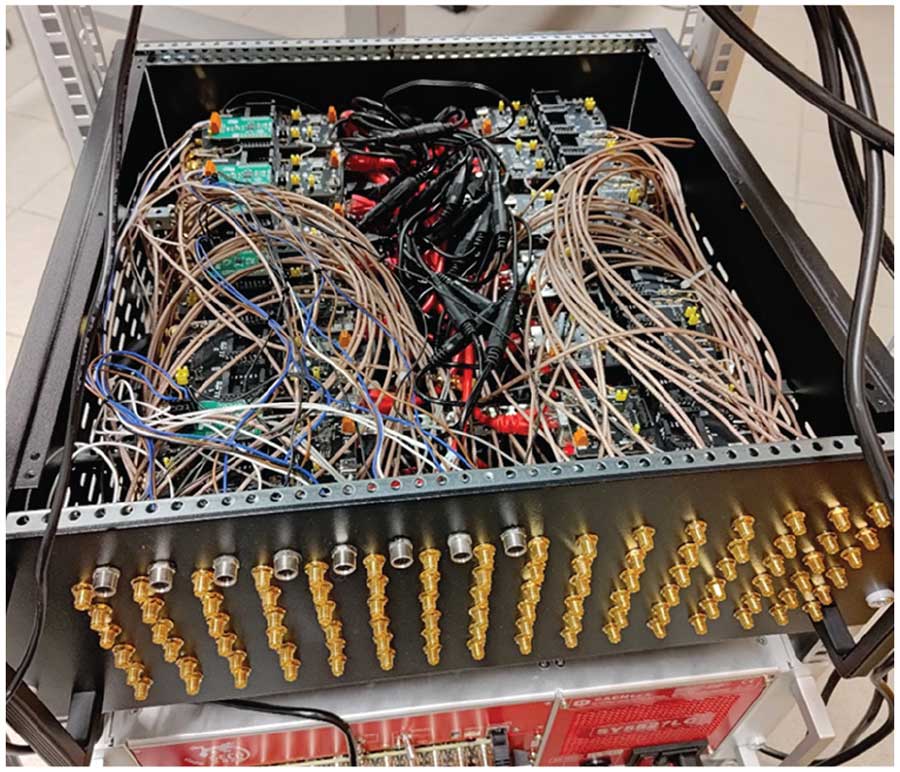
Running on both the host computer and each STEMlab 125-14 four-input, Constellation software framework provides a robust, open-source software framework for managing distributed DAQ systems. It enables centralized control, monitoring, and streamlined synchronization across multiple channels.
A key innovation in this FPGA-based DAQ system is the custom FPGA image, which performs advanced real-time data analysis directly on the device. This setup allows tasks such as pulse shape discrimination and pulse height analysis to be executed on-the-fly. Each channel operates independently, generating its own trigger by analyzing waveforms. By processing only the events of interest and extracting relevant signal parameters, the system minimizes data transfer to the host, reducing bandwidth usage and increasing system efficiency.
To extend its capabilities, the Red Pitaya Click Shield was used to integrate multiple MIKROE Click boards. For example, the Expand 11 Click board enables 5V I/O compatibility, while the RDT Click enables precise temperature DAQ using resistance temperature sensors. These features make the system suitable for environmental monitoring, temperature-sensitive measurements, and broader industrial applications.
The 96-channel DAQ platform, operated through the Constellation control framework also leverages Red Pitaya’s deep memory acquisition functionality to enable high-speed data streaming directly to RAM, allowing larger data chunks to be processed efficiently. Data is then stored on a disk at rates of up to 2 million events per second per channel. With all 96 channels running concurrently on the corresponding LTC2145 converters, the total throughput reaches 192 million events per second, meeting the needs of high-speed continuous acquisition and large-scale data analysis.
Trigger synchronization across all 24 STEMlab devices is handled by the Click Shields, achieving synchronization accuracy within 60ns. All acquired data is timestamped with 8ns resolution, ensuring precise temporal alignment—both within individual devices and across the entire system.
This high-speed, FPGA-based DAQ system provides a versatile, reliable, and modular solution for complex signal acquisition and processing tasks. It combines efficient hardware-level data processing, flexible expansion, and an open-source software stack, making it ideal for scientific research, industrial automation, and specialized applications such as nuclear fuel characterization. The system’s scalable design ensures redundancy, ease of maintenance, and robust performance in even the most data-intensive environments.
Conclusion
The 96-channel high-speed DAQ system, operated using the Constellation control framework, demonstrates how close collaboration between Analog Devices, Red Pitaya, Prevas Test & Measurement, and SKB enables the realization of scalable, high-performance measurement platforms. By combining precision analog technology with an open-source, FPGA-based architecture, the solution delivers synchronized, efficient, and flexible data acquisition suitable for demanding scientific and industrial applications. The system highlights how strong partnerships can accelerate innovation and transform advanced components into practical, system-level solutions.
Reference
Simon Spannagel, Stephan Lachnit, Hanno Perrey, Justus Braach, Lene Kristian Bryngemark, Erika Garutti, Adrian Herkert, Finn King, Christoph Krieger, David Leppla-Weber, Linus Ros, Sara Ruiz Daza, Murtaza Safdari, Luis G. Sarmiento, Annika Vauth, and Håkan Wennlöf. “Constellation: The Autonomous Control and Data Acquisition System for Dynamic Experimental Setups.” Nuclear Instruments and Methods in Physics Research Section A: Accelerators, Spectrometers, Detectors and Associated Equipment, Vol. 1085, May 2026.
关于作者
Črt Valentinčič is CTO and cofounder of Red Pitaya, responsible for the architecture and technical strategy behind its open measurement and control platforms. His work enables engineers and researchers to build
Filippo Pfaiffer is a field applications engineer at Analog Devices, supporting customers across Europe and working closely with them to enable system-level solutions. He focuses on high-speed data acquisition and