
Introduction to S-Parameters
S (scattering) parameters are used to characterize electrical networks using matched impedances. Here, scattering refers to the way traveling currents or voltages are affected when they meet a discontinuity in a transmission line. S-parameters allow a device to be treated as a “black box” with inputs and resulting outputs, making it possible to model a system without having to deal with the complex details of its actual structure.
As the bandwidth of today’s integrated circuits increases, it is important to characterize their performance over wide frequency ranges. Traditional low-frequency parameters—such as resistance, capacitance, and gain—can be frequency dependent, and thus may not fully describe the performance of the IC at the desired frequency. In addition, it may not be possible to characterize every parameter of a complex IC over frequency, so system-level characterization using S-parameters may provide better data.
A simple RF relay can be used to demonstrate the techniques of high-frequency model verification. As shown in Figure 1, an RF relay can be thought of as a three-port device, with an input, an output, and a control to switch the circuit on and off. If the device performance is independent of the control terminal, once set, the relay can be simplified to a two-port device. As such, the device can be completely characterized by observing the behavior at its input and output terminals.

In order to understand the concept of S-parameters, it is important to know some transmission line theory. Similar to the familiar dc relationship, the maximum power transfer at high frequencies is related to the impedance of the power source and the impedance of the load. Voltages, currents, and power from a source, of impedance ZS, travel in waves to the load, of impedance ZL, along a transmission line of impedance Z0. If ZL = Z0, total power is transferred from the source to the load. If ZL ≠ Z0, some power is reflected from the load back to the source, and maximum power transfer does not occur. The relationship between the incident and reflected wave is known as the reflection coefficient, Γ, a complex number that contains both magnitude and phase information about the signal.
If the match between Z0 and ZL is perfect, no reflections occur, and Γ = 0. If ZL is open- or short-circuited, Γ = 1, indicating perfect mismatch, with all power reflected back to ZS. In most passive systems, ZL is not exactly equal to Z0, so 0 < Γ < 1. For Γ to be greater than unity, the system must contain a gain element—which will not be considered in the case of the RF relay. Reflection coefficients can be expressed as a function of the impedances under consideration, so Γ can be calculated as:
 |
(1) | → |  |
(2) |
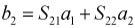
Assume that the transmission line is a two-port network, as shown in Figure 2. In this representation, it can be seen that every traveling wave is made up of two components. The total traveling wave component flowing from the output of the two-port device to the load, b2, is actually made up of the portion of a2 that is reflected from the output of the two-port device plus the portion of a1 that is transmitted through the device. Conversely, the total traveling wave flowing from the input of the device back toward the source, b1, is made up of the portion of a1 that is reflected from the input plus that fraction of a2 that is transmitted back through the device.

Using the above interpretations, equations can be written to determine the values of the reflected waves, employing S-parameters. Equation 3 and Equation 4 show the reflection and transmission wave equations.
 |
(3) |
 |
(4) |
If ZS = Z0 (impedance of two-port input), no reflections occur, and a1 = 0. If ZL = Z0 (impedance of two-port output), no reflections occur and a2 = 0. Therefore we can define the S-parameters, based on the matched condition, as:
 |
(5) |
 |
(6) |
 |
(7) |
 |
(8) |
where:
S11 = the input reflection coefficient.
S12 = the reverse transmission coefficient.
S21 = the forward transmission coefficient.
S22 = the reverse reflection coefficient.
Any two-port system can be fully described by these equations, with forward- and reverse gain characterized by S21 and S12, and forward- and reverse-reflected power characterized by S11 and S22.
To realize the above parameters in a physical system, ZS, Z0, and ZL must be matched. For most systems this is easily implemented over a wide frequency range.
Designing and Measuring Transmission Line Impedance
To ensure that a two-port system has matched impedances, it is necessary to measure ZS, Z0, and ZL. Most RF systems work in a 50-Ω environment. ZS and ZL are normally restricted by the type of vector network analyzer (VNA) used, but Z0 can be designed to match the VNA impedance.
Transmission Line Design
The impedance of a transmission line is set by the ratio of inductance and capacitance on the line. A simple model for a transmission line is shown in Figure 3.

Equations for calculating the complex impedance at a desired frequency determine the values of L and C required to obtain a particular impedance. The manner of adjusting L and C depends on the type of transmission line model, with the most common models being microstrip and co-planar waveguide. Using physical parameters, such as distance from trace to ground plane, trace width, and the dielectric constant of the PCB substrate, the inductance and capacitance can be balanced to provide the desired impedance. The easiest way to design transmission line impedance is to use one of the many available impedance design programs.
Measuring Impedance
Once the transmission line has been designed and produced, the impedance must be measured to verify that the design and execution were correct. One method for measuring impedance is to use time-domain reflectometry (TDR). TDR measurements provide a representation of the signal integrity of a PCB trace. TDR sends a fast pulse down the signal line and records the reflections, which are then used to calculate the impedance of the path at a particular distance from the source. This information can then be used to find open- or short circuits in the signal path or to analyze the impedance of a transmission line at a particular point.
TDR is based on the principle that, in an unmatched system, reflections that occur will add or subtract from the signal source at various points along the signal path (constructive and destructive interference). If a system (in this case a transmission line) is matched to 50 Ω, no reflections occur across the signal path, and the signal remains unaltered. However, if the signal encounters an open circuit, the reflections add to the signal, doubling it; if the signal encounters a short circuit, reflections null it through subtraction.
If the signal meets a terminating resistor with a value somewhat higher than the correct matching resistance, a bump will be seen in the TDR response; a slightly lower terminating resistance will cause a dip in the TDR response. Comparable responses will be seen for terminations that are capacitive or inductive, because a capacitor is a short at high frequencies and an inductor is an open circuit at high frequencies.
Among the factors that influence the accuracy of the TDR response, one of the most important is the rise time of the TDR pulse sent down the signal path. The faster the rise time of the pulse, the smaller the features that TDR can resolve.
Based on the TDR equipment’s set rise time, the minimum spatial distance that the system can detect between two discontinuities is:
 |
(9) |
where:
lmin = minimum spatial distance of the discontinuity from the source.
c0 = speed of light in a vacuum.
trise = rise time of the system.
εeff = effective permittivity of the medium where the wave is traveling.
To examine relatively long lengths of transmission lines, rise times of the order of 20 ps to 30 ps are sufficient; however, a much faster rise time is necessary to examine the impedance of integrated-circuit devices.
TDR impedance measurements can be recorded to help resolve various issues of transmission line design, such as incorrect impedance, discontinuities due to connector junctions, and soldering-related problems.
Recording S-Parameters Accurately
Once the PCB and system have been designed and manufactured, the S-parameters must be recorded at a set power over a range of frequencies using a VNA that has been calibrated to ensure accurate recordings. The choice of calibration technique will depend on such factors as frequency range of interest and the necessary reference plane for the device under test (DUT).
Calibration Techniques
Figure 4 shows the full 12-term error model with systematic effects and error sources for a two-port system. The measurement frequency range affects the calibration choice: the higher the frequency, the greater the calibration error. As more terms become significant, the calibration technique must change to accommodate the high-frequency effects.

One widely used VNA calibration technique is SOLT (short, open, load, thru) calibration, also known as TOSM (thru, open, short, match). Simple to implement, it only requires a set of known standards, which are measured in both the forward and reverse directions. These can be bought with the VNA or from other manufacturers. Once these standards are measured, the systematic errors can be calculated by determining the difference between the measured responses and the known responses of the standards.
SOLT calibration locates the reference plane of the VNA measurement at the ends of the coaxial cables used during the calibration procedure. A disadvantage of SOLT calibration is that any interconnect introduced between the reference planes, including, for example, SMA (subminiature version A) connectors and PCB traces, will affect the measurement; as the measurement frequency increases these will become greater sources of error. SOLT calibration removes only six of the error terms shown in Figure 4, but it can provide accurate results for low-frequency measurements and has the advantage of being easily implemented.
Another useful VNA calibration technique is TRL (thru, reflect, line) calibration. This technique is based only on the characteristic impedance of a short transmission line. Using two sets of two-port measurements that differ by this short length of transmission line and two reflection measurements, the full 12-term error model can be determined. The TRL calibration kit can be designed on the DUT’s PCB, allowing the calibration technique to remove errors due to transmission line design and interconnects, and moving the reference plane of the measurement from the coaxial cable up to the DUT pin.
Both calibration techniques have their advantages, but TRL removes more error sources, so it can provide greater accuracy for high-frequency measurements. It can be more difficult to implement, however, as it requires accurate transmission line design and accurate TRL standards at the frequencies of interest. SOLT is easier to implement, as most VNAs come with SOLT standard kits that are usable over a wide frequency range.
PCB Design and Implementation
For proper calibration of the VNA, correct PCB design is essential. Techniques such as TRL can compensate for errors in the PCB design, but cannot fully negate them. When designing a PCB with TRL calibration, for example, accurate S-parameter measurements, where low values of S21 (such as the insertion loss of the RF relay) are necessary, requires consideration of the return loss (S11, S22) of the thru standard. Return loss is input power reflected back to the source because of impedance mismatch. And no matter how well designed a PCB trace is, there will always be some degree of mismatch. Most PCB manufacturers can only guarantee impedance match to ±5% of the desired impedance, and even that with difficulty. This return loss causes the VNA to indicate a greater insertion loss than is actually present, as the VNA “thinks” it has sent more power through the DUT than it has.
As the required level of insertion loss decreases, it becomes necessary to reduce the amount of return loss the thru standard contributes to the calibration. This becomes increasingly difficult as the measurement frequency increases.
Improving the return loss of the calibration standards for TRL designs involves a number of key considerations. First, the transmission line design is critical and requires close coordination with the PCB manufacturer to ensure that correct design, materials, and processes are used to achieve the required impedance vs. frequency profile. The choice of connector components that can operate satisfactorily over the range is critical. Once the components are chosen, it is also necessary to make sure that the junction between the connector and the PCB is well designed; if not, it can disrupt the desired 50 Ω impedance between the coaxial cable and the PCB transmission line, thus degrading the system return loss. Many connector manufacturers provide drawings for the correct layout of high-frequency connectors, along with a predesigned transmission line design and PCB stack-up. Finding a PCB manufacturer that can produce to this design greatly simplifies the PCB design work.
Second, consider the assembly of the PCB. As the junction between the connector and the PCB transmission line is critical, soldering of the connection has a large effect on the transition. Poorly connected or misaligned connectors disrupt the delicate balance of inductance and capacitance that defines the impedance of the junctions. Figure 5 shows an example of a poorly soldered connector junction.

A solder mask coating can also have an undesired effect on the impedance of the transmission line if its dielectric constant is not taken into account by the design program. While not a major consideration in lower frequency PCBs, as frequency increases, the solder mask can become troublesome.
To ensure that the return loss of the thru trace is acceptable, it is necessary to measure it using a VNA. As the reference plane of the system goes from connector to connector, a SOLT calibration should be sufficient to measure the thru trace. Once the return loss performance of the thru has been established, deficiencies can be monitored by performing a TDR on the trace. The TDR will show the areas where the system deviates most from the desired impedance.
On the TDR plot, it should be possible to mark out the specific components of the system that contribute to most of the deviation. Figure 6 shows a transmission line trace and its corresponding TDR plot. It is possible to locate the impedance of certain components on the TDR plot to see which ones contribute most of the return loss. From this plot, it can be seen that the junction between the SMA and the transmission line deviates from 50 Ω, and that the impedance of the transmission line itself is not satisfactorily close to 50 Ω. To improve the performance of this PCB, it will be necessary to work to implement some of these considerations.

Using S-Parameters
S-parameters can provide many benefits in characterizing a DUT over a frequency range. As well as showing gain, loss, or impedance match at a certain frequency, physical parameters such as capacitance can also be calculated by replacing S-parameters with other forms such as Y-parameters (admittance parameters). Y-parameters differ only in that they are derived (Equations 5–8) in terms of a short circuit (0 Ω) at the terminal of interest instead of a matched 50-Ω termination as for S-parameters. Y-parameters can be physically measured, but they are harder to record than S-parameters, as creating a true short over a wide frequency range is difficult. Since it is easier to make a broadband 50-Ω match, it is better to record S-parameters and convert them to Y-parameters. Most modern RF software packages can do this.
Calculating Physical Parameters
For an example of using S-parameters to calculate capacitance over a desired frequency range, consider the RF relay example shown in Figure 1. To calculate the capacitance of the relay to ground when the relay is open (that is, off), it is first necessary to change the S-parameter recordings to Y-parameters, which transforms the data from a 50-Ω environment to being terminated in a short circuit. From the physical structure of the relay, it is evident that when the output port is terminated to ground and the switch is off, the capacitance to ground can be seen by examining the Y11 parameter, a measure of the amount of power sent back to the source. When the switch is open, all the power is expected to be reflected. However, some of the power will get through to the output port, which is connected to ground (by definition of the Y-parameter). The power is transferred through the capacitance to ground. Therefore, dividing the imaginary part of the Y11 parameter by 2πf will give the capacitance of the RF relay to ground at the desired frequency.
To calculate the inductance of the RF relay, a similar method is used, but Z- (impedance) parameters are used in place of Y-parameters. Z-parameters are similar to S- and Y-parameters, but instead of a resistive match or a short, an open circuit is used to define the termination. With a little thought this approach can be taken to all devices to calculate various physical parameters.
Matching Networks
Another use of S-parameters is in the design of matching networks. Many applications require impedance matching to ensure the best possible power transfer at a certain frequency. Using S-parameters, the input- and output impedance of a device can be measured. The S-parameters can then be displayed on a Smith chart and the appropriate matching network can be designed.
Providing Customers with Models
As discussed earlier, because of their universal nature, S-parameter files are useful to provide input-output information for linear circuits to customers, as parts can be fully described over large frequency ranges without the need to disclose complex (or possibly proprietary) designs. Customers can use the S-parameters in similar ways as described previously to model the part in their system.
Conclusion
S-parameters are useful tools for creating and verifying high-frequency models over a large bandwidth. Once recorded they can be used to calculate many other circuit characteristics and to create matching networks. However, a number of necessary precautions must be taken into account when designing the measurement system. Of paramount importance is the choice of calibration method and the PCB design. By following the measures outlined here, some of the potential pitfalls can be avoided.
References
Rako, Paul. “TDR: taking the pulse of signal integrity.” EDN, September 3, 2007.
Bowick, Chris, John Blyler, and Cheryl Ajluni. RF Circuit Design. Newnes. 2007.
