
Many RF engineers are well aware of the relatively heavy performance burden today’s multi-channel, wideband communications systems place on the front-end elements as compared with previous generations of communications systems. Ultra-wideband radio receivers, for example, must maintain good sensitivity and selectivity in the midst of strong interference signals within megahertz of the band of interest.
Hittite Microwave’s new product line of Tunable MMIC Filters provide RF designers with a new alternative for preselection filters or for replacing switched filter banks. The HMC881LP5E and HMC882LP5E are Tunable Low-Pass MMIC Filters (LPF). The HMC890LP5E and HMC891LP5E are Tunable Band-Pass MMIC Filters (BPF) with two independent voltage controls for adjustment of pass-band frequency and bandwidth. Hittite’s innovative filters provide ultra-small, low-cost solutions for tracking filter applications. These filters exhibit a wide tuning range, exceptional immunity to environmental conditions, and tuning speeds measured in nanoseconds, as seen in Table 1.
| Part Number | Function | Frequency Range (GHz) | Tuning Speed (GHz/ns) | Pass Band Adjustment (GHz) | Control Voltage (Vdc) | Stop Band Rejection (dB) | Size & Package |
| HMC890LP5E | Band Pass | 1 - 2 | 1 / 200 | ± 3% of center frequency | 0 to 14 | 30 dB out to 9 GHz | 5x5 mm SMT QFN |
| HMC891LP5E | Band Pass | 2 - 3.9 | 1.9 / 200 | ||||
| HMC881LP5E | Low Pass | DC - 4 | 1.8 / 150 | 2.2 - 4.0 | 35 dB out to 30 GHz | ||
| HMC882LP5E | Low Pass | DC - 7.6 | 3.1 / 150 | 4.5 - 7.6 |

Hittite’s Tunable MMIC Filters:
- Fast tuning speed: up to 3.1 GHz /150 ns
- Excellent wideband rejection: >30 dB
- Independent and linear voltage control
- Small 5 x 5 mm SMT QFN package
Pre-select filters in the radio front-end are critical to radio performance. They help remove unwanted mixer images and responses to local-oscillator harmonics which can desensitize radio reception. System engineers endeavor to allocate performance among elements within the signal-chain in a manner that lessens overall cost and complexity while achieving the required overall performance. That challenge is compounded when the radio must become software configurable to accommodate multiple radio bands. Hittite’s Tunable MMIC Filters are particularly well suited for programmable pre-selection, as seen in Figure 1, especially when radio hardware must fit within a very small space.
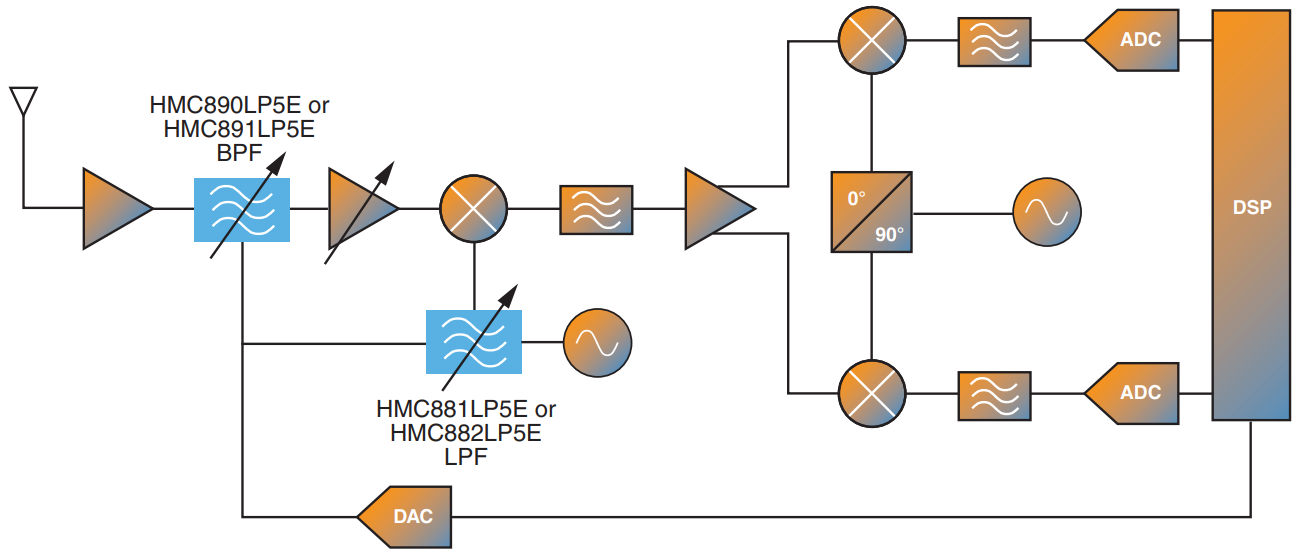
Electronically tunable filters are realizable in various forms, but until the introduction of Hittite’s Tunable MMIC Filters not many easy-to-implement, integrated solutions for moderateto-high volume applications have existed. Each filter form utilizes disparate technologies with its own strengths and weaknesses. A comparison of the predominant forms is shown in Table 2. Each filter type will be more suitable for some applications and less suitable for others. For example, mechanically tunable or switched filters can provide relatively High-Q solutions for test and measurement equipment, but they are far too slow to meet the tuning speeds required by many modern communication systems.
| Basis of Comparison | Hittite’s Tunable MMIC Filters | Hybrid or PCB Based Switched Filter Banks | YIG Tunable Filters |
| Form Factor | Very Small; 25 mm2 | Medium; 2500 mm2 | Large; 5000 mm2 |
| Tuning Mechanism | Analog Voltage (Vdc) | N-Bit Digital Control | Current Magnetic Field |
| Tuning Adjustment | Continuous | Discontinuous | Continuous |
| Relative Tuning Speed (over 80% of tuning BW) |
Fast; 150 ns | Very Fast; 150 ns | Slow; ~10 ms |
| Immunity to Temperature | Very Good | Very Good; Utilizing GaAs RF Switches |
Good; Magnet is Temperature Sensitive |
| Ease of Use | Easiest to implement
LPF; cut-off frequency adjustable with one control voltage BPF; center frequency and bandwidth adjustable with two independent voltage controls 5 x 5 mm SMT package Fully bi-directional Linear voltage controls RF ports matched to 50Ω |
Moderate to implement Dependant on filter complexity Requires 2 multi-throw switch assemblies or ICs per fixed filter channel |
Difficult to implement Not PCB based Large mechanical housing Consider spurious response and errors due to hysteresis, non-linearity, frequency drift over temperature |
| Relative cost | Low-to-moderate | Moderate-to-high | Moderate-to-high |
| Linear Dynamic Range | Good +30 dBm at Midband |
Very Good Depending on Filters Selected |
Good |

Moreover, when compared with mechanically or magnetically tuned filters, Hittite’s Tunable MMIC Filters are much more cost effective, smaller in size, easier to implement and consume almost no power. In addition, the tuning control adjustments on Hittite’s solidstate filters are relatively easy and fast.
Specialized RF expertise is needed to design filters with good pass-band characteristics while maintaining good stop-band rejection over a wide band of frequencies. The physical geometry of the hardware becomes critical to filter performance at microwave frequencies. It is often a challenge to maintain hybrid filter performance in production, as components vary from part to part. Hittite’s Tunable MMIC Filters are a prudent choice for overcoming these challenges.

(with Pass Band Center and Bandwidth Voltage Controls Tied Together)
An easy-to-use solution should include full bi-directionality, linear control adjustments, and RF ports which are matched to 50 Ω. Hittite’s Band-Pass Tunable MMIC Filters provide two independent voltage controls: center frequency and bandwidth. The Low-Pass Tunable MMIC Filters have a single control input for adjustment of cutoff frequency.
Elaborate driver circuits, compensation circuits, or matching circuits are not required.
Hittite’s Tunable MMIC Filters are inherently stable and their small physical size and insensitivity to environmental conditions provide a versatile, robust, and easy-to-use solution for spectral selection.
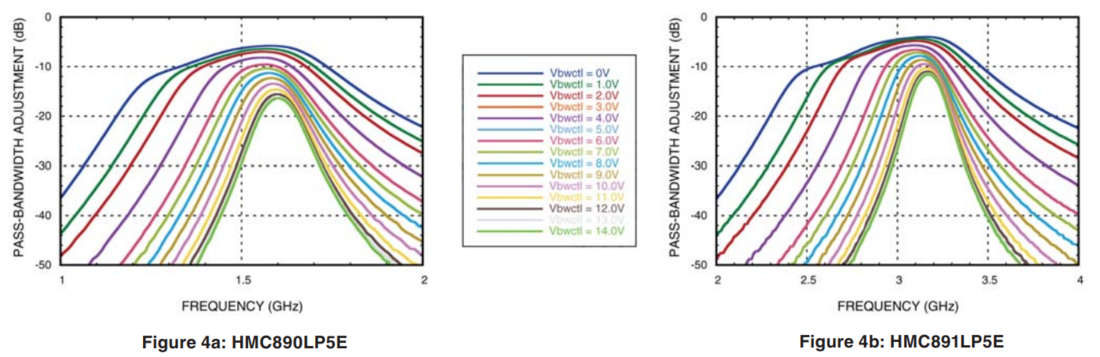
(with center frequency control set to 6V)
The HMC881LP5E and HMC882LP5E are Tunable LowPass MMIC Filters (LPF) with adjustable cut-off from 2.2 GHz to 4.0 GHz, and from 4.5 GHz to 7.6 GHz, respectively. A 0 Vdc to 14 Vdc control signal provides fast and continuous adjustment of pass-band cut-off: 150 ns over 80% of tunable bandwidth. The LPFs maintain stop-band rejection of at least 35 dB out beyond 30 GHz.
The HMC890LP5E and HMC891LP5E are Tunable Band-Pass MMIC Filters (BPF) with two separate controls for adjustment of pass-band frequency and bandwidth. Filter center frequency is adjustable from 1.0 GHz to 2.0 GHz and from 2.0 GHz to 3.9 GHz, respectively. Pass-bandwidth is independently adjustable to ±3% of filter center frequency. As in the companion low-pass filters, return loss is 10 dB and the BPFs maintain stop-band rejection of at least 30 dB out to 9 GHz.
These devices will open up new solutions to problems for which tunable filters have not traditionally been applied. For example, one of the more recent trends in clock and local oscillator (LO) signal generation is the application of fractional-N PLL synthesizers. Hittite’s PLL products offer ultra-low phase noise performance (-227 dBc/ Hz FOM in fractional-N mode, -230 dBc/Hz in FOM integer-N mode), and virtually continuous adjustment of VCO frequency. However, some modern communications systems have stringent requirements for adjacent channel interference and spectral emissions. A significant portion of that performance burden usually falls onto the LO signal generator as a requirement for exceptional spurious performance. Hittite’s Tunable MMIC Filters are ideal for purifying the PLL output signal.
Summary
Hittite continues to lead the way with state-of-the-art innovative solutions for RF and microwave signal transmission, reception, and processing. These four new, ultra-compact, Tunable MMIC Filters provide RF designers with high performance, versatile solutions in 5 x 5 mm SMT packages. Each filter is tunable over a wide range with independent voltage control inputs and performance comparable to larger, more cumbersome solutions. These devices offer +30 dBm of input IP3, stop-band rejection greater than 30 dB out to at least 9 GHz, and insensitivity to changes in temperature and mechanical stress. Hittite’s Tunable MMIC Filters deliver a cost effective, easy-to-use solution which will make the application of tunable filters more ubiquitous in RF and microwave systems.