The Right Switch-Mode Power Supply Control Scheme
要約
This article describes the advantages and disadvantages of different control schemes for switch-mode power supplies. It explains current-mode control, voltage-mode control, and hysteretic-mode control. Recommendations are provided on how a switch-mode power supply IC should be selected.
Introduction
Power supplies create the right supply voltage for electronic circuits. When selecting a power supply, attention is paid to the maximum current capability and the permissible input voltage range so that it can be used in a circuit without any problems. There are many other properties of a power supply that are also considered when choosing. A very important peculiarity of a switch-mode power supply is the type of control; for example, the control loop. Which type of regulation offers which advantages? What should be considered during the selection process?
Current-Mode Control
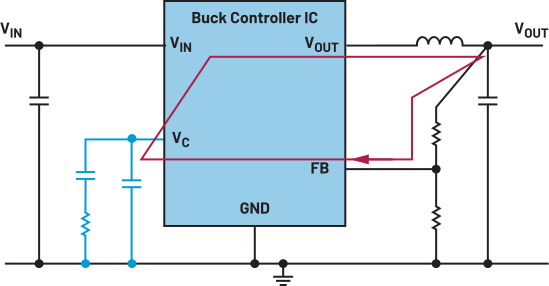
Most modern switch-mode power supplies use current-mode control architecture. This architecture compares the deviation of the output voltage from the setpoint with a sawtooth voltage ramp, which depends on the inductor current. By comparing the voltage with an operational amplifier, also known as the error amplifier, integrated in the switching regulator IC, a clock cycle is terminated. Thus, based on the values of the inductor current and the deviation of the output voltage from the setpoint, the duty cycle is adjusted. This gives the user some advantages. The control system can react directly to changes in the inductor current—for example, in the event of input voltage changes—without having to wait for the output voltage to deviate from the set-point. An overcurrent limitation can be easily implemented with this type of control. Probably the most important advantage of current-mode control is the simple adjustment of the compensation. The compensation essentially determines the stability and speed of the control loop with two capacitors and a resistor on the compensation pin, VC.
Figure 1 shows the control loop of a buck controller in red. The compensation components are shown in blue. In some power converter ICs, they are not external, but built-in. This simplifies the design process, but limits the choice of power level, inductance, and output capacitance.
Voltage-Mode Control
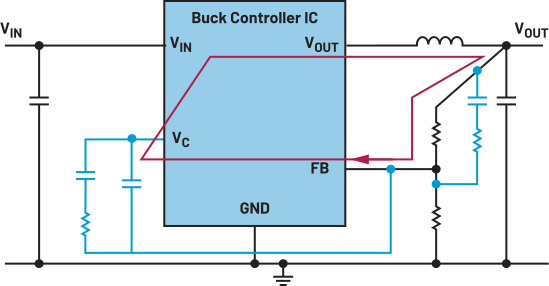
Compared to current-mode control, there is also the control according to the voltage-mode concept. Here, the output voltage is regulated in a similar way, but the inductor current is not included in the regulation. This creates some disadvantages. If the input voltage changes, the control reacts only after the output voltage has left its setpoint due to this change. This can lead to delayed control behavior. In the case of voltage-mode regulators, a current limit must be added if the power supply requires a load current limit. Probably the most serious disadvantage of this type of regulation, however, is that setting the compensation is much more complex. Usually, a type 3 compensation is required, which means that two resistors and three capacitors on the compensation pin must be selected appropriately. With this type of control, the stability behavior also changes when switching between full load operation (constant current conduction mode (CCM)) and partial load operation (discontinuous current conduction mode (DCM)). This can make compensation settings even more difficult for some applications.
These are the main reasons why new voltage-mode controllers rarely come onto the market today. Figure 2 shows a voltage-mode regulator, with a corresponding type 3 compensation. The compensation components are shown in blue.
Hysteretic-Mode Control
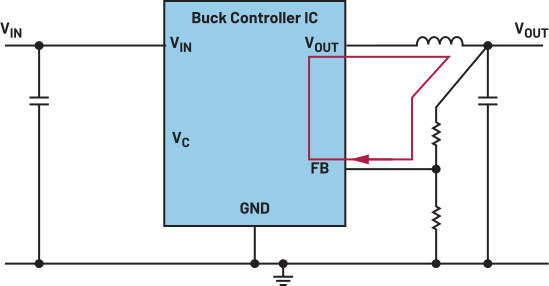
In addition to current-mode and voltage-mode control, there is a third type of control. These regulators use a hysteresis comparator in the feedback path and adjust their switching times and duty cycle according to the state of the output voltage. These regulators are, by definition, unstable. Thus, no control loop compensation is necessary. However, this advantage is offset by some disadvantages. The switching frequency of the hysteretic-mode control is not fixed, but changes depending on the input voltage, load current, and other conditions. Also, the output voltage ripple is typically higher than with a current-mode or voltage-mode regulator. See Figure 3 for a simplified schematic of such a topology.
Hysteresis regulators are often misunderstood, as there are different names for many different derivatives of this type of control. Various improvements have been designed, such as constant-on time control, to minimize the disadvantages of hysteresis control.
Conclusion
There are fundamental differences between the different types of control of a power supply. Manufacturers of integrated ICs for switch-mode power supplies use different circuit techniques to minimize the respective disadvantages of each type of regulation. For most applications, a modern switching regulator IC can be used on the basis of the performance data specified in the data sheet and an executed circuit simulation—for example, with LTspice®—without taking into account the respective control type.